August 6, 2026
The Supply-Side Architecture Behind Modern Nickel Pricing
Commodity markets have long been shaped by the tension between geological reality and political will. In most markets, supply responds to price. In the nickel market today, that relationship has been deliberately inverted. A single jurisdiction has developed the institutional machinery to use supply as a tool for targeting price, transforming what was once a passive extraction economy into something far more structurally complex. Understanding this shift is essential for anyone tracking the nickel market and Indonesia ore quotas as they evolve through 2025 and into 2026.
When big ASX news breaks, our subscribers know first
Why Indonesia Functions as the Nickel Market's Central Bank
Indonesia's position in global nickel supply is extraordinary by any measure. The country accounts for approximately 60–65% of global nickel supply, a concentration that gives its regulatory decisions immediate and lasting consequences for downstream industries, from stainless steel manufacturing to electric vehicle battery production worldwide.
The mechanism through which Indonesia exercises this influence is the RKAB system (Rencana Kerja dan Anggaran Biaya), an annual Work Plan and Budget approval framework that caps how much nickel ore each licensed mining operation may extract in a given calendar year. What began as an administrative and environmental management tool has evolved into something far more consequential: a real-time pricing lever, with Indonesian policymakers explicitly targeting a price corridor of roughly $18,000 to $21,000 per tonne.
This is not passive resource governance. Indonesia is functioning as a supply-side price architect, using quota management with a precision and strategic intent that bears comparison to how OPEC uses production controls in the oil market.
There is an important technical nuance that frequently distorts headline analysis. RKAB quota figures are expressed in wet metric tonnes (wmt), while refined nickel demand data is reported in dry metric tonne equivalents. The gap between approved quota volumes and recoverable nickel is not trivial. Variable moisture content and structurally declining ore grades mean actual nickel delivery consistently falls short of the tonnage numbers that dominate news coverage. The Indonesian nickel industry faces compounding structural pressures that make this gap increasingly significant.
The 2026 Quota Reduction: Scale, Mechanics, and Market Implications
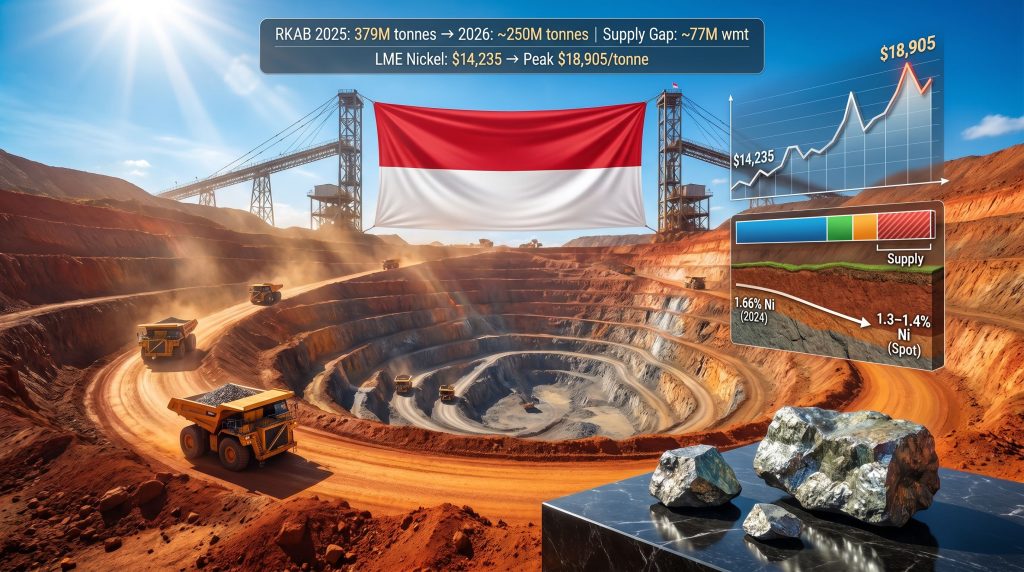
The single most consequential supply signal in the nickel market over the past twelve months has been Indonesia's stated intention to reduce its 2026 RKAB quota allocations by approximately 34%, pulling annual approved volumes from 379 million tonnes in 2025 down to roughly 250–260 million tonnes. According to Argus Media, this move represents one of the most significant supply-side interventions in the market's recent history.
The table below captures the structural arithmetic of this reduction:
| Metric | 2025 | 2026 (Planned) |
|---|---|---|
| RKAB Quota (million metric tonnes) | 379 | ~250–260 |
| Smelter Demand Requirement | — | ~327 million wmt |
| Projected Supply Gap | — | ~77 million wmt |
| Philippines Import Contribution | — | 20–25 million wmt |
The numbers reveal a structural problem that imports cannot solve. Indonesia's smelting infrastructure is projected to require approximately 327 million wmt in 2026 to operate at capacity. Even a full allocation of the reduced quota would leave a gap of roughly 77 million wmt. Philippine ore imports, which typically contribute 20–25 million wmt annually, cover less than a third of that shortfall.
The Mid-Year Adjustment: Calibration, Not Capitulation
Reports emerging in mid-2025 suggested Indonesia was considering boosting mid-year quota allocations toward 360 million tonnes, prompting an immediate market selloff as participants interpreted the move as a policy reversal. A more analytically grounded reading suggests something different.
Mid-year quota releases are best understood as calibrated interventions within an active management framework, not as evidence that Indonesia's supply discipline strategy is unravelling. There is a specific reason why some additional quota allocation was always likely: ore grades across Indonesian mining operations have declined so sharply that a given tonnage of quota-approved ore delivers materially less recoverable nickel than the same tonnage would have in prior years.
Furthermore, granting marginally more quota volume does not offset the grade-driven reduction in actual nickel output. Indonesia has navigated similar pressure campaigns before — including the implementation of its ore export ban and the introduction of a minimum price formula — without reversing its core policy positions. The current cycle is consistent with that historical pattern.
Ore Grade Decline: The Hidden Amplifier of Supply Tightness
One of the least discussed but most consequential dynamics in the Indonesian nickel sector is the structural deterioration of ore grades across the country's laterite deposits. The data tells a clear story:
| Period | Average Nickel Content in Indonesian Ore |
|---|---|
| 2024 | 1.66% |
| 2025 | 1.52% |
| Current Spot Supply | 1.3–1.4% |
This grade deterioration is not a temporary anomaly driven by selective mining or seasonal factors. It reflects the progressive depletion of higher-grade ore bodies across established mining areas in Sulawesi and the Maluku region. As miners exhaust the richer surface zones of laterite deposits, extraction moves deeper into lower-grade saprolite and limonite zones.
The practical consequence is a compounding amplification effect: every percentage reduction in approved quota volumes delivers a larger-than-proportional reduction in actual recoverable nickel, because each tonne of approved ore is itself yielding less metal. Analysts relying solely on headline quota tonnage comparisons year-over-year are systematically underestimating the tightening that is actually occurring in the ore supply chain.
Processing costs per unit of recoverable nickel also rise as grades fall, placing additional margin pressure on smelters and creating incentives for production curtailments among higher-cost operators, which further tightens the effective supply picture.
How Nickel Prices Have Responded to Quota Signals
The price action following the initial 2026 quota reduction signal provided a near-perfect empirical test of the RKAB mechanism's pricing power. LME 3-month nickel futures surged from $14,235 per tonne in mid-December to a peak of $18,905 per tonne on January 14 — a move that landed almost precisely within Indonesia's stated target corridor of $18,000 to $21,000 per tonne. Understanding Indonesia nickel price trends is therefore inseparable from understanding the quota mechanics driving them. Shanghai Futures Exchange nickel futures simultaneously moved through Yuan 130,880 per tonne.
The Seasonal Dimension: Philippine Ore and the Annual Price Cycle
Nickel pricing has a pronounced and underappreciated seasonal structure that operates independently of policy decisions. The driver is Philippine mining activity, which is heavily constrained by weather patterns.
Approximately 40–50% of annual Philippine ore production is concentrated in the second quarter, from April through June, before monsoon conditions progressively shut down mining operations across the archipelago's nickel-producing islands. This creates a predictable annual availability cycle:
- Q2 (April to June): Peak ore availability globally, maximum potential for downward price pressure
- Q3 (July to September): Rainy season intensifies, ore shipments decline progressively
- Q4 (October to December): Supply tightening accelerates, price recovery phase
- Q1 (January to February): Minimum annual ore availability, historically strongest price support conditions
This seasonal pattern explains why nickel prices surged at the end of 2024: January and February represent the annual low point for ore availability, creating the tightest supply conditions of the year. The Q2 peak availability window is also, critically, the optimal moment for any market participant seeking to argue that Indonesian quota expansion is necessary.
The Two-Tier Market Problem: Ore Scarcity Meets Refined Surplus
The nickel market and Indonesia ore quotas present a paradox that confuses many investors and procurement teams. Refined nickel is forecast to remain in surplus by approximately 261,000 tonnes in 2026, yet benchmark prices are being supported by genuine tightness in the ore supply chain. These two conditions are not contradictory; they reflect different time horizons within the same supply chain.
Ore-level scarcity feeds into elevated input costs for smelters producing nickel pig iron (NPI) and other intermediates. The lag between upstream ore constraints and downstream inventory drawdowns means that refined metal surpluses can coexist with meaningful ore-level tightness for extended periods.
Nickel Pig Iron Inventory: The Signal Most Analysts Are Missing
A critical but largely unreported development has been occurring within the NPI segment of the supply chain. Approximately 40,000 tonnes of nickel has been drawn out of NPI inventory and redirected into finished nickel production. The economics driving this shift were compelling: when mixed hydroxide prices and matte conversion margins were elevated, producers found it highly profitable to convert NPI inventory into matte and then into finished refined nickel.
The signal embedded in NPI pricing is telling. The NPI discount to LME spot metal price has compressed from approximately $250 per tonne to around $150 per tonne — a compression that signals genuine tightness in the NPI market rather than a market awash with intermediate product.
The important implication for forward pricing: NPI inventories that have been drawn down to fund finished nickel production will eventually need to be replenished. That replenishment demand adds a further pull on ore supply at exactly the time when quota-driven ore availability is tightening. This is a structural support mechanism that does not appear in standard LME inventory analysis.
Investors relying exclusively on LME deliverable nickel stocks as their demand signal are looking at one layer of a multi-layer supply chain and drawing conclusions that the full picture does not support.
The next major ASX story will hit our subscribers first
China's Strategic Pressure Campaign and Its Limits
China's leverage over Indonesia's nickel sector is real but bounded. Chinese industrial groups dominate the downstream processing infrastructure built in Indonesia over the past decade, including NPI smelters, high-pressure acid leach (HPAL) facilities, and stainless steel capacity. This investment position gives China a commercial interest in lower ore input costs and a credible threat to redirect future downstream investment if Indonesia maintains restrictive quota policies.
The Q2 window of peak Philippine ore availability is the optimal moment to exercise this pressure. When global ore supply is at its seasonal maximum, the argument that Indonesia needs to expand quotas to sustain processing plant economics carries the most surface-level plausibility. Moreover, nickel price momentum through 2025 has been closely tied to these cyclical pressure dynamics.
The 2022 LME nickel dislocation, where prices briefly spiked above $100,000 per tonne before trading was suspended, involved a dominant Chinese stainless steel producer holding a short position equivalent to roughly 25% of annual global nickel and stainless steel output at the time. The episode demonstrated that directional bets of extreme scale by Chinese industrial groups are a documented feature of the nickel market, not a historical anomaly.
China's remaining pressure options include:
- Signalling reduced appetite for new downstream processing investment in Indonesia
- Adjusting purchasing volumes to create short-term apparent demand weakness
- Slowing internal approvals for new smelter construction projects
However, Indonesia's improved fiscal position — driven by higher ore royalties and export levies from the new pricing regime — materially reduces the country's historical dependence on Chinese processing capital. The fiscal logic of the current policy framework is working in Indonesia's favour, reducing the effectiveness of Chinese investment threats over time.
Battery Demand Growth: Why Consensus Forecasts Are Likely Wrong
Nickel demand growth has averaged approximately 7% annually since 2019, well above the historical long-run average of 4–5% per year. Against this backdrop, mainstream analyst forecasts for 2025 project demand growth of only around 2% — a figure that appears increasingly inconsistent with observed consumption data.
A structural distortion has been compressing apparent demand figures for several years. The 2022 lithium price spike caused battery manufacturers and automakers to aggressively overstock battery materials, creating a three-year destocking cycle as supply chains worked through excess inventory. That inventory normalisation cycle is now complete, removing a persistent headwind from demand statistics.
The results in early 2025 data are striking. Despite EV unit sales growing by only approximately 2% in the first five months of 2025, nickel demand in battery applications surged 37% year-to-date. Three convergent factors explain this apparent paradox:
- Inventory restocking across battery supply chains following years of deliberate destocking
- Rising average battery pack sizes, up approximately 12% year-over-year, as vehicle mix shifts toward larger, higher-range platforms
- Geographic mix shift from small urban vehicles in China and Europe toward larger North American and premium global vehicles with significantly higher per-unit nickel content
The LFP versus nickel-rich chemistry dynamic deserves careful framing. Lithium Iron Phosphate batteries now account for roughly two-thirds of Chinese EV sales in 2025, representing a genuine structural shift in China's domestic market. However, nickel-rich cathode chemistries retain strong competitive advantages in markets where energy density requirements are paramount. The ongoing battery storage expansion across North America and premium European segments continues to favour nickel-intensive chemistries for high-range applications. The demand growth story for nickel in batteries is increasingly a story about markets outside China.
AI Infrastructure: An Indirect but Real Risk to Mining Project Timelines
The buildout of AI data centre infrastructure is creating an indirect but meaningful complication for nickel mining project development. The longest-lead procurement item for large-scale mining and processing projects is not grinding equipment such as ball mills or SAG mills; it is heavy electrical equipment, specifically large transformers and high-capacity switchgear.
The AI infrastructure boom has placed extraordinary demand on the same pool of heavy electrical equipment manufacturers that serve mining projects globally. Extended lead times for this equipment are already affecting project development schedules across the sector, and competition from data centre buildouts is unlikely to ease materially in the near term.
On the energy cost side, rising electricity prices driven by AI data centre demand do not fundamentally alter the economics of EV adoption. The cost advantage of electric vehicles over internal combustion alternatives remains robust even at meaningfully higher electricity price points. The more structurally significant concern is grid capacity and reliability in jurisdictions where nickel processing operations compete with data centres for industrial power allocations.
Scenario Analysis: Three Price Pathways Through 2026
| Scenario | Trigger Conditions | Price Outlook |
|---|---|---|
| Bullish: Quota Discipline Holds | Indonesia maintains ~250M tonne ceiling; Philippines rainy season tightens supply; NPI restocking demand accelerates | $18,000–$21,000/tonne |
| Base Case: Managed Adjustment | Mid-year quota boost to ~360M tonnes; seasonal tightening partially offsets; demand growth at 5–7% | $16,000–$18,500/tonne |
| Bearish: Policy Reversal and Demand Miss | Full quota restoration; LFP adoption accelerates beyond projections; Chinese economic slowdown reduces stainless demand | $13,000–$15,500/tonne |
Key Indicators Worth Monitoring
For those assessing the broader battery metals investment landscape, the following signals warrant close attention:
- RKAB quota announcements from Indonesia's Ministry of Energy and Mineral Resources, particularly the timing and scale of any mid-year adjustments
- Philippine monthly ore shipment volumes, which function as the most reliable real-time proxy for global ore availability
- NPI discount to LME spot price: a compression toward $100–$120 per tonne would signal extreme NPI tightness and a strongly bullish forward setup
- LME and SHFE inventory levels, disaggregated from Chinese off-exchange stocks which can mask actual market tightness
- Battery pack size trends in North American and European EV markets, as a leading indicator of per-vehicle nickel content growth
- Heavy electrical equipment lead times as a proxy for project development risk across the mining sector
According to S&P Global, Indonesia's combination of output cuts and policy shifts represents a deliberate and sophisticated approach to market management that is likely to persist well into 2026.
Frequently Asked Questions
What is the RKAB quota system and how does it affect nickel prices?
The RKAB system is Indonesia's annual framework for approving mining work plans and budget allocations. It functions as a binding cap on ore extraction volumes for each licensed operation. Because Indonesia controls such a dominant share of global nickel ore supply, changes to aggregate RKAB allocations transmit rapidly into global ore availability, smelter input costs, and ultimately LME benchmark prices.
Why did nickel prices spike after the 2026 quota announcement?
The combination of a 34% reduction in approved quota volumes alongside a projected smelter demand requirement that already exceeded the reduced quota created a credible forward supply gap of roughly 77 million wmt. This gap, unresolvable through Philippine imports alone, triggered a rapid repricing of LME futures from $14,235 per tonne toward $18,905 per tonne within weeks.
How can refined nickel be in surplus while ore is scarce?
These conditions reflect different layers of the supply chain operating on different time horizons. Ore scarcity drives up smelter input costs and compresses NPI margins today. Finished nickel surpluses reflect prior production decisions and inventory accumulation that take time to draw down. The NPI inventory conversion dynamic described above is one mechanism through which these two conditions are simultaneously true.
How do declining ore grades compound the effect of quota reductions?
As average nickel content in Indonesian ore has fallen from 1.66% in 2024 to approximately 1.3–1.4% in current spot supply, the same tonnage of approved quota delivers progressively less recoverable nickel. A quota reduction expressed in wet metric tonnes therefore understates the actual reduction in available nickel, because the ore itself is becoming less productive simultaneously. Consequently, the nickel market and Indonesia ore quotas will remain closely intertwined as this grade deterioration trend continues.
This article contains forward-looking analysis and market scenario projections. These represent analytical frameworks based on available data and should not be construed as financial advice. Commodity markets involve significant uncertainty, and actual outcomes may differ materially from projections discussed herein.
Want to Know When the Next Major Nickel Discovery Hits the ASX?
Discovery Alert's proprietary Discovery IQ model scans ASX announcements in real time, instantly identifying significant mineral discoveries across nickel and over 30 other commodities — translating complex data into clear, actionable opportunities for investors at every level. Explore historic discoveries and the returns they generated, then begin your 14-day free trial to position yourself ahead of the market.