August 6, 2026
Phosphate's Quiet Revolution: From Fertiliser Fields to Battery Supply Chains
For most of the twentieth century, phosphate was considered an agricultural commodity first and foremost. Its role in fertiliser production made it essential to global food security, but it rarely attracted the kind of strategic attention reserved for metals like copper, lithium, or nickel. That framing is now fundamentally obsolete. The rapid commercialisation of lithium iron phosphate battery chemistry has repositioned phosphate as a cornerstone material in the global energy transition, and governments across the developed world are beginning to treat it accordingly. Bégin-Lamarche phosphate mine funding is one of the clearest signals of this strategic shift.
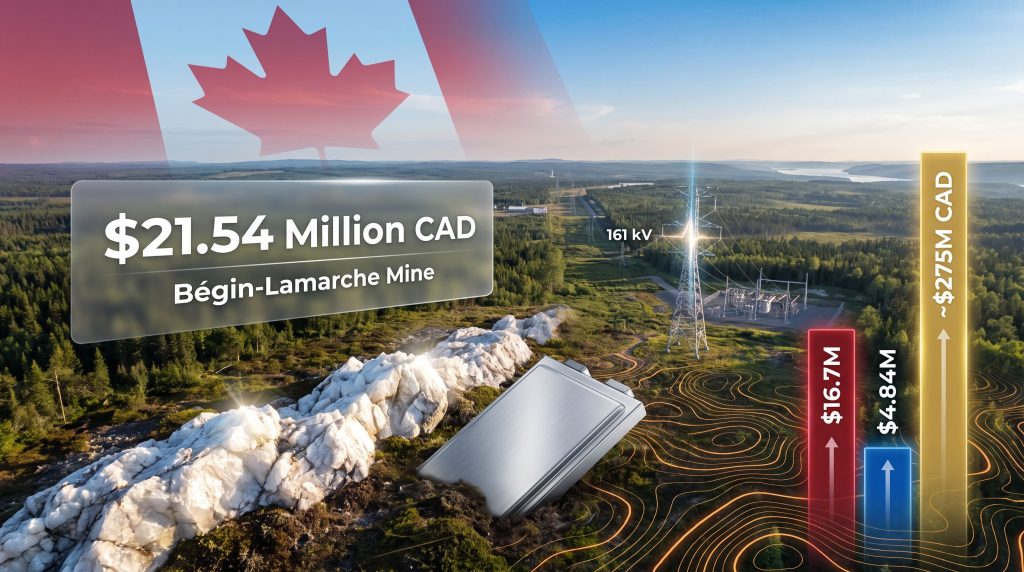
Canada's evolving posture toward domestic phosphate development is one of the clearest expressions of this shift. The federal government's commitment of over $21.5 million CAD in confirmed, non-repayable funding toward First Phosphate's Bégin-Lamarche project in Québec's Saguenay–Lac-Saint-Jean region represents more than a single investment decision. It reflects a deliberate recalibration of how Canada thinks about mineral sovereignty, allied supply chains, and the industrial foundations of its clean energy future.
When big ASX news breaks, our subscribers know first
Understanding the LFP Chemistry Shift and Why It Changes Everything
Lithium iron phosphate, commonly referred to as LFP, has emerged as the dominant battery chemistry for stationary energy storage and an increasingly preferred option for electric vehicles in cost-sensitive market segments. Unlike nickel-manganese-cobalt chemistries, LFP batteries use phosphate as a core structural component in the cathode material. This distinction matters enormously for supply chain planning. Consequently, the dynamics of the battery raw materials market are shifting rapidly in response.
The critical advantage LFP offers is its thermal stability. LFP cells are significantly less prone to thermal runaway compared to cobalt-based alternatives, making them attractive for grid-scale storage, off-grid power systems, and emergency backup infrastructure. As energy storage deployment accelerates globally, demand for the high-purity phosphorus inputs required for LFP cathode production is forecast to grow substantially.
Phosphate's expanding role now spans multiple critical use cases:
- LFP battery cathode manufacturing for electric vehicles and stationary storage systems
- Renewable energy storage integrated with solar and wind generation assets
- Off-grid power solutions serving remote communities and industrial operations
- Emergency backup systems for hospitals, data centres, and critical infrastructure
- Fertiliser production, which remains a significant demand pillar alongside its newer energy applications
This dual-use nature elevates phosphate beyond the typical commodity risk framework. A disruption to global phosphate supply would simultaneously threaten food production and battery manufacturing, creating an unusually broad vulnerability in the global economy. Furthermore, the intersection of critical minerals and energy security has elevated projects like Bégin-Lamarche to the top of national policy agendas.
The Bégin-Lamarche Phosphate Mine Funding Breakdown
The federal investment committed to Bégin-Lamarche has been structured across two distinct programs, each targeting a different phase of pre-production development.
| Funding Source | Program | Amount (CAD) | Announced | Purpose |
|---|---|---|---|---|
| Natural Resources Canada | Global Partnerships Initiative | $16.7 million | March 2026 | Feasibility study and LFP-grade phosphorus production parameters |
| Natural Resources Canada | First and Last Mile Fund | $4.84 million | August 2026 | Pre-development infrastructure works |
| Total Federal (Non-Repayable) | $21.54 million | |||
| First Phosphate (Private Match) | Private co-investment | ~$5 million | August 2026 | Matched against First and Last Mile Fund contribution |
Both federal contributions are structured as non-repayable grants, meaning they do not create debt obligations for First Phosphate. This structure is significant from an investor perspective: non-repayable contributions reduce the financial burden on a project during its most capital-intensive pre-production phases, when revenue is absent and risk is highest.
What the First and Last Mile Fund Actually Does
The First and Last Mile Fund is a Natural Resources Canada program specifically designed to address one of the most persistent bottlenecks in remote resource development: infrastructure gaps. Many of Canada's most significant mineral deposits sit in regions where the absence of adequate power transmission, road access, or transport linkages makes development economically unviable without external support.
For Bégin-Lamarche, the $4.84 million allocation targets two specific infrastructure categories:
- Approximately $3.07 million directed toward a 161 kV power transmission line and associated substation infrastructure
- Approximately $1.77 million allocated to road access construction and bypass route development
These are not optional conveniences. Without reliable grid-scale power and accessible road corridors, operating a mine at commercial scale in this part of Québec would be impractical. The infrastructure pre-development work funded through this allocation will directly determine the feasibility of connecting Bégin-Lamarche to regional rail networks and, ultimately, to the Port of Saguenay for international export access. You can read more about the Begin Lamarche project on First Phosphate's official project page.
The Private Co-Investment Mechanism
First Phosphate has committed to match the federal First and Last Mile Fund contribution on a dollar-for-dollar basis, mobilising approximately $5 million in additional private capital alongside the public contribution. This catalytic co-investment structure is increasingly common in Canadian critical minerals development, as it allows federal programs to leverage private sector participation while distributing risk across multiple parties.
Québec's Mineral Endowment: A Strategic Asset in a Geopolitical Context
Québec contributes close to one-fifth of Canada's total mineral production, a share that reflects the province's exceptional geological endowment. The Saguenay–Lac-Saint-Jean region in particular hosts phosphate deposits of substantial scale, formed through igneous geological processes that produced high-grade apatite mineralisation. In addition, rising critical minerals demand globally is intensifying interest in jurisdictions like Québec that can offer both quality ore and political stability.
Apatite, the primary phosphate mineral, varies considerably in quality. The concentration of phosphorus pentoxide (P₂O₅) in ore is the standard measure of grade, and achieving consistently high-grade concentrate output is essential for LFP battery applications. Battery-grade phosphorus specifications are considerably more stringent than those required for fertiliser production, demanding elevated purity levels with tight controls on impurities such as iron, magnesium, and aluminium.
The technical challenge of producing battery-grade phosphorus from mined apatite is non-trivial. It requires precise processing design to achieve the purity thresholds demanded by LFP cathode manufacturers, and the feasibility work funded under the Global Partnerships Initiative grant is directly targeted at defining those parameters for Bégin-Lamarche.
This geological and processing distinction is worth understanding clearly. Not all phosphate deposits are interchangeable. A deposit capable of producing fertiliser-grade concentrate may require significant additional processing investment to reach battery-grade specifications. The Bégin-Lamarche feasibility programme is specifically designed to determine whether the project's ore can meet LFP supply chain requirements at competitive processing costs. For comparison, the Ammaroo phosphate project in Australia illustrates how similarly ambitious phosphate ventures are being structured globally to meet this growing demand.
Economic Impact Projections: Jobs, Region, and Community
The projected economic contribution of Bégin-Lamarche extends well beyond the mine gate. Employment estimates across the project lifecycle illustrate the scale of potential regional impact:
| Development Phase | Estimated Employment |
|---|---|
| Construction Phase | ~500 jobs |
| Operational Phase (from 2029) | ~300 permanent jobs |
For Saguenay–Lac-Saint-Jean, a region with a history of resource-based industry, the prospect of 300 permanent, skilled jobs in mining and processing represents meaningful long-term economic diversification. The construction phase alone would inject significant wages and contractor activity into the local economy.
Indigenous community engagement is embedded as a structural requirement within the funding framework, not an afterthought. Pre-development feasibility and infrastructure studies must incorporate Indigenous consultation, and route and design decisions for both power transmission and road access require meaningful community input. This reflects a broader evolution in Canadian resource development practice, where Indigenous economic participation is treated as a prerequisite rather than a parallel consideration.
The Broader Financing Picture: Beyond Federal Grants
The confirmed federal grants represent only one layer of a more complex potential capital structure. A letter of interest has been reported for a loan guarantee of up to $275 million CAD from Denmark's Export and Investment Fund (EIFO). This figure dwarfs the confirmed grant amounts and, if converted into committed financing, would provide the bulk of the capital required to move from feasibility to construction. Proactive Investors has reported on how Quebec backing is helping fast-track the Bégin-Lamarche phosphate project toward this next stage.
| Capital Layer | Type | Status |
|---|---|---|
| Natural Resources Canada grants | Non-repayable public contribution | Confirmed ($21.54M CAD) |
| First Phosphate private match | Private co-investment | Committed (~$5M CAD) |
| EIFO loan guarantee | Conditional debt instrument | Letter of interest only (up to $275M CAD) |
Important distinction for investors: A letter of interest from an export credit agency is not committed financing. It signals that the project has passed initial eligibility screening and that the institution sees potential merit in supporting development. Conversion to a binding loan guarantee requires completion of feasibility studies, satisfactory environmental assessment outcomes, and a positive Final Investment Decision. None of these conditions have yet been met.
This layered structure is characteristic of how large pre-production mining projects are typically capitalised. Non-repayable grants de-risk the earliest stages, private equity or co-investment provides intermediate capital, and project debt financing covers the bulk of construction costs once feasibility is established.
The next major ASX story will hit our subscribers first
Project Milestones: The Road to 2029 Production
The Bégin-Lamarche development timeline is anchored to a series of interconnected milestones, each of which must be achieved before the project can advance to the next stage:
- March 2026: $16.7 million Global Partnerships Initiative grant announced for feasibility and LFP production parameter definition
- August 2026: $4.84 million First and Last Mile Fund grant announced for infrastructure pre-development
- Ongoing: Environmental impact assessment, Indigenous consultation, and infrastructure route design
- Pre-FID requirements: Bankable feasibility study completion, regulatory approvals, offtake agreement negotiations
- Target production commencement: 2029
The path from current pre-development activities to a Final Investment Decision involves substantial work across technical, regulatory, and commercial dimensions. Environmental approvals in particular can introduce timing variability that is difficult to predict at this stage. However, the accelerating pace of battery storage expansion globally continues to reinforce the commercial rationale for advancing projects of this kind.
Frequently Asked Questions: Bégin-Lamarche Phosphate Mine Funding
What is the total confirmed federal funding for the Bégin-Lamarche mine?
The confirmed federal funding totals approximately $21.54 million CAD, comprising $16.7 million through Natural Resources Canada's Global Partnerships Initiative and $4.84 million through the First and Last Mile Fund. Both contributions are non-repayable.
What type of phosphate product is Bégin-Lamarche targeting?
The project is focused on producing high-purity phosphorus concentrate meeting lithium iron phosphate battery market specifications, a considerably more demanding standard than conventional fertiliser-grade phosphate production.
When is the mine expected to begin production?
Current timelines target production commencement in 2029, subject to feasibility completion, environmental approvals, and a positive Final Investment Decision.
How many jobs will the project generate?
Approximately 500 jobs are projected during the construction phase, with around 300 permanent positions expected once operational production begins.
Is the EIFO loan guarantee confirmed financing?
No. The reported $275 million CAD EIFO instrument is currently at the letter of interest stage only. It represents conditional interest, not committed capital, and remains subject to feasibility and regulatory outcomes.
What the Bégin-Lamarche Investment Signals for Canadian Industrial Strategy
Taken together, the federal commitments to Bégin-Lamarche reflect something more significant than project-level support. They represent a stated policy preference for building domestic critical mineral supply chains capable of serving allied markets, particularly in battery materials where existing supply chains run through geopolitically sensitive regions.
Canada's positioning as a potential reliable phosphate supplier to allied nations aligns with broader trends in allied industrial policy, where supply chain resilience has become a national security consideration rather than purely an economic one. The concentration of global phosphate production and processing in a small number of countries creates systemic vulnerabilities that Canadian deposits, if successfully developed, could help to partially address.
For investors and analysts tracking Bégin-Lamarche phosphate mine funding developments, the key variables to monitor remain: the outcomes of the bankable feasibility study, the progression of environmental assessment processes, the nature of any offtake agreements secured, and whether the EIFO letter of interest advances to committed financing. Each of these milestones will materially determine whether the project reaches construction on its current timeline.
Disclaimer: This article is intended for informational purposes only and does not constitute financial or investment advice. Statements relating to future project timelines, employment projections, financing arrangements, and production targets are forward-looking in nature and subject to material risks, uncertainties, and assumptions. Readers should conduct their own independent research before making any investment decisions.
Want to Stay Ahead of the Next Major Mineral Discovery on the ASX?
Discovery Alert's proprietary Discovery IQ model delivers real-time alerts on significant ASX mineral discoveries — including critical minerals like phosphate that are reshaping global battery supply chains — turning complex data across 30-plus commodities into clear, actionable insights for both short-term traders and long-term investors. Explore Discovery Alert's discoveries page to see the historic returns major mineral discoveries have delivered, and begin your 14-day free trial today to position yourself ahead of the broader market.