
August 11, 2026
Understanding Behavioral Dynamics in Australian Mining Stock Selection
The psychology behind investment decisions often reveals more about market movements than fundamental analysis alone. When examining rio tinto versus bhp shares, behavioral patterns emerge that significantly influence how investors choose between major resource companies. These psychological factors create distinct preference patterns that extend far beyond traditional valuation metrics, affecting everything from position sizing to holding periods.
Investment psychology in the mining sector operates through complex emotional and cognitive frameworks. Risk perception varies dramatically between different commodity exposures, with investors exhibiting measurable anxiety responses to certain market triggers. These behavioral responses create predictable patterns in trading volume, price volatility, and long-term performance outcomes.
When big ASX news breaks, our subscribers know first
What Psychological Factors Drive Mining Stock Preferences?
Risk Perception and Volatility Tolerance
Mining stock selection involves psychological risk assessment that often diverges from quantitative measures. Investors demonstrate distinct comfort levels with different commodity exposures, creating measurable differences in behavior patterns across major Australian mining companies.
Table: Psychological Risk Assessment Patterns
| Behavioral Factor | High Diversification Companies | Single-Commodity Focus | Investor Response |
|---|---|---|---|
| Monitoring Frequency | Weekly checks | Daily monitoring | Stress-driven behavior |
| Position Sizing | Larger allocations | Conservative sizing | Risk aversion impact |
| Holding Duration | Extended periods | Frequent adjustments | Volatility sensitivity |
The psychological burden of commodity concentration affects decision-making through measurable behavioral changes. Companies with broader mineral portfolios generate what researchers term "diversification comfort," leading to reduced monitoring anxiety and more stable holding patterns among retail investors.
Authority Bias and Analyst Consensus Psychology
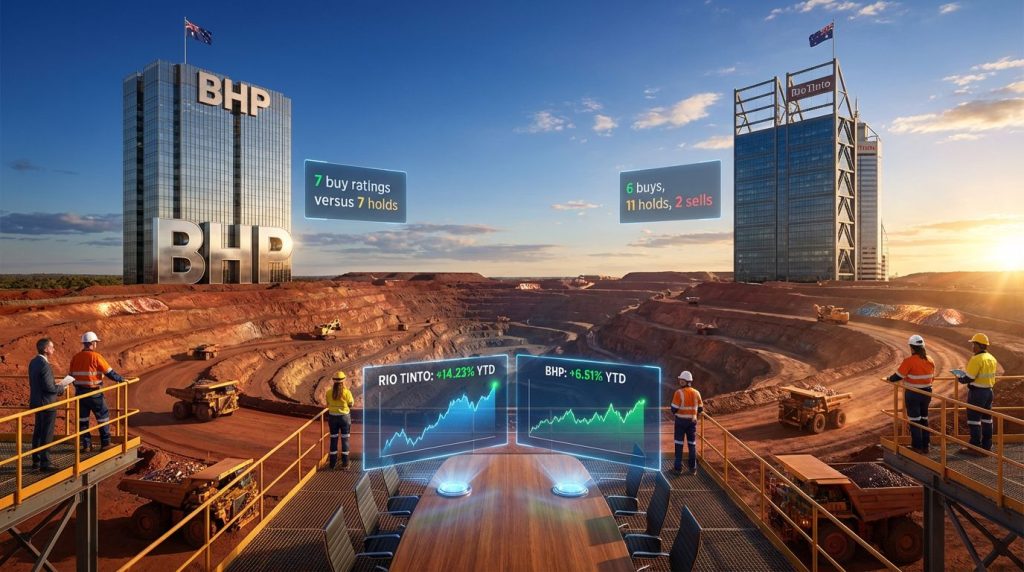
Recent analyst coverage reveals psychological comfort levels that directly influence investor sentiment. Furthermore, understanding these bull vs bear perspectives provides crucial context for evaluating mining stock performance. Rio Tinto's analyst distribution shows 7 buy ratings versus 7 hold recommendations, creating balanced psychological foundations that reduce decision paralysis among individual investors.
This contrasts sharply with BHP's more fragmented analyst opinion profile of 6 buy ratings, 11 hold recommendations, and 2 sell ratings, generating cognitive dissonance among investors seeking clear directional signals. The presence of sell recommendations creates specific psychological burdens.
Investors holding positions with negative analyst coverage must confront published downside scenarios from credible research sources, amplifying loss aversion responses beyond what fundamental analysis might suggest.
Why Do Behavioural Biases Favour Certain Mining Stocks?
Recency Bias and Performance Momentum
Current performance data reveals powerful psychological anchoring effects. Rio Tinto's 14.23% year-to-date performance versus BHP's 6.51% gains creates substantial recency bias among investors. However, industry evolution trends suggest that long-term perspectives should outweigh short-term momentum.
This 7.72 percentage point differential generates what behavioural finance researchers identify as momentum preference, where recent outperformance becomes psychologically conflated with future capability.
Performance Impact on Investor Psychology:
• Rio Tinto's psychological advantages: Recent quarterly production updates showing increased output across multiple commodity lines
• BHP's psychological challenges: Failed acquisition attempts creating competence questioning among investors
• Monthly performance divergence: Rio Tinto's +1.65% versus BHP's -1.87% reinforcing momentum bias
Event-Driven Psychological Triggers
Specific corporate events create lasting psychological impressions that influence investment decisions beyond their fundamental impact. Rio Tinto's third-quarter production update in October 2025 generated positive momentum through revealed production increases across multiple mineral categories.
This concrete evidence of diversification expansion provides psychological anchoring for investors seeking risk mitigation. Conversely, BHP's terminated Anglo American acquisition discussions create what behavioural psychologists term "execution anxiety."
This event triggers competence questioning that extends beyond the specific transaction, affecting broader confidence in management capabilities. In addition, investors should consider management red flags when evaluating corporate governance aspects.
How Does Loss Aversion Impact Mining Investment Decisions?
Downside Protection Psychology
Loss aversion theory demonstrates that investors experience losses approximately twice as intensely as equivalent gains. This psychological reality significantly impacts mining stock selection through measurable behavioural patterns.
Analyst Downside Scenario Analysis:
• BHP downside targets: Analyst projections suggest potential decline to $39.31 AUD, representing -7.64% downside risk
• Rio Tinto upside focus: Maximum analyst targets reach $157.96 AUD, implying +16.98% potential gains
• Psychological impact differential: BHP investors face published downside scenarios whilst Rio Tinto holders focus on upside potential
The distribution of analyst sentiment creates asymmetric psychological impacts. BHP's 2 sell recommendations among 19 total analysts generates disproportionate anxiety compared to Rio Tinto's single sell rating among 15 analysts. This creates what researchers term "negative sentiment amplification" among loss-averse investors.
Balance Sheet Comfort Factors
Mining companies with stronger diversification profiles provide psychological comfort through reduced single-commodity dependency. This psychological benefit translates into measurable investor behaviours including larger position sizes and extended holding periods.
Diversified commodity exposure reduces the psychological stress associated with single-commodity price volatility, leading to more stable long-term investment patterns among retail investors.
Consequently, understanding the broader context of rio tinto versus bhp shares requires examining how risk perception influences portfolio allocation decisions.
What Role Does Confirmation Bias Play in Investment Decisions?
Information Processing Patterns
Investors demonstrate predictable information filtering based on existing position bias. This creates distinct narrative preferences that reinforce investment decisions regardless of fundamental changes.
Pro-Diversification Confirmation Seeking:
• Focus on copper demand growth stories linked to renewable energy trends
• Emphasis on Chinese economic recovery signals supporting multiple commodities
• Highlighting risk mitigation through multi-commodity exposure
Pro-Scale Confirmation Seeking:
• Emphasis on iron ore's fundamental importance to global infrastructure
• Focus on operational scale advantages in cost management
• Historical performance during previous commodity cycles
Recent news flow demonstrates this bias clearly. Rio Tinto's copper production expansion aligns with global energy transition narratives, creating positive confirmation loops for investors seeking ESG-aligned investments. Meanwhile, BHP supporters emphasise iron ore's continued fundamental importance despite pricing pressures.
How Do Cognitive Shortcuts Influence Portfolio Allocation?
Availability Heuristic Applications
Recent media coverage significantly influences investor perception through availability bias. Chinese economic announcements create disproportionate psychological impact on iron ore-focused companies, whilst copper price movements generate excessive optimism for diversified miners.
For instance, implementing a contrarian mining strategy can help investors overcome these cognitive shortcuts and identify genuine value opportunities.
Heuristic Decision-Making Patterns:
-
Recent news amplification: Latest quarterly results become proxies for long-term viability
-
Media narrative influence: ESG stories favour copper and aluminium exposure over iron ore concentration
-
Analyst upgrade cycles: Recent recommendation changes carry disproportionate psychological weight
Representativeness Heuristic Impact
Investors frequently extrapolate short-term performance trends indefinitely, creating systematic cognitive errors in portfolio allocation. Quarterly production updates become psychological anchors for multi-year investment decisions, despite cyclical commodity market realities.
This manifests through overconfident projections following positive quarterly results and excessive pessimism during temporary operational challenges. Additionally, understanding broader investing key strategies can help mitigate these systematic biases.
The next major ASX story will hit our subscribers first
What Emotional Factors Drive Long-Term Holding Decisions?
Psychological Comfort and Investment Horizon
The "sleep-at-night" factor significantly influences mining stock selection. Diversified revenue streams provide emotional comfort that translates into measurable behavioural outcomes including larger position sizes and extended holding periods.
Table: Emotional Investment Driver Analysis
| Psychological Factor | Single-Commodity Focus | Multi-Commodity Exposure | Behavioural Outcome |
|---|---|---|---|
| Sleep quality impact | Moderate disruption | Minimal disruption | Affects position sizing |
| Regret minimisation | Challenging execution | Easier implementation | Influences timing decisions |
| Pride of ownership | Variable satisfaction | Consistent comfort | Drives holding duration |
Psychological comfort with diversified operations creates cascading effects throughout investment decision-making. Reduced monitoring anxiety leads to less frequent portfolio adjustments, whilst emotional stability during volatile periods prevents panic selling behaviours.
Social Proof and Institutional Following
Professional investors' psychological comfort creates important social proof effects for retail investors. Institutional preference patterns reduce individual investor anxiety through peer validation mechanisms.
Social Validation Mechanisms:
• Institutional preference signals reduce retail investor decision anxiety
• Conference circuit sentiment reinforces positive investment narratives
• Analyst coverage quality provides professional validation for investment decisions
What Psychological Triggers Should Investors Monitor?
Behavioural Warning Signs
Successful mining stock investment requires recognition of psychological decision traps that commonly affect commodity sector investing.
Overconfidence Indicators:
• Extrapolating recent performance trends beyond reasonable timeframes
• Ignoring cyclical nature of commodity markets during positive periods
• Dismissing historical volatility patterns based on current stability
Fear-Based Decision Signals:
• Panic selling during normal commodity price volatility cycles
• Overweighting defensive characteristics at the expense of growth potential
• Avoiding all China-exposed investments regardless of fundamental value
Cognitive Bias Recognition
Investors must develop systematic approaches to identify their own behavioural patterns. Regular portfolio reviews help combat confirmation bias, whilst predetermined rebalancing triggers reduce loss aversion impact during volatile periods.
Stress testing investment scenarios psychologically prepares investors for future challenges, reducing emotional decision-making during actual market stress. Furthermore, comparing stock performance metrics can provide objective benchmarks for evaluation.
How Can Investors Overcome Psychological Investment Traps?
Systematic Decision-Making Frameworks
Portfolio Construction Psychology:
-
Equal-weight initial positions to reduce anchoring bias effects
-
Predetermined rebalancing triggers based on quantitative metrics rather than emotional responses
-
Diversified commodity exposure across multiple mining companies and sectors
-
Long-term perspective maintenance through systematic review processes
Risk Management Psychology:
• Position sizing based on volatility comfort rather than recent performance
• Regular portfolio reviews using structured frameworks to combat confirmation bias
• Scenario planning exercises to prepare for psychological challenges during market stress
Emotional Regulation Techniques
Successful mining sector investing requires systematic approaches to emotional regulation. This includes developing predetermined response protocols for various market scenarios and maintaining disciplined rebalancing schedules regardless of short-term performance.
Practical Implementation Steps:
• Systematic monitoring schedules: Weekly rather than daily portfolio reviews to reduce anxiety
• Quantitative rebalancing rules: Trigger points based on allocation percentages rather than subjective comfort
• Diversification maintenance: Regular assessment of commodity exposure balance across holdings
What Does Behavioural Finance Suggest for Future Performance?
Psychological Momentum Indicators
Current behavioural dynamics reveal several important momentum patterns. Companies with recent positive performance tend to maintain psychological advantages through reinforcing feedback loops, whilst those facing temporary challenges often experience amplified negative sentiment beyond fundamental justification.
Positive Feedback Loop Characteristics:
• Recent production increases generating analyst optimism
• Diversification strategies reducing investor anxiety levels
• ESG narrative alignment creating institutional support
Contrarian Psychology Opportunities
However, contrarian psychology suggests that extreme sentiment positions often create future opportunities. Companies experiencing current underperformance may present value opportunities as negative sentiment reaches unsustainable levels.
Mean Reversion Psychology Indicators:
• Excessive pessimism creating value accumulation opportunities
• Institutional investors beginning position building despite negative sentiment
• Historical performance patterns suggesting cyclical recovery potential
Investment Strategy Implications:
The behavioural analysis suggests that sustainable mining sector investing requires balancing psychological comfort with contrarian opportunity recognition. Investors should consider both current sentiment extremes and long-term cyclical patterns when making allocation decisions.
Understanding these psychological dynamics provides crucial context for rio tinto versus bhp shares investment decisions. Whilst behavioural factors currently favour diversified operations and positive momentum, successful long-term investing requires systematic approaches that account for both psychological comfort and fundamental value opportunities across market cycles. For detailed investment comparisons, investors can access comprehensive analyses that examine both technical and psychological factors.
Ready to Capitalise on Mining Psychology Insights?
Understanding behavioural biases in mining stock selection requires staying ahead of market-moving announcements that can trigger these psychological responses. Discovery Alert's proprietary Discovery IQ model delivers real-time alerts on significant ASX mineral discoveries, helping investors navigate psychological traps by providing objective, data-driven insights when major announcements create market opportunities.