May 22, 2026
The Economics of Dependency: How Mining Equipment Became a Geopolitical Weapon
Supply chains are rarely noticed until they fail. For decades, the global mining equipment industry operated on a relatively predictable architecture: Western original equipment manufacturers (OEMs) designed, built, and serviced the machinery that extractive industries worldwide depended upon, and resource-rich nations bought, leased, or financed that equipment through well-established commercial channels. That architecture assumed geopolitical stability. When that stability fractured in 2022, the mining sector discovered just how exposed it had become.
Russia's underground mining operations represent one of the most technically demanding equipment environments on earth. The combination of extreme cold, permafrost geology, deep shaft configurations, and the sheer physical scale of operations like those in the Norilsk-Taimyr complex means that equipment failures carry disproportionate consequences. When Western OEMs exited the Russian market following 2022 sanctions, the challenge was not simply finding replacement machines.
It was finding replacement machines capable of performing in conditions that most of the world's mining fleet was never designed for, while simultaneously losing access to the service networks, spare parts logistics, and engineering support that kept existing fleets operational.
That structural pressure is the essential context behind the BelAZ and Nornickel joint venture factory in Siberia, a manufacturing initiative that represents something more significant than a bilateral business arrangement between two post-Soviet industrial entities. Indeed, geopolitics in mining has increasingly become a decisive force shaping how resource nations develop their industrial capabilities.
When big ASX news breaks, our subscribers know first
From Emergency Workarounds to Permanent Infrastructure
The initial response to Western OEM withdrawal from Russia followed a recognisable pattern: procurement teams explored grey-market channels, sought equipment through third-country intermediaries, extended maintenance cycles on existing fleets, and attempted to source components through alternative Asian suppliers. These tactics bought time but could not substitute for an engineered solution.
Underground mining equipment presents specific procurement challenges that surface fleet equipment does not:
-
Lead times for new underground load-haul-dump (LHD) vehicles and articulated dump trucks typically range from 18 to 36 months, reflecting the customisation required for site-specific geological and dimensional constraints.
-
Safety-critical components including braking systems, fire suppression, and atmospheric monitoring must meet certification standards that cannot be bypassed without significant operational liability.
-
Service dependencies are embedded into equipment design, with major OEMs historically bundling parts supply, remote diagnostics, and engineering support into multi-year contracts that become inoperative when the OEM relationship ends.
-
Spare parts for discontinued European or Japanese equipment models cannot simply be replicated without original engineering drawings, material specifications, and precision tooling.
Grey-market procurement could address some of these challenges for surface equipment. For underground mining technology operating at depth in Siberian permafrost, however, the margin for improvisation is significantly narrower. This is what ultimately drove Nornickel from reactive procurement to a fundamentally different strategic posture.
What the BelAZ and Nornickel Joint Venture Factory in Siberia Actually Involves
The partnership formalised between BelAZ, the Belarusian heavy equipment manufacturer, and Norilsk Nickel Mining and Metallurgical Company targets the construction of a dedicated manufacturing facility in the Krasnoyarsk region of Siberia. The facility is designed to produce underground mining equipment including load-haul-dump vehicles and dump trucks, with an initial product range built around two primary platforms.
Nornickel is one of the world's most significant producers of critical minerals, holding dominant global positions in palladium and platinum production and ranking among the largest nickel producers worldwide. The scale and complexity of its underground operations create a consistent, high-volume demand base that makes a dedicated domestic supply arrangement economically viable in a way it might not be for smaller operators.
The venture is structured around a clear operational logic: rather than continuing to depend on imported equipment whose supply continuity is subject to factors entirely outside Nornickel's control, the company anchors a manufacturing facility that produces equipment to its own operational specifications, tested and refined in its own mine environments, with maintenance and spare parts supply embedded in the same facility.
This vertical integration of equipment supply represents a meaningful shift in how a major mining operator conceptualises its capital equipment function, treating it less as a procurement activity and more as a core operational competency.
The Equipment: What the Siberian Factory Will Build
The initial product line centres on two MoAZ-platform vehicles developed through the Belarusian–Russian industrial collaboration. MoAZ is a Minsk-based manufacturer with historical roots in Soviet-era heavy vehicle production, distinct from but operationally aligned with BelAZ.
| Equipment Model | Classification | Payload Capacity | Propulsion | Development Stage |
|---|---|---|---|---|
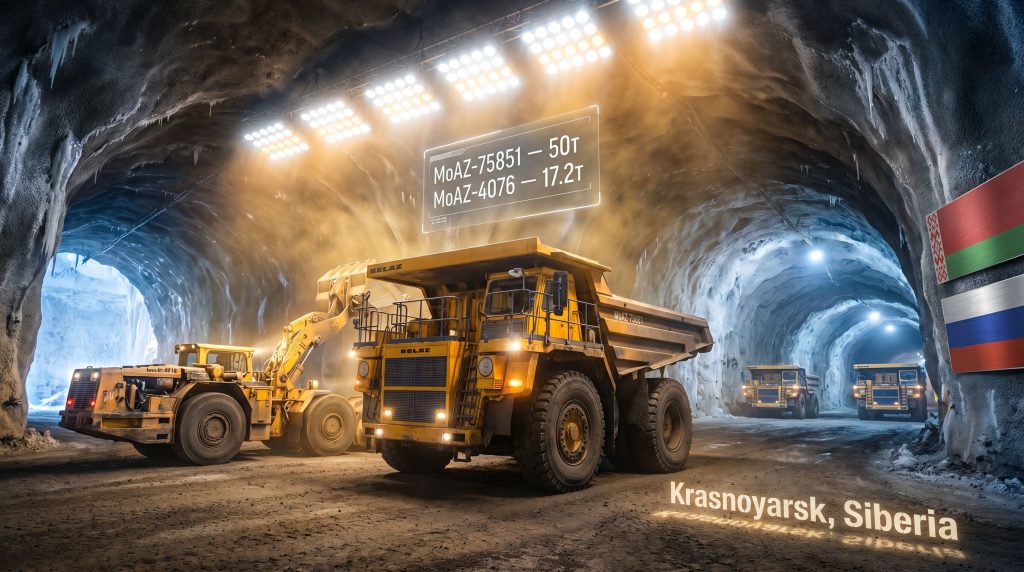
| MoAZ-75851 | Underground Dump Truck | 50 tonnes | Diesel | Active testing at Norilsk sites |
| MoAZ-4076 | Underground LHD Loader | 17.2 tonnes | Diesel | Delivered to Norilsk operations |
| BelAZ–Renera platform | Underground Dump Truck | TBC | Battery-electric | Development agreement signed |
The MoAZ-75851 is particularly significant. A 50-tonne underground dump truck is a substantial machine by any standard, and deploying six units for prototype evaluation at active Norilsk mine sites provides real-world validation data that laboratory or controlled testing cannot replicate. Siberian underground conditions, specifically sub-zero ambient temperatures, permafrost wall stability characteristics, and ventilation airflow restrictions in deep workings, create mechanical stress profiles that standard testing cycles do not fully capture.
The MoAZ-4076 loader, at 17.2 tonnes, falls within the mid-range category of underground LHD equipment. A unit was delivered to Norilsk operations in early 2025, indicating that the programme had moved beyond engineering specification into physical deployment within a compressed timeline.
Battery-Electric Development: The Renera Dimension
A separate tripartite agreement between BelAZ, Nornickel, and Renera, a Russian battery technology company, targets the development of battery-powered underground dump trucks. This development pathway carries particular relevance for deep underground operations where diesel engine exhaust management creates both health and operational constraints.
In ventilation-constrained underground environments, diesel-powered equipment requires substantial airflow volumes to dilute exhaust gases to safe concentrations. This creates a direct relationship between fleet size, diesel engine power output, and the capital cost of ventilation infrastructure. Battery-electric equipment eliminates exhaust emissions at the point of use, potentially reducing ventilation requirements and enabling deeper or more extensive mine development at lower infrastructure cost.
Western OEMs recognised this dynamic years earlier. Sandvik's TH665B battery-electric truck and Epiroc's Minetruck MT65 e-drive are both established commercial products with operational deployments across multiple jurisdictions. The BelAZ–Nornickel–Renera agreement positions Russian manufacturing as a participant in this transition rather than a passive observer, though the gap between an agreement to develop and a commercially deployed product represents a substantial engineering and testing programme.
Krasnoyarsk as Manufacturing Base: Why Location Matters
The Krasnoyarsk region sits within the established Siberian industrial corridor. Its selection for the manufacturing facility reflects several converging considerations that go beyond simple proximity to Nornickel's operations.
Krasnoyarsk hosts existing metallurgical infrastructure and an industrial workforce with deep roots in Soviet-era heavy engineering. Rail connectivity to the broader Russian interior and to the Arctic industrial network reduces finished-equipment logistics costs. Furthermore, the established supply chain for raw materials including structural steel, castings, and machined components reduces the lead time and complexity of establishing component procurement networks from scratch.
The facility's mandate extends beyond new unit production. Repair, maintenance, and spare parts fabrication are incorporated into its operational scope. This lifecycle integration is critical: it means the facility is designed to support existing fleet operational continuity, not merely to supply new machines. For operators whose current fleets include equipment for which Western spare parts supply has been severed, a domestic repair and parts capability addresses an immediate operational need while new production capacity is being established.
The combined new-unit-plus-lifecycle-support model also changes the economics of the facility. A pure new-unit manufacturer must achieve sufficient production volume to justify its fixed cost base. A facility that simultaneously generates revenue from repair, maintenance, and parts supply can sustain itself at lower new-unit volumes during the ramp-up phase.
Russia's Import Substitution Framework and the Role of Industrial Policy
The importozameshcheniye (import substitution) framework has been a feature of Russian industrial policy since 2014, but the scope and urgency of domestic manufacturing investment accelerated substantially after 2022. The Russian Ministry of Trade and Industry has directed capital allocation across multiple industrial sectors toward domestic production of goods previously sourced internationally.
Within this framework, mining equipment occupies a strategically sensitive position. Russia's resource extraction sector generates a significant proportion of federal fiscal revenue; disruption to mining operations through equipment shortfalls has direct macroeconomic consequences that create strong policy incentives for domestic supply development. Consequently, the trade war impacts reverberating through global supply chains have further reinforced the urgency of self-sufficiency.
The Eurasian Economic Union (EAEU) framework, which provides for tariff-free goods movement between Russia, Belarus, Kazakhstan, Kyrgyzstan, and Armenia, enables BelAZ's Belarusian manufacturing base to function as a complementary production node without customs friction. This cross-border industrial integration is not incidental to the venture's structure — it is architecturally embedded in it.
State-aligned enterprises with strong balance sheets, captive demand, and strategic importance to federal revenues are uniquely positioned to anchor domestic manufacturing investments that purely commercial capital allocation would not prioritise at equivalent scale or pace. Nornickel fits this profile precisely.
BelAZ's historical position as the dominant post-Soviet supplier of large-format mining vehicles gives it existing engineering heritage, manufacturing process knowledge, and customer relationships across former Soviet mining operations that a new entrant would require decades to replicate. The combination of BelAZ's manufacturing heritage and Nornickel's operational scale and financial capacity creates a partnership agreement that neither entity could execute as effectively independently.
The next major ASX story will hit our subscribers first
The Technical Challenges That Will Determine Whether This Venture Succeeds
Announcing a joint venture and building a genuinely competitive underground equipment manufacturer are separated by a significant engineering and industrial development gap. Several structural challenges will determine whether the Krasnoyarsk facility becomes a true OEM capability or remains a licensed assembly operation with limited independent competency.
Component localisation presents the most persistent technical obstacle. Modern underground mining equipment incorporates:
-
High-pressure hydraulic systems with precision-engineered seals and pumps historically sourced from European specialists
-
Electronic control systems and onboard diagnostics that rely on semiconductor components subject to separate export controls
-
Drivetrain components including torque converters, transmissions, and axle assemblies with tight metallurgical and dimensional tolerances
-
Safety-critical systems including automatic fire suppression, proximity detection, and operator protection structures that carry international certification requirements
Each of these component categories represents a sub-supply chain that must either be localised within Russian or Belarusian manufacturing capacity or sourced through alternative non-Western channels. The former requires time and investment; the latter carries ongoing supply continuity risk of its own.
Production scaling introduces workforce and quality management challenges distinct from prototype development. The engineering skills required to validate a prototype at a single mine site and the manufacturing process disciplines required to achieve consistent quality at commercial production volumes are different competencies. Siberia's labour market, while industrially experienced, is not historically associated with precision OEM manufacturing at this equipment category's technical requirements.
What This Means for the Global Underground Mining Equipment Market
Prior to 2022, the Russian and CIS underground mining equipment market represented meaningful revenue for Western OEMs including Sandvik, Epiroc, and Komatsu. The permanent structural loss of this market, accelerated by domestic manufacturing investment rather than simply regulatory restriction, changes the long-term addressable market calculations for these companies.
More consequentially, a successful Russian domestic underground equipment manufacturing capability establishes a replicable model. Resource-rich economies with strained Western political relationships, particularly across parts of Africa and Central Asia where Russian diplomatic alignment is stronger, may view a domestically manufactured alternative to Western OEM products as strategically attractive. In this respect, the critical minerals demand surge reshaping global markets makes self-sufficient production infrastructure all the more strategically valuable.
The battery-electric development dimension adds a further competitive variable. If the BelAZ–Nornickel–Renera programme produces commercially viable battery underground trucks within a competitive timeframe, it creates an export-capable product platform for markets where Western equipment is unavailable, unaffordable, or politically undesirable. However, the energy security risks associated with deep supply chain fragmentation remain a critical consideration for all parties involved in this emerging industrial landscape.
The BelAZ and Nornickel joint venture factory in Siberia, and the broader industrial logic it represents, is best understood not as a single factory project but as an early indicator of how global mining equipment supply chains are beginning to fragment along geopolitical lines. The long-term question is not whether this fragmentation is occurring, but how deep, how durable, and ultimately how consequential it will prove for the operational performance of the world's most critical mineral production assets.
Disclaimer: This article contains forward-looking statements and analysis regarding industrial development programmes, market dynamics, and technology development timelines. Actual outcomes may differ materially from projections discussed herein. Readers should conduct independent research before making investment or commercial decisions based on this analysis.
Want to Stay Ahead of the Next Major Mineral Discovery Reshaping Global Markets?
As geopolitical forces redraw global mining supply chains, the opportunities emerging from critical mineral discoveries on the ASX are becoming increasingly time-sensitive — Discovery Alert's proprietary Discovery IQ model delivers real-time alerts the moment significant discoveries are announced, turning complex mineral data into actionable insights for investors at every level. Explore historic discoveries and their extraordinary returns, then begin your 14-day free trial to position yourself ahead of the market.