
August 24, 2026
When a Single Airport Becomes America's Ebola Frontier
Global disease outbreaks rarely respect borders, but how governments respond to that reality reveals a great deal about the tension between public health science and political calculation. The mechanics of outbreak containment at international entry points involve layered decisions about resource allocation, epidemiological probability, and the uncomfortable intersection of immigration policy with infectious disease management. The current US Ebola screening at Washington Dulles Airport offers a revealing case study in all three.
What makes the 2026 response structurally distinct from past models is not simply its urgency, but its architecture. Concentrating all enhanced health screening at one facility while invoking rarely-used legal authorities represents a deliberate departure from established public health orthodoxy, and the consequences of that choice are already being felt across airlines, diplomatic channels, and supply chains.
When big ASX news breaks, our subscribers know first
Why Washington Dulles Has Become America's Only Ebola Entry Point
The Shift From Five Hubs to One
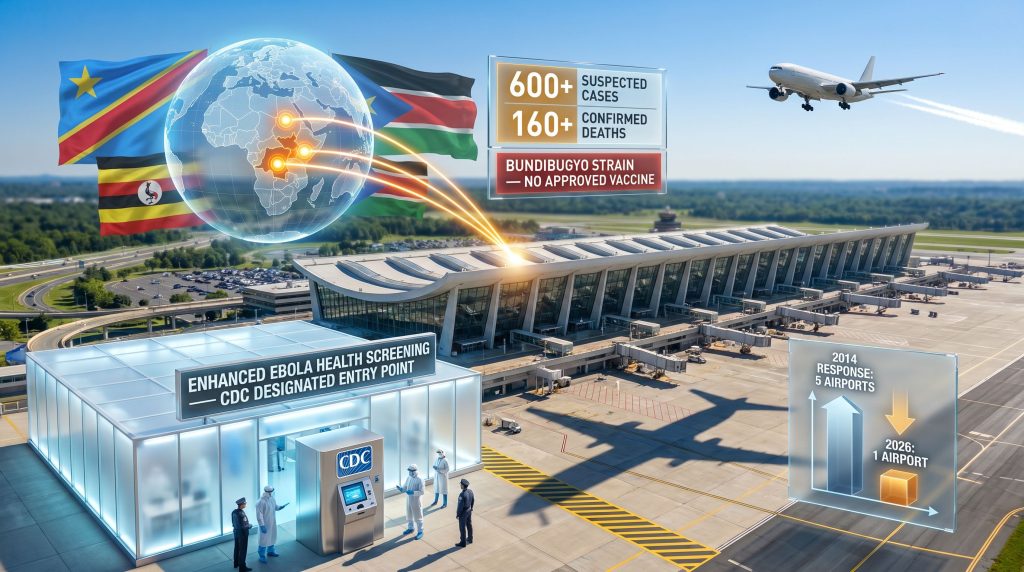
During the 2014 to 2016 West African Ebola outbreak, the United States distributed enhanced arrival screening across five major airports, including John F. Kennedy International, Newark Liberty, Chicago O'Hare, Hartsfield-Jackson Atlanta, and Washington Dulles. The logic was geographic dispersal: spreading screening capacity across multiple hubs reduced bottlenecks and matched the distribution of direct and connecting flight traffic from West Africa.
The 2026 approach inverts that model entirely. Washington Dulles International Airport has been designated as the sole US entry point for travellers arriving from the Democratic Republic of the Congo (DRC), Uganda, and South Sudan who have passed through those countries within the prior 21 days. Chicago O'Hare, despite its historical role in the 2014 response and its status as one of America's busiest international hubs, has been excluded from the current screening network.
The consolidation model gives federal agencies tighter operational control over CDC personnel deployment, isolation room availability, and data coordination with state health departments. However, it simultaneously creates a single point of failure if case volumes increase or if travellers find ways to reroute through third countries to reach different US entry points.
Which Countries Are Affected and the 21-Day Threshold
The three countries currently triggering mandatory Dulles rerouting were selected on the basis of active outbreak geography:
- Democratic Republic of the Congo (DRC): The epicentre of the current outbreak, with the heaviest case concentration in the eastern provinces
- Uganda: Has confirmed infections linked to cross-border transmission from the DRC
- South Sudan: Identified as a high-risk transit and exposure zone given porous borders and limited healthcare surveillance capacity
The 21-day travel window is epidemiologically grounded. Ebola's maximum incubation period is generally accepted at 21 days, meaning any person who was exposed within that timeframe could still be in the pre-symptomatic phase on arrival. This threshold has been the standard framework for Ebola entry screening since at least the 2014 response.
The World Health Organisation declared the outbreak a Public Health Emergency of International Concern (PHEIC), one of the most serious designations in global health governance, reserved for events with documented international spread potential and serious cross-border public health risk. As of the screening programme's launch, more than 160 confirmed deaths and over 600 suspected cases had been recorded, according to Congolese health authorities and international health agencies.
How the Ebola Screening Process at Dulles Actually Works
Step-by-Step: The Arrival Sequence for Affected Travellers
For travellers who fall within the screening criteria, the process at Washington Dulles unfolds as a sequential health assessment. The Department of Homeland Security has directed flights from Ebola-affected countries to Dulles, consolidating all health assessments at this single facility:
-
Flight rerouting: The Department of Homeland Security directs affected inbound flights to land at Dulles regardless of their originally scheduled US destination.
-
Health questionnaire: CDC officials administer a structured form covering recent travel history, potential exposure events, and any symptom onset since departure.
-
Temperature check: Non-invasive thermal screening or contact temperature measurement is conducted to detect fever, one of Ebola's earliest clinical signs.
-
Visual symptom assessment: Public health officers observe travellers for visible indicators of illness including nausea, unexplained bruising, or other clinical markers.
-
Contact data collection: Personal and travel contact information is recorded and may be shared with state and local health departments for follow-up monitoring during the remainder of the incubation window.
-
Clearance or medical escalation: Travellers who present no flags proceed to their final US destination. Those identified as potential exposure cases are transferred to designated hospital isolation units for clinical testing.
Official position from the CDC: As of the screening programme's launch, no suspected, probable, or confirmed Ebola cases have been identified inside the United States. The agency characterises the current domestic risk level as low.
Who Is Subject to These Measures?
The screening requirements apply to two distinct groups under different legal frameworks:
-
US citizens and lawful permanent residents who transited through the DRC, Uganda, or South Sudan within the prior 21 days are subject to mandatory health screening at Dulles before continuing to their final destination.
-
Non-citizens face more restrictive measures under Title 42 public health authority, invoked for a minimum of 30 days, which limits or restricts entry for those with recent travel through the affected countries.
Humanitarian workers, medical aid personnel, and staff from international organisations operating in the outbreak zone are also subject to screening, regardless of citizenship status. Travellers are strongly advised to review the US Embassy's worldwide caution advisory before finalising any travel arrangements to or through affected regions.
Understanding Title 42 in This Context
Title 42 is a section of the US Public Health Service Act that grants the government authority to restrict entry of individuals from countries where a communicable disease poses a public health threat. Its invocation here is legally distinct from standard immigration enforcement and is administered by the CDC rather than immigration agencies. The 30-day minimum duration creates a defined review window, after which conditions can be extended, modified, or lifted depending on outbreak trajectory.
How the 2026 Response Compares to the 2014 Model
| Feature | 2014 to 2016 West Africa Response | 2026 Central and East Africa Response |
|---|---|---|
| Screening airports | 5 major US hubs | 1 (Washington Dulles only) |
| Affected countries | Guinea, Liberia, Sierra Leone | DRC, Uganda, South Sudan |
| Ebola strain | Zaire (vaccine eventually available) | Bundibugyo (no approved vaccine) |
| WHO PHEIC declared | Yes | Yes |
| Title 42 invoked | No | Yes, minimum 30 days |
| US cases confirmed | 4, including 2 deaths | 0 as of screening launch |
| Non-citizen entry restrictions | Limited | Broad, nationality-based |
Critical distinction: The current outbreak is caused by the Bundibugyo strain of Ebola, for which there are no approved vaccines or targeted treatments. During the 2014 outbreak, the rVSV-ZEBOV vaccine was eventually deployed and played a significant role in containment. The absence of any equivalent tool in 2026 substantially raises the stakes of every border management decision.
What Infectious Disease Experts Say About the Single-Airport Model
The Case for Broader Geographic Screening
Specialists in infectious disease epidemiology have raised substantive concerns about the operational viability of a single-hub screening model. Concentrating all affected arrivals at one airport places significant strain on CDC staffing, isolation unit capacity, and the logistical coordination required to manage medical escalations efficiently.
Dr. Jeanne Marrazzo, who leads the Infectious Diseases Society of America, has publicly argued that distributing screening across a wider network of regional airports would be more operationally effective from a public health standpoint. She notes that achieving this would require meaningful investment in public health infrastructure and sustained inter-agency coordination, resources that have been under considerable pressure in recent years.
A further concern among epidemiologists is the risk of screening circumvention, whereby travellers reroute through third countries specifically to avoid Dulles and enter the US through non-screening airports. This is not a theoretical risk; it reflects documented behaviour patterns during past outbreak responses and represents a genuine gap in the single-hub model.
The Nationality Restriction Debate
Dr. Marrazzo has also challenged the policy's reliance on citizenship and recent travel geography as the primary criteria for entry restriction. Her argument, shared by a broad segment of the infectious disease community, is that restricting individuals on the basis of where they travelled rather than on clinical or epidemiological evidence of actual exposure does not reflect the scientific principles of outbreak containment.
Historical data from the 2014 response does not provide strong evidence that travel restrictions from affected regions demonstrably reduced US case importation. The four US cases recorded during that outbreak were all linked to direct healthcare exposure, not community transmission from screened arrivals.
Travel and Aviation Disruptions Already Unfolding
The policy's operational consequences have moved quickly from the theoretical to the practical. An Air France flight travelling from Paris to Detroit was diverted to Montreal after a Congolese passenger was identified as having boarded despite active travel restrictions. Canadian public health officials subsequently confirmed the traveller presented no symptoms and was returned to Paris without incident.
This single diversion illustrates the compliance complexity facing carriers operating routes through Central and East African hubs. Airlines now face:
- Mandatory pre-boarding screening obligations before departure
- Potential liability exposure for non-compliant boarding decisions
- Operational cost increases from flight rerouting and extended ground time at Dulles
- Reputational risk in markets where the policy is perceived as discriminatory
Uganda's government has formally and publicly objected to Washington's response. Information Minister Chris Baryomunsi characterised the restrictions as an overreaction, warning that the measures risk inflicting disproportionate economic damage on regional travel and aviation beyond the three directly affected countries. The concern is well-founded: neighbouring African nations with no active outbreak cases are already experiencing traveller hesitancy and booking cancellations.
The next major ASX story will hit our subscribers first
The Economic and Geopolitical Dimensions
DRC's Critical Minerals Exposure
The DRC natural resources landscape means the country is not only the epicentre of the current health crisis, but also a dominant global supplier of cobalt, accounting for roughly 70% of global production, and a major source of copper essential to electric vehicle batteries, grid infrastructure, and advanced electronics manufacturing. Furthermore, the DRC cobalt export ban introduced earlier in 2025 had already created upstream supply pressures before the outbreak emerged as a compounding factor. Any sustained escalation in outbreak severity carries real risk of disrupting:
- Mining operations in the eastern DRC provinces where the outbreak is most active
- Cross-border trade corridors linking DRC to regional export hubs
- Logistics and supply chains serving global battery material markets
For industries heavily exposed to critical minerals supply chains, the outbreak represents a compounding risk factor sitting alongside the existing challenges of artisanal mining regulation, infrastructure deficits, and ongoing regional conflict. In addition, the broader context of critical minerals demand driven by the energy transition makes any sustained disruption to DRC production particularly consequential for global markets.
The Funding Gap at the Source
A frequently underreported dimension of this crisis is the severe underfunding of the DRC's own outbreak response. The on-the-ground containment effort is reportedly facing critical shortages of personal protective equipment, medications, and operational financing. This is partly a consequence of broader reductions in international development aid and global health funding directed toward fragile states.
The United Kingdom has committed $27 million toward outbreak containment efforts in Congo, providing useful context for the scale of international financing required to mount an effective source-level response. Without sustained investment at the point of origin, border screening at Dulles functions more as a downstream filter than a containment strategy.
American Personnel and the Multinational Dimension
The outbreak has already drawn American citizens into direct clinical exposure. At least one US doctor infected while working in the DRC is currently receiving treatment in Germany, while a second American medical professional with documented exposure is under quarantine in the Czech Republic. These cases demonstrate how rapidly what begins as a localised health emergency can escalate into a multinational incident requiring diplomatic, consular, and medical coordination across multiple continents.
The US-Congo minerals partnership adds a further layer of strategic complexity to the bilateral relationship. Secretary of State Marco Rubio has publicly stated that the administration's primary objective is preventing Ebola from reaching American soil. Critics argue that this framing, while politically coherent, risks prioritising optics over the epidemiological consensus that the most durable form of domestic protection is effective outbreak containment at the source.
Frequently Asked Questions: US Ebola Screening at Washington Dulles Airport
Why Is Washington Dulles the Only Airport Conducting Ebola Screening?
The US government chose to centralise all enhanced Ebola arrival screening at Washington Dulles to streamline CDC oversight, concentrate isolation resources, and simplify inter-agency coordination. This represents a deliberate departure from the five-hub model used during the 2014 outbreak.
What Happens If a Traveller Shows Symptoms During Screening at Dulles?
Any traveller flagged for potential Ebola exposure or active clinical symptoms is immediately transferred to a designated hospital isolation unit for testing and medical monitoring. Onward travel to their final US destination is suspended until clinical clearance is confirmed.
Does This Screening Apply to All Travellers Arriving From African Countries?
No. The enhanced screening and entry restrictions apply only to individuals who have been physically present in the DRC, Uganda, or South Sudan within the 21 days prior to US arrival. Travellers from other African nations are not subject to these specific measures.
Is There a Vaccine Available for the Current Ebola Strain?
No approved vaccine or targeted treatment currently exists for the Bundibugyo strain responsible for this outbreak. The WHO is evaluating experimental candidates, but none have received formal authorisation for deployment against this specific strain.
Can Non-US Citizens Enter the Country If They Recently Travelled Through Affected Areas?
Non-citizens who travelled through the DRC, Uganda, or South Sudan within the prior 21 days face entry restrictions under Title 42 public health authority, invoked for a minimum of 30 days. Limited exceptions may apply for specific humanitarian and diplomatic categories.
Has Anyone in the US Been Diagnosed With Ebola From This Outbreak?
As of the launch of the Dulles screening programme, the CDC has confirmed that no suspected, probable, or confirmed Ebola cases have been identified inside the United States.
What This Policy Reveals About Outbreak Preparedness
The architecture of the US Ebola screening at Washington Dulles Airport reflects a set of strategic trade-offs that extend well beyond any single outbreak. The decision to consolidate screening at one airport prioritises federal control and resource efficiency over geographic coverage. The invocation of Title 42 prioritises legal clarity and speed of implementation over scientific nuance.
Several conclusions emerge from examining the full picture:
- The absence of an approved vaccine for the Bundibugyo strain fundamentally changes the risk calculus of every policy decision compared to 2014
- Single-hub screening models carry inherent vulnerabilities including diversion risk and capacity constraints that distributed models reduce
- Effective containment ultimately depends on strengthening health systems at the source, a goal undermined by declining international aid budgets
- The outbreak simultaneously functions as a public health emergency, a geopolitical test for US-Africa relations, and a material risk event for global critical mineral supply chains
Disclaimer: This article is intended for informational purposes only and does not constitute medical, legal, or travel advice. Readers should consult official guidance from the CDC, WHO, and relevant government authorities for the most current information on travel restrictions and outbreak status. Outbreak data and policy conditions are subject to rapid change.
Want to Stay Ahead of Critical Mineral Supply Disruptions Affecting the ASX?
When geopolitical crises like the DRC Ebola outbreak threaten cobalt and copper supply chains, the ripple effects reach ASX-listed mineral explorers and producers fast — Discovery Alert's proprietary Discovery IQ model delivers real-time alerts on significant ASX mineral discoveries, ensuring subscribers can identify actionable opportunities before the broader market reacts. Explore historic examples of major discovery returns and begin your 14-day free trial today to position yourself ahead of the next market-moving event.