August 25, 2026
The Hidden Data Problem Sitting at the Heart of Mining's AI Revolution
Most conversations about artificial intelligence in mining focus on the technology itself — the algorithms, the sensors, the dashboards. Far fewer examine the foundational layer that determines whether any of it actually works in a live production environment. The MaxMine AI system for mining operations represents one of the more rigorous attempts to address this foundational challenge. Before a single model can classify a load cycle or flag an anomaly, there must be data — not just data in bulk, but data that is accurate, labelled, and representative of the chaotic, variable reality of a working mine site.
This distinction between raw data collection and genuinely useful operational intelligence is where most AI projects in heavy industry quietly collapse. Gartner research estimates that 60% of AI projects fail due to a lack of AI-ready data, with 42% of organisations abandoning AI initiatives before they ever reach production scale. In mining, where equipment operates across shifting ground conditions, mixed fleets from multiple manufacturers, and operators with vastly different experience levels, the challenge of AI-ready mining data is particularly acute.
Understanding why some platforms clear this bar while others stall in perpetual pilot phases requires looking closely at what separates industrial AI that genuinely deploys at scale from the kind that generates impressive presentations but little operational change.
When big ASX news breaks, our subscribers know first
Why Conventional Fleet Management Systems Are Running Out of Road
The Structural Ceiling of Legacy Monitoring Infrastructure
Standard fleet management systems were designed for a different era of mine site operations. Their core function — tracking machine location, shift hours, and basic cycle counts — was adequate when the primary need was visibility rather than intelligence. That calculus has shifted considerably.
Modern mining operations need to understand not just what happened during a shift, but why it happened, who was responsible, and what it cost in productivity terms. Legacy systems generate surface-level telemetry that cannot answer these questions with any useful granularity. The result is a persistent operational gap between what site managers believe is happening and what is actually occurring at the machine level.
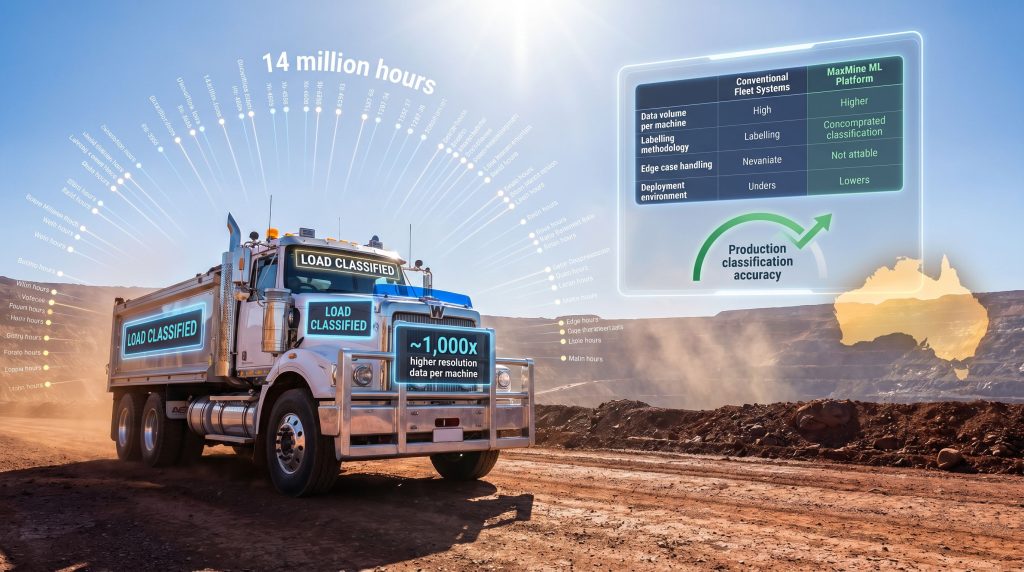
The volume difference is striking. The MaxMine AI system for mining operations captures approximately 1,000 times more data per machine than conventional fleet management platforms. That is not a marginal improvement in resolution — it represents an entirely different category of operational visibility, one that makes granular behavioural analysis and edge-case classification genuinely possible.
From Reactive Reporting to Real-Time Operational Intelligence
The shift from end-of-shift reporting to continuous, real-time operational intelligence changes how mine managers can respond to productivity and safety events. Rather than reviewing what went wrong after the fact, site teams gain the ability to identify patterns as they emerge and intervene before minor inefficiencies compound into significant production losses.
Furthermore, this transition enables training operators based on verifiable behavioural data rather than supervisor perception. The broader context of mining automation trends suggests this shift from reactive to predictive operational management is increasingly a competitive necessity, particularly for mining contractors operating on thin margins where small improvements in cycle efficiency translate directly to profitability.
How the MaxMine AI System Actually Works
An OEM-Agnostic Architecture Built for Real-World Complexity
One of the persistent barriers to AI adoption across mixed-fleet mining operations has been the fragmentation of data across OEM-specific software ecosystems. A site running Caterpillar, Komatsu, and Hitachi equipment has historically needed separate management systems for each, creating data silos that prevent any unified view of fleet performance.
The MaxMine platform is designed to function across equipment from any manufacturer without requiring site-specific hardware customisation. Its cloud-delivered subscription model removes the need for local IT infrastructure, eliminating a major capital expenditure barrier that has historically slowed enterprise software adoption at the site level.
The Aviation Black Box Concept Applied to Mining Equipment
The platform's core data architecture draws conceptual parallels with aviation flight recorders. Just as a black box captures the full operational context of a flight — including mechanical state, pilot inputs, and environmental conditions — MaxMine records operator behaviour, machine mechanical response, and site-level context simultaneously.
This simultaneous multi-layer capture is critical. Most AI systems in mining analyse mechanical signals in isolation from the human inputs that drive them. By capturing both layers together, the platform can distinguish between a mechanical fault and an operator behaviour pattern producing the same symptom, a distinction that has significant implications for maintenance decisions and training interventions.
Load and Dump Classification: The Production-Grade ML Milestone
The most recent development in the MaxMine platform is the deployment of a production-grade machine learning module specifically designed for load and dump cycle classification. This capability targets one of the most practically difficult problems in open-cut mining operations: accurately distinguishing between valid loads, missed loads, partial loads, and misclassified events in conditions that are constantly changing.
This system has now been fully operational for six months across customers including Glencore, NRW Holdings, and Macmahon, delivering measurable outcomes across three dimensions:
- Reduced administrative burden for site operations teams through automated classification, replacing manual review processes
- Improved accuracy in production tracking, particularly in complex edge-case scenarios that previously generated reporting errors
- Structured data pipelines that allow the system to scale across new sites without requiring bespoke engineering for each deployment
The 14 Million Hours That Make the Difference
Why Training Data Scale Creates an Insurmountable Competitive Moat
The load and dump classification model was trained on a dataset spanning more than 14 million hours of labelled, high-quality operational data. This training set encompasses multiple asset types, machine models, site configurations, and operational conditions, providing the model with exposure to the kind of variability it will encounter in any live deployment.
In machine learning terms, the breadth and depth of this training foundation directly determines a model's ability to generalise. A model trained on data from a single site or a narrow range of equipment types will perform well in familiar conditions and fail unpredictably when it encounters anything outside its training distribution. The scale of MaxMine's dataset is what enables consistent, high-confidence performance across the diversity of real-world mine sites.
Ground-Truthed Labelling: The Detail Most AI Vendors Skip
Raw sensor data is not the same as labelled training data. The difference between the two is the difference between a recording and an analysis. Ground-truthed labelling means that every operational event in the training dataset has been verified against what actually happened on the ground — not inferred from a proxy signal or assumed from surrounding context.
This verification process is resource-intensive, which is precisely why most AI vendors in the mining space do not do it at scale. The consequence of skipping it is model degradation over time, as the compounding errors introduced by inaccurate labels progressively reduce confidence in production environments.
The Chief Scientist at the Australian Institute of Machine Learning has noted that the ability to deploy a single model with high accuracy across such a wide range of asset and site types is genuinely rare in industrial AI, and that "this capability points directly to the richness, accuracy, and human error-free nature of the underlying datasets, combined with the long-term, multi-site, multi-machine scope of the training data."
| Data Characteristic | Conventional Fleet Systems | MaxMine ML Platform |
|---|---|---|
| Data volume per machine | Standard telemetry | ~1,000x higher resolution |
| Labelling methodology | Largely unlabelled or manual | Ground-truthed, human error-free |
| Training dataset scope | Single-site or single-asset | Multi-site, multi-machine, long-term |
| Edge case handling | Requires bespoke development | Handled through structured ML pipelines |
| Deployment environment | On-premise or mixed | Private, secure cloud |
The Real Cost of Misclassified Load Events
How Classification Errors Cascade Through Mine Operations
Load and dump classification errors are not simply a data quality inconvenience. They create cascading inaccuracies that flow through production reporting, shift reconciliation, and contractor payment calculations.
Illustrative scenario: At a large open-cut operation running 40 trucks across two 12-hour shifts, a misclassification rate of just 2% on load events could generate hundreds of incorrectly recorded cycles per week. Across a full year, this compounds into substantial discrepancies between reported and actual production volumes. For mining contractors billing on a per-tonne basis, this directly affects revenue recognition, royalty calculations, and mine plan reconciliation. A near-zero misclassification rate is not a technical achievement for its own sake — it is a financial integrity mechanism.
Why Per-Tonne Billing Models Amplify Classification Risk
The financial stakes of accurate load classification are particularly elevated in contract mining arrangements where payment is tied to tonnes moved. In these structures, any systematic bias in classification — whether toward over-counting or under-counting loads — creates a direct financial exposure for either the contractor or the mine owner.
Higher classification accuracy consequently serves a dual function: it improves operational planning by generating reliable production KPIs, and it protects the commercial integrity of contractual arrangements in an industry where disputes over production volumes are both common and costly.
Sovereign AI Development and the AI Accelerator CRC
Building Domestic AI Capability for Critical Industrial Sectors
MaxMine's executive chair has taken on a formal sector lead role within the newly established AI Accelerator Cooperative Research Centre, an initiative focused on developing Australia's sovereign AI creation capacity across critical industrial sectors. The CRC's mandate is to enable industries such as mining to build and own their own AI tools rather than depending on offshore platforms developed without reference to Australian operational conditions.
This distinction matters more than it might initially appear. AI in mining systems trained primarily on data from North American or European operations carry assumptions about equipment configurations, regulatory environments, and operational practices that may not translate cleanly to Australian mine sites. Sovereign AI development means building models on data that genuinely reflects local conditions.
The Critical Minerals Dimension
Australia's role as a leading producer of lithium, rare earths, cobalt, and nickel creates a specific strategic context for domestic AI development. As global demand for these materials intensifies, driven by energy transition requirements, the operational efficiency of Australia's critical minerals sector becomes a direct determinant of export competitiveness.
AI-enabled productivity improvements translate into lower cost-per-tonne metrics. In a global market where Australian producers compete against lower-cost jurisdictions, particularly in Southeast Asia and Africa, the margin between a competitive and uncompetitive operation is increasingly measured in operational efficiency rather than resource endowment alone.
Dependence on offshore AI infrastructure also introduces data sovereignty considerations that are particularly sensitive for operations connected to national security supply chains. Maintaining operational intelligence within domestic systems is, furthermore, both a commercial and a strategic priority.
The next major ASX story will hit our subscribers first
How MaxMine Compares Across the Mining AI Landscape
Mapping Capability Differences Across Platform Types
| Capability Area | Typical Industry Approach | MaxMine's Differentiation |
|---|---|---|
| Predictive maintenance | Sensor-based anomaly detection | Integrated with operator behaviour context |
| Safety monitoring | Camera/vision systems or wearables | Black box behavioural analysis and coaching |
| Production tracking | Rule-based cycle counting | ML-based load and dump classification |
| Fleet management | OEM-specific software | OEM-agnostic, cross-fleet platform |
| Data delivery | On-premise or OEM cloud | Private, secure cloud subscription |
| Behaviour change | Not typically addressed | Active coaching and change management |
The Behaviour Change Gap Most Platforms Never Address
A structural weakness in most AI platforms deployed across mining operations is the absence of any mechanism to translate data insights into changed behaviour at the operator level. These platforms generate dashboards and reports that surface problems clearly — however, what they do not do is close the loop between insight and action.
MaxMine integrates coaching and change management as core components of its improvement methodology, not as optional add-ons. This creates a feedback mechanism between what the data reveals and what operators and supervisors actually do differently as a result. In operational improvement terms, this is the difference between knowing a problem exists and solving it. The importance of data-driven mining operations in achieving this outcome cannot be overstated.
Where the Industry Is Heading: Digital Twins, Computer Vision, and Agentic AI
The broader mining AI sector is evolving rapidly in several directions simultaneously:
- Digital twin environments are enabling mine planners to simulate operational scenarios before committing equipment and personnel to physical execution
- Computer vision systems are being deployed for ore sorting at processing plants, personnel safety zone enforcement, and conveyor monitoring
- Agentic AI — referring to systems capable of taking autonomous operational decisions within defined parameters — is emerging as the next frontier for semi-autonomous mine operations
The high-resolution behavioural dataset accumulated through years of multi-site deployment positions MaxMine's platform as a potential foundation layer for more advanced agentic applications as the technology matures. As noted by industry analysts reviewing MaxMine's approach, the quality of the underlying training data is what separates a system capable of supporting autonomous decision-making from one that requires constant human supervision.
Key Challenges That Cannot Be Ignored
Data Readiness Remains the Primary Barrier to Scale
The Gartner statistic on AI project failure rates is instructive precisely because it points to infrastructure rather than algorithm quality as the limiting factor. Many mine sites still operate legacy sensor infrastructure that generates incomplete, inconsistent, or entirely unlabelled data streams. Without significant investment in data infrastructure, the model at the top of the stack cannot deliver reliable outcomes regardless of its sophistication.
This creates a meaningful barrier to entry for newer AI vendors attempting to compete on algorithm quality alone. The advantage held by platforms with large, pre-existing labelled datasets is structural and compounds over time as more operational data is added.
Organisational Readiness Is as Important as Technical Capability
Technology deployment and operational improvement are not the same thing. Site teams must be equipped, motivated, and supported to act on AI-generated insights for any productivity benefit to materialise. Resistance to behaviour change at the operator and supervisor level is a consistent implementation risk across heavy industry AI deployments, and it is rarely addressed adequately in vendor implementation frameworks.
Effective AI platforms must treat change management support as a core deliverable, not a peripheral service. This is one of the more underappreciated dimensions of the MaxMine AI system for mining operations approach, and it is a meaningful differentiator from pure analytics tools that deliver insights without any mechanism for translating them into action.
Frequently Asked Questions
What does the MaxMine AI system do at the site level?
The platform captures high-resolution data on machine performance, operator behaviour, and site conditions simultaneously. Its machine learning module classifies operational events such as load and dump cycles with high accuracy, reducing administrative burden and improving the reliability of production reporting.
How does it differ from standard fleet management software?
It captures approximately 1,000 times more data per machine than conventional systems, operates across equipment from any manufacturer, and incorporates behaviour change coaching as a core component rather than treating data delivery as the end goal.
What is the significance of 14 million hours of training data?
This scale of labelled, ground-truthed training data enables the model to handle edge cases and operational variability that simpler rule-based systems cannot resolve. It also provides the generalisation capacity needed to perform consistently across different sites and machine types without requiring bespoke engineering for each new deployment.
What is the AI Accelerator CRC and why does it matter for mining?
The AI Accelerator Cooperative Research Centre is focused on developing Australia's domestic AI creation capacity across critical industrial sectors. MaxMine's executive chair holds a formal sector lead role in its mining division, contributing to a broader effort to reduce Australian industry's reliance on offshore AI infrastructure.
Is this platform relevant beyond large-scale operations?
The cloud-delivered subscription model removes the capital expenditure barrier typically associated with enterprise mining software. While current deployments include major operators, the architecture is technically scalable across operations of varying sizes.
Want to Know When the Next Major Mining Discovery Hits the ASX?
Discovery Alert's proprietary Discovery IQ model scans ASX announcements in real time, instantly alerting subscribers to significant mineral discoveries across more than 30 commodities — turning complex data into clear, actionable opportunities the moment they emerge. Explore historic discoveries and their extraordinary returns, then begin your 14-day free trial at Discovery Alert to position yourself ahead of the broader market.