July 21, 2026
Africa's Last Great Iron Ore Frontier: Why the Belinga Iron Ore Project in Gabon Is One of the Most Consequential Mining Bets of the Decade
The iron ore industry operates in long cycles. Capital commitments made today produce ore in five to ten years, by which time markets, geopolitics, and technology may look entirely different. This structural tension is precisely why large, undeveloped deposits like the Belinga iron ore project in Gabon sit idle for decades, waiting for a moment when geology, governance, capital, and market conditions briefly align. That alignment is what Gabon is attempting to engineer right now, and the outcome will likely define the country's economic trajectory for a generation.
When big ASX news breaks, our subscribers know first
Seventy Years of Untouched Ore: Understanding Why Belinga Remained Dormant
Iron mineralisation in the Belinga range of northeastern Gabon was identified as early as the 1950s, making it one of the longest-studied undeveloped deposits on the African continent. The geology was never the obstacle. Historical surveys conducted by both the US Geological Survey and France's Treasury identified approximately 1 billion tonnes of high-grade ore. The Gabonese government has referenced a potential resource of 7.5 billion tonnes, though this figure awaits independent confirmation under modern reporting standards such as JORC or NI 43-101.
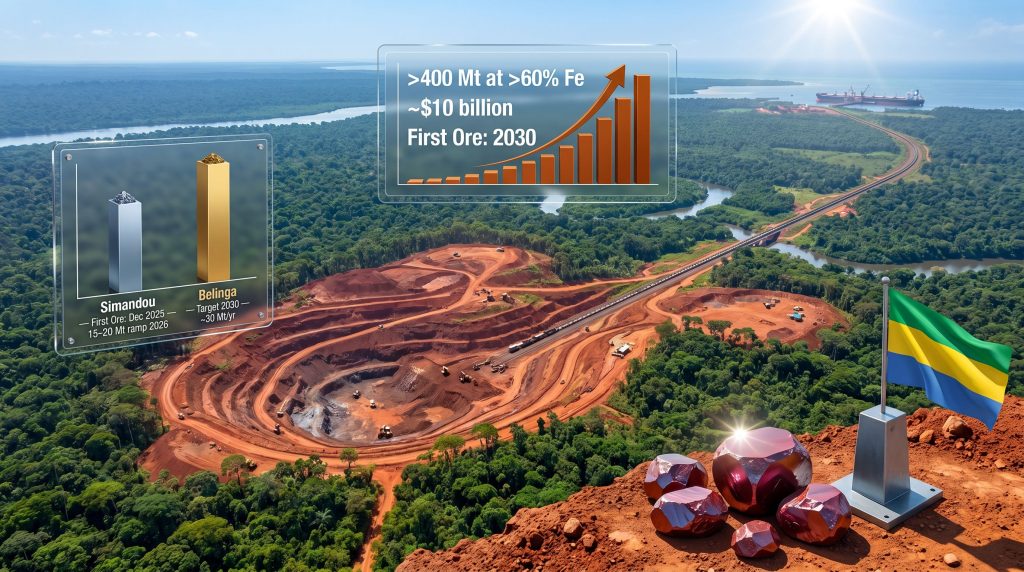
Earlier technical work by SRK Consulting estimated deposits exceeding 400 million tonnes at iron grades above 60% Fe, which is considered premium-quality ore in global seaborne markets. For context, ore grading above 62% Fe commands significant price premiums over benchmark indices, and ore consistently above 60% Fe is increasingly sought after as steel producers in China and elsewhere face pressure to improve blast furnace efficiency and reduce emissions per tonne of steel produced.
Yet none of this geological quality translated into production. The deposit sits approximately 500 kilometres from the Gabonese coast, in the Ogooué-Ivindo province, one of the most ecologically sensitive and infrastructure-sparse regions in Central Africa. There is no existing railway capable of handling bulk mining volumes, no deep-water port within viable proximity, and no power grid with the capacity to support large-scale industrial processing.
Building this infrastructure from scratch, in a rainforest corridor adjacent to Ivindo National Park and the ecologically significant Kongou Falls, carries both enormous capital requirements and serious environmental scrutiny. Gabon's mines ministry has indicated total infrastructure investment requirements of approximately $10 billion, covering a railway corridor of roughly 450 to 560 kilometres, a deep-water port facility, multiple hydroelectric dams for dedicated power generation, and the mine and processing infrastructure itself.
The CMEC Collapse: What a Decade of Failure Reveals About This Project's Complexity
The history of Belinga's failed development attempts provides an instructive framework for evaluating the current effort. In 2006, a Chinese consortium led by CMEC secured development rights under a package nominally valued at approximately $3 billion. The commitment included a 560-kilometre railway, a deep-water port, and a hydroelectric dam, broadly mirroring the infrastructure scope being discussed today.
The project never progressed beyond planning. China Exim Bank suspended financing in 2008, citing incomplete environmental impact assessments. What followed was years of inactivity as JV structural disagreements, cost-sharing disputes, and iron ore price volatility eroded commercial urgency. The licence lapsed entirely by 2013 without a single tonne of ore being extracted or a metre of track being laid.
| Failure Factor | What Went Wrong |
|---|---|
| Environmental compliance | China Exim Bank withheld financing pending unresolved impact assessments |
| Consortium alignment | Cost-sharing and governance disputes fractured the JV structure |
| Market timing | Iron ore price volatility reduced the commercial case for commitment |
| Infrastructure financing gap | No viable standalone mechanism to fund enabling infrastructure |
| Governance opacity | Bongo-era contract structures created persistent investor risk |
The critical analytical point here is that Belinga's geology was never challenged. The CMEC episode was a failure of institutional architecture, not mineralogy. That distinction matters enormously because it means the current development attempt does not need to re-prove the ore body, but it does need to solve every non-geological problem that defeated the previous consortium.
Fortescue and Ivindo Iron: How the Current Attempt Is Structurally Different
The Belinga iron ore project in Gabon is currently being advanced through Ivindo Iron SA, a joint venture in which Fortescue Ltd (Australia) holds approximately 72% and the Gabonese state retains the balance. The operating vehicle is Fortescue Belinga, the project-level development entity. Fortescue's ambitions for the project include a target of first ore on ship by 2030.
What separates this attempt from its predecessor is a combination of demonstrated commitment and institutional legitimacy. In December 2023, Fortescue exported a first symbolic cargo from the deposit, a deliberate signal to markets and governments that the company was serious about proving logistical and geological viability before making larger capital commitments.
Since then, the project has entered a systematic exploration and pre-feasibility phase. By late 2025, more than 160,000 metres of drilling had been completed across the deposit, an exploration programme of a scale that signals genuine technical advancement rather than speculative positioning. In December 2025, Fortescue chairman Andrew Forrest and President Oligui Nguema jointly reaffirmed a target of first ore on ship by 2030, alongside an agreement to establish a presidential task force to streamline regulatory approvals and reduce bureaucratic friction.
What "Changed Dimension" Actually Means in Technical Terms
Gabon's mines minister described the project as having "changed dimension," a phrase that carries specific meaning in a mining development context. It signals:
- Movement from a purely exploration-phase activity to integrated mine-rail-port planning
- A shift from the concept of raw ore export toward value-added industrial processing, requiring on-site beneficiation and transformation infrastructure
- Elevation of the deposit from a speculative resource to a project with defined infrastructure scope and a credible timeline
This transition from exploration to development-stage thinking is significant for investors because it marks the point at which capital requirements shift from manageable exploration budgets to multi-billion-dollar infrastructure commitments.
Gabon's Political Reset and What It Means for Investor Confidence
The August 2023 military coup that ended 55 years of Bongo family rule introduced both risk and opportunity into Belinga's investment thesis. The risk is obvious: post-coup political transitions carry institutional continuity uncertainty, and no amount of reform signalling can fully replace the predictability of established rule of law.
President Brice Clotaire Oligui Nguema, who formalised his mandate through a presidential election victory in April 2025, has tied his political identity to economic diversification in a way his predecessors never did. Approximately one-third of Gabon's 2.3 million population lives in poverty despite decades of oil revenue, an indictment of resource extraction without industrial value addition that the current administration has made central to its political narrative.
The governance reforms introduced since 2023 are architecturally different from the opacity that characterised the Bongo era:
- Full public disclosure of all mining agreements ordered
- Independent audit of every contract signed between 2010 and 2024 commissioned
- Comprehensive revision of mining, forestry, and petroleum codes underway
- Tax and customs framework modernisation in progress
- Digital company registration introduced, enabling business incorporation in under 48 hours
- Active pursuit of a new IMF programme as an external credibility anchor
The audit of contracts signed during the prior administration, combined with mandatory disclosure of mining agreements, represents a structural departure from the governance failures that undermined the CMEC deal. Whether these reforms translate into durable institutional change remains the defining test for investor confidence.
The Infrastructure Build: Why This Is an Industrial System, Not Just a Mine
A common misconception about large undeveloped deposits like Belinga is that the challenge is primarily geological. In reality, for a deposit of this geography, the challenge is almost entirely logistical and financial. The mine itself is arguably the simplest component of the development programme.
The integrated system required to bring Belinga into production consists of four mutually dependent components:
- Railway corridor: Approximately 450 to 500 kilometres connecting the Ogooué-Ivindo deposit to the Gabonese coast, traversing ecologically sensitive terrain
- Deep-water port facility: A purpose-built bulk ore terminal, with Koubi Koubi identified as one potential coastal location, capable of accommodating Capesize or Very Large Ore Carrier vessels
- Hydroelectric power infrastructure: Multiple dam facilities dedicated to supplying industrial-scale power for on-site ore processing and transformation
- Mine and beneficiation plant: Designed to support value-chain elevation rather than simple raw ore export, targeting planned capacity of approximately 30 million tonnes per year
The value-chain ambition embedded in this design creates a more complex financing picture than a simpler dig-and-ship model. Processing infrastructure requires higher upfront capital intensity, longer payback periods, and more sophisticated off-take arrangements. It also theoretically unlocks higher margins per tonne, but only if the processing economics are competitive with producing regions that already have infrastructure in place.
The next major ASX story will hit our subscribers first
Climate Finance, Green Bonds, and the Ecological Contradiction
One of the more analytically interesting dimensions of the current Belinga push is the Gabonese administration's intention to access green and climate-linked capital as part of the infrastructure financing package. The logic rests on framing the hydroelectric dam components as clean energy infrastructure eligible for concessional climate finance.
Gabon has genuine green finance credentials that lend some credibility to this approach. The country has received international payments for rainforest conservation and successfully completed a debt-for-nature blue bond swap in 2023, positioning it as one of the more credible African sovereigns in the sustainable finance space.
However, the application of climate finance instruments to a heavy-industry iron ore corridor introduces significant structural tension. The environmental concerns surrounding Belinga are well-documented, particularly given the project's proximity to protected ecosystems:
- The railway and mine corridor passes through the Ogooué-Ivindo region, one of Central Africa's most biodiverse areas
- Proximity to Ivindo National Park creates potential for international conservation organisations to contest multilateral lender involvement
- Kongou Falls represents a site of near-UNESCO-level ecological sensitivity within the project corridor
- Multilateral development banks applying green bond frameworks typically require rigorous Environmental and Social Impact Assessments (ESIAs) that could impose multi-year design constraints
Marrying climate finance to a heavy-industry iron ore mega-project is conceptually awkward at best. The hydroelectric framing may prove legally contestable under strict green bond standards, particularly when the power generated is dedicated to a bulk mining operation rather than general national energy access.
The AfDB Platform and the Mobilisation Doctrine
President Oligui Nguema chose the African Development Bank's Annual Meetings in Brazzaville in May 2026, the first AfDB annual meetings held in Congo, as the primary platform to formally pitch Belinga to the global investment community. The timing was deliberate.
The AfDB's 2026 theme, Mobilising Africa's Development Financing at Scale in a Multi-Polar World, encapsulates precisely the institutional gap that Gabon is trying to close. Africa's large-scale resource projects are, in the AfDB's framing, largely identified. The binding constraint is no longer geological discovery but financing mobilisation at the scale required to convert known resources into productive infrastructure.
Belinga functions as a test case for this doctrine. If a project with world-class geology, a credible 72%-equity partner in Fortescue, an active exploration programme, and a post-2023 governance reform agenda cannot attract the international consortium needed to fund $10 billion in enabling infrastructure, it raises fundamental questions about the bankability of Africa's known large-scale mining opportunities.
Simandou: The Competitive Pressure Reshaping Belinga's Commercial Window
No analysis of the Belinga iron ore project in Gabon is complete without examining the competitive threat posed by Guinea's Simandou deposit, which shipped its first ore to China in December 2025. Furthermore, understanding the broader iron ore demand outlook is essential context for assessing whether Belinga can enter a favourable market when it eventually reaches production.
| Metric | Simandou (Guinea) | Belinga (Gabon) |
|---|---|---|
| First ore shipped | December 2025 | Target: 2030 |
| 2026 production ramp | 15 to 20 million tonnes | Pre-production |
| Ore grade | High-grade | High-grade (~60%+ Fe) |
| Infrastructure status | Rail and port operational | Railway and port yet to be built |
| Market impact | Reshaping seaborne cost curve | Entering as a new cost competitor |
Wood Mackenzie has identified Simandou as the single largest driver of seaborne iron ore supply growth over the coming decade. The consultancy's analysis indicates that Simandou's progressive ramp-up will displace higher-cost producers and compress margins across the seaborne market. With major forecasters projecting benchmark iron ore prices drifting toward approximately $95 per tonne in 2026 as Chinese steel demand softens and seaborne supply grows, the commercial environment Belinga will enter in 2030 could be materially less favourable than conditions today.
This creates a specific strategic risk for Belinga. As a greenfield, high-capital-intensity project, its breakeven cost structure will be heavily influenced by the financing terms secured for infrastructure. Consequently, a project that enters production into a $95 per tonne price environment carrying expensive infrastructure debt faces a very different risk-return profile than one entering a $120 to $130 per tonne market.
The broader iron ore price decline trend adds further weight to this concern, as surplus conditions and softening Chinese demand create a challenging pricing backdrop for any new high-cost entrant to the seaborne market.
Key Risk Matrix: What Could Prevent Belinga From Reaching the 2030 Target
Market and Pricing Risks
- Sustained iron ore prices below $95 per tonne could reduce project IRR below bankable thresholds for infrastructure lenders
- Simandou's faster-than-projected ramp accelerates price compression in the high-grade segment
- The China steel and iron ore market represents a structural rather than cyclical softening dynamic, with the property sector downturn removing a historically significant demand driver
Infrastructure Financing Risks
- The $10 billion requirement demands a multi-party international consortium; no single financier can carry this exposure
- Green finance eligibility for the mine-rail corridor remains legally and commercially untested at this scale
- Multilateral lender ESIA requirements could impose significant design constraints or timeline delays
Governance and Political Risks
- Post-coup political transitions carry inherent institutional continuity risk regardless of reform quality
- IMF programme negotiations introduce external conditionality that may constrain the government's co-investment capacity
- Contract audit outcomes from the 2010 to 2024 review could generate legacy disputes complicating new agreements
Environmental and Social Risks
- Ivindo National Park proximity creates conditions for international NGO campaigns targeting multilateral lenders
- Resettlement and community impact requirements in Ogooué-Ivindo province add cost and timeline risk
- Biodiversity offset requirements under modern environmental standards may impose infrastructure design changes that increase capital costs
Gabon's Broader Diversification Logic: Why This Project Matters Beyond Mining
The Belinga iron ore project in Gabon carries significance beyond its direct commercial metrics. Oil revenues have historically dominated Gabon's export earnings and fiscal receipts. The persistence of poverty affecting roughly one-third of the population despite this resource wealth reflects the fundamental limitation of extractive economies that export unprocessed commodities without building industrial value chains.
Ogooué-Ivindo province, the physical location of the Belinga deposit, is among Gabon's least economically developed regions. A successful, operating mine-rail-port system would direct industrial employment, infrastructure investment, and fiscal revenue toward one of the country's most underserved areas, creating a geographic distribution of economic activity that oil revenues never achieved.
However, Gabon is not the only nation competing for global iron ore investment capital. Australia's iron ore advantage — built on established infrastructure, sovereign stability, and proximity to Asian markets — sets a high benchmark that African projects must work harder to overcome in the eyes of international capital allocators.
In addition, the impact of tariffs on iron ore markets adds another layer of uncertainty for any greenfield project seeking to build a commercial case across a five-to-ten-year development horizon. Gabon's ambition mirrors a broader continental shift. From the Democratic Republic of Congo's battery mineral processing push to Zimbabwe's lithium beneficiation requirements, African governments are increasingly insisting on value addition rather than raw material export.
Whether Belinga succeeds or fails will serve as a defining reference case for this continental ambition. The ore has been in the ground since at least 1955. The question that the next five years will answer is whether the institutional, financial, and market conditions can align long enough for it to finally reach a ship.
Belinga Iron Ore Project: Key Statistics at a Glance
| Parameter | Data Point |
|---|---|
| Deposit location | Ogooué-Ivindo province, northeastern Gabon |
| Distance from coast | ~500 km |
| Historical resource estimate (SRK) | >400 Mt at >60% Fe |
| Government-cited potential | 7.5 billion tonnes (unconfirmed) |
| Planned annual production capacity | ~30 million tonnes per year |
| Railway length required | ~450 to 560 km |
| Total estimated investment | ~$10 billion |
| Fortescue equity stake | ~72% (via Ivindo Iron SA) |
| Drilling completed (to late 2025) | >160,000 metres |
| First ore target | 2030 |
| Previous licence holder | CMEC (China), lapsed 2013 |
| Iron ore price forecast (2026) | ~$95 per tonne |
| Simandou 2026 production ramp | 15 to 20 million tonnes |
This article contains forward-looking statements and projections based on publicly available information, analyst forecasts, and government disclosures. Readers should not interpret any element of this analysis as financial advice. Iron ore price forecasts, production timelines, and resource estimates are subject to material change and carry significant uncertainty. Investors should conduct independent due diligence before making any investment decisions related to the projects or companies discussed.
Want to Identify the Next Major Mineral Discovery Before the Market Does?
Discovery Alert's proprietary Discovery IQ model delivers real-time alerts on significant ASX mineral discoveries, transforming complex mineral data into actionable investment insights for both short-term traders and long-term investors — start your 14-day free trial today and explore how historic discoveries have generated extraordinary returns to understand what's possible when you're positioned ahead of the market.