July 21, 2026
The Electricity Problem That Tariffs Cannot Solve
For decades, trade economists have debated whether tariff walls can rebuild hollowed-out domestic industries. The aluminium sector offers one of the most instructive case studies available: seven years of Section 232 tariff protection, rates climbing from 10% to an eventual 50%, and yet the United States today still imports roughly 60% of the primary aluminium it consumes, according to the USGS 2026 Mineral Commodity Summary. That persistent gap between policy intent and industrial reality is the central challenge the Washington aluminium incentive programme of 2026 is designed to confront.
The uncomfortable truth embedded in that 60% figure is that US aluminium tariffs address the wrong variable. The structural barrier to US primary aluminium production has never been import competition in the conventional sense. It has been electricity pricing, and no tariff schedule can substitute for a gigawatt of competitively priced power.
When big ASX news breaks, our subscribers know first
Two Washington Programmes, One Name, Very Different Fates
Washington State: A Legislative Framework With No Participants
Before examining the federal programme, it is worth understanding what Washington State's own aluminium incentive framework was, and why it no longer functions. Once a foundational node in American primary metal production, Washington State hosted multiple large-scale smelting operations running on abundant Pacific Northwest hydroelectricity. That industrial base has been entirely dismantled. As of 2024, every primary aluminium smelter in the state has permanently closed.
Washington State's aluminium-specific incentive structure was created in 2004 under 2SSB 6304 as an emergency response to surging electricity costs that were accelerating plant closures. The programme offered a layered set of tax relief mechanisms:
| Incentive Type | Detail |
|---|---|
| Preferential B&O Tax Rate | 0.2904% versus the standard 0.484% manufacturing rate, active through 2006 |
| B&O Tax Credit | Applied against property taxes paid by qualifying smelter operations |
| Sales and Use Tax Credit | Applied to the state portion of taxes on property, labour, and services |
| Natural Gas Use Tax Exemption | Full exemption on natural gas consumption for qualifying smelters |
Participation required companies to maintain at least 75% of their January 1, 2004 payroll headcount and keep operations running through 2006, when energy cost conditions were expected to improve.
The programme's limited reach was evident from its earliest years. By fiscal year 2005, participating operations claimed just $2.1 million in combined incentives, reflecting how few smelters remained economically viable even then. Since 2021, no Washington aluminium producer has claimed any of these preferences. All four aluminium smelter tax preferences are scheduled to expire on January 1, 2027, leaving the framework as a legislative artefact with no active industrial counterpart.
The Federal Programme: A Conditional Tariff Architecture
When the phrase "Washington aluminium incentive programme" appears in 2026 industry reporting, it refers not to Olympia but to a federal proclamation signed on July 20, 2026, directing the Commerce Secretary to construct a structured incentive mechanism layered on top of the existing Section 232 tariff regime.
The mechanism works as a conditional tariff discount tied to verified domestic investment commitments:
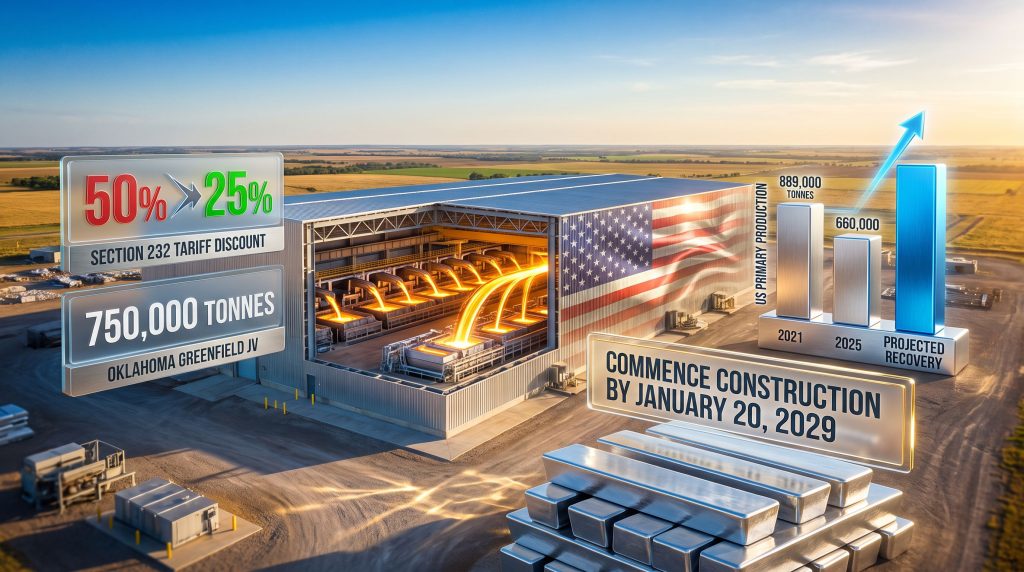
- Standard Section 232 tariff rate: 50%, elevated from 25% in June 2025 following the termination of all country exemptions
- Discounted rate for qualifying companies: 25%, applied to import volumes that match a company's approved domestic construction commitment
- Eligibility trigger: Submission and approval of a formal onshoring plan committing to build, expand, or refurbish a US primary aluminium smelter
- Construction deadline: Physical construction must commence by January 20, 2029
- Compliance enforcement: The Commerce Department retains authority to retroactively recover the tariff discount if a company fails to meet its stated commitments
This represents an important structural evolution in US trade policy thinking: rather than applying tariff protection uniformly to all market participants, the 2026 framework rewards only those who put capital at risk in domestic infrastructure. It is investment-conditioned trade policy, not blanket protectionism.
Why a Decade of Tariffs Produced a Declining Industry
The Numbers That Expose the Policy Gap
To understand why the Washington aluminium incentive programme takes the form it does, it is necessary to understand the full scale of the production decline that preceded it. The statistics are striking:
| Metric | Figure |
|---|---|
| US primary aluminium production (2025 estimate) | ~660,000 tonnes |
| US primary aluminium production (2021) | ~889,000 tonnes |
| Decline 2021 to 2025 | ~26% |
| Installed US smelting capacity | 1.31 million tonnes per year |
| Effective capacity utilisation | ~50% |
| Active primary smelters (2026) | 6 across 5 states |
| Active smelters in 2000 | 23 across 12 companies |
| US apparent aluminium consumption | ~5.7 million tonnes |
| Domestic primary production share of consumption | ~10 to 12% |
Two of the six active US smelter lines, at Hawesville, Kentucky and New Madrid, Missouri, have been offline since 2022 and 2024 respectively. The country's installed smelting capacity of 1.31 million tonnes per year is running at roughly half its potential, not because market demand is absent, but because full-capacity operation is economically unviable at prevailing US energy prices.
The Electricity Cost Chasm
Primary aluminium smelting is among the most electricity-intensive industrial processes in existence, with energy representing 30 to 40% of total production costs. Canadian smelters operating on Quebec hydropower access electricity at approximately USD 26.50 to 41 per megawatt-hour, while US industrial electricity rates in most regions sit materially higher.
This creates a structural cost disadvantage that no tariff schedule can fully neutralise. A company can be protected from import competition by a 50% tariff and still find that operating a US smelter at full capacity destroys value relative to importing metal and paying the tariff. That is the arithmetic that defeated every previous restart plan.
The scale of the power commitment required also deserves emphasis. A one-million-tonne smelter requires approximately one gigawatt of firm, continuous electrical power. Securing that volume of competitively priced electricity in the United States, without the benefit of dedicated hydroelectric infrastructure comparable to Quebec's, is a multi-year permitting and contracting challenge entirely separate from the trade policy environment. Furthermore, securing reliable aluminium power supply arrangements has proven to be one of the most persistent obstacles facing smelter operators globally.
Century Aluminum's Kentucky expansion project received a USD 500 million Department of Energy grant and still stalled on power contract negotiations before reaching the construction phase. That precedent illustrates precisely why the 2026 federal programme builds a 2029 construction commencement deadline into its structure rather than a production target with a shorter timeline.
The Projects Most Likely to Activate the Programme
Century Aluminum and Emirates Global Aluminium: The Oklahoma Centrepiece
The Washington aluminium incentive programme's investment-conditioned design appears architecturally suited to a specific project: a 750,000-tonne greenfield smelter announced in February 2026 as a joint venture between Century Aluminum and Emirates Global Aluminium, to be located in Inola, Oklahoma. If completed, this single facility would more than double current US primary aluminium output. Century has characterised it as the largest single capital investment ever made in the American aluminium sector.
Century has also separately restarted idled capacity at its Mt Holly facility in South Carolina, adding over 50,000 tonnes of annual production and lifting national primary output by approximately 10%.
Market Reactions and Stock Performance
Capital markets have begun pricing the policy's implications into producer equities with notable differentiation. Among the aluminium industry leaders, performance has diverged sharply based on each company's exposure to the incentive mechanism:
- Century Aluminum (CENX): Up approximately 11% year-to-date, reflecting direct exposure to the incentive mechanism
- Kaiser Aluminum (KALU): Up approximately 35%, benefiting from downstream positioning and tightening domestic supply
- Alcoa (AA): Down approximately 17%, reflecting greater exposure to tariff-inflated input costs relative to its production mix
The divergence in stock performance reflects an important industry distinction: companies with the infrastructure and balance sheet capacity to submit credible onshoring plans stand to benefit most directly, while those more reliant on imported inputs face margin compression from elevated tariff costs.
The Ceiling on What the Programme Can Deliver
Even under optimistic assumptions, the Aluminum Association estimates that restarting every currently idled US smelter would satisfy only 15 to 20% of current import volumes. The Oklahoma joint venture, if completed, would roughly double current primary output but still leave the United States structurally dependent on imported metal. Full programme success, across all approved onshoring plans, would likely still leave the US 40 to 50% import-dependent on primary aluminium for years to come.
| Scenario | Estimated Impact on Import Dependency |
|---|---|
| All idled smelters restarted | Covers 15 to 20% of current import volume |
| Oklahoma JV smelter completed (750,000 t) | Roughly doubles current primary output |
| Full programme success (all onshoring plans approved) | Still leaves US approximately 40 to 50% import-dependent |
Critical Minerals, Defence Supply Chains, and the Strategic Framing
Why Aluminium Reshoring Is a Security Argument, Not Just a Trade Argument
The July 2026 federal proclamation was accompanied by a separate executive order tightening Pentagon sourcing rules for critical minerals obtained from China, Russia, Iran, and North Korea. The linkage is deliberate. Aluminium alloys are foundational to armoured vehicles, naval vessels, aerospace platforms, and precision munitions, placing primary aluminium production within the same strategic supply chain framework as semiconductors and rare earth elements.
China's Critical Mineral Dominance and the Export Ban Dimension
China's position across aluminium-adjacent critical mineral supply chains amplifies the strategic urgency considerably:
| Critical Mineral | China's Estimated Global Share |
|---|---|
| Refined gallium | 94 to 99% |
| Germanium | Up to 83% |
| Antimony (mined) | ~50% |
A December 2024 Chinese export ban on gallium, germanium, and antimony to the United States, suspended under a fragile truce until November 27, 2026, was assessed by the USGS to carry a potential USD 3.4 billion economic impact if fully implemented. Washington is treating light metal reshoring and critical mineral security as a single integrated supply chain challenge. China's export restrictions on these materials explain why the aluminium incentive proclamation and the critical mineral executive order were signed simultaneously rather than treated as separate policy tracks.
The gallium-aluminium connection is more direct than it might appear. Gallium is a byproduct of aluminium refining, extracted during the Bayer process from bauxite. A domestic primary aluminium industry capable of recovering gallium as a co-product would meaningfully reduce US dependence on Chinese-controlled gallium supplies, estimated at 94 to 99% of global refined output. Indeed, gallium's strategic importance to semiconductor manufacturing and renewable energy systems makes this co-production potential a compelling dimension of the reshoring case.
Global Price Dynamics and the Canadian Supply Squeeze
Canada's Shrinking Role in US Aluminium Supply
Canada has historically dominated US aluminium import flows, supplying approximately 56% of US imports on average between 2021 and 2024. That share has declined sharply, falling from roughly 75% in 2024 to approximately 54% in Q1 2026, as Canadian producers including Rio Tinto redirected metal toward European buyers in response to the elevated US tariff environment. The United States is consequently becoming a less attractive destination for Canadian metal, which has material consequences for domestic supply tightness.
The Midwest Premium as a Real-Time Policy Indicator
The US Midwest premium, the surcharge American buyers pay above the London Metal Exchange benchmark price, functions as one of the most sensitive real-time indicators of domestic supply conditions:
| Metric | Value |
|---|---|
| US Midwest premium breach of USD 1 per pound | January 2026 |
| Peak Midwest premium (February 2026) | ~USD 2,182 per tonne |
| US all-in price premium versus global levels | ~70% above global benchmark |
| LME aluminium price range (through July 2026) | USD 3,100 to 3,150 per tonne |
| LME year-on-year price increase | ~21% |
The premium surge creates acute cost pressure for downstream American manufacturers, particularly in automotive, packaging, and aerospace applications, that have no near-term domestic supply alternative. These buyers are caught between tariff-elevated import costs and a domestic supply base that physically cannot meet their volume requirements.
China's Production Ceiling and Its Price Significance
China produced approximately 45.02 million tonnes of primary aluminium in 2025, representing around 61% of global output of 74 million tonnes, while operating under a domestic production policy cap of 45 million tonnes. Operating at near-ceiling capacity, China has minimal ability to increase primary aluminium output further. This structural constraint makes China's production decisions the single most powerful driver of global LME price direction, even though current tariff levels make China structurally irrelevant as a direct US import source.
The next major ASX story will hit our subscribers first
Assessing the Programme's Chances of Success
Four Structural Barriers That Have Defeated Previous Restart Efforts
The Washington aluminium incentive programme operates against a backdrop of failed restart attempts stretching back decades. Understanding the persistent barriers is essential to calibrating realistic expectations for the 2026 framework:
- Capital cost: Constructing a new primary aluminium smelter outside China costs up to USD 4 billion per million tonnes of annual capacity, requiring long-term certainty on both power pricing and metal prices before any rational investor will commit equity
- Power availability: A one-million-tonne smelter requires approximately one gigawatt of firm, continuous power, a procurement challenge that involves multi-year permitting and contracting timelines independent of any trade policy environment
- Permitting timelines: New industrial facilities of this scale require environmental review processes that routinely extend project timelines by years, even when federal interest in the project is clear
- Construction lead times: The programme's 2029 construction commencement deadline is itself a recognition that industrial build cycles operate on entirely different timescales than tariff announcement news cycles
The Recycling Sector's Growing Structural Importance
One aspect of the US aluminium supply picture that receives insufficient attention in trade policy discussions is the role of secondary production. The United States now produces approximately 3.6 million tonnes of recycled aluminium annually, which has become the functional backbone of domestic metal supply in the absence of adequate primary smelting capacity. Secondary aluminium production requires roughly 5% of the energy needed to produce primary metal, making it inherently less vulnerable to the electricity cost dynamics that constrain primary smelting.
The growth of the recycling sector is not a substitute for primary production in all applications. Defence-grade aluminium alloys, aerospace structural components, and certain specialised industrial applications require primary metal with specific compositional properties that recycled metal cannot consistently deliver at scale. This distinction underpins why Washington's policy framework specifically targets primary smelting capacity rather than treating aluminium supply as a homogeneous problem.
Internationally, however, comparable green transition incentives have shown that targeted subsidies can shift industrial trajectories. For instance, Australia's $2 billion green aluminium production credit scheme demonstrates how production-linked financial incentives can be structured to attract capital into energy-intensive smelting operations facing decarbonisation pressures.
The Washington aluminium incentive programme represents the most structurally sophisticated attempt yet to address domestic primary production decline. Whether it succeeds ultimately depends not on its policy design, which is genuinely innovative in conditioning tariff benefits on capital commitment, but on whether the United States can resolve the electricity pricing problem that has made domestic smelting economically marginal for two consecutive decades.
Frequently Asked Questions: Washington Aluminium Incentive Programme
Is Washington State's original aluminium incentive programme still active?
No. Washington State's aluminium-specific tax incentive framework, established in 2004, has had no active participants since 2021. All primary aluminium smelters in the state have permanently closed. The remaining state-level tax preferences are scheduled to expire on January 1, 2027, with no replacement legislation currently proposed.
What exactly is the 2026 federal Washington aluminium incentive programme?
It is a conditional tariff discount mechanism announced on July 20, 2026, offering qualifying companies a reduced Section 232 tariff rate of 25% rather than the standard 50% on primary aluminium imports, provided they submit an approved smelter construction, expansion, or refurbishment plan and commence physical construction before January 20, 2029.
Which companies are best positioned to benefit?
Century Aluminum and Alcoa, as the two dominant US primary aluminium producers with existing infrastructure, are the most immediate beneficiaries. The Oklahoma greenfield joint venture between Century Aluminum and Emirates Global Aluminium is the most significant near-term test case for the programme's ability to catalyse genuine capital commitment. Furthermore, reporting on aluminium smelting's broader industry contribution suggests that smelter investments of this scale carry significant downstream employment and supply chain multiplier effects.
Could aluminium smelting return to Washington State under the federal programme?
Potentially, given the state's hydroelectric resources remain a theoretical competitive advantage. However, no projects currently target Washington State, and the expiry of the state-level incentive framework in 2027 without replacement removes one layer of potential support for any such investment.
Disclaimer: This article contains forward-looking statements, projections, and market analysis intended for informational purposes only. Production figures, price data, and policy timelines are sourced from publicly available information including USGS Mineral Commodity Summaries and industry reporting current to July 2026. Readers should not rely on this content as financial or investment advice. Market conditions and policy frameworks can change materially and without notice.
Want to Catch the Next Major Mineral Discovery Before the Market Does?
Discovery Alert's proprietary Discovery IQ model scans ASX announcements in real time, instantly identifying high-potential mineral discoveries across 30-plus commodities and translating complex data into clear, actionable insights — explore historic discoveries and the returns they generated, then begin your 14-day free trial at Discovery Alert to position yourself ahead of the broader market.