
June 16, 2026
Underground Gold Mining's Quiet Value Driver: Why Extensional Drilling Defines Long-Term Returns
In underground gold mining, the most consequential value creation rarely happens at the processing plant or on the balance sheet. It happens in the geological dark, hundreds of metres below surface, when a drill bit intersects something that wasn't supposed to be there yet. For investors tracking high-grade Australian gold producers, understanding how mine life extension programs work, and what early drill results actually signal, is the difference between recognising a structural re-rating opportunity and dismissing it as routine operational news.
The Bellevue Gold Tribune South drilling success announced in June 2026 sits firmly in that first category. To appreciate why, it helps to understand the mechanics of extensional drilling within a producing underground mine, and why the sequencing of infrastructure development before exploration is far more significant than the headlines suggest.
When big ASX news breaks, our subscribers know first
The Geology Behind the Tribune Line of Lode
The Bellevue gold deposit sits within the Archaean-age greenstone belts of Western Australia's Eastern Goldfields, a geological province responsible for a disproportionate share of Australia's historical gold production. High-grade deposits in this setting typically occur along structurally controlled lode systems, where gold-bearing hydrothermal fluids migrated along fault zones and deposited mineralisation in dilational jogs, breccia zones, and contact boundaries.
The Tribune line of lode at the Bellevue mine is consistent with this structural archetype. Its historical intersections reflect the kind of high-grade, narrow-vein character common to Eastern Goldfields deposits, where intervals such as 10 metres at 15.4 grams per tonne (g/t) gold, 2.4 metres at 46.2 g/t gold, and 1 metre at 39.1 g/t gold have been recorded in prior grade control drilling. Furthermore, these exploration drill results underscore the structural richness of the Tribune corridor.
Note: The above intervals reflect previously reported Tribune area grade control drilling results included for geological context. Past drill results are not a guarantee of future mineralisation continuity.
What makes the Tribune South extension geologically compelling is the structural persistence argument. Lode systems in Archaean greenstone terranes do not simply terminate at arbitrary depth. They plunge, rotate, or bifurcate, but they rarely vanish. The working thesis for Tribune South is that the same structural controls governing mineralisation in the established reserve continue southward at depth, and the first three drill holes have returned visible gold to support that hypothesis.
Why Visible Gold in Underground Drill Core Matters More Than Many Investors Realise
Visible gold — gold that can be seen with the naked eye in drill core — is not a common occurrence even in high-grade deposits. Most gold mineralisation at economically significant grades is invisible at the hand specimen scale, occurring as micron-scale grains within pyrite or quartz veining. When visible gold appears in core, it typically indicates one or more of the following:
- Locally elevated grades that may significantly exceed the broader mineralised interval average
- Structural complexity consistent with high-grade ore shoots, which often represent the most economically significant portions of a lode system
- Coarse free gold, which processes efficiently through conventional carbon-in-leach circuits used at operations like Bellevue
The fact that three of the first holes drilled from underground into the Tribune South target encountered visible gold is statistically significant for a first drill series. It suggests the mineralising system is active in this southern corridor and that the geological model underpinning the program was sufficiently accurate to target the right structures from the outset. Interpreting drill results correctly at this early stage is, however, critical to forming a measured view.
Formal assay results remain pending, and investors should treat visible gold observations as geological encouragement rather than confirmed grade. Laboratory fire assay results, particularly for coarse gold, can vary considerably from visual estimates due to the nugget effect — a well-documented sampling phenomenon where coarse gold particles cause high variability between adjacent samples.
The Southern Belle Decline: Infrastructure as Exploration Enabler
One of the least appreciated dynamics in underground gold mining is the relationship between development capital and exploration optionality. Surface diamond drilling can test geological targets, but it is fundamentally limited in its ability to test southern and down-plunge extensions of steep or moderately plunging ore bodies. Underground drilling from within the mine footprint dramatically improves drill hole orientation, reduces drill hole length to target, and allows tighter spacing between intercepts.
The Southern Belle Decline achieves three distinct strategic objectives simultaneously:
- Second independent mine access: Provides operational redundancy, reducing the single-point-of-failure risk that characterises mines with only one portal or main decline
- Dewatering access: Enables systematic dewatering of historically flooded southern zones, unlocking ore bodies that were physically inaccessible despite being geologically understood
- Underground drill platform establishment: Creates the physical infrastructure from which extensional and exploration drilling can be conducted toward Tribune South and adjacent targets
This third function is the exploration enabler that makes the Tribune South program possible. Without the Southern Belle Decline progressing to sufficient depth and southern extent, the first drill holes targeting Tribune South simply could not have been drilled from underground. The capital invested in the decline is therefore not purely a mining infrastructure cost; it is simultaneously an exploration investment that has now begun to generate geological returns.
Grade Reconciliation: What a 3.7% Grade Outperformance Tells Geological Modellers
Before extensional drilling commenced, Bellevue conducted a focused grade control drilling phase across the Tribune corridor. The results of that program demonstrated a 3.7% increase in grade relative to the original resource model, alongside a 2.2% reduction in tonnes. This reconciliation outcome deserves careful interpretation.
In underground gold mining, resource models are constructed from exploration drill holes typically spaced tens of metres apart. Grade control drilling, conducted at much tighter spacing ahead of mining, provides the high-resolution data needed to accurately define ore boundaries and optimise blast design. When grade control results exceed the resource model grade while slightly reducing estimated tonnes, it typically indicates that:
- The resource model was constructed conservatively, using lower interpolation confidence in areas of wider drill spacing
- The high-grade core of the ore body is tighter than the broader mineralised envelope captured in the resource model
- Mining selectivity can be improved, extracting higher-value material with better dilution control
A geological model that is conservatively calibrated on grade is generally preferable to one that overpromises and underdelivers. For Tribune South, the implication is that the structural and grade model guiding extensional drilling is likely to be similarly conservative, making the visible gold results in the first drill series a more credible early signal.
Consequently, understanding true vs apparent widths in these intercepts will be an important step once formal assay data becomes available, as it directly affects how investors and geological modellers assess the economic significance of each intersection.
Production Performance and the Path to FY26 Guidance Midpoint
Against the operational backdrop of Tribune South drilling, Bellevue Gold's production metrics for FY26 demonstrate the stability that makes exploration investment viable. The five established mining zones — Deacon, Deacon North, Marceline, Viago, and Tribune — are now all operational and collectively contributing to a run-rate of approximately 40,000 ounces per quarter.
| Metric | Value |
|---|---|
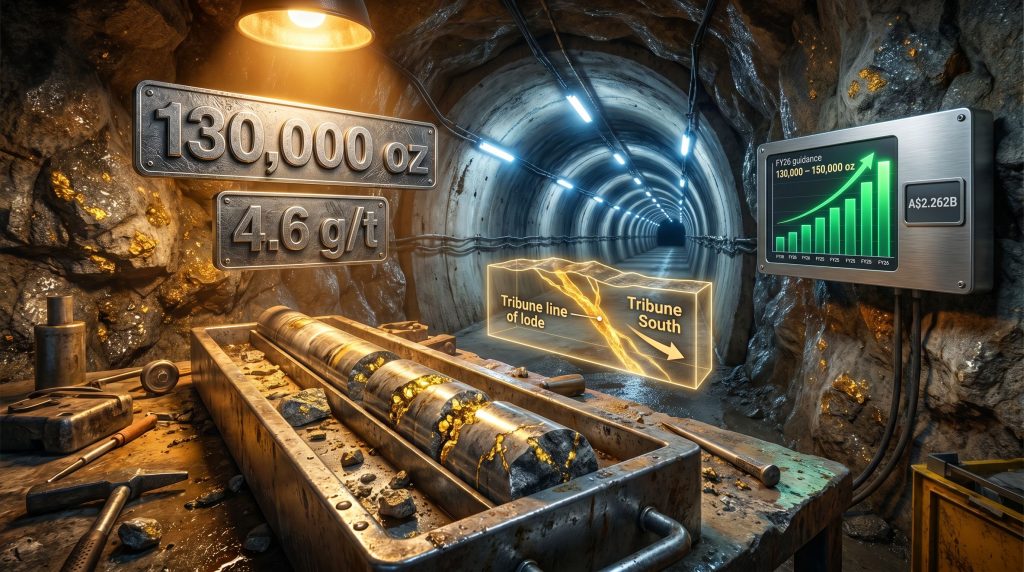
| 11-Month Cumulative Production (to May 31, 2026) | 130,000 oz |
| FY26 Annual Guidance Range | 130,000 to 150,000 oz |
| April and May 2026 Combined Output | 28,100 oz |
| Estimated Head Grade (April and May) | 4.6 g/t |
| Growth and Exploration CapEx (11 months to May 31) | $96 million |
| Full-Year CapEx Guidance | $105M to $115M |
| Market Capitalisation (as at June 16, 2026) | A$2.262 billion |
With eleven months of production already matching the lower boundary of full-year guidance, the company's trajectory positions it toward the midpoint or potentially above the guidance range with one month remaining in FY26. The April and May head grade of 4.6 g/t is particularly noteworthy, as it represents the ore quality necessary to sustain throughput economics at the processing plant while managing unit costs. According to Bellevue's grade control drilling results, this level of grade performance is consistent with the broader pattern of the Tribune corridor outperforming conservative resource estimates.
The next major ASX story will hit our subscribers first
Cost Discipline in a Rising Royalty Environment
Western Australian gold producers pay a royalty calculated as a percentage of gross revenue to the state government. As spot gold prices have risen materially through FY26, the royalty cost per ounce has increased proportionally, creating a structural cost headwind that is invisible to producers operating in fixed-royalty or royalty-free jurisdictions. Bellevue's ability to maintain AISC guidance of A$2,600 to A$2,900 per ounce despite this dynamic reflects disciplined management of the controllable cost base.
The company's renewable energy integration strategy has emerged as a structurally significant advantage in this context. Diesel costs in remote Western Australian mining operations are not simply a fuel expense; they encompass logistics, storage, generator maintenance, and backup capacity. Reducing direct diesel exposure lowers both the absolute cost and the sensitivity of the cost base to oil price fluctuations, providing a partial natural hedge against one of underground mining's most variable operating inputs.
Paste Plant Construction: The Operational Upgrade Enabling Deeper Mining
The paste plant currently under construction at Bellevue represents one of the most operationally transformative capital projects in the company's FY26 program. Paste fill technology works by combining mill tailings with cement and water to create a flowable, self-setting backfill material that is pumped underground to fill mined-out stopes.
The operational significance of this technology in the context of Tribune South is direct:
- Ground stability at depth: As mining progresses southward and deeper with Tribune South, geotechnical complexity increases. Paste fill stabilises adjacent rock masses, reducing the risk of stope failure and enabling more aggressive extraction geometries
- Extraction rate improvement: Cemented paste fill provides a competent wall against which adjacent stopes can be blasted, improving ore recovery and reducing dilution
- Tailings management: Paste fill reduces surface tailings storage requirements by redirecting waste underground, improving the environmental footprint of the operation
The paste plant's scheduled completion positions Bellevue to extract maximum value from any Tribune South ore body that is delineated through the ongoing extensional drilling program.
Hedge Book Strategy and the Mining Contractor Transition Risk
Bellevue's continued pre-delivery into its hedge book during FY26 serves a dual purpose that becomes clearer when viewed against the September quarter 2026 mining contractor transition. Transitioning underground mining contractors is one of the highest-risk operational events a producing mine can undertake. Productivity typically declines during the handover period as new crews familiarise themselves with the ground conditions, equipment, and operational procedures specific to the mine.
By pre-delivering ounces into the hedge book at fixed prices ahead of this transition, Bellevue reduces the revenue impact of any temporary production shortfall during the changeover period. This is a sophisticated application of financial risk management that directly supports operational continuity, and it reflects the kind of integrated mine management thinking that institutional investors typically assign a premium to in underground gold producers.
Key Catalysts Shaping the Tribune South Investment Narrative
For investors and analysts monitoring the Bellevue Gold Tribune South drilling success as part of a broader investment thesis, the following catalysts represent the most material near-term information events:
- Laboratory assay results from the three visible gold intersections in the initial Tribune South drill series, which will convert geological observations into grade data suitable for resource modelling
- Additional drill series from the southern drill drive as the Southern Belle Decline continues to advance, expanding the number of drill platforms available to test the southern corridor
- FY27 exploration guidance detailing the budget and drilling metres allocated to the Tribune South program and adjacent southern targets
- Resource model updates that incorporate Tribune South intercepts alongside existing resource data to quantify the potential extension to ore reserve inventory
- September quarter 2026 mining contractor transition outcomes, which will indicate whether the operational handover has been managed without material disruption to the quarterly production run-rate
In addition, a definitive feasibility study review may ultimately be required if Tribune South intercepts are sufficiently compelling to warrant a formal revision of the mine plan and life-of-mine economics.
This article contains forward-looking analysis and references to exploration results that are subject to significant uncertainty. Visible gold observations are not a substitute for laboratory assay results. Readers should consult a licensed financial adviser before making investment decisions based on exploration-stage information.
The Multi-Year Southern Corridor Thesis
The Bellevue Gold Tribune South drilling success is best understood not as a single drill result but as the opening move in what management has flagged as a multi-year southern corridor exploration campaign. The Southern Belle Decline, the paste plant investment, the five-zone production platform, and the disciplined cost management framework collectively create the conditions under which resource growth through extensional drilling becomes both financially sustainable and geologically credible.
The historical performance of the Tribune corridor, the conservative reconciliation of the resource model, and the structural geology of the Eastern Goldfields lode system all support the thesis that mineralisation does not terminate at the current ore reserve boundary. The first three drill holes have provided early empirical evidence consistent with that thesis. Proper drill results interpretation of the pending assays will be the next critical step in determining the true scale of the southern extension. What follows in the assay laboratory and in the southern drill drive over the coming quarters will determine whether Tribune South becomes a mine life extension story or remains an exploration target.
For a producer operating at A$2.262 billion market capitalisation with an established five-zone production base and disciplined capital allocation, the ability to organically grow its resource inventory through underground extensional drilling represents a lower-risk, higher-confidence pathway to value creation than greenfields exploration. Furthermore, Bellevue's 2024 Diggers and Dealers presentation outlined the strategic rationale behind this approach in considerable detail, underscoring that the Tribune South program is the natural continuation of a long-held management conviction. That distinction is precisely what makes the Tribune South program worth watching closely.
Ready to Position Yourself Ahead of the Next Major ASX Gold Discovery?
Discovery Alert's proprietary Discovery IQ model delivers real-time alerts the moment significant mineral discoveries hit the ASX, transforming complex geological data into actionable investment insights for both short-term traders and long-term investors. Explore how major discoveries have historically generated substantial returns on Discovery Alert's dedicated discoveries page, and begin your 14-day free trial today to ensure you're never the last to know.