June 16, 2026
When Peace Becomes a Catalyst: Understanding Gold's Paradox in a De-escalating World
There is a common assumption among retail investors that gold thrives exclusively on chaos. War, instability, and systemic fear are typically cited as the fuel behind precious metals rallies. Yet history consistently reveals a more complex picture: gold does not simply react to conflict — it prices in the full architecture of macro risk, including inflation trajectories, currency valuations, and interest rate expectations. When geopolitical de-escalation dismantles multiple layers of that risk architecture simultaneously, the resulting price movements can be sharp, swift, and counterintuitive.
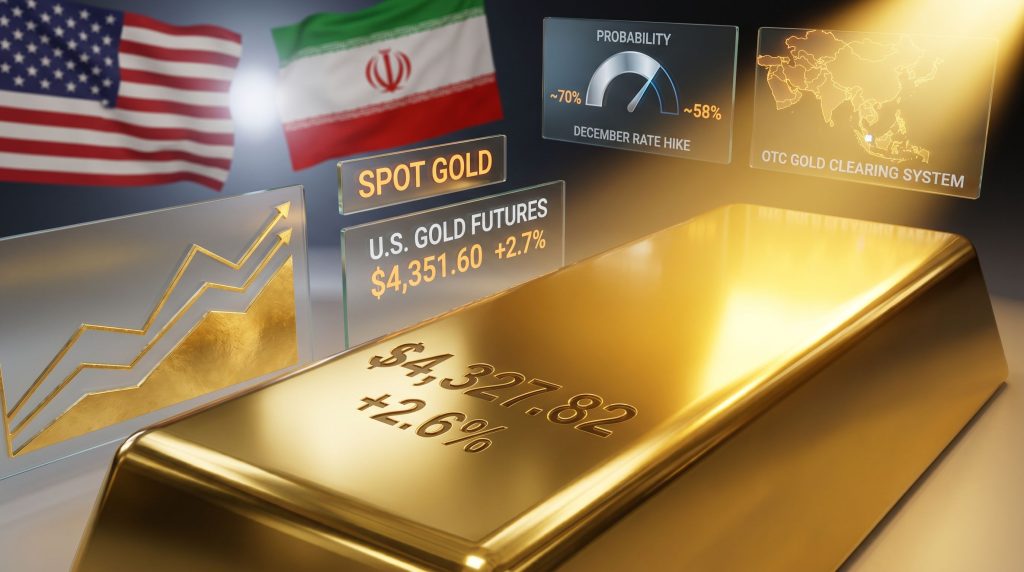
This dynamic played out in compelling fashion as gold rises when Iran and U.S. agree to halt war, triggering a third consecutive session of gains and pushing spot prices to levels not seen since earlier in June 2026. Furthermore, understanding the gold price forecast context helps explain why this move carried such weight among institutional traders.
When big ASX news breaks, our subscribers know first
The Multi-Lever Framework Behind Gold's Rally
Understanding why gold surged requires looking beyond the peace agreement itself. A ceasefire announcement does not, in isolation, move precious metals markets in a predictable direction. What makes this particular event significant is that it affected three of the most powerful cross-asset variables for gold pricing at the same time.
The three primary transmission mechanisms were:
- Energy prices: The conflict had sustained elevated oil prices, keeping inflation expectations high and compressing the window for any Federal Reserve pivot toward rate cuts.
- Treasury yields: As inflation risk receded with the ceasefire news, traders reassessed the likelihood of continued rate hikes, compressing yields on U.S. government bonds.
- U.S. dollar: The dollar index fell 0.2% in the session, a modest but meaningful move that reduces the effective cost of gold for buyers using other currencies, thereby stimulating international demand.
Philip Streible, chief market strategist at Blue Line Futures, noted that the peace agreement effectively caused markets to price out the conflict's inflationary risk, with Treasury yields, the dollar, and oil all moving in a direction that was simultaneously favourable for bullion. When these three variables shift in alignment, technically significant rallies often follow. In addition, the relationship between gold and bonds dynamics helps explain how yield compression feeds directly into bullion demand.
Breaking Down the Price Action: A Session-by-Session View
The market response was immediate and substantial. Rather than waiting for the formal Geneva ratification ceremony, traders responded to the announcement of a signed memorandum of understanding — a behavioural pattern consistent with how financial markets have historically front-run diplomatic confirmations.
| Metric | Value |
|---|---|
| Spot Gold Price | $4,327.82 per ounce |
| Session Gain (Spot) | +2.6% |
| U.S. Gold Futures Settlement | $4,351.60 |
| Futures Session Gain | +2.7% |
| Consecutive Sessions of Gains | 3 |
| U.S. Dollar Index Movement | -0.2% |
| Highest Level Since | June 5, 2026 |
The agreement was signed by senior U.S. officials including the President and Vice President, along with the speaker of Iran's parliament. Reports from both sides had previously suggested a formal ceremony would follow in Geneva. Markets, characteristically, did not wait for the ceremony.
This pattern of markets responding to announcements rather than formal ratifications is well-documented across geopolitical events. The premium attached to uncertainty is priced out the moment credible confirmation arrives, regardless of whether ink has dried on a final treaty document.
According to reporting from Kitco, gold prices jumped 2% in the immediate aftermath of initial ceasefire signals, a move that set the stage for the broader rally that followed as confirmation came through official channels.
How War-Driven Inflation Premiums Distort Gold Pricing
One of the least discussed dynamics in commodities markets is how conflict-era inflation expectations create artificial upward pressure on interest rate forecasts, which in turn act as a headwind for gold. This mechanism works as follows:
- Armed conflict disrupts energy supply chains, elevating oil prices.
- Higher energy costs flow through into broader consumer price indices, lifting headline inflation.
- Central banks, particularly the Federal Reserve, interpret sustained inflation as a reason to maintain or increase borrowing costs.
- Elevated rate expectations strengthen the U.S. dollar and lift Treasury yields, both of which reduce the relative attractiveness of non-yielding gold.
- When conflict ends and energy prices recede, this entire chain reverses, potentially more quickly than it formed.
This is why gold can rally on peace news. It is not that investors are abandoning gold safe-haven dynamics. Rather, the removal of conflict-linked inflation risk is equivalent to removing a structural headwind that had been suppressing gold's natural buoyancy in a high-debt, dollar-saturated macro environment.
Federal Reserve Rate Expectations: The Probability Shift That Moved Markets
One of the most quantitatively meaningful aspects of the post-ceasefire session was the repricing of Federal Reserve rate hike probabilities. According to CME FedWatch data, the probability of a U.S. rate hike in December shifted materially within a single trading session.
| Scenario | December Rate Hike Probability |
|---|---|
| Prior Week (During Conflict) | ~70% |
| Post-Ceasefire Announcement | ~58% |
| Net Shift | -12 percentage points |
A 12-percentage-point swing in rate hike probability is not a trivial adjustment. For non-yielding assets like gold, where the opportunity cost of holding bullion relative to interest-bearing instruments is a primary valuation driver, this shift translated directly into buying pressure.
The mechanics are straightforward: when the probability of higher rates falls, the expected future yield advantage of bonds and cash diminishes. Investors recalibrate their portfolio allocation, and gold, which carries no coupon or dividend, becomes more competitive as a store of value.
Chair Kevin Warsh and the June 2026 FOMC Meeting
With the ceasefire providing an immediate tailwind, market attention pivoted rapidly toward the Federal Reserve's June 16–17 policy meeting. This particular FOMC gathering carries additional weight as the first chaired by Kevin Warsh, whose communication style and policy philosophy are still being calibrated by market participants.
Streible from Blue Line Futures framed the near-term outlook succinctly: the next directional move for gold will be determined largely by Warsh's tone and whatever forward guidance he provides on the interest rate path.
Three scenarios are plausible depending on the Fed's stance:
- Dovish pivot signal: If Warsh indicates that the Fed sees sufficient grounds to consider rate reductions, gold could extend its rally meaningfully, with price targets above $4,500 per ounce becoming technically feasible.
- Neutral hold with measured language: A steady-as-she-goes approach would likely see gold consolidate near current levels as markets price in a prolonged pause rather than a directional catalyst.
- Hawkish surprise: Should Warsh signal renewed concern about inflation persistence or indicate that rate hikes remain on the table, the recent gains could partially reverse, with technical support levels near $4,200 coming into view.
The next major ASX story will hit our subscribers first
Is This Rally Structural or Sentiment-Driven?
A critical distinction that sophisticated investors must draw is whether the current gold move represents a genuine re-rating of bullion's fundamental value, or simply the mechanical unwinding of a geopolitical risk premium.
The weight of market commentary leans toward the latter interpretation. The conflict with Iran had embedded specific and quantifiable risks into energy, inflation, and rate markets. As those risks dissipate, the associated premium dissipates with them. This is not inherently a signal of new structural demand for gold.
Investors who conflate a risk-premium unwind with a fundamental re-rating of gold's long-term value may be positioning incorrectly. Distinguishing between sentiment-driven price moves and demand-side structural shifts is essential for managing precious metals exposure with precision.
Historical precedents offer instructive context. After the resolution of the Gulf War in 1991, gold experienced a brief post-conflict rebound before entering a prolonged multi-year bear market. Conversely, after the 2008 financial crisis, gold's rally was structural because it was driven by quantitative easing, negative real rates, and a fundamental shift in central bank gold demand. The current environment more closely resembles the former pattern, though with important nuances given unprecedented global debt levels and ongoing de-dollarisation trends.
Singapore's Gold Infrastructure: A Structural Demand Signal Worth Watching
Separate from the ceasefire dynamics, a structurally significant development emerged from Singapore. The city-state's deputy prime minister announced plans to establish an over-the-counter gold clearing system alongside central bank gold-vaulting services.
This development deserves more attention than it typically receives in daily market coverage. Here is why it matters:
- Institutional liquidity: An OTC clearing mechanism in Singapore would significantly reduce settlement risk for large institutional gold trades in the Asian time zone, potentially attracting volume currently routed through London or Zurich.
- Central bank participation: Gold-vaulting services tailored for central banks signal that Singapore is positioning itself to capture flows from Asian and Middle Eastern reserve managers actively diversifying away from dollar-denominated assets.
- Price floor mechanism: Greater institutional infrastructure in Asia does not create artificial price support, but it does deepen the demand base that provides natural buying at pullback levels.
This development operates on an entirely different timeline from geopolitical events. Where ceasefire news moves gold in hours, infrastructure like this shifts the long-term demand architecture over years. Investors focused only on near-term catalysts risk overlooking this more durable tailwind.
Cross-Metal Performance: Why Gold Led the Session
How Did Silver and Platinum Compare?
Not all precious metals responded equally to the ceasefire announcement. Gold's 2.6% single-session gain notably outpaced moves in silver and platinum — a divergence that reflects the specific nature of the risk being unwound. Consequently, understanding gold and silver markets in parallel reveals important distinctions in how each metal absorbs macro signals.
Silver and platinum carry meaningful industrial demand components. Silver is heavily tied to solar panel manufacturing and electronics, while platinum is deeply linked to automotive catalytic converter demand. Neither metal's pricing is as directly connected to inflation expectations and Treasury yield dynamics as gold.
As a result, when a geopolitically-driven inflation risk premium is removed from the market, gold responds more acutely because that premium was more specifically embedded in gold's price in the first place. Options market positioning during the session provided additional signals, with elevated put activity suggesting some traders had anticipated downside risk — meaning the surprise strength of the ceasefire announcement forced a degree of short-covering that amplified the upward move. Forbes also reported that both gold and silver hit three-week highs following the ceasefire agreement, however the divergence in magnitude remained telling.
FAQ: Gold Prices, the Iran-U.S. Ceasefire, and What Comes Next
Why Did Gold Rise When a Peace Deal Was Announced?
The conflict had inflated energy costs and lifted inflation expectations, driving Treasury yields and the dollar higher. These factors suppressed gold. When the ceasefire was confirmed, those pressures reversed simultaneously, releasing gold's upward potential.
What Is the Current Gold Price Following the Iran-U.S. Agreement?
Spot gold traded at $4,327.82 per ounce, a gain of 2.6% in a single session representing the highest price since June 5, 2026, and a third consecutive day of gains.
How Did the Peace Deal Affect Federal Reserve Rate Expectations?
CME FedWatch data showed December rate hike probability falling from approximately 70% to 58%, a shift of 12 percentage points that directly reduced headwinds for non-yielding assets like gold.
What Should Gold Investors Watch at the June 2026 Fed Meeting?
Kevin Warsh's tone and forward guidance at his first FOMC meeting as Chair will be the primary near-term price driver. Markets will be particularly attentive to any language around the future interest rate path.
What Is Singapore's New Gold Clearing System and Why Does It Matter?
Singapore announced plans to establish an OTC gold clearing mechanism and central bank vaulting services, positioning it as a major institutional gold hub in Asia. This represents a long-term structural demand signal independent of near-term geopolitical events.
Can Gold Continue Rising if Geopolitical Risks Are Reduced?
Potentially yes, particularly if the Federal Reserve adopts a more accommodative tone in response to reduced energy-driven inflation. However, if the conflict risk premium was the primary driver of recent strength, some consolidation near current levels remains a plausible outcome.
What This Moment Tells Us About Gold's Role in Modern Portfolios
The interplay between gold rises as Iran and U.S. agree to halt war and broader market dynamics offers a masterclass in how precious metals pricing actually functions in the contemporary macro environment. Gold is not a single-variable instrument — it is a multi-dimensional hedge that simultaneously absorbs signals from currency markets, interest rate expectations, energy prices, and institutional demand flows.
For investors navigating the second half of 2026, the key variables to monitor include:
- The Federal Reserve's evolving stance on rates
- The sustainability of lower energy prices following the ceasefire
- The pace of institutional adoption in Asian markets following Singapore's infrastructure announcement
- Whether dollar weakness deepens or reverses as the post-conflict economic picture clarifies
This article is intended for informational purposes only and does not constitute financial advice. Gold markets are subject to significant volatility and past performance is not indicative of future results. Investors should conduct independent research or consult a qualified financial adviser before making investment decisions.
Want to Know Which ASX Gold Discoveries Could Be Positioned for the Next Major Move?
Discovery Alert's proprietary Discovery IQ model delivers real-time alerts on significant ASX mineral discoveries, instantly transforming complex data across 30+ commodities into clear, actionable insights for investors at every level — start your 14-day free trial at Discovery Alert today, or explore how historic mineral discoveries have generated substantial returns to understand the full opportunity ahead.