
June 16, 2026
The Monetary Metal at a Crossroads: Understanding the Gold vs Dollar Debate
Monetary history rarely announces its turning points with fanfare. The transitions that reshape how the world stores value, settles trade, and denominates debt tend to unfold gradually, then suddenly. The Roman denarius lost its silver content over generations. The British pound surrendered reserve currency status across decades of post-war adjustment. Today, a structurally similar process appears to be playing out in slow motion around the world's most scrutinised financial relationship: gold vs the dollar.
Understanding this contest requires more than tracking a price chart. It demands an honest reckoning with fiscal mathematics, geopolitical incentives, market structure, and the psychology of institutions managing trillions in sovereign wealth. What follows is a multi-layered examination of the forces shaping this monetary race, and what they may mean for long-term investors.
When big ASX news breaks, our subscribers know first
Understanding the Inverse Relationship Between Gold and the U.S. Dollar
How Gold Pricing in USD Creates a Natural Tension
Because gold is priced globally in U.S. dollars, any shift in the dollar's purchasing power directly affects the metal's quoted price. A stronger dollar makes gold more expensive in foreign currencies, suppressing international demand and exerting downward pressure on price. Conversely, a weakening dollar reduces the effective cost of gold for buyers operating in other currencies, typically stimulating demand and pushing the price higher.
This inverse dynamic forms the baseline of the gold vs dollar framework that most market participants learn first. However, treating it as a fixed rule introduces significant analytical risk.
Why This Inverse Correlation Is Not an Ironclad Rule
Several forces can override the standard inverse relationship entirely:
- Central bank demand operates independently of short-term currency movements, creating structural buying pressure regardless of dollar strength
- Geopolitical shock events often drive simultaneous safe-haven flows into both gold and the dollar, temporarily suspending the inverse correlation
- Real interest rate dynamics can dominate price action, with falling real rates supporting gold even when nominal dollar strength persists
- Inflation expectations can cause gold to rise in dollar terms even as the dollar itself holds nominal value against other currencies
The gold vs dollar relationship serves as a useful starting framework but becomes increasingly unreliable during periods of systemic stress, when the very foundations of the monetary system come into question.
When Gold and the Dollar Rise Together: Safe-Haven Convergence Explained
During acute geopolitical crises or financial market dislocations, investors often crowd into both assets simultaneously. This reflects a short-term flight to perceived safety rather than a structural endorsement of either asset. The key distinction is duration: safe-haven convergence tends to be temporary, while structural monetary shifts are generational.
What Actually Drives Gold Prices Beyond the Dollar?
Real Interest Rates: The Hidden Variable Most Investors Overlook
The single most reliable driver of gold price behaviour across long cycles is the real interest rate environment, specifically the difference between nominal yields and inflation expectations. When real rates turn negative, the opportunity cost of holding non-yielding gold disappears, making the metal comparatively attractive. Conversely, sharply rising real rates historically represent gold's most consistent headwind.
This relationship explains why gold can rise during periods of nominal dollar strength if inflation is simultaneously outpacing Treasury yields, a dynamic that played out visibly during the post-2020 inflation cycle.
Central Bank Accumulation: A Structural Demand Shift
Perhaps the most consequential development in modern gold markets is the scale and consistency of central bank gold demand. This is not opportunistic trading. It represents a deliberate, multi-year reallocation of sovereign reserves away from U.S. Treasuries and toward physical gold.
Summary Table: Key Drivers of Gold Price Movement
| Driver | Impact on Gold | Relationship to USD |
|---|---|---|
| Rising real interest rates | Bearish | Typically USD-positive |
| Falling purchasing power | Bullish | USD-negative signal |
| Geopolitical instability | Bullish | Can be USD-neutral or positive |
| Central bank gold buying | Structurally bullish | Diverges from USD correlation |
| Stablecoin / digital dollar expansion | Uncertain | Intended to be USD-supportive |
The Case for the U.S. Dollar's Long-Term Dominance
The Architecture of Dollar Supremacy: Petrodollar, SWIFT, and Eurodollar Demand
The dollar's dominance is not accidental. It is the product of interlocking institutional frameworks built over eight decades. The petrodollar system, which linked global oil transactions to USD settlement, created an enormous and persistent global demand for American currency that had nothing to do with U.S. domestic economic performance. The SWIFT payments network further embedded dollar usage into the plumbing of international commerce.
These structural advantages represent genuine and substantial moats around dollar demand, and any serious analysis of the gold vs dollar question must acknowledge them honestly.
The Digital Dollar Thesis: Can Stablecoins Reinvent Reserve Currency Demand?
Proponents of sustained dollar dominance point to the emergence of U.S.-dollar-denominated stablecoins as a potential demand renaissance. The argument holds that just as the global oil market created a vast absorption mechanism for USD liquidity across the 20th century, a network of digital dollar instruments issued by major corporations and financial institutions could perform a similar function in the digital economy.
Legislative frameworks in the United States are actively seeking to formalise and expand the stablecoin ecosystem, positioning digital dollar infrastructure as a tool for extending reserve currency relevance into new digital commerce channels. Whether this thesis proves correct depends on whether global users adopt USD stablecoins at scale, something that remains an open empirical question rather than a certainty.
Historical Precedent for Reserve Currency Resilience
No reserve currency in history has lasted indefinitely. The Spanish real, Dutch guilder, and British pound each commanded global monetary dominance before ceding it through a combination of fiscal overextension, military overspend, and the rise of a more economically dynamic competitor. The dollar's defenders argue that its institutional depth, legal infrastructure, and network effects make it categorically different from these historical precedents. Critics counter that this logic has been applied to every failing reserve currency at the moment of its peak.
The Case for Gold as the Superior Long-Term Store of Value
What History Reveals About Fiat Currency Longevity
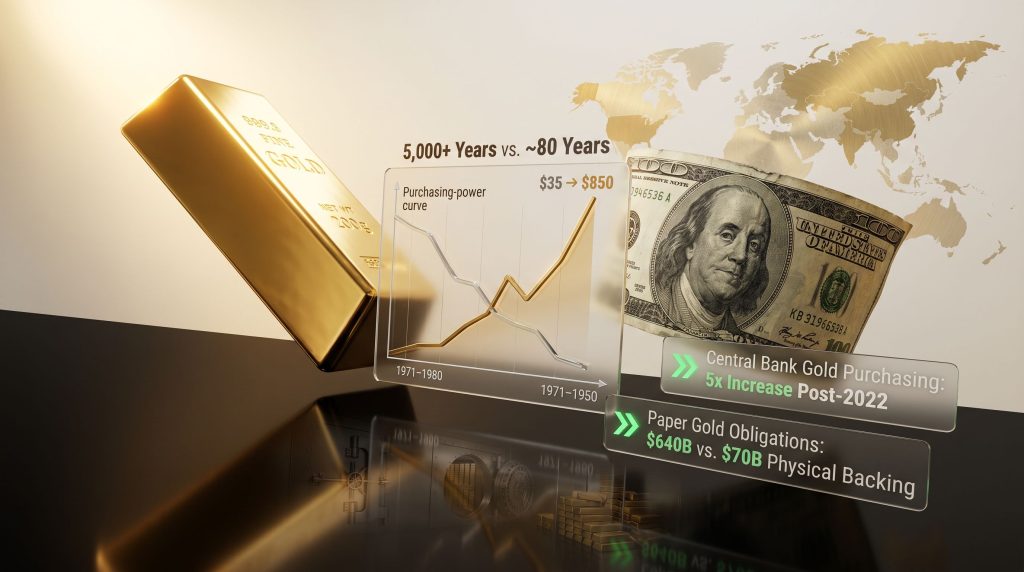
Across five thousand years of recorded monetary history, gold has maintained purchasing power through the collapse of every major fiat monetary system it has outlived. The U.S. dollar, in its current fully fiat form, has existed for roughly 55 years since the Nixon administration severed the Bretton Woods gold link in 1971 — furthermore, understanding the end of the gold standard helps contextualise just how brief this experiment has been. The contrast in time horizons alone is analytically significant.
The Debt-to-GDP Problem: Why Fiscal Math Undermines Dollar Confidence
The structural fiscal position of the United States presents a challenge that dollar optimists have not yet answered with credible arithmetic:
- U.S. federal spending has been running approximately $7 trillion annually against roughly $5 trillion in revenues
- Debt-to-GDP ratios exceeding 125% have historically constrained real economic growth, according to classical economic theory
- Economist Ray Dalio's framework identifies structural fiscal imbalances of this magnitude as a leading indicator of reserve currency deterioration
- Economic philosophers from David Hume to Ludwig von Mises have each argued that sustained debt accumulation at this scale eventually produces outcomes that deficit spending cannot outrun
The 1971–1980 Bull Market as a Historical Stress Test
Between 1971 and 1980, gold appreciated from approximately $35 per ounce to $850, representing a gain exceeding 2,300%. Critically, a significant mid-cycle correction in 1975 shook out a substantial cohort of investors before the bull market resumed its full trajectory. This historical episode illustrates how violent price volatility within a secular uptrend can obscure long-term directional strength and test even well-informed conviction.
The 1975 correction is worth examining closely because its psychological signature closely resembles conditions that periodically resurface in any prolonged gold bull market. Investors who held through that correction captured the majority of the cycle's gains. Those who interpreted the drawdown as the end of the trend did not.
How Central Banks Are Voting With Their Reserves
The Global Pivot: From U.S. Treasuries to Physical Gold
The most revealing signal in the contemporary gold vs dollar debate comes not from retail sentiment surveys or Wall Street strategy notes, but from the reserve management decisions of sovereign institutions. The data tells an unambiguous directional story:
- Global central banks began net-selling U.S. Treasuries and net-buying physical gold as early as 2014
- Following the U.S. decision to leverage dollar-denominated financial infrastructure as a geopolitical tool in 2022, central bank gold purchasing accelerated by an estimated 5x
- For the first time in modern financial history, central banks collectively hold more physical gold than U.S. Treasuries
In addition, monitoring central bank gold reserves over time makes the directional intent of sovereign institutions unmistakably clear.
Central Bank Reserve Shift: Illustrative Timeline
| Period | Dominant Reserve Behaviour | Gold Trend |
|---|---|---|
| Pre-2014 | Net UST accumulation | Modest central bank buying |
| 2014–2021 | Incremental UST reduction | Gradual gold accumulation |
| 2022–Present | Accelerated UST offloading | Exponential gold purchasing (estimated 5x increase) |
Why the 2022 Dollar Weaponisation Was a Structural Inflection Point
When the United States froze Russian sovereign reserves denominated in dollars following the 2022 Ukraine conflict, it transmitted an unmistakable message to every nation holding significant USD assets: dollar-denominated reserves are subject to political seizure under conditions defined unilaterally by Washington. The consequent acceleration in central bank gold buying reflects a rational institutional response to counterparty risk that previously seemed theoretical.
China's Long-Game: Treasury Reduction and Gold Accumulation
China's approach to reserve management over the past decade represents one of the most strategically patient capital allocation exercises in modern financial history. Having once held over $1.3 trillion in U.S. Treasuries, China has progressively reduced that position to approximately half that figure. Simultaneously, China is estimated to have imported in the order of 14,000 tons of physical gold since 2015, a figure that dwarfs official reserve disclosures and suggests a deliberate programme of monetary repositioning conducted largely outside Western financial media scrutiny.
BRICS+ Nations and the Architecture of a Post-Dollar Settlement System
The structural ambition underlying BRICS+ monetary discussions extends beyond simply reducing dollar dependence. Signals from the Bank for International Settlements in Switzerland and the Shanghai Gold Exchange together point toward an emerging framework in which gold in the monetary system plays a more central settlement role in international trade, particularly among nations seeking an alternative to dollar-denominated infrastructure.
The next major ASX story will hit our subscribers first
The Paper Gold Problem: Why the Physical Market Is Rewriting the Rules
Unallocated Gold and the Fractional Reserve Bullion System Explained
For decades, the dominant mechanism through which most investors gained gold exposure was through unallocated accounts, meaning ownership claims to a pool of gold that may not exist in sufficient physical quantity to satisfy simultaneous redemption requests. This structure allowed bullion banks to lever paper gold claims far beyond the physical metal available, effectively creating a synthetic gold supply that served to suppress price discovery.
The Scale of the Discrepancy: Paper Claims vs. Physical Supply
As recently as 2021, the London bullion market carried an estimated $640 billion in paper gold obligations against only approximately $70 billion in verifiable physical gold backing, representing a leverage ratio of roughly 9:1. This structure closely resembles fractional reserve banking applied to a commodity, and carries analogous systemic fragility when redemption demand accelerates.
Basel III Regulatory Changes and Their Impact on Physical Gold Demand
The Bank for International Settlements' implementation of Basel III regulations introduced requirements compelling banks to hold more allocated, physically backed gold rather than paper claims. Understanding the Basel III gold impact is significant precisely because the institution best positioned to understand the structural vulnerabilities of the paper gold system moved proactively to insulate itself and the broader banking sector from them. The implicit acknowledgment embedded in that regulatory action was not lost on sophisticated market observers.
The Shift from Paper Settlement to Physical Delivery: What It Signals
Since 2024, a meaningful acceleration in physical delivery requests from major bullion exchanges has been visible. When large institutional players and sovereign entities begin demanding physical metal rather than accepting paper settlement, it signals a fundamental change in how the most sophisticated participants assess counterparty risk in the gold market. This shift has profound long-term implications for price discovery.
Is the S&P 500 a Reliable Indicator of Dollar Health?
Market Concentration Risk: When Index Performance Masks Underlying Weakness
The S&P 500 is frequently cited as evidence of American economic dynamism and, by extension, dollar system health. A closer examination of index composition reveals a more fragmented picture:
- Approximately 10 companies currently account for roughly 70% of S&P 500 index weight
- Of the 500 index constituents, only around 41 companies are generating meaningful positive earnings momentum
- The remaining constituents are broadly tracking flat or negative earnings trajectories, a breadth profile inconsistent with broad-based economic expansion
Berkshire Hathaway's $400B Cash Position as a Contrarian Signal
Berkshire Hathaway's accumulation of approximately $400 billion in cash and short-term instruments represents one of the largest corporate liquidity buffers in market history. Warren Buffett's historically patient approach to capital allocation means this cash position carries interpretive weight: it suggests that a highly experienced long-term investor cannot identify equity opportunities offering adequate risk-adjusted returns at current valuations, a data point that deserves serious consideration in any macro framework.
What Inflation Data Really Tells Us About the Dollar's Purchasing Power
Official CPI vs. Real-World Purchasing Power Erosion
Official inflation measures have attracted sustained methodological criticism from economists across the ideological spectrum, centred on index composition choices, substitution effects, and hedonic adjustments that collectively produce figures below what many households experience directly. Whatever one concludes about the accuracy of official CPI, the dollar's long-term purchasing power trajectory is not seriously contested: it has declined substantially since 1971.
Commodity Prices in Dollars vs. Commodity Prices in Gold: A Revealing Comparison
When major commodities including oil, copper, and agricultural staples are charted in U.S. dollar terms across multi-decade periods, they appear to undergo dramatic price inflation. When the same commodities are priced in gold, their cost has remained broadly stable or declined in real terms. This divergence is a powerful structural argument that what appears as commodity inflation is largely a reflection of currency debasement rather than genuine scarcity or demand-driven pricing.
This reframing fundamentally changes the nature of the gold vs the dollar debate. Gold does not need to appreciate in dollar terms to preserve wealth; it needs only to maintain its commodity purchasing power, which the historical record suggests it does with remarkable consistency. For those wishing to track this relationship in real time, live XAU/USD price data provides a useful reference point for monitoring dollar-denominated gold movements.
Gold vs Dollar: Comparing the Two Monetary Philosophies
Comparative Framework: Gold vs. U.S. Dollar as a Store of Value
| Attribute | U.S. Dollar | Physical Gold |
|---|---|---|
| Yield / Income | Yes (interest-bearing) | None |
| Inflation sensitivity | Erodes with inflation | Historically preserves value |
| Central bank control | Fully controlled | Supply-constrained |
| Global reserve status | Dominant (declining share) | Rising institutional demand |
| Digital infrastructure | Expanding (stablecoins) | Limited direct digital utility |
| Debt backing | Backed by sovereign debt | No counterparty liability |
| Historical longevity | ~55 years as fully fiat currency | 5,000+ years as monetary metal |
How Should Investors Think About Gold in a Dollar-Dominated World?
Three Investor Profiles and Their Gold Allocation Rationale
- The Tactical Trader uses gold as a short-term hedge against dollar weakness and risk-off sentiment, entering and exiting positions based on real interest rate cycles and DXY momentum signals
- The Macro Strategist allocates to gold as a portfolio diversifier, constructing positions sized according to inflation expectations, fiscal trajectory analysis, and central bank behaviour
- The Monetary Realist holds physical gold as long-term insurance against systemic fiat currency risk, treating short-term price volatility as irrelevant relative to the multi-decade monetary transition underway
The key insight across all three profiles is that each has a legitimately different time horizon and risk framework. A Monetary Realist's conviction is not shaken by a 25% drawdown from a cycle high precisely because the investment thesis operates over decades, not quarters.
Frequently Asked Questions: Gold vs the Dollar
Does gold always go up when the dollar goes down?
Not always. The inverse relationship between gold and the dollar is a statistical tendency, not a mechanical rule. Safe-haven convergence events, central bank intervention, and real interest rate dynamics can all produce periods where gold and the dollar move in the same direction simultaneously.
Why do central banks buy gold if the dollar is still the world's reserve currency?
Central banks buy gold to diversify away from single-counterparty risk, hedge against dollar purchasing power erosion, and maintain reserve assets with no liability attached to them. Physical gold carries no credit risk and cannot be frozen or sanctioned by a foreign government, attributes that became acutely relevant after 2022.
What happens to gold if the U.S. dollar loses reserve currency status?
Historical precedent from prior reserve currency transitions suggests that gold benefits substantially during periods of monetary system reorganisation. As the anchor currency weakens, gold's role as a neutral reserve asset without national affiliation becomes more rather than less valuable.
Is gold a better inflation hedge than Treasury Inflation-Protected Securities (TIPS)?
TIPS hedge against official CPI measurements. Gold hedges against the broader erosion of purchasing power, including inflation that official measures may understate. Over long periods, gold's track record of maintaining commodity purchasing power compares favourably with TIPS, particularly during periods of financial repression where real yields are held below actual inflation.
How does the DXY index relate to gold price movements?
The DXY measures the dollar's value against a basket of six major currencies. It is a relative measure of dollar strength, not an absolute measure of purchasing power. Gold can rise even when the DXY holds firm if inflation is simultaneously eroding the real value of all currencies in the basket. Furthermore, longer-term dollar vs gold comparisons across a decade or more reveal structural trends that short-term charts routinely obscure.
Can gold and the dollar both rise at the same time?
Yes. During acute geopolitical crises or systemic financial stress, capital frequently flows into both assets simultaneously. This co-movement tends to be temporary, driven by crisis psychology rather than fundamental monetary realignment.
What the Long-Term Signals Are Saying About Gold vs Dollar
Three Scenarios for the Gold-Dollar Relationship Over the Next Decade
Scenario Modelling Table
| Scenario | Dollar Trajectory | Gold Outlook | Key Trigger |
|---|---|---|---|
| Digital Dollar Resurgence | Stabilises or strengthens | Moderate; tactical pressure | Stablecoin adoption at scale |
| Gradual Reserve Diversification | Slow structural decline | Sustained long-term appreciation | Continued central bank accumulation |
| Accelerated De-Dollarisation | Sharp decline | Significant upside re-rating | BRICS+ gold-backed settlement system |
The Shanghai Gold Exchange's growing role in global price discovery, combined with China's systematic Treasury reduction and physical gold accumulation, suggests the third scenario carries more structural momentum than mainstream financial commentary typically acknowledges.
Key Takeaways: Gold vs the Dollar in the Current Macro Environment
- The inverse relationship between gold and the U.S. dollar is a useful starting framework but an incomplete analytical tool for serious long-term investors
- Central bank behaviour since 2022 represents the most significant structural shift in global reserve management in modern financial history
- Fiscal imbalances including debt-to-GDP ratios above 125% create a long-term headwind for dollar confidence that gold historically benefits from
- The paper gold market's structural leverage of approximately 9:1 has introduced a new dynamic where physical delivery demand is actively competing with paper settlement conventions
- Commodity pricing in gold versus dollars reveals that a substantial portion of what is reported as inflation may be more accurately described as currency debasement
- The ultimate answer to the gold vs the dollar question depends less on short-term price action and more on one's considered view of how sovereign debt trajectories, digital currency infrastructure, and global reserve diversification evolve across the next one to two decades
Disclaimer: This article is provided for informational and educational purposes only and does not constitute financial, investment, or legal advice. All forecasts, scenario projections, and analytical frameworks presented involve inherent uncertainty. Past performance of any asset class, including gold and U.S. dollar-denominated instruments, is not indicative of future results. Readers should consult a qualified financial adviser before making any investment decisions. Figures and statistics cited reflect publicly available information and, where attributed to specific analysts or frameworks, represent those individuals' stated views rather than the views of this publication.
Want to Know Which ASX Stocks Could Benefit From Gold's Monetary Renaissance?
Discovery Alert's proprietary Discovery IQ model scans ASX announcements in real time, instantly identifying significant mineral discoveries and translating complex data into actionable investment insights — explore historic discoveries and their exceptional returns to understand the scale of opportunity, then begin your 14-day free trial at Discovery Alert to position yourself ahead of the broader market.