June 18, 2026
Rethinking Competitive Advantage in Metals: Why Separation Efficiency Now Defines the Winners
For most of the twentieth century, the dominant logic in metals-intensive industries was simple: extract more, process faster, sell cheaper. Volume was king, and competitive moats were built on access to large ore bodies and low-cost labour. That logic is fracturing. Declining ore grades, tightening environmental regulation, escalating energy costs, and surging demand for metals that power clean energy technologies have shifted the strategic question from how much can be extracted to how efficiently materials can be recovered at every stage of the value chain.
The answer to that question increasingly runs through the benefits of metal separation. Whether in primary ore processing, industrial recycling, e-waste recovery, or food and pharmaceutical manufacturing, the ability to isolate target materials with precision and minimal waste is becoming one of the highest-leverage capabilities in modern industrial operations. Understanding the full spectrum of these benefits — across environmental, economic, quality, and circular economy dimensions — is no longer optional for operators, investors, or policymakers engaged with materials-intensive supply chains.
When big ASX news breaks, our subscribers know first
The Industrial Scope of Metal Separation and Why It Cannot Be Reduced to a Single Technology
Metal separation is not a monolithic discipline. It encompasses a wide array of physical, chemical, and digital methods, each suited to specific material types, particle sizes, ore complexities, and operational environments. Magnetic separation targets ferrous metals and magnetically susceptible minerals. Eddy current separation isolates non-ferrous conductors like aluminium and copper from mixed streams. Flotation exploits surface chemistry to selectively concentrate fine-grained sulphide minerals.
Furthermore, laser-assisted sorting uses spectral identification to distinguish materials at speed. Solvent extraction and selective sulfidation address rare earth processing at grades previously considered unviable. The diversity of application domains makes this breadth necessary. Requirements in a lithium-ion battery recycling facility differ fundamentally from those at a gold processing plant or a pharmaceutical ingredient manufacturing line.
Key application sectors include:
- Mining and ore processing, where separation of target minerals from gangue material determines concentrate grade and smelter payability
- Metal recycling, where ferrous and non-ferrous material recovery from auto shredder residue, demolition waste, and industrial scrap creates secondary raw material supply
- E-waste recovery, where gold, silver, palladium, and rare earth elements are isolated from printed circuit boards and consumer electronics
- Food and pharmaceutical manufacturing, where magnetic separation removes ferrous contamination to meet strict product safety and regulatory standards
- Biomedical and laboratory applications, where high-purity metal isolation underpins diagnostic and therapeutic processes
The strategic significance of separation capability across all these domains is intensifying as demand for energy transition metals — including lithium, cobalt, nickel, and rare earth elements — outpaces what new primary mining alone can reliably supply.
How the Benefits of Metal Separation Translate Into Measurable Environmental Gains
Reducing Chemical Dependency and Secondary Pollution Risk
Physical separation methods, particularly magnetic separation, accomplish material isolation without chemical reagents. This is not a minor operational detail. Conventional hydrometallurgical processing routes rely on acids, solvents, and oxidising agents that generate hazardous waste streams requiring careful management and disposal. Eliminating or reducing reagent use at the separation stage directly reduces the volume of secondary pollution produced per tonne of metal recovered.
Beyond reagent elimination, effective separation upstream reduces the mass of material that must be fed into downstream chemical processing steps. Smaller volumes of material requiring intensive chemical treatment means lower reagent consumption, smaller waste ponds, and reduced risk of tailings failure or leachate contamination — issues that have produced some of the most damaging environmental incidents in modern mining history.
Greenhouse Gas Reductions Through Selective Processing
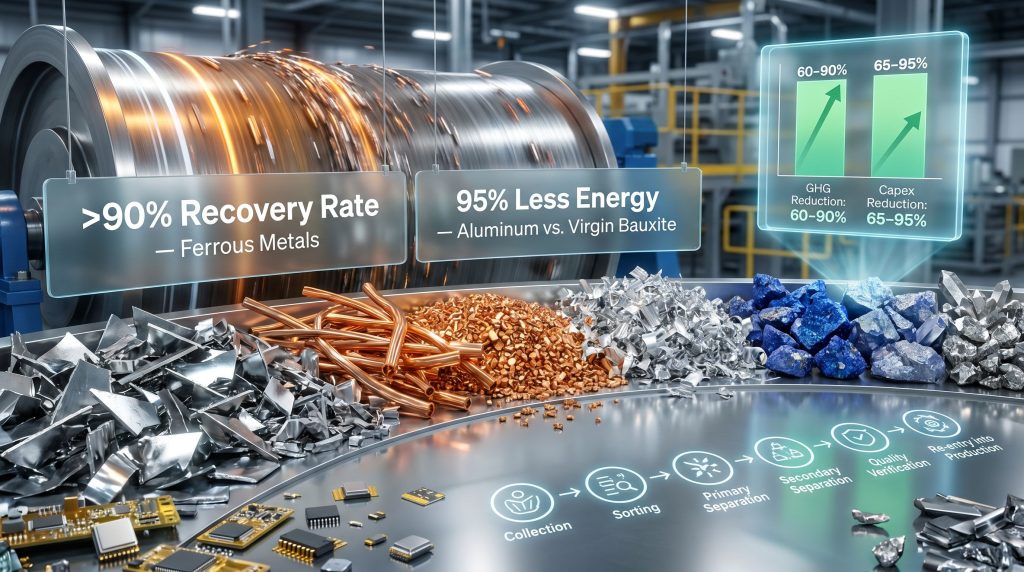
The carbon intensity of metal production varies enormously depending on how efficiently raw materials are separated before energy-intensive refining steps. Selective separation methods have demonstrated the capacity to reduce greenhouse gas emissions by 60 to 90 percent compared to conventional liquid-phase separation approaches, depending on system boundaries, feedstock characteristics, and the specific technologies deployed.
The mechanism is straightforward: when separation produces a higher-purity feed for downstream processing, less energy is consumed per unit of recoverable metal, and fewer process steps are required to reach specification. The aluminium industry provides the most frequently cited illustration. Recycling aluminium through separation-based recovery processes uses approximately 95 percent less energy than producing primary aluminium from bauxite via the Bayer and Hall-Héroult processes. This is not marginal efficiency improvement; it is a structural difference in the energy economics of production.
Diverting Metals From Landfill and Reducing Mining Pressure
Every tonne of metal recovered through separation from municipal solid waste, auto shredder residue, or electronic scrap is a tonne that does not go to landfill and a tonne that does not need to be sourced from primary extraction. The compounding environmental benefit operates at three levels simultaneously:
- Reduced landfill volume and the associated methane generation and leachate risk
- Lower demand for new mine development, with its associated land clearing, habitat disruption, and water consumption
- Reduced long-distance transport of primary ore, which contributes meaningfully to sector-wide carbon emissions
The environmental case for metal separation extends well beyond recycling efficiency. It represents a systemic intervention in the linear resource model, converting what was once waste into a recoverable industrial input and reducing the total ecological burden of metal production across its entire lifecycle.
Economic Advantages That Make Metal Separation a Financially Rational Priority
Recovery Rates and Their Direct Impact on Revenue and Cost Structures
The economic case for investing in advanced separation infrastructure begins with recovery rates. Higher recovery means more saleable product per tonne of feed material, which directly improves revenue without increasing mining or collection costs. For ferrous metals processed through magnetic separation, recovery rates exceeding 90 percent are routinely achievable. Mechanical separation of metals applied to magnetite and hematite ores delivers comparable performance.
The following table summarises typical separation technology performance across key metal types:
| Metal Type | Separation Technology | Performance Indicator |
|---|---|---|
| Ferrous metals (iron, steel) | Magnetic separation | Recovery rates above 90% |
| Magnetite and hematite | High-intensity magnetic separation | Recovery rates above 90% |
| Aluminium | Eddy current and density separation | Up to 95% energy saving versus primary production |
| Gold and silver from e-waste | Selective chemical and physical separation | High-value recovery from secondary streams |
| Rare earth elements | Solvent extraction and selective sulfidation | Economically viable at previously marginal grades |
Capital Cost Innovation Through Process Selectivity
Emerging separation approaches are not only improving recovery performance; they are dramatically reducing the capital intensity of processing infrastructure. Sulfidation-based selective separation methods have demonstrated capital cost reductions of 65 to 95 percent compared to conventional hydrometallurgical processing routes in specific critical minerals processing applications.
The mechanism involves converting target metals into sulphide phases that can be selectively concentrated through physical means, avoiding the need for extensive chemical processing infrastructure. Modular plant architectures further compress upfront capital requirements by allowing incremental capacity expansion matched to production ramp-up curves.
Equipment Protection as a Hidden Economic Multiplier
One of the less-discussed economic benefits of effective metal separation is the protection it provides to downstream processing equipment. Ferrous contaminants as small as 1mm in diameter can cause significant damage to crushers, conveyors, pumps, and grinding mills operating at high throughput. Magnetic separation systems positioned early in the material flow intercept these contaminants before they cause mechanical failure, reducing maintenance frequency and unplanned downtime.
The economic logic compounds: better upstream separation produces cleaner feed, which generates fewer processing anomalies downstream, which translates into lower reprocessing rates, reduced energy consumption per tonne of output, and improved throughput consistency across the entire production system.
Product Quality, Purity Standards, and the Role of Automation
Purity as a Competitive and Regulatory Requirement
Across every sector that relies on metal inputs, purity is not optional. In food and pharmaceutical manufacturing, the presence of ferrous particles above 1mm in finished products constitutes a regulatory failure with serious consumer safety and liability consequences. In metals concentrate trading, the grade of the concentrate determines the payable metal calculation and the penalties or premiums applied by the smelter.
Sector-specific purity requirements include:
- Mining and mineral processing: Precise separation of target minerals from gangue improves concentrate grade, reduces smelter penalties, and increases payable metal per tonne shipped
- Food and pharmaceutical manufacturing: Magnetic removal of ferrous particles ensures regulatory compliance and consumer safety across high-volume production lines
- Electronics and advanced manufacturing: High-purity metal inputs reduce defect rates and support the demanding performance specifications of semiconductor, battery, and sensor applications
Automation, AI Integration, and Real-Time Process Optimisation
The integration of smart sensors, IoT-enabled monitoring equipment, and machine learning-driven process control systems has transformed separation from a largely static operational activity into a dynamic, continuously optimised process. AI-powered mining efficiency tools allow control systems to detect changes in feed material characteristics — including variations in particle size distribution, mineralogy, or moisture content — and adjust operational parameters without manual intervention.
This capability is consequential for product quality consistency. Human-operated separation circuits are subject to response lag, shift-to-shift variability, and interpretation errors that create fluctuations in output purity. Automated systems operating on continuous sensor feedback, however, maintain tighter purity bands across extended production runs, reducing the proportion of off-specification material requiring reprocessing.
High-capacity automated separation systems can now process multiple tonnes of material per hour while simultaneously maintaining stringent purity thresholds and logging quality assurance data in real time — a combination that earlier-generation separation infrastructure was fundamentally incapable of delivering.
Technology Frontiers: What Is Expanding the Economic Boundary of Metal Separation
A Comparative Framework of Core Separation Technologies
Understanding which technology applies where is foundational to evaluating separation strategy. The table below maps core technologies against their primary applications, advantages, and limitations:
| Technology | Primary Application | Key Advantage | Key Limitation |
|---|---|---|---|
| Magnetic separation | Ferrous recovery, ore processing | Chemical-free, high throughput | Restricted to magnetically susceptible materials |
| High-resolution flotation | Complex sulphide ores, fine particles | Excellent selectivity at fine grain sizes | Water-intensive, reagent management required |
| Laser-assisted sorting | Mixed recyclables, e-waste | Precise spectral material identification | High capital cost, throughput constraints |
| Eddy current separation | Non-ferrous recycling | Effective on non-magnetic conductors | Performance degrades on fine particles |
| Selective sulfidation | Rare earth and critical mineral recovery | Capital cost reduction of 65 to 95 percent | Emerging technology, limited commercial scale |
| Waterless dry separation | Arid and water-constrained environments | Zero water consumption | Reduced efficiency for fine-grained materials |
Recovering What Was Previously Left Behind
Perhaps the most strategically significant frontier in the benefits of metal separation is the expansion of economic viability to ore grades and material types that were previously abandoned as unprocessable or unprofitable. Novel chemical and physical separation agents are lowering the minimum viable ore grade threshold for several critical minerals.
E-waste is emerging as a particularly important secondary ore body. Printed circuit boards from consumer electronics contain gold concentrations that, on a per-tonne basis, can exceed those of many operating gold mines. The battery recycling process combining physical pre-processing with selective chemical isolation is enabling the economically viable recovery of gold, silver, palladium, and rare earths from these streams at scales that are beginning to attract serious industrial investment.
The next major ASX story will hit our subscribers first
Metal Separation as a Structural Enabler of the Circular Economy
How Separation Closes the Material Loop
The linear model of resource extraction, manufacturing, use, and disposal is increasingly incompatible with both regulatory frameworks and physical resource availability. Metal separation is the technical mechanism through which circular material flows become operational rather than aspirational. Without the ability to reliably isolate high-purity metal streams from complex mixed inputs, critical minerals recycling cannot compete on quality or cost with primary extraction.
The step-by-step pathway through which metal separation integrates into circular material flows operates as follows:
- Collection of end-of-life products including vehicles, electronics, and industrial scrap, followed by initial pre-processing to reduce particle size and expose constituent materials
- Sorting and classification using automated systems that identify material types by composition, magnetic properties, density, and spectral characteristics
- Primary separation to create bulk ferrous and non-ferrous streams using magnetic, eddy current, or density-based methods matched to material type
- Secondary and selective separation to isolate high-value or chemically complex metals from the primary streams using flotation, laser sorting, or selective chemical methods
- Quality verification through analytical testing of separated streams against buyer specifications and applicable regulatory standards
- Re-entry into production as secondary raw materials, substituting primary ore inputs in manufacturing supply chains
Critical Minerals and the Energy Transition Dependency on Separation Efficiency
The energy transition's material requirements are creating a structural dependency on separation capability that has no precedent in the history of industrial metals markets. The volumes of lithium, cobalt, nickel, and rare earth elements required to manufacture sufficient batteries, motors, and power electronics for projected clean energy deployment cannot be sourced from new mine development alone within the timeframes implied by net-zero commitments.
Both pathways require advanced separation. Higher separation efficiency applied to lower-grade primary ores expands the economically recoverable resource base without requiring proportionally more mining activity. Furthermore, secondary recovery from batteries, motors, and electronic components requires selective separation capable of handling complex, degraded, and contaminated feed materials at industrial scale. Consequently, separation efficiency is not merely a process optimisation metric — for critical minerals in the context of the energy transition, it is a supply security variable.
Frequently Asked Questions: Understanding the Benefits of Metal Separation
What is the primary benefit of metal separation in recycling operations?
Metal separation in recycling enables the recovery of high-purity secondary materials from end-of-life products, reducing reliance on virgin ore extraction, cutting energy consumption by up to 95 percent for metals like aluminium, and diverting significant material volumes from landfill while generating commercially valuable outputs.
How does metal separation reduce environmental impact compared to primary extraction?
By using physical and selectively targeted chemical methods rather than broad-spectrum processing, metal separation minimises chemical waste generation, can reduce greenhouse gas emissions by up to 90 percent in specific applications, and lowers the land use, water consumption, and habitat disruption associated with primary mining operations.
Which industries derive the greatest operational benefit from metal separation technologies?
Mining and mineral processing, metal recycling, electronics manufacturing, food and pharmaceutical production, automotive recycling, and clean energy technology supply chains all depend on metal separation to maintain product quality, operational efficiency, regulatory compliance, and supply chain security.
Is metal separation economically viable for low-grade ores and complex mixed material streams?
Emerging technologies including selective sulfidation and advanced flotation methods are extending economic viability to ore grades and material types previously considered unprocessable, with some separation processes demonstrating capital cost reductions of 65 to 95 percent compared to conventional hydrometallurgical routes. In addition, scrap metal recycling operations are increasingly adopting these advanced methods to unlock value from previously marginal streams.
How is digital integration changing the performance of industrial separation systems?
AI-driven process control, real-time sensor monitoring, and robotics are enabling continuous optimisation of separation circuits, reducing human error, maintaining tighter purity output bands, and lowering operational costs across high-throughput industrial facilities in ways that earlier-generation separation infrastructure could not achieve.
Key Takeaways: The Strategic Case for Metal Separation Investment
- The benefits of metal separation span environmental, economic, quality, and supply chain dimensions simultaneously, making it one of the highest-leverage points of intervention in modern industrial processing
- Recovery rates exceeding 90 percent for ferrous metals and energy savings of up to 95 percent for aluminium recycling demonstrate quantifiable returns on separation investment that are operationally verifiable
- Selective separation technologies are expanding the economic frontier of recovery, enabling viable processing of previously marginal ores and complex secondary streams including e-waste
- Automation and AI integration are converting separation from a static operational function into a continuously optimised quality control system capable of maintaining stringent purity standards at scale
- As critical mineral demand intensifies with the energy transition and primary ore grades continue their long-term structural decline, separation efficiency will increasingly determine which operations remain economically competitive, environmentally compliant, and strategically relevant
Disclaimer: This article contains forward-looking observations and general industry analysis for informational purposes only. It does not constitute financial, investment, or operational advice. Specific statistics and performance claims referenced in this article reflect figures cited in industry publications and should be independently verified against primary sources before being used as the basis for commercial or investment decisions. Readers should seek qualified professional advice appropriate to their circumstances.
Want to Identify the Next Major Mineral Discovery Before the Broader Market Does?
Discovery Alert's proprietary Discovery IQ model delivers real-time alerts on significant ASX mineral discoveries, transforming complex mineral data into actionable investment insights for both short-term traders and long-term investors — explore the historic returns that major discoveries have generated and begin your 14-day free trial to secure your market-leading edge.