June 8, 2026
The uranium sector presents a compelling investment opportunity as structural demand drivers converge with persistent supply constraints. Unlike the speculative bubble of 2007, current market dynamics reflect policy-driven fundamentals that extend beyond traditional nuclear baseload requirements. Furthermore, advanced economies are pursuing nuclear power as a strategic energy security solution, while emerging technologies create additional demand layers previously absent from uranium market volatility patterns.
This market environment creates distinct risk-return profiles across ASX-listed uranium companies, from established producers to development-stage projects. Consequently, understanding these positioning differences becomes critical for investors seeking exposure to uranium's structural tailwinds without excessive speculation risk when considering the best ASX uranium stocks.
Nuclear Renaissance Driving Structural Demand Growth
Current uranium demand exhibits qualitatively different characteristics compared to historical cycles. Reactor lifetime extensions across developed markets provide visible demand growth, with multiple countries approving operational licences beyond original 40-year design specifications. The United States Nuclear Regulatory Commission now issues 80-year operating licences, while European nations maintain nuclear capacity as climate policy infrastructure.
Advanced Technology Creating New Demand Categories
Artificial intelligence data centres represent the most significant new uranium demand driver since nuclear power's initial commercialisation. Major technology corporations have committed to nuclear-powered infrastructure, with Microsoft signing agreements for small modular reactor development and Google establishing partnerships with Kairos Power for data centre applications.
This demand category differs fundamentally from utility baseload consumption patterns. Technology companies require continuous, high-density power generation that renewable sources cannot reliably provide at required scales. Nuclear power offers the only viable clean energy solution capable of meeting these specifications consistently.
Policy-Driven Demand Sustainability
Government energy security initiatives provide structural demand support absent during previous uranium cycles. The US Senate uranium ban includes significant implications for global supply chains, while European Union taxonomy classifications designate nuclear power as sustainable energy infrastructure. These policy frameworks create procurement visibility extending 10-15 years forward, unlike speculative demand that characterised earlier market peaks.
Key demand growth drivers include:
- Reactor lifetime extension programmes across OECD countries
- New reactor construction programmes in Asia and Eastern Europe
- AI data centre electricity consumption requirements
- Government strategic reserve accumulation
- Small modular reactor technology deployment
When big ASX news breaks, our subscribers know first
Current Market Dynamics Supporting Investment Thesis
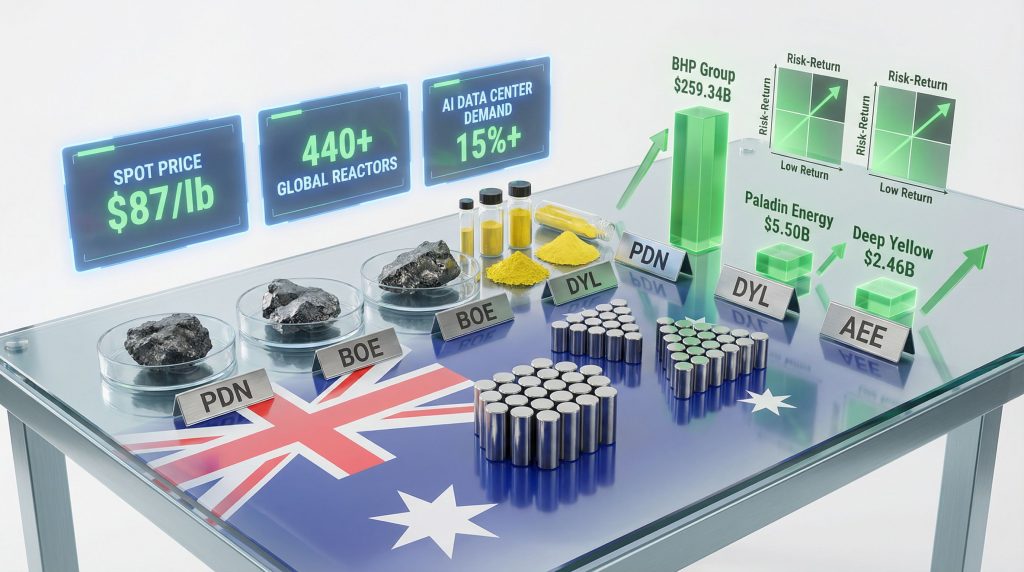
Uranium spot pricing reflects fundamental supply-demand imbalances rather than speculative positioning. At US$87 per pound in early 2026, current pricing levels remain 36% below 2007 peak levels whilst providing adequate margins for established producers.
Supply Chain Vulnerabilities Creating Price Support
Multiple supply disruptions have emerged simultaneously, creating structural scarcity beyond normal market cyclicality. Niger's uranium export restrictions following political transitions removed approximately 1,200 tonnes annually from global markets. Moreover, Kazatomprom, controlling roughly 40% of global production, has reduced output guidance due to sulphuric acid supply constraints and infrastructure limitations.
Critical supply constraint factors:
| Production Source | Capacity Impact | Primary Constraint | Resolution Timeline |
|---|---|---|---|
| Kazakhstan (in-situ leaching) | 35-40 Mlbs/year | Sulphuric acid shortages | 12-24 months |
| Niger (conventional mining) | 5-7% global share | Export restrictions | Political resolution required |
| Secondary sources (enrichment tails) | 10-15 Mlbs/year | Regulatory uncertainty | Declining through 2030 |
Long-Term Contract Market Evolution
Institutional uranium purchasing increasingly occurs through long-term contract structures, creating price floor mechanisms that did not exist during previous cycles. Approximately 80% of uranium trades through multi-year agreements, with spot markets reflecting marginal supply costs rather than fundamental pricing.
Contract pricing typically incorporates 5-15% premiums to spot levels, reflecting supply certainty value for utility purchasers. This structure provides revenue predictability for producers whilst creating upside leverage when spot markets tighten.
Australian Mining Jurisdiction Advantages
Australia maintains the world's largest identified uranium resources, representing approximately 31% of global economically demonstrable reserves according to Geoscience Australia assessments. This resource base provides strategic advantages beyond simple reserve quantities, particularly for uranium mining in Australia operations.
Regulatory Framework Stability
Australian uranium projects operate within established regulatory frameworks that provide operational predictability exceeding many alternative jurisdictions. The Australian Radiation Protection and Nuclear Safety Authority maintains comprehensive licensing protocols, whilst state-level environmental assessment procedures offer transparent approval pathways.
Jurisdiction comparison advantages include:
- Established rule of law and contract enforceability
- Developed mining supply chains and skilled workforce availability
- Indigenous consultation frameworks providing community engagement certainty
- Export approval processes through Department of Foreign Affairs
- Access to Australian capital markets and institutional investor base
Infrastructure and Operational Efficiency
Australian mining operations benefit from existing infrastructure networks that reduce capital deployment requirements for new projects. Road, rail, and port facilities provide connectivity to international markets without requiring greenfield infrastructure development typical in emerging market jurisdictions.
Production-Stage Companies Offering Lower Risk Exposure
Established uranium producers provide the most direct exposure to commodity price appreciation whilst minimising development and operational execution risks. These companies generate immediate cash flows from uranium sales, creating revenue visibility absent from development-stage projects when implementing uranium investment strategies.
Paladin Energy (ASX: PDN) – Operational Excellence Focus
Paladin Energy operates the Langer Heinrich mine in Namibia, which resumed production during 2024 following care and maintenance periods. The company targets 4.75 million pounds annual production, positioning it as Australia's primary pure-play uranium producer.
Investment characteristics:
- Direct uranium price correlation: 70-80% of revenue exposed to spot pricing
- Operational risk mitigation: Established mine infrastructure and processing capacity
- Geographic diversification: Namibian jurisdiction providing African market access
- Production ramp trajectory: Scaling toward full capacity utilisation through 2026
The company's operational focus eliminates development risk whilst providing leveraged exposure to uranium price appreciation. Production costs remain competitive at current spot price levels, generating positive operating cash flows.
Boss Energy (ASX: BOE) – Diversified Production Portfolio
Boss Energy operates uranium production from its Honeymoon mine in South Australia whilst maintaining 30% ownership in the Alta Mesa project in the United States. This geographic diversification provides exposure to multiple uranium markets and regulatory jurisdictions.
Strategic positioning advantages:
- Domestic production base: South Australian operations under established regulatory framework
- US market exposure: Alta Mesa stake providing North American market access
- Operational track record: Demonstrated production capability and technical expertise
- Development pipeline: Additional project opportunities for production expansion
Boss Energy faces near-term uncertainty from its Q3 2026 feasibility study, following withdrawal of previous technical assessments due to mineralisation assumption revisions. This creates temporary volatility risk whilst maintaining longer-term production potential.
Development-Stage Opportunities With Higher Return Potential
Development-stage uranium companies offer leveraged exposure to commodity price appreciation through project advancement and final investment decision catalysts. These opportunities carry higher execution risk whilst providing potential for significant re-rating during development milestones, particularly given evolving US uranium production dynamics.
Deep Yellow (ASX: DYL) – Project Development Analysis
Deep Yellow controls the Tumas uranium project in Namibia, representing one of the most advanced undeveloped uranium assets globally. The company has deferred final investment decision timing pending improved offtake agreement terms and financing conditions.
Development stage characteristics:
- Resource base: Large-scale uranium deposit with established resource estimates
- Technical advancement: Completed feasibility studies and permitting progress
- Funding requirements: Capital intensive development requiring external financing
- Market timing sensitivity: FID dependent on uranium price levels and contract terms
Recent market volatility reflects development stage uncertainties, with the company addressing capital raising speculation whilst reporting wider half-year losses. These operational challenges create near-term share price pressure whilst maintaining longer-term development optionality.
Aura Energy (ASX: AEE) – Speculative Exposure Assessment
Aura Energy targets Q3 2026 final investment decision for its Tiris uranium project in Mauritania, representing high-risk exposure to uranium development opportunities. The company's small market capitalisation creates maximum leverage to successful project advancement.
Speculative investment profile:
- Early development stage: Requires significant capital and regulatory advancement
- Jurisdiction risk: Mauritanian operations in emerging market environment
- Funding uncertainty: No established financing pathway for development capital
- Maximum leverage potential: Small capitalisation providing extreme upside sensitivity
Aura Energy suits only speculative investment capital given development uncertainties and extended timelines to production. Success requires multiple favourable outcomes including financing, permitting, and market conditions alignment.
Market Capitalisation Risk-Return Matrix
ASX uranium stocks exhibit distinct risk-return profiles based on development stage, operational status, and market capitalisation. Understanding these positioning differences enables appropriate portfolio allocation decisions for the best ASX uranium stocks.
ASX Uranium Investment Hierarchy:
| Investment Tier | Representative Stocks | Risk Level | Return Potential | Key Characteristics |
|---|---|---|---|---|
| Large-cap diversified | BHP Group | Low | Moderate | Uranium exposure within diversified commodity portfolio |
| Mid-cap producers | Paladin Energy, Boss Energy | Medium | High | Pure-play uranium production with operational cash flows |
| Small-cap developers | Deep Yellow | High | Very High | Development-stage projects requiring capital and execution |
| Micro-cap explorers | Aura Energy | Very High | Extreme | Early-stage projects with maximum leverage and uncertainty |
Large-Cap Diversified Exposure Through BHP Group
BHP Group provides conservative uranium exposure through its Olympic Dam operation, which produces uranium as a byproduct of copper mining. The company's A$259 billion market capitalisation offers minimal volatility whilst providing modest uranium price correlation.
This exposure suits investors seeking uranium participation within diversified commodity portfolios, avoiding pure-play volatility whilst maintaining some price sensitivity.
Mid-Cap Pure-Play Positioning
Paladin Energy and Boss Energy occupy the optimal risk-return positioning for most uranium-focused investors. Both companies provide direct commodity exposure through operational production whilst maintaining sufficient scale for institutional investment consideration.
Market capitalisations between A$2-6 billion enable meaningful position sizes for institutional portfolios whilst avoiding micro-cap liquidity constraints that limit scalability.
The next major ASX story will hit our subscribers first
Technical and Fundamental Performance Catalysts
Uranium stock performance responds to both commodity-specific catalysts and company-specific operational milestones. Understanding these drivers enables better timing and positioning decisions for top ASX uranium stocks.
Production Ramp-Up Milestones
Operational producers benefit from quarterly production reporting that demonstrates execution capability and margin expansion. Paladin Energy's production guidance provides quarterly benchmarks for operational assessment, whilst capacity utilisation improvements drive margin expansion.
Key production metrics include:
- Annual production targets versus achieved output
- Unit production costs relative to uranium spot pricing
- Production ramp trajectory toward full capacity utilisation
- Technical recovery rates and processing efficiency improvements
Final Investment Decision Timelines
Development-stage companies experience significant re-rating potential upon final investment decision announcements. These catalysts typically require simultaneous achievement of multiple conditions including financing completion, offtake agreements, and regulatory approvals.
Deep Yellow's deferred FID creates uncertainty whilst maintaining catalyst potential once conditions improve. Market expectations for FID timing directly impact share price performance during development phases.
Uranium Price Correlation Analysis
Pure-play uranium stocks demonstrate 70-85% correlation with spot uranium pricing, whilst diversified producers show 15-25% correlation depending on uranium revenue contribution. This relationship provides predictable performance patterns during commodity price cycles, as tracked by uranium market data.
"Every US$10 per pound increase in uranium spot price typically improves pure-play producer margins by 15-25%, directly translating to earnings and cash flow improvements that drive share price appreciation."
Investment Strategies for Different Risk Profiles
Optimal uranium investment strategies depend on individual risk tolerance, return objectives, and portfolio diversification requirements. Each investor category requires different stock selection and position sizing approaches.
Conservative Income-Focused Strategies
Conservative investors should prioritise operational uranium producers with established cash flow generation and minimal execution risk. BHP Group provides diversified exposure within large-cap dividend-paying framework, whilst Paladin Energy offers pure-play exposure with operational certainty.
Conservative allocation framework:
- Core holding: 60-70% in established producers (Paladin Energy, Boss Energy)
- Diversified exposure: 20-30% in large-cap multi-commodity producers (BHP Group)
- Development exposure: Maximum 10% in advanced development projects
- Position sizing: Individual positions limited to 5% of total portfolio value
Growth-Oriented Resource Strategies
Growth investors can increase pure-play uranium exposure whilst maintaining operational focus through producer combinations. Paladin Energy and Boss Energy provide complementary geographic exposure with different operational profiles.
Growth allocation approach:
- Primary exposure: 70-80% in operational pure-play producers
- Development upside: 15-20% in advanced development projects (Deep Yellow)
- Speculative allocation: Maximum 5% in early-stage exploration companies
- Concentration tolerance: Individual positions up to 10% of portfolio value
Speculative High-Risk Strategies
Speculative investors can maximise uranium leverage through development-stage and exploration companies, accepting higher volatility for potential outsized returns. This approach requires strict risk management and position sizing discipline.
Speculative framework:
- Development focus: 50-60% in advanced development projects
- Exploration exposure: 25-30% in early-stage exploration companies
- Operational hedge: 15-20% in established producers for stability
- Position sizing: Strict 2-3% individual position limits with stop-loss protocols
Market Timing and Entry Considerations
Uranium sector timing requires balancing commodity cycle positioning with company-specific catalyst timing. Current market conditions provide multiple entry opportunities across different risk categories.
Technical Analysis Framework
Uranium stocks exhibit cyclical patterns that respond to both technical momentum and fundamental catalysts. Current spot price levels near US$87 per pound provide adequate margins for producers whilst remaining below historical peaks.
Technical considerations include:
- Spot price support levels based on production cost curves
- Relative strength comparisons between uranium stocks and broader commodity indices
- Volume analysis during catalyst events and earnings announcements
- Sector rotation patterns between growth and value investment styles
Fundamental Valuation Metrics
Traditional valuation metrics require adjustment for uranium's unique market structure. Net asset value calculations based on resource estimates provide baseline valuations for development companies, whilst cash flow multiples suit operational producers.
Valuation framework components:
- Net present value of uranium resources using long-term price assumptions
- Enterprise value to resource ratios compared to historical averages
- Price to cash flow multiples for operational producers
- Development risk adjustments for pre-production companies
Risk Assessment and Mitigation Strategies
Uranium investments face multiple risk categories that require active monitoring and mitigation strategies. Understanding these risks enables better portfolio construction and position management decisions.
Operational Execution Challenges
Mining operations face technical, environmental, and logistical challenges that can disrupt production and impact profitability. Uranium's regulatory complexity adds additional operational risk layers compared to conventional mining commodities.
Primary operational risks:
- Technical mining challenges including ground conditions and processing difficulties
- Environmental compliance requirements and community relations management
- Skilled workforce availability and cost inflation pressures
- Supply chain disruptions affecting critical inputs and equipment
Regulatory and Political Risk Factors
Uranium faces unique regulatory oversight due to nuclear security considerations. Changes in nuclear policy, export restrictions, or environmental regulations can materially impact project viability and operational permissions.
Regulatory risk mitigation:
- Geographic diversification across multiple mining jurisdictions
- Engagement with established regulatory frameworks in developed economies
- Monitoring of nuclear policy developments and energy security initiatives
- Maintaining compliance buffer capacity for environmental and safety requirements
Market Sentiment Volatility
Uranium markets remain susceptible to sentiment-driven volatility that can disconnect pricing from fundamental supply-demand conditions. Historical precedent demonstrates both rapid appreciation and severe correction potential.
Volatility management strategies:
- Position sizing appropriate to individual risk tolerance levels
- Diversification across operational stages and geographic jurisdictions
- Stop-loss protocols for speculative positions in development companies
- Rebalancing procedures during extreme price movements
Investment Outlook and Strategic Positioning
The current uranium cycle presents structural investment opportunities supported by policy-driven demand and constrained supply fundamentals. However, individual stock selection requires careful analysis of operational capabilities, development risks, and valuation metrics.
Investment thesis summary:
The best ASX uranium stocks for 2026 include Paladin Energy (PDN) for operational exposure, Boss Energy (BOE) for diversified production, Deep Yellow (DYL) for development upside, and BHP Group (BHP) for conservative exposure. Each offers different risk-return profiles suited to various investor objectives and risk tolerance levels.
Success in uranium investing requires matching stock selection to individual risk profiles whilst maintaining position sizing discipline. Current market conditions favour operational producers over development-stage companies, though catalyst-driven re-rating opportunities exist across all categories.
Key monitoring priorities include:
- Uranium spot price trends and long-term contract market development
- Company-specific production milestones and operational performance metrics
- Regulatory developments affecting nuclear policy and uranium demand growth
- Geopolitical stability in major uranium-producing regions
Investment in uranium stocks carries significant risks including commodity price volatility, operational execution challenges, and regulatory uncertainty. Investors should conduct thorough due diligence and consider professional financial advice before making investment decisions. Past performance does not guarantee future results.
Ready to Capitalise on Uranium's Market-Leading Opportunities?
Discovery Alert's proprietary Discovery IQ model delivers real-time alerts on significant ASX mineral discoveries, including emerging uranium opportunities that could generate substantial returns. Begin your 14-day free trial today to position yourself ahead of the market and understand why historic discoveries can lead to exceptional outcomes by exploring Discovery Alert's dedicated discoveries page.