June 15, 2026
The Hidden Cost Driver Sitting Beneath Every Major Mining Operation
Most discussions about mining decarbonisation and productivity centre on haul trucks, processing plants, and pit design. Conveyor systems, by contrast, rarely command the same level of strategic attention, despite being among the most energy-intensive and failure-prone assets in large-scale bulk materials handling. When a conveyor goes down at a high-throughput copper or iron ore operation, the cost is not measured in minutes but in tonnes, and the financial exposure can run to hundreds of thousands of dollars per unplanned stoppage event.
This is precisely why the evolution of BHP and BOTON intelligent lower-carbon conveyor systems in mining deserves serious industry scrutiny. The convergence of artificial intelligence, robotics, and full-lifecycle sustainability tracking is quietly rewriting the economics of materials handling, and the partnership framework being built between two of the world's most influential mining and industrial technology organisations offers a compelling lens through which to examine this shift.
When big ASX news breaks, our subscribers know first
What the BHP-BOTON Global Framework Agreement Actually Represents
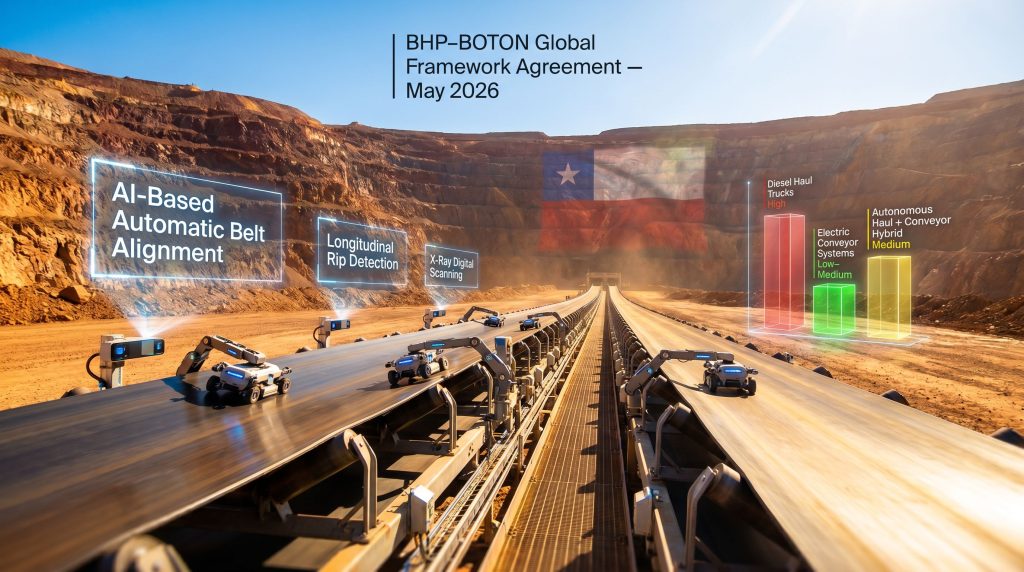
In May 2026, BHP and Wuxi BOTON Technology Co., Ltd. formalised a Global Framework Agreement at BOTON's Innovation Centre in Wuxi, China. The agreement is structured around three pillars: co-development of intelligent conveyor technologies, a joint exploration of full-lifecycle carbon tracking systems, and the expansion of BOTON's localised service infrastructure across BHP's key operational regions.
What distinguishes this arrangement from a conventional equipment supply contract is its architectural intent. Rather than defining a buyer-seller relationship governed by purchase orders and delivery schedules, the agreement positions both organisations as co-developers, sharing responsibility for technology direction, sustainability integration, and service delivery. BHP's Chief Commercial Officer described the partnership as one built on a shared focus on innovation, safety, and sustainability.
The objective is advancing the next generation of mining conveyor solutions to improve productivity and support decarbonisation targets across global operations. Furthermore, BOTON's leadership framed the agreement as marking a transition from product supplier to strategic partner, reflecting an evolution in the commercial relationship that extends well beyond conventional manufacturing and logistics.
From Transactional Supply to Integrated Technology Partnerships
The shift in framing here is significant. Traditional mining equipment procurement is transactional by design, with performance specifications, warranty terms, and price driving vendor selection. Integrated technology alliances, by contrast, require vendors to take on co-development risk, contribute intellectual property, and align their product roadmaps with the operational and sustainability objectives of the mining partner.
This model demands a higher calibre of technical capability from the supplier and a greater willingness to share proprietary operational data from the miner. For BOTON, it represents a substantial elevation in strategic positioning within the global mining technology supply chain.
The Four Intelligent Technologies Powering the Partnership
The co-development agenda under the BHP and BOTON intelligent lower-carbon conveyor systems agreement focuses on four core technology streams, each targeting a distinct failure mode or inefficiency in conventional conveyor operations.
| Technology | Primary Function | Key Operational Benefit |
|---|---|---|
| AI-Based Automatic Belt Alignment | Real-time correction of belt tracking deviations | Reduces unplanned stoppages and belt edge wear |
| Longitudinal Rip Detection | Identifies belt damage before full failure occurs | Prevents catastrophic shutdowns and product spillage |
| X-Ray Digital Scanning | Non-invasive inspection of internal belt structure | Extends service life and improves safety margins |
| Robotic Inspection Systems | Automates routine monitoring tasks | Reduces human exposure in hazardous zones |
These technologies collectively represent a shift from reactive to predictive maintenance philosophy. In conventional conveyor operations, maintenance teams respond to failures after they occur, resulting in costly unplanned downtime, emergency part procurement, and potential safety incidents. AI-integrated detection systems change this dynamic fundamentally by surfacing anomalies before they escalate into failures.
Why Belt Alignment Matters More Than Most Engineers Acknowledge
Belt misalignment is one of the most pervasive and underappreciated sources of energy waste and premature wear in conveyor operations. When a belt tracks even slightly off-centre, the resulting friction increases power draw, accelerates idler and belt wear, and raises the risk of material spillage. Over a conveyor system spanning several kilometres, such as those common at large open-cut copper and iron ore operations, cumulative misalignment losses can represent a meaningful fraction of total site energy consumption.
AI-based alignment systems address this by continuously monitoring belt position and issuing real-time corrections, eliminating the need for manual tracking checks and reducing the window during which misalignment can cause damage. The AI mining efficiency implications of fleet-wide deployment at a major operation like Escondida, one of the world's largest copper mines by production volume, are considerable.
Longitudinal Rip Detection and the Economics of Catastrophic Failure Prevention
Longitudinal ripping, where a foreign object or belt defect causes a tear that propagates along the belt's length, represents one of the most expensive failure modes in bulk materials handling. A single rip event can destroy hundreds of metres of belting, trigger extended operational shutdowns, and generate significant environmental incidents through product spillage.
Detection systems that identify the precursors to ripping, whether through embedded sensors, acoustic monitoring, or imaging analysis, can provide operators with advance warning measured in seconds rather than discovering a failure after tens of metres of belt have been destroyed. The return on investment case for this technology alone is compelling at high-tonnage operations. According to Australian Mining, the partnership specifically targets these next-generation detection capabilities as a priority development stream.
Full-Lifecycle Carbon Tracking: A New Frontier in Mining Supply Chain Sustainability
One of the most technically ambitious elements of the BHP-BOTON agreement is the proposed joint development of a Supply Chain Partner Programme designed to track carbon emissions across the entire conveyor belt lifecycle. This goes considerably beyond what most mining operations currently measure or report.
The four-stage lifecycle tracking framework under exploration covers:
- Stage 1 – Raw Materials Sourcing: Quantifying embodied emissions from rubber compound production, steel cord manufacturing, and synthetic fabric inputs that form the core of conveyor belt construction
- Stage 2 – Manufacturing Emissions: Capturing energy consumption, process emissions, and logistics-related carbon at BOTON's production facilities from raw input to finished belt product
- Stage 3 – Operational Carbon: Monitoring real-time energy draw, efficiency losses from misalignment and wear, and the cumulative carbon intensity of belt operation across the asset's working life
- Stage 4 – End-of-Life Recycling: Accounting for the emissions avoided through belt recycling, material recovery, and circular reuse pathways, rather than landfill disposal
It is important to note that the partnership commits to exploring and developing this lifecycle tracking framework, with no specific implementation timeline publicly disclosed. This is a long-horizon sustainability initiative rather than an operationally deployed system.
The circularity dimension is particularly noteworthy. Conveyor belts are composite materials combining rubber, steel cord, and fabric, making end-of-life processing technically complex. Developing scalable recycling pathways for used mining conveyor belts would represent a genuine advance in circular economy practice within the resources sector.
How Conveyor Systems Connect to Scope 1 and Scope 2 Emissions Reduction
Understanding why BHP has prioritised intelligent conveyor development as part of its decarbonisation strategy requires appreciating the energy profile of large-scale conveyor systems. A single overland conveyor at a major mining operation can consume megawatts of electrical power continuously across a 24-hour operating cycle. Across a portfolio of operations spanning multiple continents, conveyor energy consumption aggregates to a material component of total site Scope 2 emissions.
The comparison with diesel haul trucks is instructive. The broader mining electrification shift underway across the sector makes this comparison increasingly relevant:
| Transport Mode | Energy Source | Relative Carbon Intensity | Automation Potential |
|---|---|---|---|
| Diesel Haul Trucks | Fossil fuel combustion | High | Moderate |
| Electric Conveyor Systems | Grid or renewable electricity | Low to Medium | High |
| Autonomous Haul and Conveyor Hybrid | Mixed sources | Medium | Very High |
Electrified conveyors powered by renewable mining power represent the lowest-carbon bulk materials transport option currently available at scale, and optimising their efficiency through AI alignment, rip detection, and predictive maintenance further reduces the carbon intensity per tonne moved. This positions intelligent conveyor technology as a direct operational lever for Scope 2 emissions reduction, not merely a productivity tool.
The Service Infrastructure Question: Why Last-Mile Support Defines Technology Adoption
One of the most practical, and frequently overlooked, barriers to deploying advanced industrial technology at remote mine sites is the absence of capable local service infrastructure. Sophisticated AI systems and robotic inspection platforms require trained technicians, stocked spare parts, and rapid response capability to maintain their operational value. Without co-located support, downtime risk actually increases rather than decreases.
BOTON's commitment under the agreement to establish frontline service stations in BHP's key mining regions, leveraging existing facilities in Australia and Thailand, directly targets this barrier. For operations like Escondida in Chile, Olympic Dam in South Australia, or iron ore assets in the Pilbara, proximity of technical support is not an operational luxury but a prerequisite for reliable technology performance.
The next major ASX story will hit our subscribers first
A Practical Evaluation Framework for Mine Operators Considering Intelligent Conveyor Upgrades
For engineering and operations teams assessing intelligent conveyor system investments, a structured evaluation approach reduces the risk of deploying technology that underperforms against its stated benefits. The following step-by-step framework provides a logical sequence for decision-making:
- Establish performance baselines by auditing current conveyor mean time between failures, energy consumption per tonne moved, and unplanned downtime frequency across the existing fleet
- Map carbon exposure by identifying the conveyor operations contributing most significantly to site-level Scope 1 and Scope 2 emissions, prioritising systems with the highest energy intensity
- Match technology to failure modes by analysing which intelligent systems, whether rip detection, AI alignment, or robotic inspection, address the highest-cost or highest-frequency failure patterns at the specific operation
- Model total cost of ownership by integrating capital expenditure, ongoing service costs, and projected savings from downtime reduction and energy efficiency improvements across the expected asset life
- Verify service capability by confirming that the technology vendor can provide trained on-site or near-site support at the mine's geographic location, with credible response time commitments
- Align with ESG reporting requirements by ensuring that any lifecycle carbon tracking capability offered by the vendor integrates with the operation's existing sustainability reporting frameworks and disclosure obligations
Key Performance Indicators for Ongoing Intelligent Conveyor Assessment
Once deployed, the performance of intelligent conveyor systems should be tracked against a defined set of metrics that reflect both operational and sustainability objectives. Furthermore, data-driven mining operations frameworks increasingly inform how these metrics are captured and reported in real time:
- Mean Time Between Failures (MTBF): Comparing baseline reactive maintenance regimes against AI-assisted predictive maintenance outcomes
- Belt Utilisation Rate: Measuring the percentage of scheduled operating hours actually achieved, with higher utilisation reflecting lower unplanned downtime
- Energy Consumption per Tonne Moved: Quantifying efficiency gains attributable to alignment optimisation and load management
- Carbon Intensity per Tonne Handled: The critical sustainability metric for operations with public decarbonisation commitments
- Total Cost of Ownership: Integrating capital, operational, and end-of-life costs into a single comparative metric for vendor and technology evaluation
The Geopolitical Dimension: China-Australia Technology Partnerships in Mining
The BHP-BOTON collaboration is not occurring in a geopolitical vacuum. The relationship between Australian mining majors and Chinese industrial technology providers has navigated significant diplomatic complexity over the past decade, shaped by trade tensions, critical minerals policy, and competing strategic interests.
What the formalisation of this agreement in May 2026 demonstrates is that at the operational technology level, commercial pragmatism continues to drive collaboration where clear mutual benefit exists. BOTON brings advanced manufacturing capability, deep conveyor engineering expertise, and an established international service network. BHP brings scale, operational data, and a proving ground in Escondida that provides real-world validation far beyond what any laboratory testing environment can replicate.
For other major miners evaluating similar partnerships, the BHP-BOTON model offers a practical template for accessing frontier industrial technology through structured co-development frameworks. These include joint IP protections, shared sustainability commitments, and integrated service delivery obligations, rather than simple technology licensing or one-directional product supply. The mining decarbonisation benefits that flow from such arrangements are increasingly central to how these partnerships are evaluated at board level.
Frequently Asked Questions: BHP and BOTON Intelligent Lower-Carbon Conveyor Systems
What is the BHP-BOTON Global Framework Agreement?
Signed in May 2026 at BOTON's Innovation Centre in Wuxi, China, the agreement formalises a co-development and lifecycle technology partnership between BHP and Wuxi BOTON Technology Co., Ltd., covering intelligent conveyor systems, full-lifecycle carbon tracking, and expanded global service capability.
Which intelligent technologies are central to the partnership?
The four core technology streams are AI-based automatic belt alignment, longitudinal rip detection, X-ray digital scanning of internal belt structures, and robotic inspection systems, all developed to reduce downtime, improve safety, and lower energy consumption at large-scale mining operations.
Where has this technology been trialled in real mining conditions?
Development and deployment work has been conducted at BHP's Escondida copper mine in Chile, providing a high-throughput, real-world proving environment for the BHP and BOTON intelligent lower-carbon conveyor systems before potential broader global rollout across BHP's operational portfolio. Details on the broader implementation scope are available via Mining Technology.
How does the partnership support decarbonisation goals?
The proposed Supply Chain Partner Programme would track carbon emissions across four lifecycle stages, from raw material extraction through manufacturing, operation, and end-of-life recycling, supporting BHP's broader Scope 1, 2, and supply chain emissions reduction commitments.
Why are conveyor systems strategically important to mining sustainability?
Conveyor systems are among the most energy-intensive components in bulk materials operations. Optimising their efficiency through AI, automation, and electrification reduces operational energy consumption and associated carbon emissions, making them a material lever in mine-level decarbonisation strategies, particularly for operations where renewable electricity supply is accessible.
What the BHP-BOTON Model Signals for the Future of Mining Technology
The structure of the BHP-BOTON agreement reflects a broader industry transition that is still in its early stages. As mining operations face simultaneous pressure to reduce operating costs, meet increasingly stringent safety standards, and demonstrate credible progress against public decarbonisation commitments, the conventional equipment procurement model is proving inadequate.
Technology partnerships that integrate co-development, lifecycle sustainability accountability, and co-located service infrastructure into a single framework address multiple strategic imperatives at once. They shift the vendor relationship from a cost centre to a value creation mechanism, aligning commercial incentives with operational and environmental performance outcomes.
For mine planners, engineers, and operational leadership teams across the sector, the BHP and BOTON intelligent lower-carbon conveyor systems partnership offers more than a case study in materials handling innovation. It provides a working model for how the next generation of mining technology alliances will likely be structured, governed, and measured, and why organisations that continue to approach technology procurement transactionally risk falling behind peers who are building integrated, intelligence-driven operational ecosystems.
This article contains forward-looking elements including references to technology development timelines, sustainability programme design, and service expansion plans that have not yet been fully implemented. Readers should note that outcomes may differ materially from stated intentions, and no specific financial projections or investment recommendations are implied by the content of this analysis.
Want to Capitalise on the Next Major ASX Mineral Discovery Before the Broader Market?
Discovery Alert's proprietary Discovery IQ model delivers real-time alerts on significant ASX mineral discoveries, instantly transforming complex data across more than 30 commodities into clear, actionable insights for both short-term traders and long-term investors — begin your 14-day free trial today and explore historic discoveries that have generated extraordinary returns.