June 15, 2026
Egypt's Western Desert: Why the World's Energy Investors Are Paying Attention
When geologists and energy economists assess where the next meaningful wave of African hydrocarbon production will originate, one region consistently surfaces in the analysis: Egypt Western Desert oil exploration. Covering roughly one million square kilometres and stretching from the Nile Valley to the Libyan border, this vast geological canvas represents approximately two-thirds of Egypt's total land area. Yet despite its scale, the Western Desert has historically been underestimated relative to offshore gas plays in the Nile Delta. That calculus is now shifting rapidly, driven by a convergence of technology deployment, aggressive well targeting, and a national energy security imperative reshaping Egypt's upstream oil and gas sector.
When big ASX news breaks, our subscribers know first
Why the Western Desert Holds a Structural Advantage Over Egypt's Other Hydrocarbon Regions
Understanding why Egypt Western Desert oil exploration has accelerated requires examining the basin's geological and logistical advantages compared to competing domestic plays.
Unlike deepwater or offshore environments, the Western Desert offers large, contiguous exploration blocks with established surface infrastructure, proven stratigraphic analogues, and decades of production history across key concessions such as Khalda, El Rizzak, Sitra, and Rosa North. This reduces the capital intensity of new well programmes significantly.
| Producing Region | Primary Resource Type | Strategic Role | Exploration Maturity |
|---|---|---|---|
| Western Desert | Crude oil and natural gas | Largest onshore province | Active — new wells being drilled |
| Nile Delta (offshore) | Natural gas | Major gas supply hub | Mature — incremental development |
| Eastern Desert | Crude oil | Secondary onshore producer | Moderate — ongoing exploration |
| Sinai Peninsula | Oil and gas | Supplementary production | Lower — geopolitical complexity |
| Red Sea | Offshore oil | Emerging potential | Early-stage |
The Western Desert's combination of geological diversity, proven reserve history, and cost-efficient access infrastructure positions it as Egypt's highest-return exploration frontier in the near term. Critically, the region's sandstone and carbonate reservoirs have demonstrated consistent productivity across multiple operator concessions, providing geological confidence that supports aggressive drilling mandates.
Furthermore, as detailed reporting from Egypt Oil & Gas confirms, the Western Desert has long functioned as Egypt's giant petroleum reservoir, with its productive potential still far from fully realised.
The Western Desert is not a frontier play in the conventional sense. It is a mature basin with material upside, where improved targeting technology is converting previously bypassed pay zones into productive reserves.
The Production Numbers That Defined Mid-2026
Between late May and early June 2026, Egypt's Western Desert recorded a combined increase in crude oil and condensate output of nearly 12,000 barrels per day, according to official sector data. This gain was not the result of a single major discovery but rather the compounding effect of multiple simultaneous drilling programmes across different operator concessions.
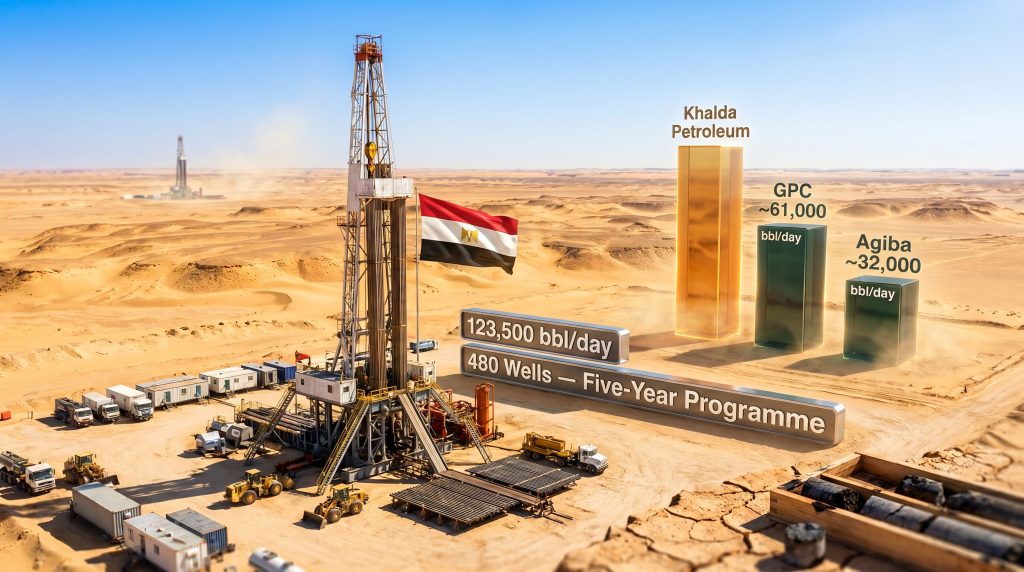
The headline contributor was Khalda Petroleum, the joint venture between Egypt's General Petroleum Corporation and US-based Apache Corporation. Within a matter of weeks, Khalda lifted daily production from 113,300 barrels per day to 123,500 barrels per day, a short-cycle uplift of approximately 9%. Officials attributed part of this improvement to the deployment of artificial intelligence tools that streamlined operational workflows and reduced non-productive drilling time.
Agiba Petroleum, the joint venture between the Egyptian General Petroleum Corporation (EGPC) and Italian major Eni, was also a significant contributor. A sustained two-year drilling campaign across the Western Desert pushed Agiba's production to approximately 32,000 barrels per day, the highest output level recorded by the entity in three years.
The General Petroleum Company (GPC), the state-owned operator, reported its strongest performance since October 2024, producing approximately 74,500 barrels of oil equivalent per day, comprising around 61,000 barrels of crude oil alongside associated gas volumes. GPC credited AI-assisted process optimisation and targeted infrastructure reinvestment for the recovery. However, understanding these results also requires situating them within broader crude oil price trends that shape investment decisions across the global upstream sector.
Landmark Discoveries Reshaping the Reserve Outlook
The Bustan South-1X Well: A Generational Find
The single most significant exploration result from recent Western Desert activity came from the Bustan South-1X exploratory well, drilled by Agiba Petroleum using the Egyptian Drilling Company's EDC-9 rig. Egyptian petroleum officials described this as the most important oil and gas reserve discovery in the country's desert regions in 15 years, a characterisation that carries considerable weight given Egypt's long history of Western Desert production.
What makes the Bustan South-1X result particularly notable from a geological standpoint is the combination of oil and gas encountered within the same structure. Multi-phase discoveries are more valuable operationally because associated gas provides either reinjection capacity to sustain reservoir pressure or exportable volumes, extending the productive economics of the primary crude stream. According to AGBI's reporting, Egypt's new gas and oil reserves in the Western Desert mark a pivotal moment for the country's energy ambitions.
Apache-EGPC Natural Gas Discovery: The Western Desert's Gas Dimension
In March 2026, the partnership between EGPC and Apache Corporation confirmed a natural gas discovery in the Western Desert with an estimated productive capacity of approximately 26 million cubic feet of gas per day, alongside an estimated 2,700 barrels of condensate per day. This find reinforces an important but often overlooked characteristic of the Western Desert: it is not purely a crude oil province.
The presence of significant gas volumes within the basin has implications for Egypt's broader energy strategy. With existing LNG export infrastructure and growing regional gas demand, Western Desert gas discoveries carry dual monetisation pathways that pure crude finds do not.
The Four-Well Discovery Cluster: Combined Metrics
Beyond the flagship finds, a cluster of smaller but cumulatively significant well results added material new capacity to the Western Desert portfolio.
| Well / Operator | Concession Area | Crude Oil Output | Gas Output |
|---|---|---|---|
| Sultan S-1X RC (Khalda Petroleum) | Western Desert | >1,500 bbl/day combined | ~1.7 MMcf/day combined |
| Alex NW-1X (Khalda Petroleum) | Western Desert | Included above | Included above |
| East Abu Sennan (Tharwa Petroleum) | East Abu Sennan | ~1,500 bbl/day | Not specified |
| AS Z-2X (Borg El Arab Petroleum) | Abu Sennan Development Area | ~1,305 bbl/day | ~900,000 cf/day |
| Combined Cluster Total | Multiple concessions | ~4,500 bbl/day | ~2.6 MMcf/day |
These distributed results highlight a feature of the Western Desert that is frequently underappreciated: the basin supports numerous concurrent operators across different concession areas, meaning production growth is less dependent on any single joint venture or discovery event. This structural diversification reduces concentration risk and provides a more resilient production growth profile.
Technology as the Hidden Variable in Egypt's Exploration Surge
Artificial Intelligence in Reservoir Management
The integration of AI into Egypt's upstream operations represents a meaningful shift in how mature basin production is managed. Traditional reservoir management in established fields relies heavily on historical well data, decline curve analysis, and periodic geophysical surveys. AI in exploration workflows can process substantially larger datasets in real time, identifying production optimisation opportunities and flagging anomalous well behaviour before it translates into output losses.
For the Western Desert specifically, AI applications have been credited with:
- Streamlining drilling operational workflows to reduce rig downtime
- Improving subsurface reservoir characterisation using integrated seismic and well log datasets
- Accelerating production decisions by reducing the time between well completion and first oil
- Identifying bypassed pay zones in existing fields that conventional analysis had not prioritised
Egypt's First Nationwide Aerial Geophysical Survey in 40 Years
Arguably the most strategically significant technology deployment announced in 2026 was the launch of Egypt's first comprehensive nationwide aerial geophysical survey in more than four decades. Announced in May 2026, the programme covers six major geological regions including portions of the Western Desert, deploying advanced airborne geophysical instruments capable of mapping subsurface fault systems, structural highs, and potential hydrocarbon traps at resolution levels far exceeding those available to the previous survey generation from the 1980s.
A geophysical survey of this scale is not simply a mapping exercise. It is an intelligence infrastructure upgrade that will inform well-targeting decisions for years, potentially decades, into the future.
For investors and analysts tracking Egypt Western Desert oil exploration activity, this survey is a leading indicator of future drilling success rates. Improved subsurface mapping directly correlates with lower dry-hole probability, which is among the most important cost variables in exploration-stage upstream investment. In addition, the accuracy of geological logging codes used throughout the survey process plays a critical role in ensuring that subsurface data is correctly interpreted and applied to future well-targeting decisions.
Egypt's Reserve Base and the Mathematics of Reserve Replacement
National Reserve Position
| Resource Category | Estimated Reserve Volume | Source Authority |
|---|---|---|
| Recoverable crude oil reserves | ~3.3 billion barrels | Arab Energy Organization |
| Natural gas reserves | ~2.1 trillion cubic metres | Arab Energy Organization |
| Western Desert crude contribution | Largest onshore province | Industry consensus |
Egypt's reserve base of approximately 3.3 billion barrels of recoverable crude is substantial but not inexhaustible. At current and projected production rates, maintaining or growing this figure requires continuous reserve replacement through new discoveries and enhanced recovery from existing fields. This is the fundamental mathematics behind the 480-well, five-year drilling programme, with 101 wells targeted for 2026 alone.
The logic of reserve replacement is straightforward but frequently misunderstood outside industry circles. Each barrel produced from existing fields reduces the reserve base by one barrel unless new volumes are added through exploration success or improved recovery techniques. Egypt's drilling mandate is explicitly designed to keep reserve additions ahead of production depletion, protecting the country's reserve-to-production ratio, a critical metric for long-term energy sovereignty assessments.
The 480-Well Programme: Scale in Context
An authorisation to drill 480 exploratory wells over five years is a significant commitment by any regional standard. For context, many national oil companies operating in comparable basin environments drill fewer than 50 exploratory wells annually across their entire portfolio. Egypt's programme concentrates this activity primarily within proven producing provinces, particularly the Western Desert, where geological risk is lower and infrastructure already exists to bring discoveries online rapidly.
Furthermore, monitoring the drilling activity decline observed in other global markets provides useful context: Egypt's counter-cyclical commitment to expanding its drilling mandate stands out as a deliberate strategic choice rather than a reactive response to short-term price movements.
The next major ASX story will hit our subscribers first
Joint Ventures and the International Capital Model
Egypt's approach to Western Desert development relies on a well-established joint venture model where the EGPC retains strategic oversight while international partners provide capital, technology, and technical expertise. This structure has several underappreciated advantages:
- Risk distribution: Geological and financial risk is shared between EGPC and international partners, reducing the sovereign balance sheet impact of unsuccessful wells.
- Technology transfer: International operators bring proprietary drilling techniques, reservoir simulation tools, and operational best practices that may not be accessible through domestic channels alone.
- Capital efficiency: Joint venture structures allow Egypt to drill more wells than the domestic capital budget alone would support, accelerating the pace of reserve conversion.
- Accountability mechanisms: Production-sharing agreements and joint venture governance frameworks create incentive alignment between state and commercial partners around production optimisation.
The involvement of Apache Corporation and Eni specifically brings operators with extensive global basin experience, including in geological environments analogous to the Western Desert's sandstone and carbonate systems.
What the Current Trajectory Means for Egypt's Energy Security Position
Egypt's energy security calculus is shaped by several converging pressures. Domestic energy consumption has grown alongside population expansion, increasing the cost of fuel subsidies and import dependency. Simultaneously, Egypt's role as a regional energy transit hub, including LNG export capacity, creates additional incentive to maximise domestic production volumes.
The approximately 12,000 barrels per day increase recorded across the Western Desert in a single two-week window reflects a programme that is beginning to compound. As additional wells from the 480-well programme reach production, the cumulative output additions will grow. Whether this trajectory can be sustained depends on several variables:
- Continued exploration success rates from the ongoing drilling campaign
- Reservoir performance of recently discovered fields as production histories develop
- Aerial survey outcomes and the quality of new well targets they generate
- Joint venture capital commitment from international partners in a global environment where oil price trends directly influence upstream investment decisions
- Infrastructure capacity to handle increased throughput from new producing wells
It is important to note that reserve estimates, production forecasts, and exploration success rate projections involve inherent uncertainty. Actual outcomes may differ materially from current expectations based on geological, operational, and market factors.
Frequently Asked Questions: Egypt Western Desert Oil Exploration
What is the Western Desert's approximate daily oil production contribution?
Khalda Petroleum alone produces approximately 123,500 barrels per day as of early June 2026. Adding Agiba Petroleum's roughly 32,000 barrels per day and GPC's approximately 61,000 barrels of crude per day, the Western Desert accounts for a substantial share of Egypt's total national crude output across multiple concurrent operators.
Which technologies are transforming exploration efficiency in the Western Desert?
AI-driven operational optimisation and advanced airborne geophysical survey technologies are the two primary tools currently reshaping Egypt's exploration efficiency. The combination of better subsurface mapping and smarter real-time production management is improving both discovery rates and per-well productivity.
How significant is the Bustan South-1X discovery in historical context?
It represents Egypt's most material oil and gas reserve discovery in its desert regions in 15 years, according to official sector characterisation. Its dual oil and gas resource profile adds particular strategic value beyond raw production volumes.
What are Egypt's confirmed national hydrocarbon reserves?
According to the Arab Energy Organization, Egypt holds approximately 3.3 billion barrels of recoverable crude oil and roughly 2.1 trillion cubic metres of natural gas, positioning it among the leading energy producers in the North Africa and Middle East region.
Want To Track the Next Major Mineral Discovery Before the Market Does?
Discovery Alert's proprietary Discovery IQ model delivers real-time alerts the moment significant ASX mineral discoveries are announced, turning complex geological data into actionable investment insights for both short-term traders and long-term investors. Explore Discovery Alert's dedicated discoveries page to understand how historic finds have generated substantial returns, and begin your 14-day free trial today to position yourself ahead of the broader market.