
June 15, 2026
The Minerals Beneath the Wildlife: Why Responsible Extraction Is Africa's Defining Governance Challenge
Across the African continent, a structural tension is quietly intensifying. The same geological formations that sustain extraordinary biodiversity, anchor transboundary conservation zones, and underpin rural livelihoods also contain the raw materials the global energy transition cannot function without. Lithium, cobalt, nickel, manganese, copper, and rare earth elements sit beneath landscapes that conservation scientists have spent decades protecting. As critical minerals demand steepens sharply through the 2030s, the pressure on resource-rich nations to extract faster, cheaper, and at greater scale has never been higher. The question confronting countries like Zimbabwe is not whether to mine, but whether the institutional architecture exists to mine responsibly before irreversible ecological and social damage occurs.
It is within this context that the WWF Zimbabwe responsible mining initiative carries significance well beyond its immediate geographic scope.
When big ASX news breaks, our subscribers know first
Zimbabwe's Mineral Endowment: Strategic Asset or Governance Stress Test?
Zimbabwe holds one of the most diverse mineral endowment profiles in sub-Saharan Africa. Its lithium deposits alone have attracted significant international attention, and the country sits within the broader Southern African Development Community (SADC) region, which collectively contains a substantial share of the world's known reserves of energy transition minerals.
Yet mineral wealth without governance depth is a liability dressed as an opportunity. Zimbabwe's mining sector has historically operated across a spectrum from large formal operations to informal artisanal activity, and both categories interact with some of the continent's most ecologically sensitive terrain. The Kavango-Zambezi Transfrontier Conservation Area (KAZA TFCA), which spans portions of Zimbabwe, Botswana, Zambia, Angola, and Namibia, covers approximately 520,000 square kilometres and represents one of the largest terrestrial conservation areas on Earth.
Mining activity within or adjacent to this zone creates compounding ecological risks: habitat fragmentation, disruption of wildlife corridors, degradation of river systems, and intensification of human-wildlife conflict. The intersection of this ecological reality with surging global commodity demand is precisely what makes Zimbabwe's current policy moment so consequential.
What the WWF Zimbabwe Responsible Mining Initiative Actually Involves
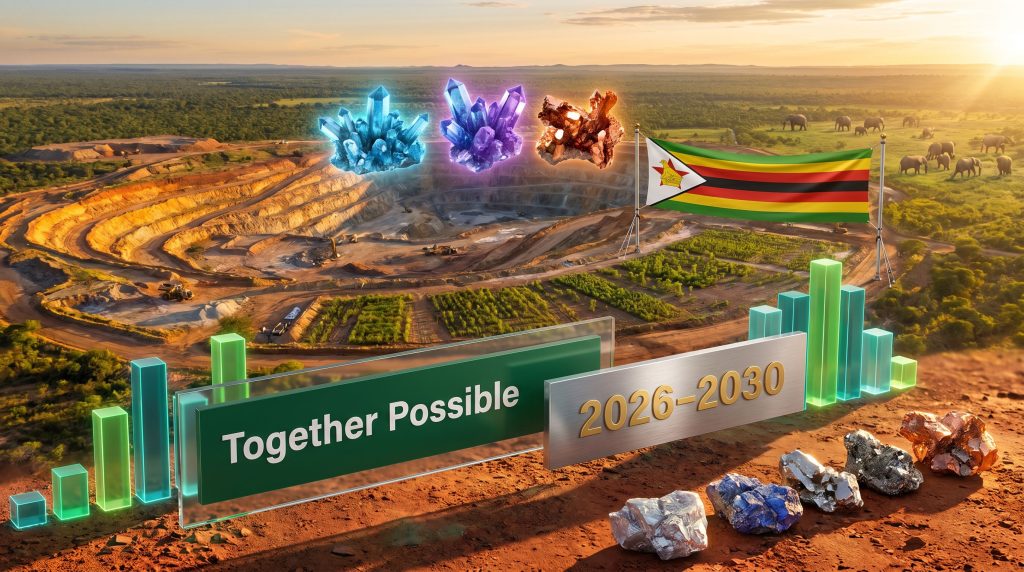
The WWF Zimbabwe responsible mining initiative formally entered its implementation phase following a National Stakeholder Engagement Meeting convened at Bronte Hotel in Harare. The event simultaneously served as the official launch of WWF Zimbabwe's Strategic Plan covering 2026 to 2030, organised under the thematic umbrella of Together Possible.
The broader programme operates under the full title: Fostering Environmentally and Socially Responsible, Decarbonized, Inclusive and Transformative Value Chains for Energy Transition Minerals in the SADC Region. Its design reflects a deliberate attempt to address the entire mineral value chain, not just extraction endpoints.
The Institutional Architecture Behind the Programme
The multi-agency structure underpinning this initiative is one of its more distinctive features. Understanding who is involved, and at what level, matters for assessing both its credibility and its accountability mechanisms.
| Stakeholder Role | Organisation |
|---|---|
| Regional Lead Agency | United Nations Economic Commission for Africa (UNECA) |
| Primary Funder | Germany's International Climate Initiative (IKI) |
| Funding Ministry | German Federal Ministry for the Environment |
| Zimbabwe Implementation Partners | WWF Zimbabwe and Zimbabwe Environmental Law Organisation (ZELO) |
| Government Representation | Ministry of Mines and Mining Development; Ministry of Environment, Climate and Wildlife |
The layered institutional design, from international climate finance through to local civil society implementation, is intended to create accountability at every tier. Furthermore, the inaugural stakeholder engagement brought together representatives from government ministries, development partners, academic institutions, civil society organisations, the private sector, and community groups, establishing a broad-based coalition from the outset.
Why Hwange and Binga Districts Were Chosen as the Pilot Focus
The programme's initial geographic concentration on Hwange and Binga districts in western Zimbabwe is not arbitrary. Both districts sit within the KAZA TFCA, meaning that mining governance failures here carry transboundary ecological consequences that extend across multiple sovereign territories.
From a minerals governance perspective, piloting a responsible mining framework in the most ecologically complex and politically sensitive terrain first is a deliberate stress-testing strategy. If accountability mechanisms, community participation structures, and enforcement protocols can function within a transfrontier conservation zone, they are more likely to scale effectively to less ecologically constrained environments across the region.
The Five Strategic Pillars of the 2026–2030 Framework
WWF Zimbabwe's Strategic Plan for 2026 to 2030 is structured around five interconnected priorities. Each pillar addresses a distinct dimension of the responsible mining challenge, but they are designed to function as a system rather than in isolation.
-
Landscape Restoration — Active rehabilitation of mining-affected ecosystems, with defined timelines and independently verifiable benchmarks rather than open-ended commitments.
-
Climate Resilience — Integrating climate adaptation into mining governance frameworks, recognising that communities and ecosystems in semi-arid western Zimbabwe face compounding climate stressors that mining activity can accelerate.
-
Biodiversity Conservation — Protecting endemic species and high-conservation-value habitats in regions where mineral extraction and wildlife corridors overlap, a particular challenge in KAZA TFCA districts.
-
Sustainable Livelihoods — Structuring benefit-sharing mechanisms so that mining-derived economic value creates durable income streams for affected communities, reducing the vulnerability cycles associated with single-industry extraction dependency.
-
Inclusive Governance — Formalising the roles of women, youth, and historically marginalised community members in environmental decision-making processes, including permitting, monitoring, and compliance review.
The philosophy underpinning the entire plan rests on a principle articulated by WWF Zimbabwe Country Coordinator Itai Chibaya: that a development pathway built on dismantling the ecosystems that sustain communities is not development at all. Economic extraction must operate within ecological boundaries, not beyond them.
Closing the Enforcement Gap: From Paper Regulations to Operational Obligations
One of the least discussed but most critical dimensions of the WWF Zimbabwe responsible mining initiative is its explicit focus on the enforcement problem. Across sub-Saharan Africa, the gap between environmental regulations as written and environmental regulations as enforced has historically been wide enough to render compliance frameworks largely symbolic.
Zimbabwe's government has signalled an intent to close this gap through its Responsible Mining Initiative Part 2, which is designed to shift the regulatory posture from voluntary compliance incentives toward binding obligations with enforceable penalties. Several specific mechanisms underpin this shift:
-
Environmental Impact Assessments (EIAs) are being repositioned from procedural prerequisites into legally binding instruments, with mine rehabilitation and closure obligations subject to enforcement rather than discretionary compliance.
-
Community-level environmental monitoring is embedded in the initiative's operational architecture, enabling local populations to serve as frontline accountability actors rather than passive recipients of regulatory decisions made in Harare.
-
Benefit-sharing mechanisms are being developed with transparency requirements, so that revenue flows from mining operations to affected communities in structured, auditable ways.
-
Human-wildlife conflict management protocols are being integrated into mine planning requirements in KAZA TFCA districts, acknowledging that ecological disruption from extraction directly intensifies community-wildlife tensions.
The Permanent Secretary in the Ministry of Mines and Mining Development, Dr. Thomas Utete Wushe, made clear at the Harare launch that Zimbabwe's approach to mineral development is not unconditional. His position, as stated publicly, is that environmental impact assessments are not optional formalities and that mine rehabilitation obligations will be applied without exception.
Similarly, Washington Zhakata, Chief Director for Environment, Climate and Wildlife, emphasised that the standard for success will be what is observable on the ground by 2030, not what is stated in policy documents today. Consequently, mine reclamation obligations are increasingly central to how Zimbabwe frames its regulatory commitments.
Governance Insight: The shift from voluntary to enforceable compliance is the single most important variable in determining whether responsible mining frameworks generate real outcomes or remain aspirational documents. Regulatory intent without enforcement capacity is simply well-intentioned theatre.
Benchmarking the Initiative Against Regional Standards
Understanding where Zimbabwe's framework sits relative to emerging African mining governance norms provides useful analytical context. The Responsible Mining Foundation has noted that governance gaps between policy design and operational practice remain a persistent challenge across multiple jurisdictions.
| Governance Dimension | Zimbabwe Initiative | Regional Best Practice Benchmark |
|---|---|---|
| Environmental Impact Assessment | Mandatory, legally enforced | Mandatory with independent third-party review |
| Community Benefit Sharing | Structured mechanisms under development | Formalised revenue-sharing legislation |
| Mine Rehabilitation Obligations | Stated policy of strict enforcement | Bonded rehabilitation funds held in escrow |
| Community Environmental Monitoring | Embedded in programme design | Independently funded community monitoring bodies |
| Inclusion of Women and Youth | Explicitly prioritised | Quota-based representation in governance structures |
| Decarbonisation Requirements | Integrated into value chain design | Sector-specific emissions targets with reporting |
The comparison reveals that Zimbabwe's stated intentions are broadly consistent with regional best practice, while implementation mechanisms in several areas — particularly bonded rehabilitation funds and independent third-party EIA review — remain aspirational rather than operational. Closing these gaps will define whether the initiative achieves durable impact.
The next major ASX story will hit our subscribers first
The SADC Dimension: Why National Solutions Are Insufficient
A critically underappreciated aspect of the responsible mining challenge in southern Africa is its inherently transboundary character. Energy transition mineral deposits, river catchments, wildlife corridors, and the communities that depend on all three do not recognise national borders. In addition, considerations around natural capital in mining increasingly inform how multilateral frameworks are structured across the region.
The SADC regional framing of the initiative reflects a recognition that unilateral national governance improvements, however well-designed, create openings for regulatory arbitrage. If one jurisdiction enforces stringent environmental standards while neighbouring countries do not, mobile capital and extractive operators will gravitate toward the path of least resistance. Harmonised standards across SADC member states are, therefore, a practical prerequisite for preventing a race to the bottom.
KAZA TFCA's five-country architecture makes this especially concrete. A mining operation in Zimbabwe's Hwange District that contaminates a shared river system does not confine its impact to Zimbabwean territory. Cross-border environmental governance is not an abstract policy aspiration in this context; it is an operational necessity.
Implementation Risks That Could Undermine the Initiative
Analytical rigour requires honest assessment of the risks that could prevent the initiative from translating its strategic design into measurable outcomes.
-
Enforcement capacity constraints remain a persistent structural challenge across southern African mining jurisdictions. Regulatory ambition is only as effective as the institutional capacity to monitor violations and impose meaningful penalties consistently.
-
Financing continuity exposure is a real vulnerability. Five-year programmes dependent on international climate finance, including IKI funding from Germany, face potential disruption from geopolitical shifts in donor priorities or changes in funding cycle allocations.
-
Private sector alignment cannot be assumed. Without well-structured incentives or credible penalty risks, mining operators may treat responsible mining frameworks as compliance optics rather than operational transformation requirements.
-
Community trust deficits in regions with long histories of extractive industries delivering minimal local benefit represent a structural barrier. Genuine participation cannot be achieved through one-off consultations; it requires sustained, transparent engagement over years.
-
Multi-agency coordination complexity across multiple ministries, international agencies, civil society organisations, and community bodies creates inherent governance costs. Without clear accountability structures, coordination can fragment into institutional paralysis.
Warning: The credibility of any responsible mining framework is ultimately determined not at its launch, but in the consistency of its enforcement eighteen to thirty months into implementation, when political attention has shifted and commercial pressures have intensified. Launch events are the easiest part.
What Success Looks Like by 2030
Translating strategic intent into verifiable outcomes requires concrete accountability anchors. For the WWF Zimbabwe responsible mining initiative, a meaningful success framework by 2030 would include:
-
Independently verified landscape restoration progress in Hwange and Binga districts, measured against pre-intervention degradation baselines.
-
Transparent, publicly accessible records of community benefit-sharing disbursements from mining operations in targeted areas.
-
Documented reduction in human-wildlife conflict incidents in KAZA TFCA mining zones, tracked against established pre-initiative baselines.
-
Measurable increases in women and youth representation within formal environmental governance and mining oversight structures.
-
Demonstrated decarbonisation progress across targeted mining value chains, with reporting aligned to Zimbabwe's national climate commitments.
-
A replicable governance model capable of informing critical minerals trade frameworks and responsible extraction standards across other SADC member states.
If these outcomes are achieved with integrity, Zimbabwe would occupy a genuinely distinctive position: a resource-rich African nation that demonstrated the energy transition minerals the world needs can be extracted without sacrificing the ecosystems and communities that underpin long-term national prosperity. As WWF South Africa has noted, the responsible mining of transition minerals demands precisely this kind of rigorous, accountable governance architecture. ESG-focused capital allocators, multilateral development institutions, and regional policymakers will be closely observing whether that demonstration materialises.
Disclaimer: This article is intended for informational purposes only and does not constitute financial, legal, or investment advice. Statements regarding policy intentions, programme targets, and projected outcomes reflect publicly available information and are subject to change. Readers should conduct independent research before making any investment or policy-related decisions.
Want to Stay Ahead of the Next Major African Mineral Discovery?
As critical minerals demand accelerates across the 2030s and governance frameworks reshape where and how extraction occurs, Discovery Alert's proprietary Discovery IQ model delivers real-time alerts on significant ASX mineral discoveries — instantly translating complex mineral data into actionable investment insights for both short-term traders and long-term investors. Explore historic discoveries and their market returns on Discovery Alert's dedicated discoveries page, and begin your 14-day free trial today to position yourself ahead of the market.