June 15, 2026
The Metallurgical Puzzle Sitting at the Heart of Industrial Decarbonization
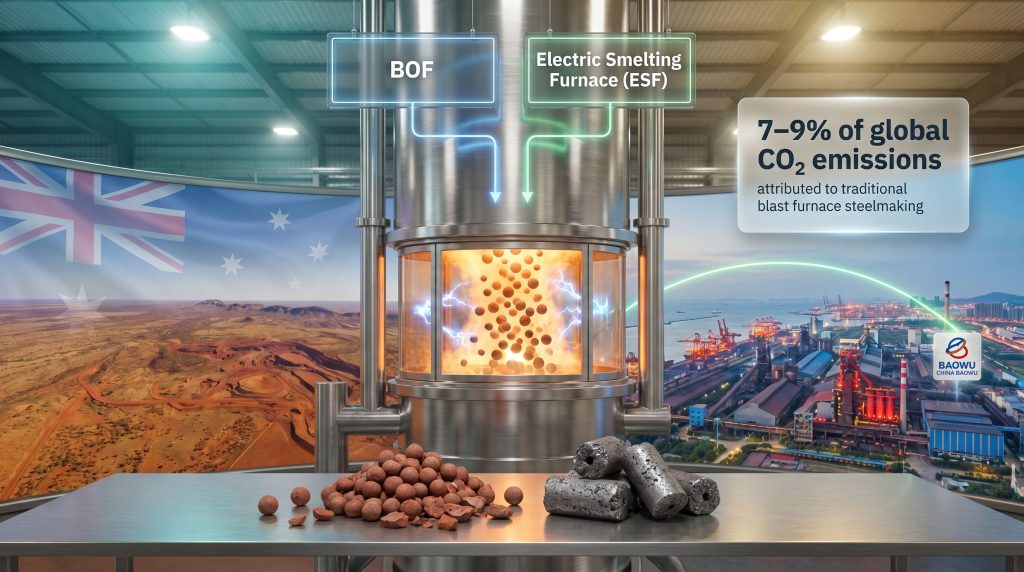
Steel sits at the centre of modern civilisation. It frames our buildings, reinforces our infrastructure, and underpins the machinery of global trade. Yet the process used to produce the overwhelming majority of the world's steel has remained fundamentally unchanged for more than a century, and it carries an enormous carbon cost. Conventional blast furnace steelmaking is responsible for approximately 7 to 9 percent of global CO₂ emissions, making Rio and China Baowu low carbon steelmaking trials all the more strategically significant for the global steel sector.
What makes this problem particularly resistant to simple solutions is not just economics. The barriers are metallurgical. Blast furnaces are designed around the chemical properties of coke, and the iron ore grades they consume have been optimised over decades to suit that process. Replacing the entire paradigm requires not only new technology, but new feedstock logic.
That is precisely why the completion of industrial-scale pelletisation and shaft furnace trials between Rio Tinto (ASX: RIO) and China Baowu at the Baoshan Zhanjiang steel operations in China represents a genuinely meaningful moment for the global steel decarbonization agenda.
When big ASX news breaks, our subscribers know first
Why Blast Furnace Technology Has Proven So Difficult to Displace
The Carbon Intensity of Conventional Steelmaking
In a traditional integrated steelmaking plant, coking coal is converted into metallurgical coke, which is then fed into a blast furnace alongside iron ore. The coke serves a dual function: it generates the intense heat required to melt ore, and it acts as the chemical reducing agent that strips oxygen from iron oxide to produce metallic iron.
The problem is that this chemical reaction produces CO₂ as its primary byproduct. There is no way to run a coke-based blast furnace without generating substantial carbon emissions. On average, producing one tonne of crude steel via the blast furnace route generates approximately 1.8 to 2.1 tonnes of CO₂, depending on the efficiency of the facility and the quality of inputs used.
Why Ore Grade Has Always Been a Gatekeeping Variable
One of the less-discussed constraints on low-carbon steelmaking pathways involves the chemistry of the iron ore itself. Hydrogen iron ore reduction, which uses hydrogen gas rather than coke as the reducing agent, is highly sensitive to ore quality. Contaminants such as alumina, silica, and phosphorus can interfere with the reduction chemistry inside a shaft furnace, producing a lower-quality sponge iron product that is harder to refine downstream.
This is why, for years, the emerging DRI sector has relied almost exclusively on high-grade iron ore pellets, typically those with iron content above 67 percent Fe. The dominance of this requirement created a quiet but significant problem for Australia's iron ore industry.
How Hydrogen-Based Direct Reduction Actually Works
From Blast Furnace to Shaft Furnace: The Process Shift Explained
Direct reduced iron (DRI) technology replaces the blast furnace with a shaft furnace, which is a tall vertical reactor that allows iron ore pellets to descend slowly through a rising stream of hot reducing gas. When hydrogen is used as that reducing gas, the chemical reaction that removes oxygen from iron oxide produces water vapour rather than CO₂, dramatically cutting the emissions profile of the process.
The full DRI steelmaking pathway works as follows:
-
Iron ore pelletisation – Raw ore is processed into pellets of consistent size, chemistry, and physical strength suitable for shaft furnace feeding. Pellet quality is critical, as inconsistent pellets can cause uneven gas flow inside the furnace.
-
Shaft furnace reduction – Pellets are exposed to a hydrogen-rich reducing gas as they descend through the reactor. Over several hours, oxygen is chemically removed from the iron oxide without any combustion taking place.
-
Direct reduced iron output – The output product, known as sponge iron or DRI, retains a high metallic iron content and can be handled as a solid material or discharged hot directly into the next processing stage.
-
Steelmaking conversion – The DRI is charged into either a basic oxygen furnace (BOF) or an electric arc furnace (EAF) or an electric smelting furnace (ESF) to produce crude steel, removing remaining impurities and adjusting alloy chemistry to specification.
Electric Smelting Furnaces vs. Basic Oxygen Furnaces
One of the distinctive features of the Rio and China Baowu low carbon steelmaking trials was the testing of two separate downstream conversion routes, the conventional BOF pathway and an electric smelting furnace configuration. This dual-route approach is strategically significant because it reflects real-world steelmaking constraints.
| Feature | Basic Oxygen Furnace (BOF) | Electric Smelting Furnace (ESF) |
|---|---|---|
| Primary energy source | Chemical (carbon/coke additions) | Electrical |
| Carbon emissions intensity | Moderate to high | Lower (grid-dependent) |
| Compatibility with DRI | Yes, with blend adjustments | Yes, purpose-designed |
| Scalability for green steel | Limited by carbon inputs | High potential |
| Technology maturity | Commercially proven globally | Emerging at industrial scale |
The ESF route is considered the more promising long-term pathway for truly low-carbon steel, but it requires access to clean electricity at competitive prices. Testing both routes simultaneously gives the partnership a more complete picture of commercial viability across different energy contexts.
What the Zhanjiang Trials Actually Demonstrated
Why Location and Operational Context Matter
The Baoshan Zhanjiang facility is not a small pilot plant or a controlled laboratory environment. It is a large, modern, commercially operating steel facility in Guangdong province, China. Conducting the trials at this location rather than in a dedicated research environment means the results reflect actual industrial conditions, including variability in feedstock handling, furnace operational rhythms, and downstream processing constraints.
This distinction matters enormously. The steel sector is full of technologies that have demonstrated promise at pilot scale but failed to translate when confronted with the thermal loads, throughput demands, and operational complexity of a full-scale production environment.
The Pilbara Blend at the Centre of the Experiment
Rio Tinto's Pilbara Blend is the company's flagship iron ore product and one of the most widely traded iron ore products in the global seaborne market. It is a mid-grade material, with iron content typically around 62 percent Fe, sitting well below the 67 percent threshold historically considered necessary for DRI-grade feedstock.
According to results published by Rio Tinto, "the trials demonstrated that pellets incorporating approximately one-third Pilbara Blend iron ore can successfully feed a hydrogen-based shaft furnace at industrial scale, directly challenging the long-held assumption that DRI pathways require exclusively high-grade feedstock."
Achieving this at industrial scale, rather than in a controlled laboratory setting, is the key milestone. It suggests the metallurgical barriers associated with mid-grade ore in DRI applications may be more manageable than previously assumed, at least when pellet formulation and furnace operating parameters are carefully engineered.
What the One-Third Blend Ratio Tells Industry
The use of approximately one-third Pilbara Blend in the pellet mix is an important technical signal. It indicates that mid-grade ore is not being used as a dominant feedstock but rather as a meaningful partial substitute within a blended formulation. This approach likely allows the pellet chemistry to remain within acceptable bounds for shaft furnace operation while simultaneously incorporating a lower-cost, more abundantly available ore type.
From a metallurgical standpoint, blending is a well-established technique for managing ore quality variation. What is new here is the validation that this approach can work within the demanding chemistry of hydrogen-based reduction at commercial scale.
Why This Matters for Australia's Iron Ore Industry
The Mid-Grade Problem in Context
Australia's iron ore leadership in global seaborne supply means the Pilbara region produces hundreds of millions of tonnes annually. However, a large proportion of that output sits in the mid-grade range, and the long-term trajectory of global steel decarbonization has posed a quiet but serious question: what happens to mid-grade Pilbara ore in a world where steelmakers increasingly require high-grade DRI-compatible feedstock?
| Ore Type | Typical Fe Grade | DRI Suitability (Pre-Trial) | Post-Trial Outlook |
|---|---|---|---|
| High-grade DR-grade pellets | 67%+ Fe | Established and commercially deployed | Unchanged |
| Pilbara Blend (Rio Tinto) | ~62% Fe | Widely questioned for DRI use | Demonstrated viable in blend at industrial scale |
| Brazilian high-grade fines | 65%+ Fe | Established | Unchanged |
| Other mid-grade Pilbara ores | 58–62% Fe | Largely unproven for DRI | Under evaluation |
If further trials confirm and extend the Zhanjiang findings, the implications for Western Australian iron ore exports could be substantial. It would mean that a very large existing export base remains relevant within a transitioning steel sector, rather than being progressively displaced by higher-grade alternatives from other regions.
A Speculative but Plausible Industry Scenario
One scenario now under consideration within the industry is that large-scale DRI plants of the future could be specifically engineered to accommodate blended feedstocks that include mid-grade Pilbara ore. Furthermore, if shaft furnace and pelletisation technology continues to advance in parallel with hydrogen supply buildout, the feedstock constraints that have historically limited mid-grade ore's role in low-carbon steelmaking could progressively diminish.
This remains speculative. A one-third blend ratio is not the same as full replacement of high-grade feedstock, and scaling this approach across diverse operational contexts will require significant further validation. Investors and industry stakeholders should treat this as a directional signal rather than a confirmed commercial outcome.
The Rio Tinto and China Baowu Partnership: Strategic Architecture
Building Collaboration from 2020 Onwards
The relationship between Rio Tinto and China Baowu, which is the world's largest steel producer by output, did not emerge suddenly. The two companies have been building cooperative frameworks around decarbonization since at least 2020, with formal structures progressively deepening as both parties developed greater technical clarity on feasible pathways.
A Memorandum of Understanding signed in 2023 formalised a shared agenda focused specifically on reducing the carbon intensity of steelmaking using Rio Tinto's iron ore products. The completed Zhanjiang trials represent the most advanced technical output of that collaborative framework to date. As ESG News reported, this extended climate partnership is designed to decarbonise the entire steel value chain, not simply one segment of it.
What Cross-Border Industrial Collaboration Reveals
The Rio and China Baowu low carbon steelmaking trials model is notable for what it reveals about how large-scale industrial decarbonization is likely to be achieved. Neither party could have conducted these trials independently with the same relevance. Rio Tinto brings the feedstock and the upstream pelletisation expertise. China Baowu brings the industrial-scale steelmaking infrastructure, the operational knowledge of shaft furnace technology, and direct access to the Chinese steel market, which accounts for roughly half of global steel production.
The collaboration integrates both ends of the supply chain within a single joint technical programme. This is structurally different from a supplier-customer relationship, and it creates incentive alignment around solving shared technical problems rather than simply negotiating price and volume.
The next major ASX story will hit our subscribers first
The Global Green Steel Race: Where This Trial Fits
Mapping the Competitive Landscape
These trials sit within a broader global effort to commercialise DRI-based steelmaking pathways. For instance, green iron production initiatives are advancing across multiple continents, with several major programmes progressing simultaneously at varying stages of development.
| Initiative | Parties Involved | Technology Route | Current Stage |
|---|---|---|---|
| Rio Tinto and China Baowu | Mining major + world's largest steel producer | H₂ shaft furnace + BOF and ESF | Industrial trials completed (2026) |
| HYBRIT (Sweden) | SSAB, LKAB, Vattenfall | H₂ DRI + Electric Arc Furnace | Pilot and demonstration phase |
| Thyssenkrupp DRI | Thyssenkrupp Steel | H₂ shaft furnace | Demonstration scale |
| BHP and JFE Steel | Mining major + Japanese steelmaker | Various low-carbon technology routes | Research and development |
The Zhanjiang trials appear to represent one of the more advanced industrial-scale validations of this technology to date, particularly in the context of using commercially traded seaborne iron ore rather than purpose-engineered research-grade material. Consequently, Rio Tinto zero-carbon steel ambitions are reinforced by this industrial progress, building a compelling case across multiple partnerships and geographies.
Where Hydrogen Becomes the Binding Constraint
Successfully reducing iron ore in a shaft furnace with hydrogen at industrial scale is one challenge. Sourcing sufficient low-emissions hydrogen to run that process at commercial volumes is another challenge entirely. Green hydrogen, produced by electrolysing water using renewable electricity, remains significantly more expensive than hydrogen derived from natural gas.
Until green hydrogen costs fall to levels competitive with fossil-based alternatives, DRI plants using hydrogen will likely operate using a mix of hydrogen and natural gas as the reducing agent, with the hydrogen fraction increasing over time as economics improve. This transitional approach still delivers meaningful emissions reductions compared to conventional blast furnace steelmaking, but it does not yet reach the near-zero emissions potential of a fully hydrogen-powered DRI route.
Remaining Barriers Between Proven Technology and Widespread Deployment
Capital Requirements Are Not Trivial
Even with the industrial validation achieved at Zhanjiang, the pathway from successful trial to widespread commercial deployment involves a series of substantial capital commitments. However, the sector's direction of travel is now considerably clearer. Key investment requirements include:
-
Shaft furnace infrastructure: Existing blast furnace-based steel plants require either major retrofitting or replacement with new shaft furnace technology, at considerable cost per facility.
-
Pelletisation capacity: Mid-grade ores require sophisticated pelletisation to meet DRI-grade input specifications. Expanding pelletisation infrastructure at the scale required adds meaningful capital expenditure to iron ore producers.
-
Green hydrogen production: Achieving the emissions benefits of hydrogen-based DRI depends on the availability of green hydrogen at competitive prices, which in turn requires large-scale renewable energy and electrolysis capacity.
-
Grid infrastructure: The electric smelting furnace route demands access to reliable, clean electrical power at industrial scale, which is not uniformly available across all steelmaking geographies.
Pellet Quality Consistency at Volume
One of the more technically nuanced challenges involves maintaining consistent pellet chemistry and physical integrity across very large production volumes. Laboratory and small-scale trials can optimise pellet formulations carefully. Full commercial-scale pelletisation plants must do so continuously, with real-world variability in ore feed chemistry, moisture content, and grinding performance. Any degradation in pellet quality at volume can affect shaft furnace gas flow dynamics and DRI metallic yield, with downstream consequences for steel quality.
Frequently Asked Questions: Rio Tinto, China Baowu, and Low-Carbon Steelmaking
What is direct reduced iron and why does it matter for green steel?
Direct reduced iron is metallic iron produced by removing oxygen from iron ore using a reducing gas, typically a mixture of hydrogen and carbon monoxide, rather than through combustion with coke. It is the core intermediate product in the DRI steelmaking pathway and enables significantly lower carbon emissions than conventional blast furnace production when the reducing gas contains a high proportion of hydrogen.
What made the Zhanjiang trials different from earlier small-scale experiments?
The trials were conducted at an operating commercial steel facility rather than in a laboratory or dedicated pilot environment. This exposed the technology to real industrial operating conditions, including the throughput demands, thermal variability, and downstream processing requirements of a full-scale steelmaking plant. Industrial-scale validation is fundamentally different from pilot-scale success.
Can Pilbara iron ore fully replace high-grade DRI feedstock in the future?
Based on current evidence, a full replacement scenario is not yet validated. The Zhanjiang trials used a blend incorporating approximately one-third Pilbara Blend ore. Whether a higher proportion of mid-grade ore can be used while maintaining acceptable shaft furnace performance and DRI quality remains an open research question requiring further investigation.
What does this mean for Rio Tinto's long-term iron ore strategy?
For Rio Tinto, demonstrating that its flagship Pilbara Blend product has a viable role in the DRI supply chain is strategically important. It extends the commercial relevance of the company's dominant product into the emerging green steel economy, and it positions Rio Tinto as an active technology partner in steel sector decarbonization rather than a passive commodity supplier facing potential feedstock substitution. In addition, China steel and iron ore dynamics will play a central role in determining how quickly these validated technologies scale across the world's largest steel-producing nation.
Key Takeaways: Reading the Signals Correctly
For Iron Ore Producers
The industrial validation of mid-grade ore in a hydrogen-based DRI process is a meaningful development for Pilbara-focused producers. It does not eliminate the commercial premium that high-grade DR-grade material commands, but it opens a potential pathway for mid-grade ore to participate in the green steel supply chain rather than being progressively marginalised by it.
For Steel Producers
The Zhanjiang trials provide industrial proof that the DRI transition is technically achievable using commercially available seaborne iron ore products. For steelmakers navigating decarbonization investment decisions, this reduces one layer of feedstock uncertainty in the DRI business case.
For Investors
Rio and China Baowu low carbon steelmaking trials contribute to Rio Tinto's positioning as a mining major actively engineering relevance within the green steel transition. However, investors should note that industrial trial success and commercial-scale deployment are separated by significant capital, hydrogen supply, and infrastructure hurdles. The trials represent a technical proof point, not a near-term earnings catalyst.
This article contains references to forward-looking scenarios and industry projections. These involve inherent uncertainty and should not be interpreted as financial advice. Readers are encouraged to conduct independent research and consult qualified advisers before making investment decisions.
For further coverage of Rio Tinto's operational and sustainability activities, as well as broader analysis of the Australian mining sector, visit australianminingreview.com.au.
Want to Stay Ahead of the Next Major ASX Mining Discovery?
Discovery Alert's proprietary Discovery IQ model delivers real-time alerts on significant ASX mineral discoveries — instantly converting complex data across more than 30 commodities into clear, actionable insights for both traders and long-term investors. Explore historic discoveries and the extraordinary returns they have generated, then begin your 14-day free trial at Discovery Alert to position yourself ahead of the broader market.