
July 11, 2026
The Hidden Capital Engine Powering BHP's Copper Ambitions
Global mining majors have spent decades accumulating infrastructure alongside their ore bodies, treating power lines, pipelines, and water systems as operational necessities rather than balance sheet assets. That logic is now being systematically dismantled. The world's largest miners are beginning to treat midstream infrastructure the same way airlines treat their terminal leases or telecoms treat their tower networks: as monetisable assets that can be separated from the underlying operation without sacrificing control. The BHP sale of Chilean desalination plant and power lines assets represents one of the most significant expressions of this shift yet seen in the copper sector.
When big ASX news breaks, our subscribers know first
Rethinking What a Mining Company Should Own
There is a fundamental distinction between assets that generate copper and assets that simply enable copper to be generated. Ore bodies, concentrators, smelters, and tailings facilities are irreplaceable components of the production chain. High-voltage transmission networks and seawater desalination plants, by contrast, are infrastructure utilities whose value lies in their cash flow reliability rather than their metallurgical function.
This distinction is driving a structural transformation in how Tier 1 miners think about their balance sheets. Private infrastructure capital, including pension funds, sovereign wealth managers, and dedicated infrastructure funds, has spent years competing for long-duration assets with contracted cash flows. Mining infrastructure, historically locked inside vertically integrated mining companies, is now being recognised as a natural fit for this capital class.
BHP's move to potentially divest its Chilean utility assets is not a distress signal. It is a deliberate separation of ownership from utilisation, a model that has already been proven in adjacent sectors and is now arriving in large-scale copper mining. Furthermore, the copper supply crunch facing the industry makes capital efficiency of this kind increasingly critical for majors seeking to expand production capacity.
Asset Profiles: What Is Actually on the Table
The two asset categories under consideration represent genuinely distinct infrastructure propositions, each with its own buyer universe and risk profile.
Puerto Coloso: A Desalination Marvel With No Substitute
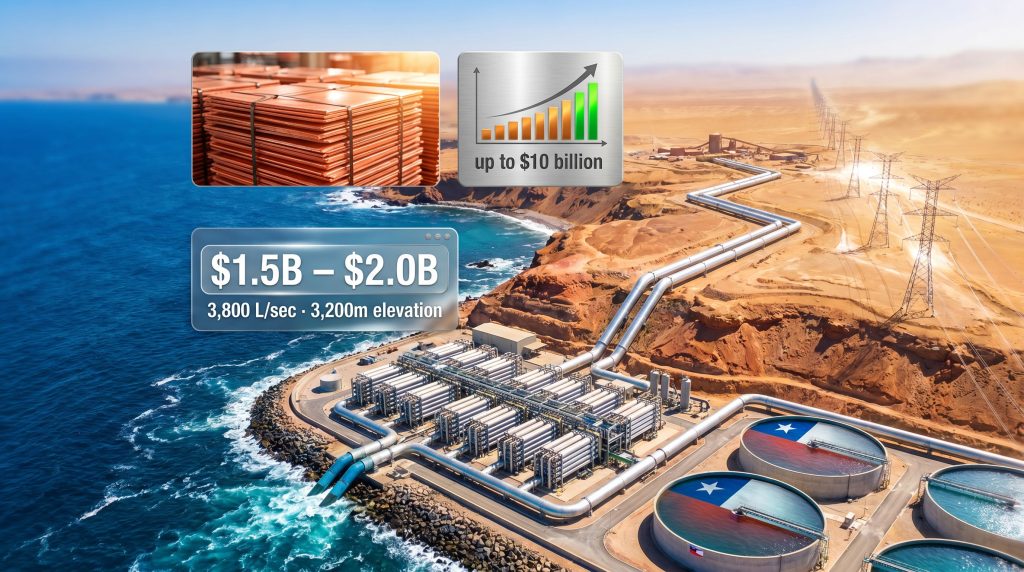
The Puerto Coloso desalination plant is not simply large. It is operationally irreplaceable. The facility operates using reverse osmosis technology and is capable of processing 3,800 litres of seawater per second, subsequently pumping that treated water to altitudes exceeding 3,200 metres above sea level to supply Escondida, the single highest-output copper mine on the planet.
The engineering achievement embedded in this asset is frequently underappreciated. Pumping desalinated water at that volume against gravity to that elevation requires enormous sustained energy input and represents a feat of industrial hydraulic engineering that took years to develop. The plant did not exist in its current form at Escondida's inception. It was progressively expanded as Chilean environmental regulation progressively tightened restrictions on freshwater extraction from the Atacama region's already critically stressed aquifer systems.
This regulatory trajectory is not reversing. Chilean authorities have applied increasing scrutiny to mining operations drawing on the Atacama watershed, meaning any future copper operation in northern Chile will face the same water supply problem that Escondida solved through desalination. Puerto Coloso is therefore not just a functioning utility but a proof-of-concept and potential template for the region's entire copper mining water future.
Estimated standalone valuation: $500 million to $700 million.
The Transmission Network: Grid Scale Across Three Mines
The electricity transmission infrastructure spans approximately 1,000 kilometres of high-voltage lines serving not just Escondida but also the Spence and Cerro Colorado copper operations. This is a regional electricity distribution system of genuine scale, comparable in reach to utility networks serving mid-sized regions in developed economies.
What makes this asset particularly attractive to infrastructure capital is the counterparty quality. Any buyer would effectively be selling electricity transmission services to BHP, one of the highest-grade corporate counterparties in the global mining sector, under long-term service agreements. The revenue profile resembles a regulated utility with blue-chip off-take security.
Estimated standalone valuation: $1 billion to $1.3 billion.
Combined Transaction Overview
| Asset | Operational Scope | Estimated Valuation |
|---|---|---|
| Puerto Coloso Desalination Plant | 3,800 L/sec capacity; 3,200m+ elevation delivery | $500M to $700M |
| Chilean Power Transmission Lines | ~1,000 km high-voltage network; 3 copper mines served | $1B to $1.3B |
| Combined Transaction | Integrated infrastructure package | $1.5B to $2.0B |
The $10 Billion Capital Recycling Architecture
To understand why these assets are being explored for sale, it is necessary to understand the broader capital programme within which this transaction sits. BHP has publicly outlined an ambition to unlock up to $10 billion from non-core assets, infrastructure holdings, and by-product monetisation to fund its copper and potash growth pipeline without proportional increases in debt.
The transactions already completed or in progress provide the context:
- BHP sold a 49% stake in power transmission assets serving its Western Australian iron ore operations to Global Infrastructure Partners, a BlackRock subsidiary, establishing the structural template for this type of transaction.
- BHP finalised a $4.3 billion silver streaming deal tied to the Antamina copper-zinc mine in Peru, monetising future by-product silver output in exchange for upfront capital.
- The BHP sale of Chilean desalination plant and power lines assets, if completed at the midpoint of its estimated range, would contribute an additional $1.75 billion toward the overall target.
These are not isolated events. They represent a coordinated, multi-channel liquidity generation programme with a consistent underlying logic: convert infrastructure and by-product positions into copper growth capital.
The strategic coherence of this approach is notable. Each transaction follows the same structural principle: separate ownership from operational access, secure long-term service agreements to protect production continuity, and redeploy proceeds into copper ore body development where BHP's competitive advantage is strongest.
Where the Proceeds Are Headed
The capital freed through this infrastructure monetisation programme has identifiable destinations within BHP's disclosed growth pipeline:
- Escondida expansion: The world's largest copper mine is undergoing one of the most capital-intensive expansion programmes currently active globally, with investments targeting sustained high-volume output through the next decade.
- Josemaria copper-gold project: Located in Argentina's San Juan province, this large-scale development project represents a significant future production asset.
- Filo del Sol: Positioned along the Argentina-Chile border, this project sits within a district increasingly recognised as one of South America's most prospective emerging copper corridors.
- Vicuña copper district: BHP has committed capital to the Vicuña district in Argentina, which is being developed as a large-scale copper province with long-term production potential.
These projects collectively define BHP's forward copper production profile through the 2030s. In addition, the Rio Tinto copper expansion underway in parallel illustrates how the sector's largest players are racing to secure future production capacity. The infrastructure divestiture programme is, in this context, a financing mechanism for the next generation of production, not a contraction of ambition.
Why Water Scarcity Elevates the Desalination Asset's Strategic Value
The Atacama Desert receives less than 15 millimetres of rainfall annually across large portions of its extent, making it one of the most hyperarid environments on Earth. For copper mining operations in northern Chile, this is not a background condition. It is an existential operational constraint.
Historically, mining operations sourced water from groundwater aquifers and river systems in the Atacama region. Decades of intensive extraction combined with climate-related reductions in recharge rates have placed these systems under severe stress. Chilean regulators have responded with increasingly restrictive water rights frameworks that constrain mining operations' access to freshwater from terrestrial sources.
This regulatory evolution has one inevitable consequence: desalination is no longer optional for large-scale copper mining in northern Chile. It is the only viable pathway to water security at scale. The Puerto Coloso plant, already sized for Escondida's current operational needs, carries a strategic premium that extends well beyond its current cash flow profile. Consequently, any buyer acquires not just contracted revenue but exposure to infrastructure that is structurally non-replicable in the short term within the region's regulatory and physical geography.
This makes the desalination asset particularly compelling for infrastructure capital with environmental, social, and governance mandates. Scaling sustainability through desalination has become an increasingly recognised pathway for responsible copper production, and reverse osmosis technology that reduces pressure on stressed Atacama water systems carries genuine environmental credentials that align with institutional sustainability frameworks.
The next major ASX story will hit our subscribers first
Who Is Likely to Buy These Assets?
No formal sale process has been launched as of July 2026, and no potential acquirers have been identified publicly. However, the structural characteristics of these assets point clearly toward several buyer categories.
Specialist Global Infrastructure Funds are the most natural acquirers. Firms like Macquarie Infrastructure, Brookfield Infrastructure, and Global Infrastructure Partners, which already holds the precedent transaction in BHP's Australian iron ore transmission assets, actively compete for exactly this asset profile: long-duration, contracted cash flows with investment-grade counterparties.
Pension and Sovereign Wealth Funds managing large allocations to real assets and infrastructure have shown increasing appetite for mining-adjacent infrastructure, particularly where the off-take arrangements provide inflation-passthrough characteristics. The contracted nature of the revenue stream, backed by BHP's balance sheet quality, fits this mandate precisely.
Renewable Energy Developers active in Chile's northern regions may view the transmission network as strategic grid access infrastructure relevant to Chile's ambitious renewable energy transition programme. Chile has set significant renewable energy capacity targets, and high-voltage transmission assets in the north, where solar irradiance is among the highest on Earth, carry optionality value beyond their immediate mining service function.
Regional Latin American Energy Operators may also evaluate the transmission network as a natural extension of existing grid infrastructure in the region.
Transaction Structure and Timeline
The deal remains at an exploratory stage. Several structural pathways remain open:
- Full outright sale of both assets to a single acquirer, maximising transaction simplicity and minimising execution complexity.
- Partial stake divestiture, mirroring the 49% model used in Western Australia, which allows BHP to retain partial economic exposure while releasing significant capital.
- Separate asset sales, marketing the desalination plant and transmission network independently to different buyer pools, potentially maximising competitive tension and valuation outcomes.
Market sources suggest a potential completion within 2026, though this is contingent on formal process launch, regulatory approvals in Chile, and final board authorisation. BHP has declined to provide any official public commentary on the process.
The Broader Mining Finance Megatrend
BHP's Chilean infrastructure exploration is one data point within a much larger structural shift. Tier 1 miners globally are progressively recognising that owning utility-grade infrastructure ties up capital that earns a utility-grade return while the underlying mining business competes for capital allocation against other corporate priorities.
Private infrastructure capital, by contrast, can underwrite these assets at lower required returns given their contracted, long-duration cash flow profiles. This creates a genuine valuation arbitrage: infrastructure assets sitting on mining company balance sheets at mining company cost-of-capital discount rates are worth more in the hands of infrastructure funds that price them at infrastructure fund discount rates.
This arbitrage is what makes BHP's programme financially logical beyond the headline capital release. Every dollar of infrastructure monetised at an infrastructure fund valuation is a dollar of copper growth capital funded at an effectively lower cost than debt or equity issuance could achieve. The commodity price impact on balance sheet decisions further reinforces why BHP and its peers are pursuing these structures now rather than waiting for commodity cycles to do the heavy lifting.
For investors tracking the sector, the Chile copper outlook remains a critical input when assessing the long-term value of these Chilean infrastructure assets. For investors tracking BHP (ASX: BHP), the BHP sale of Chilean desalination plant and power lines, if completed at the upper end of the valuation range, brings the company materially closer to its $10 billion non-core asset target. Combined with the Antamina streaming deal and the Australian iron ore transmission transaction, the coordinated programme demonstrates a disciplined, long-cycle approach to balance sheet optimisation that enhances copper exposure without proportional leverage increases. Those exploring copper investment strategies will find BHP's approach a compelling case study in how major producers are reshaping their capital structures to fund the next wave of production growth.
Disclaimer: This article contains forward-looking statements, estimated valuations, and analytical commentary based on publicly available information as of July 2026. Valuations cited represent market estimates from sources familiar with the matter and should not be construed as confirmed transaction terms. Investors should conduct independent due diligence before making any investment decisions.
Want to Capitalise on the Next Major Copper Discovery Before the Market Catches On?
Discovery Alert's proprietary Discovery IQ model scans ASX announcements in real time, instantly identifying significant mineral discoveries — including transformative copper finds — and delivering actionable insights to subscribers ahead of the broader market. Explore how historic discoveries have generated substantial returns on Discovery Alert's dedicated discoveries page, and begin your 14-day free trial today to position yourself at the forefront of the next major copper opportunity.