July 11, 2026
Why Most Investors Are Thinking About Commodity Markets the Wrong Way
There is a persistent misconception embedded in how most retail investors approach natural resource markets: that the news cycle is the signal. In reality, the most durable returns in cyclical commodity markets have almost never been generated by reacting to headlines. They have been built by understanding structural supply and demand dynamics years before those dynamics become obvious to the broader market.
This distinction sits at the core of Rick Rule on gold copper uranium and oil shock, the investment philosophy that Rick Rule, a financier with more than five decades of experience in the natural resource sector, has applied throughout his career. Interviewed at the Rule Symposium for Natural Resource Investing at the Boca Raton Resort in Florida, Rule offered a rare window into how a 50-year veteran thinks about gold, copper, uranium, and the oil shock he flagged months before it materialised in mid-2026.
What follows is not a summary of market sentiment. It is a structured analysis of the arithmetic frameworks, portfolio architecture principles, and structural commodity theses that underpin one of the most rigorous approaches to resource investing in practice today.
When big ASX news breaks, our subscribers know first
The Psychology of Contrarian Investing: Buying Hate Before the Window Closes
Why News-Driven Positioning Destroys Long-Term Returns
One of the clearest observations Rule shared at the symposium was that too many investors rely on news because it allows them to feel rather than think. Reactive positioning is cognitively easier than structural analysis, but it consistently undermines long-term performance in cyclical markets. The path to genuine contrarian junior mining success requires the discipline to separate current sentiment from underlying fundamentals.
The psychological trap is well documented in behavioural finance. When an asset is broadly despised, its price typically sits well below intrinsic value, creating an asymmetric opportunity for patient investors. However, the challenge is that the emotional environment necessary to produce that mispricing is the same environment that makes purchasing the asset feel deeply uncomfortable.
The Inevitable vs. Imminent Distinction
One of the more nuanced points Rule raised is the critical difference between something being inevitable and something being imminent. This distinction represents one of the most common and costly errors made even by experienced resource investors: holding a structurally correct thesis but applying the wrong time horizon to it.
If an investor understands that the copper supply crunch will structurally overwhelm supply within three to five years but cannot psychologically tolerate a six-month drawdown in copper equities, the thesis will be abandoned before it pays out. Strategic correctness without tactical conviction produces the same outcome as being wrong.
The easy money in cyclical resource markets is made by purchasing assets when they are broadly despised. Once sentiment normalises, the opportunity shifts from speculative to structural. It remains profitable, but it demands patience and a depth of understanding sufficient to hold through inevitable volatility.
Rule's current read on the market is that nothing across the major commodity sectors is genuinely hated right now. That means the easy, contrarian money has largely been made. What remains is structural certainty, which is still highly attractive but demands a different investor temperament than pure contrarian positioning.
Rick Rule's Portfolio Architecture: Four Buckets, Four Functions
How a 50-Year Resource Financier Structures Capital
Rule organises his capital across four distinct categories, each serving a fundamentally different risk-return function:
- Physical gold functions as a savings asset, not a speculation. It is not traded against near-term price targets but held as a store of purchasing power across an anticipated decade-long dollar debasement cycle.
- US dollar liquidity is maintained separately as a buffer for opportunistic deployment when assets become genuinely hated and mispriced.
- Senior gold producer equities provide leveraged exposure to the gold price within an investment-grade framework.
- Junior gold exploration stocks are held as outright speculations with asymmetric upside tied to exploration discovery outcomes.
This architecture is notable for its deliberate refusal to conflate categories. Many retail investors make the mistake of treating speculative junior miners as savings assets or treating physical gold as a trading vehicle. The discipline of maintaining clear functional distinctions across the portfolio is itself a risk management framework.
The Hours-Per-Month Rule: A Framework Every Retail Investor Should Understand
One of the more practically applicable insights from the symposium involves portfolio concentration. Rule's position is that the number of stocks an investor should hold is directly proportional to the number of hours per month they are genuinely willing to spend researching those companies.
An investor committing ten hours per month to research should own approximately ten stocks. Thirty hours per month justifies thirty positions. Rule himself, with a full team of geologists, engineers, and financial analysts, studies markets for at least forty hours per week and maintains a correspondingly larger portfolio.
Most retail investors are structurally over-diversified relative to their actual research capacity. Owning forty stocks while spending two hours per month on analysis is not diversification. It is the illusion of diversification with the reality of uninformed speculation.
The Exhibitor Standard: Ownership as a Quality Filter
At the Rule Symposium, no company is permitted to exhibit on the floor unless Rule personally owns it in his own or managed accounts. More than 130 companies were turned away ahead of the 2026 event. This personal ownership standard functions as the ultimate quality filter, because no analytical framework produces more rigorous vetting than having one's own capital at risk.
Importantly, Rule distinguishes between investment-grade and speculative positions. Both can qualify for the floor. What they must share is being suitable for purpose, meaning the risk profile and business fundamentals are aligned with what they are represented to be.
The Oil Shock: Two Phases, One Structural Deficit
Understanding the Mechanics Behind the 2026 Oil Price Move
Months before oil prices spiked in mid-2026 following renewed US military engagement with Iran, Rule had publicly flagged the Gulf conflict as a significant wildcard for energy markets. Furthermore, the nature of an oil price shock is more structurally complex than a simple geopolitical price spike. Consequently, the crude oil price trends playing out now reflect both sentiment-driven and fundamentals-driven forces simultaneously.
| Phase | Primary Driver | Timeline | Market Behaviour |
|---|---|---|---|
| Phase 1: Fear Pricing | Strategic stockpiling, conflict anticipation | Immediate | Price rises on sentiment and hoarding behaviour |
| Phase 2: Physical Rationing | Real inventory depletion, supply disruption | 2 to 3 weeks post-escalation | Sharp repricing based on physical shortage signals |
| Phase 3: Structural Deficit | Decade of underinvestment in sustaining capital | 2029 to 2030 | Permanent price rationing independent of geopolitics |
The crucial insight is that whilst a ceasefire can end the Phase 1 and Phase 2 dynamics, it cannot reverse the Phase 3 structural supply deficit. Rule's oil investments are positioned for the structural phase, not the geopolitical spike.
The $1 Billion Per Day Underinvestment Problem
The oil industry is currently underinvesting in sustaining capital by approximately $1 billion per day below replacement levels. This is not a figure generated by conflict. It predates the current Gulf tensions by years and reflects a systemic retreat from long-cycle capital expenditure driven by energy transition uncertainty, ESG-driven capital restrictions, and investor preference for near-term cash returns over exploratory reinvestment.
The consequence is a structural supply deficit expected to become acute by approximately 2029 to 2030. No armistice or diplomatic resolution can compress the multi-year capital cycle required to bring replacement production online.
Investors positioning solely on geopolitical headlines risk being reversed by ceasefire announcements. The structural oil supply deficit is entirely independent of any single conflict's resolution and is driven by capital cycle dynamics that have been developing for over a decade.
Historical Parallel: How Energy Security Shocks Reshape Policy for Decades
Rule drew a direct historical parallel to the 1973 Arab oil embargo, which directly catalysed the construction of France's nuclear fleet, currently the fourth largest in the world, and Japan's nuclear programme, the third largest at its peak. Both nations concluded that domestic energy security required insulation from geopolitical supply shocks, making that determination on the back of a single, acute pricing event.
The current Gulf conflict has produced a comparable re-awakening of energy security as a primary policy concern across the United States, Japan, and Europe. Whether this translates into capital commitments of equivalent scale remains to be observed, but the directional policy shift is measurable and accelerating.
Copper: The Most Arithmetically Certain Commodity Thesis of the Decade
The Supply-Demand Mathematics That Make Copper Unavoidable
Rule's copper thesis is built entirely on arithmetic. The global copper market is currently running a production deficit, meaning the world is consuming more copper than it produces. Existing inventory buffers provide approximately three years of runway before global stockpiles are exhausted.
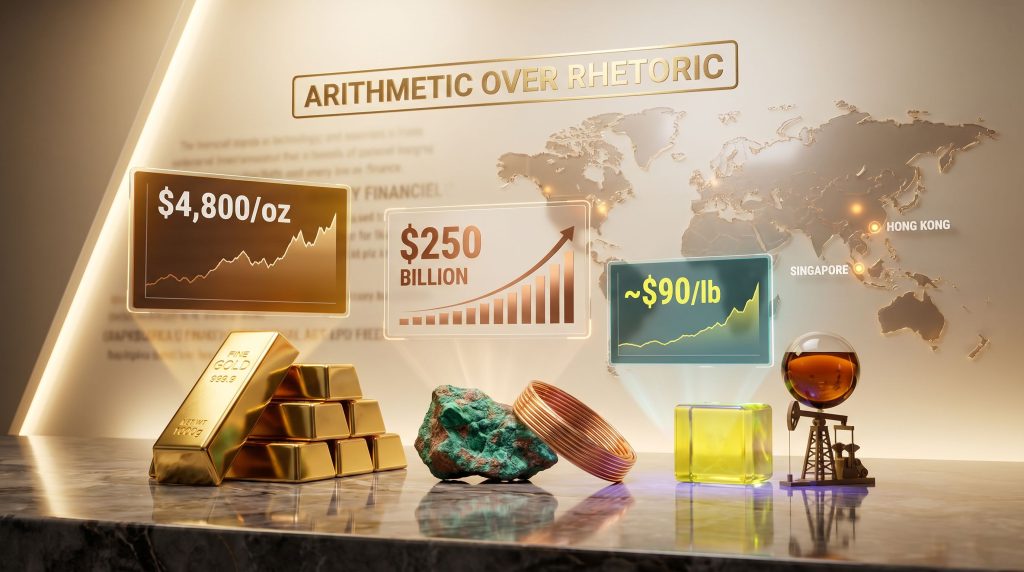
A paper presented at Metals Week in London identified that the ten largest copper mining companies globally would need to collectively invest $250 billion simply to maintain current production levels, not to grow output in a market already running a deficit. Critically, those companies do not currently hold that capital on their balance sheets, and even if they mobilised it immediately, the 16 to 17 year exploration-to-production timeline means that investment today cannot meaningfully impact supply until the mid-2040s.
The 15 to 17 Year Lag: Why Capital Cannot Solve a Geological Timeline Problem
This is perhaps the most underappreciated structural feature of the copper market. Mining is not a sector where capital can be deployed quickly to produce results. From greenfield exploration discovery to first commercial production, the average timeline runs 16 to 17 years, encompassing geological assessment, feasibility studies, permitting, financing, construction, and commissioning.
Twenty to thirty years of systemic underinvestment in copper exploration and development cannot be compressed into a five-year capital sprint. Absent a global depression that collapses demand, copper will be rationed by price. This is not a prediction or a theory. It is mathematical consequence.
Is the AI Trade Bullish or Bearish for Copper Demand?
When AI sector volatility prompted questions about whether softening technology sentiment could reduce copper demand, Rule's response was unambiguous: the framing is incorrect. The primary driver of copper demand is demographic, not technological.
| Demand Driver | Near-Term Impact | Long-Term Impact |
|---|---|---|
| AI Data Centre Build-Out | Modest (~2% annual demand addition) | Significant, as power infrastructure is highly copper-intensive |
| Emerging Market Electrification | Structural baseline growth | Approximately 1 billion people gaining primary electricity access over 20 years |
| Renewable Energy Transition | Accelerating | Solar, wind, and grid infrastructure require 4 to 6 times more copper per megawatt than fossil fuel equivalents |
| EV Adoption | Cyclical softness currently | Long-term demand multiplier versus internal combustion vehicles |
The baseline copper demand case rests on the simple reality that more people are alive today than yesterday, that energy-intensive living standards in emerging and frontier markets are rising, and that approximately one billion people currently lack access to primary electricity. Meeting that demand requires copper across generation, transmission, and end-use infrastructure regardless of what happens in the AI sector.
Uranium: Structural Certainty After the Easy Money Has Been Made
The Four Pillars of the Uranium Investment Case
Rule characterises uranium as the commodity with the clearest structural investment case for the coming decade, even though the contrarian phase has passed. In addition, the uranium market trends are being further reinforced by accelerating nuclear policy reversals globally. The four structural pillars supporting the thesis are:
- Zero-carbon baseload power: Uranium remains the only scalable source of continuous, carbon-free electricity generation. Intermittent renewable sources cannot satisfy the 24/7 power requirements of AI data centres or industrial baseload demand.
- Political rehabilitation: The regulatory and political environment has shifted from active hostility to subsidisation in the United States and active encouragement in multiple other jurisdictions.
- Energy security re-prioritisation: The Gulf conflict has accelerated nuclear policy reversals in Japan, the United States, and parts of Europe, mirroring the dynamic that followed the 1973 Arab oil embargo.
- Market structure transition: Uranium is shifting from a volatile spot market to a long-term contract market, allowing analysts to model producer economics with unusual precision.
How Term Pricing at ~$90/lb Changes the Analytical Landscape
The transition to a term-contract market is a genuinely distinctive feature of uranium that separates it from virtually every other major commodity. When producers sell uranium under long-term contracts at approximately $90 per pound, analysts can construct producer economic models using known prices and volumes rather than projections.
Uranium has moved past the hated asset phase. What remains is structural certainty: rising demand driven by AI power requirements and energy security policy, constrained supply from years of underinvestment, and a term-contract market that enables a level of economic precision rarely available in resource sector investing.
The next major ASX story will hit our subscribers first
Gold: A Savings Asset in the Sixth Inning of a Multi-Decade Bull Market
Where the Gold Cycle Stands Right Now
Rule's framework for the gold bull market places its inception at approximately the year 2000. By his assessment, the market is currently in roughly the sixth inning of a nine-inning game, with approximately ten years of structurally driven upside remaining. Crucially, he notes that in most extended bull markets, the most powerful price moves occur in the final stages of the cycle.
Near-term, Rule acknowledged that relatively elevated US nominal interest rates are currently supporting faith in the dollar and creating headwinds for gold. His suspicion is that gold may experience nominal weakness through the remainder of 2026. He is clear, however, that he does not invest based on near-term suspicions.
The Dollar Debasement Arithmetic: A Potential $4,800/oz Outcome
The gold price forecast at the core of Rule's thesis rests on a 10-year projection in which the US dollar loses approximately 75% of its purchasing power. If that thesis is correct, the nominal gold price in US dollar terms would roughly triple from current levels, implying a potential price approaching $4,800 per ounce.
Gold, in Rule's framework, trades inversely to faith in the US dollar, not against the dollar's nominal yield. The underlying arithmetic of US fiscal expansion, debt monetisation, and structural deficit spending is what determines the long-run trajectory.
The Silver Rotation: From Physical Metal to Mining Equities
Earlier in 2026, Rule executed a significant portfolio rotation, selling approximately 80% of his physical silver holdings and deploying approximately half of those proceeds into silver mining equities. The logic was purely arithmetical.
Silver had been purchased as a speculative asset when it was broadly hated at under $20 per ounce. By the time the price reached $75, the original contrarian thesis had resolved. A parabolic price chart had formed, and Rule's observation is that parabolic up-charts reliably resolve to the downside.
The rotation into silver mining equities was justified by a valuation gap: silver stocks were priced as though silver was worth approximately $35 per ounce in a market where it was trading at $75. This meant the mining equities offered the same upside as physical silver if prices continued rising, better sideways performance if prices stalled, and less downside exposure if prices fell.
| Asset | Rule's Classification | Condition for Holding | Current Status |
|---|---|---|---|
| Physical Gold | Savings | Until end of dollar debasement cycle | Core holding, not trading |
| Physical Silver | Speculation (resolved) | When silver was broadly hated at under $20/oz | 80% sold; rotated to miners |
| Senior Gold Stocks | Investment | Leveraged exposure to gold price | Active allocation |
| Junior Gold Explorers | Speculation | Asymmetric upside on discovery outcomes | Active allocation |
| Silver Mining Equities | Speculation | Valuation discount to spot silver price | Active allocation post-rotation |
The Real Inflation Rate: The Silent Tax on Dollar-Denominated Savings
One of the most practically impactful insights from the symposium is the gap between official inflation figures and observed household cost increases. The US Consumer Price Index currently reports purchasing power erosion of approximately 2.5% annually. Rule's estimate for the real basket inflation experienced by American households is closer to 8% per year.
The practical implication is significant. Retirement planning, long-term savings strategies, and portfolio construction built on CPI-adjusted assumptions are systematically underestimating the erosion of dollar-denominated purchasing power by a factor of more than three. Rule urged investors to construct their own informal basket of goods and services and compare 2020 prices to current prices as a grounding exercise.
The gap between the official 2.5% CPI figure and the estimated 8% real household inflation rate represents a silent, compounding tax on dollar-denominated savings. Over a decade, the arithmetic of that divergence fundamentally changes the calculus for hard asset allocation.
The Eastern Gold Infrastructure Build: What Western Investors Are Missing
A Structural Shift in Global Gold Market Architecture
Beyond the commodity-specific theses, Rule highlighted a broader structural development in global gold market infrastructure. Hong Kong has launched an independent gold clearing system. Singapore is developing parallel infrastructure. London has shifted certain operations toward Asian trading hours, signalling where price discovery gravity is migrating.
The interpretation is that Eastern financial centres are not merely accumulating physical gold as an asset. They are constructing the institutional machinery for a gold-centric monetary architecture that could function independently of Western clearing and settlement systems. This is a decades-long structural shift, not a near-term trade.
The Precious Metals Market Share Gap: A Four-Fold Demand Scenario
| Metric | Current Level | 40-Year Historical Mean | Reversion Scenario |
|---|---|---|---|
| Precious metals share of US savings and investment assets | 0.5% | 2.0% | Four-fold demand growth |
| US share of global savings and investment assets | ~22% | ~22% | Stable |
| Implied demand multiplier on mean reversion | N/A | N/A | 4x minimum, with likely overshoot |
Currently, precious metals and precious metals-related investments represent approximately half of one percent of US savings and investment assets. The four-decade historical mean is approximately 2%. A return to that mean would require a four-fold increase in demand. Rule notes that in sentiment-driven markets, mean reversion historically produces an overshoot, meaning the ultimate demand recovery could significantly exceed the four-fold baseline scenario.
How to Position Across Gold, Copper, Uranium, and Oil: A Structural Framework
The Contrarian Opportunity Matrix: Where Rule Is Deploying Capital
| Commodity | Contrarian Opportunity Remaining | Structural Certainty | Current Positioning Logic |
|---|---|---|---|
| Gold | Moderate; not hated but structurally underowned | Very high | Saving in physical; buying senior and junior miners |
| Silver | Low; parabolic chart resolved | Moderate | Rotated from physical to mining equities |
| Copper | Low; not hated | Very high | Active long-term structural position |
| Uranium | Low; political rehabilitation complete | Very high | Strategic core position with analytical precision from term contracts |
| Oil | Moderate; conflict creates near-term noise | High (structural deficit by 2029 to 2030) | Positioned for structural phase, not geopolitical spike |
Two Investor Profiles Require Two Different Approaches
Investors already fully allocated to natural resources can afford patience. They can wait for genuine market panic and widespread hatred before deploying incremental capital. The structural upcycle is working in their favour without urgency to add exposure at current sentiment levels.
Investors with 99% of net worth in dollar-denominated assets face a fundamentally different decision framework. The compounding erosion of dollar purchasing power at an estimated real rate of 8% annually is already underway. Waiting for perfect entry points in gold, copper, or uranium whilst holding predominantly dollar assets means continuing to accept a structural loss in real purchasing power.
The Research Depth Imperative: Why Conviction Requires Work
The final structural point Rule made to the symposium audience addresses the mechanism by which most investors fail to execute otherwise correct theses. Understanding enough about an investment to comprehend the gap between its current price and its intrinsic value is the only reliable source of the conviction required to hold through normal market perturbations.
Without that depth of understanding, even strategically correct investors get shaken out during the routine volatility that precedes structural price recoveries. Furthermore, as Rule explains in depth, the compounding advantage of five decades of pattern recognition over recent-experience extrapolation is, at its core, the advantage of understanding why something is mispriced rather than simply believing that it is.
The structural case for Rick Rule on gold copper uranium and oil shock is built entirely on arithmetic. Supply deficits, demographic demand trajectories, monetary debasement, and decades of underinvestment in productive capacity are measurable, forecastable, and independent of any single news cycle. The investors positioned to benefit most are those with sufficient understanding to hold through the inevitable volatility without abandoning the thesis.
Frequently Asked Questions: Rick Rule on Gold, Copper, Uranium and Oil Shock
What is Rick Rule's current gold price forecast?
Rule holds gold as a savings asset rather than a speculative position and does not trade against near-term price targets. He anticipates nominal gold weakness may persist through the balance of 2026 as US interest rates remain elevated. Over a 10-year horizon, his thesis projects that a 75% erosion of US dollar purchasing power could produce a nominal tripling of the gold price, implying a potential target approaching $4,800 per ounce from current levels. This is a long-term structural thesis, not a near-term price forecast, and involves significant uncertainty.
Why does Rick Rule believe copper prices must rise structurally?
The copper market is running a current production deficit. Global inventory buffers provide approximately three years before stockpiles are exhausted. Bridging the supply gap requires an estimated $250 billion in investment from the ten largest producers, capital they do not currently hold. Even fully capitalised, the 16 to 17 year exploration-to-production timeline means no near-term investment can resolve the structural shortage. Absent a global depression collapsing demand, copper supply will be rationed by price.
Is uranium still a good investment after its recent recovery?
The easy contrarian money has been made in uranium. The asset is no longer hated. However, the structural demand case remains intact through the transition to term-contract pricing, the AI-driven baseload power requirement, and accelerating nuclear policy reversals globally. The investment opportunity has consequently shifted from contrarian speculation to structural positioning with analytically tractable economics.
What is the oil shock Rick Rule flagged, and is it playing out?
Rule identified two distinct dynamics: a near-term geopolitical price spike from Gulf conflict and hoarding behaviour, and a structural supply deficit arriving by approximately 2029 to 2030 from sustained underinvestment of approximately $1 billion per day below replacement capital requirements. A ceasefire ends the geopolitical phase. It cannot, however, reverse the structural deficit. His oil investments are positioned for the latter.
How does Rick Rule decide which stocks to own?
No company exhibits at the Rule Symposium unless Rule personally holds it in his own or managed accounts. For individual investors, he recommends limiting portfolio holdings to the number of hours per month genuinely available for company research, typically 10 to 30 positions for most retail investors, with concentration providing better informed oversight than over-diversification.
Disclaimer: This article contains forward-looking statements, structural theses, and long-term price projections derived from publicly expressed views at the Rule Symposium for Natural Resource Investing. All forecasts and projections involve material uncertainty and should not be construed as financial advice. Past performance of commodity markets is not indicative of future results. Investors should conduct independent due diligence and consult qualified financial advisers before making investment decisions.
Want to Position Ahead of the Next Major ASX Mineral Discovery?
Discovery Alert's proprietary Discovery IQ model delivers real-time alerts the moment significant mineral discoveries are announced on the ASX, transforming complex geological and commodity data into actionable investment insights for both short-term traders and long-term investors — explore historic examples of exceptional discovery returns to understand the magnitude of opportunity, then begin your 14-day free trial at Discovery Alert to ensure you're positioned before the broader market catches on.