July 11, 2026
The Invisible Fault Line: Why Venezuela's Investment Risk Was Seismic Long Before June 2026
When geologists study fault systems, they distinguish between the earthquake itself and the underlying tectonic stress that made rupture inevitable. Venezuela's upstream oil sector operates on precisely this logic. The twin earthquakes that struck on 24 June 2026 did not create the Venezuela earthquake oil investment uncertainty gripping the country's energy industry. They simply made visible the stresses that had been accumulating for years beneath the surface of a sanctions-burdened, hyperinflationary economy that has long struggled to convert reserve wealth into reliable production growth.
Understanding Venezuela earthquake oil investment uncertainty requires looking past the seismic events themselves and examining the structural environment that determined how international capital would respond. That environment was already fragile before a single tremor occurred.
When big ASX news breaks, our subscribers know first
Venezuela's Upstream Ambitions Were Already Under Strain
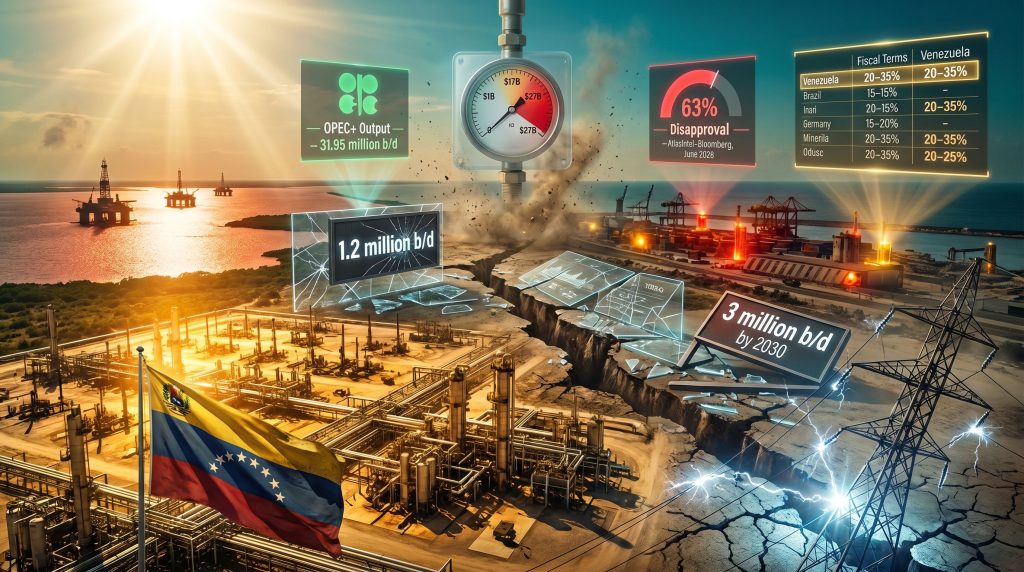
Venezuela's crude output had climbed to approximately 1.2 million barrels per day (b/d) by June 2026, up from roughly 1.1 million b/d in prior months. On the surface, this trajectory looks encouraging. The government's stated target of 3 million b/d by 2030 frames a bold recovery narrative for a country that once ranked among the world's top five producers.
However, the arithmetic of that ambition is daunting. Moving from 1.2 million b/d to 3 million b/d in under four years requires not incremental improvement but a wholesale transformation of upstream capital flows. Venezuela's production base is geographically divided between two distinct zones:
- The Orinoco Heavy Oil Belt, located east of Caracas, which contains the world's largest certified crude reserves but requires heavy capital investment and sophisticated processing infrastructure to extract and upgrade its extra-heavy crude
- The Lake Maracaibo basin in western Venezuela, a mature producing region with ageing infrastructure that demands sustained maintenance capital to prevent accelerating decline rates
Neither zone sustained direct structural damage from the June earthquakes. Yet neither saw any acceleration in investment commitments afterward. This asymmetry tells investors something important: the barriers to capital deployment in Venezuela are not primarily physical.
Why Capital Commitments Remain Stubbornly Low
The deeper structural problem lies in the gap between intent and execution. Western energy majors including Chevron, Eni, and Repsol have maintained operational continuity, but none have materially expanded capital commitments. A pipeline of signed letters of intent exists, yet the conversion rate from preliminary agreements to binding, enforceable contracts remains critically low. Industry sources have described the current priority as turning those preliminary arrangements into actual contracts, a process that was already moving slowly before the earthquakes introduced fresh layers of uncertainty.
Furthermore, the Venezuela-PdVSA policy shift adds another dimension to this challenge. A critical but underappreciated constraint is the commercialisation structure itself. Operators producing lighter crude grades may be required to sell output directly to state oil company PdV and receive heavier crude or fuel oil as payment in kind rather than cash. This in-kind settlement model creates real complications for revenue recognition, balance sheet management, and cash flow planning, particularly for operators whose refineries or offtake agreements are configured for lighter crude specifications.
What the June 2026 Earthquakes Actually Damaged
The twin seismic events measured magnitude 7.2 and 7.5 and struck on 24 June 2026, with the destruction concentrated along the La Guaira coastal corridor north of Caracas. According to Al Jazeera, the confirmed death toll exceeded 3,800, with thousands more unaccounted for, making this one of the most severe natural disasters in Venezuela's modern history.
The geographic separation between the disaster zone and Venezuela's core production regions is the first thing analysts correctly identified. La Guaira is not an oil town. The Orinoco Belt and Lake Maracaibo are geographically remote from the quake's epicentre. Direct damage to wellheads, pipelines, and processing facilities was minimal to negligible.
| Infrastructure Category | Damage Level | Investment Implication |
|---|---|---|
| Orinoco Belt oilfields | Minimal/None | Short-term production continuity maintained |
| Lake Maracaibo facilities | Minimal/None | Upstream operations largely unaffected |
| La Guaira port | Significant | Freight delays, elevated demurrage and insurance costs |
| National power grid | Severe | Blackouts across Carabobo, Aragua, and Yaracuy states |
| Urban residential/commercial | Severe | Humanitarian crisis displacing economic recovery focus |
The table above reveals the crucial insight that most early market commentary missed. The direct threat to Venezuela's oil production from the earthquakes was not physical destruction of upstream assets. It was the severe deterioration of an already fragile national power grid. Widespread electricity blackouts spread across multiple Venezuelan states, including Carabobo, Aragua, and Yaracuy. Industry executives have been clear that crude output at current levels cannot be maintained without reliable electricity supply to oilfield operations.
How the Power Grid Became the Critical Vulnerability
This matters because the power grid's vulnerability did not originate with the earthquakes. The seismic events exposed and accelerated a pre-existing systemic failure. The Venezuela power crisis has been deteriorating for years under chronic underinvestment, and the earthquakes pushed it past a critical threshold in populated and economically active regions. For ordinary Venezuelans, the most immediate energy concern became something far more basic than oil contracts: having natural gas restored for domestic cooking while pipeline and building safety inspections remained ongoing.
La Guaira port's placement under a disaster declaration added logistical friction through freight delays and elevated insurance and demurrage costs, but these are incremental constraints on an already constrained export infrastructure rather than transformative disruptions.
The Risk-Pricing Problem: Why No One Can Value This Market Accurately
The Loss Estimation Challenge: Preliminary damage estimates for the June 2026 earthquakes range from $1 billion to $27 billion. Some economic modelling suggests physical destruction could approach $100 billion in extreme scenarios, a figure that would represent approximately 7% of Venezuela's estimated GDP of around $111 billion. The extraordinary width of this range is not analytical imprecision. It is a precise measurement of how opaque Venezuela's economic environment has become.
The near-impossibility of accurate catastrophe loss valuation in Venezuela stems from several compounding factors:
- Sanctions-induced data opacity: International financial reporting standards and third-party verification mechanisms that function in open economies do not operate normally in Venezuela's sanctioned environment
- Hyperinflationary distortion: Asset valuations, replacement costs, and GDP calculations are all distorted by chronic monetary instability, making comparable loss assessment unreliable
- Absence of catastrophe insurance markets: In most major economies, insurance industry modelling provides a rapid, market-tested loss anchor. Venezuela has no functioning catastrophe insurance market, removing the primary risk-transfer mechanism that global capital relies upon
- Infrastructure data deficits: Reliable asset inventories for physical infrastructure are simply not publicly available at the granularity needed for credible loss modelling
This risk-transfer vacuum is particularly consequential along the coastal corridor. Any meaningful scaling of Venezuela's oil export capacity would require that corridor to function efficiently. The absence of insurance mechanisms means that foreign operators bear unhedgeable physical risk on every ton of cargo and every piece of equipment that moves through affected zones. In addition, broader questions about sanctions and oil trade in sanctioned environments offer a useful comparative lens for understanding why these barriers compound so severely.
Regulatory Reform: Better Terms on Paper, Unresolved Problems in Practice
Interim President Delcy Rodriguez approved new oil sector regulations in the immediate aftermath of the earthquakes, framing them as a mechanism to generate resources for national recovery and reconstruction. The reforms implement earlier legislative changes that permit entities other than PdV to operate oil fields directly.
The structural changes are genuinely significant on paper:
- Simplified tax architecture replacing the prior complexity
- State revenue share reduced to 20-35% across most projects, sharply down from the previous benchmark of 83.33%
- More clearly defined royalty tier structures intended to improve investment planning certainty
How Do Venezuela's Terms Compare Regionally?
For context, how do these terms compare with Venezuela's regional competitors?
| Country | State Revenue Share (Typical) | Foreign Operator Flexibility | Political Risk Rating |
|---|---|---|---|
| Venezuela (post-reform) | 20-35% | Moderate (improving) | Very High |
| Brazil (pre-salt) | ~40-60% (profit-sharing) | High | Moderate |
| Colombia | ~30-50% | High | Moderate-High |
| Ecuador | ~25-50% | Moderate | High |
| Guyana | ~50-60% (Stabroek) | High | Low-Moderate |
Venezuela's post-reform fiscal terms are competitive, and in some configurations more favourable than regional peers. Guyana, which has attracted substantial IOC capital, operates with a higher state revenue take at the flagship Stabroek block. On fiscal terms alone, Venezuela should be attracting more investment than it currently receives.
The problem is structural rather than numerical. The energy ministry retains broad discretionary authority over contract interpretation and implementation, creating a gap between the written terms of an agreement and the real-world conditions under which operators will function. Industry assessments characterise the contract models as workable rather than ideal, a description that conveys qualified confidence without endorsement. For large IOCs with fiduciary obligations to institutional shareholders, qualified confidence is insufficient to justify committing significant capital in a jurisdiction with Venezuela's political and legal history.
The residue of historical nationalisation losses also continues to shape institutional memory at major international oil companies. Billions of dollars in assets were expropriated under prior administrations, and the international arbitration processes that followed have created lasting wariness. New fiscal terms do not automatically dissolve institutional caution built on concrete historical experience.
Geopolitical Overlay: US Policy, Opposition Politics, and Governance Legitimacy
The US posture toward Venezuela in the post-earthquake period has been defined by a preference for political stability rather than a rapid transition to democratic governance. Most officials who served under former President Nicolas Maduro, including individuals subject to US drug trafficking indictments, remain in their positions under the Rodriguez administration. This continuity reflects a calculated tolerance of existing governance structures rather than implicit endorsement of them.
The US committed to continuing disaster recovery aid following the earthquakes while simultaneously reducing humanitarian assistance to numerous other countries, a selective engagement that reflects geopolitical calculation. Opposition leader Maria Corina Machado was initially denied permission to enter Venezuela in the immediate aftermath of the disaster, though President Trump subsequently indicated this position might be revisited.
Governance Legitimacy Indicator: A June 2026 AtlasIntel-Bloomberg poll recorded 63% disapproval of the Rodriguez administration, up from 59% in the preceding month. A separate measure within the same survey showed 65% disapproval of the government's earthquake response specifically. These figures represent a meaningful deterioration in political legitimacy at precisely the moment when the administration is seeking to attract foreign capital.
Political consultancy Teneo's analyst Nicholas Watson has framed the disaster's political implications as genuinely bifurcated: it could either provide temporary relief from political pressure for the Rodriguez government or accelerate a democratic transition process. For investors, these two outcomes carry substantially different implications for contract continuity, legal enforceability, and the stability of the regulatory framework.
Venezuela holds exempt status from OPEC+ production targets, alongside Iran and Libya. This classification, while providing production flexibility, reflects the international community's implicit assessment of the country's structural limitations. OPEC+ total production reached 31.95 million b/d in June 2026, partially recovering from the catastrophic 8.1 million b/d collapse triggered by the US-Iran conflict that began in February 2026. The Venezuela oil market impact of its 1.1-1.2 million b/d contribution, modest relative to the bloc's total, carries strategic significance as a non-Hormuz Western Hemisphere supply source at a time when Strait of Hormuz disruption risks remain elevated and unresolved.
The next major ASX story will hit our subscribers first
Who Is Betting on Venezuela, and Who Is Holding Back
The investor landscape is not monolithic. A meaningful segmentation exists between large international oil companies and smaller independent operators, and this segmentation reveals important insights about how risk is currently being priced.
Major IOCs remain largely absent from new capital commitments. The combination of political risk, commercialisation uncertainty, inadequate contract enforceability, and institutional memory of expropriation creates a barrier that improved fiscal terms alone cannot overcome.
Independent operators and wildcatters present a contrasting picture. Some independents are reportedly pricing in a potential 30% upside on Venezuelan assets under a normalisation scenario. This premium reflects a fundamentally different risk tolerance profile and capital structure. Independent operators typically have lower weighted average cost of capital thresholds for speculative investments, more concentrated ownership structures that allow faster decision-making, and a business model explicitly calibrated for higher-risk frontier opportunities.
India's ONGC Videsh holds existing equity stakes in Venezuelan upstream projects, giving India a direct exposure that the earthquake has complicated further. India has separately been expanding strategic petroleum reserves in response to Hormuz disruption risks, adding context to why Venezuelan supply matters to New Delhi as a non-Gulf source of crude.
Cash flow management also remains a structural constraint. Disbursements from the US Treasury Department-administered oil revenue fund have been characterised by some operators as insufficiently frequent, limiting the reinvestment capacity that sustained production growth requires.
A Framework for What Would Actually Unlock Investment
The conditions required to shift Venezuela from speculative interest to committed capital deployment are identifiable, even if their achievement is uncertain:
- Power grid restoration across Carabobo, Aragua, Yaracuy, and other affected states to a level that ensures sustained operational reliability for upstream facilities
- Completion of the $200 billion debt restructuring on creditor-protective terms, with a target window of November 2026 that analysts warn may slip under post-earthquake reconstruction pressures
- Contract conversion from preliminary letters of intent into enforceable agreements with limited ministerial discretion
- Resolution of the in-kind payment commercialisation model to provide operators with cash or internationally tradeable commodity settlements rather than PdV-supplied crude
- More frequent disbursement cycles from the US Treasury-administered revenue fund
- Sustained political stability sufficient to provide a multi-year investment planning horizon
The debt restructuring dimension carries a particular risk that analysts have flagged. Post-earthquake reconstruction pressure could incentivise policymakers to accelerate restructuring terms in ways that generate near-term cash but embed unsustainable long-term debt obligations. Creditors evaluating this scenario may calculate that the risk of adverse restructuring actually increases in an emergency environment, potentially hardening rather than softening their negotiating positions.
Three Investment Scenarios for Venezuela's Upstream Trajectory
Scenario A: Accelerated Stabilisation (Optimistic)
Debt restructuring completes on schedule by late 2026 with creditor-protective terms. Power grid restoration enables sustained output. Contract conversion accelerates, drawing independent operators and eventually mid-tier IOCs. Production moves meaningfully toward the 3 million b/d target range by 2028-2029.
Scenario B: Prolonged Stagnation (Base Case)
Earthquake recovery absorbs political bandwidth, delaying contract finalisation. Power instability causes intermittent output disruptions, keeping production in a 1.0-1.2 million b/d range. Debt restructuring negotiations extend beyond November 2026. Independent operators maintain interest but major IOCs remain absent through the planning horizon.
Scenario C: Political Transition Disruption (Downside)
Elevated disapproval ratings catalyse governance instability or transition. Uncertainty freezes investment activity for 12-24 months. Production falls below 1 million b/d as power grid deterioration accelerates without maintenance capital. Venezuela's OPEC+ exempt status becomes largely academic as output collapses toward levels last seen during the worst years of the prior decade.
The most instructive observation across all three scenarios is that the earthquakes themselves are not the primary variable. They are an accelerant and a complicating factor layered onto a pre-existing investment environment that was already the binding constraint on Venezuela's upstream growth. Consequently, understanding geopolitical investment risk in similarly complex markets provides essential context for framing what Venezuela's recovery would realistically require. Resolving Venezuela earthquake oil investment uncertainty ultimately requires addressing the structural conditions that existed before the ground moved, because those conditions will determine the trajectory long after the aftershocks have faded.
This article contains forward-looking analysis, scenario projections, and economic estimates. All forecasts and scenario assessments are inherently speculative and subject to material revision. Nothing in this article constitutes investment advice. Readers should conduct independent research and seek professional financial guidance before making any investment decisions related to markets, companies, or instruments discussed herein.
Want to Stay Ahead of High-Impact Resource Opportunities Beyond Frontier Markets?
Discovery Alert's proprietary Discovery IQ model delivers real-time alerts on significant ASX mineral discoveries, transforming complex resource data into actionable investment insights for both short-term traders and long-term investors. Explore why major mineral discoveries have historically generated substantial returns by visiting Discovery Alert's dedicated discoveries page, and begin your 14-day free trial today to position yourself ahead of the broader market.