
July 11, 2026
When Permits Are Not Enough: Mexico's Regulatory Reckoning With Foreign Extractive Investment
The long-held assumption that a valid permit represents a durable social contract between a mining company and its host government is under serious pressure across Latin America. Nowhere is that tension more visible right now than in the Yucatan Peninsula, where Mexico seeks a permanent halt to Vulcan Materials mining operations at one of the region's most environmentally sensitive sites. The case involving the Sac-Tun quarry, widely known as the Calica operation, has evolved well beyond a routine regulatory dispute. It now sits at the intersection of environmental law, international trade arbitration, bilateral diplomacy, and the broader question of how Mexico intends to balance resource sovereignty with foreign investment obligations.
Understanding why this matters requires looking past the headline and into the structural mechanics of how Mexico's regulatory architecture has fundamentally shifted, and what that means for any foreign-owned extractive operation holding legacy permits in ecologically classified terrain. Furthermore, the case offers important lessons for operators navigating a rapidly evolving geopolitical mining landscape worldwide.
When big ASX news breaks, our subscribers know first
The Sac-Tun Quarry: Scale, Ecology, and the Roots of the Conflict
The Calica limestone quarry sits in Quintana Roo, the Caribbean-facing state best known internationally for its tourism corridor stretching from Cancun south through Playa del Carmen. The site is not simply a patch of exposed rock. It occupies land above one of the world's most extensive underground freshwater systems, the Yucatan aquifer network, which feeds cenotes, coastal lagoons, and wetland ecosystems protected under Mexican federal environmental law.
Vulcan Materials, one of the largest construction aggregates producers in the United States, operated at this site for more than three decades. The company built a dedicated deep-water port to facilitate direct limestone shipments, primarily destined for U.S. construction markets. The scale of infrastructure committed to this single operation underscores just how commercially significant the Calica site was to Vulcan's supply chain.
The ecological sensitivities that now sit at the centre of the dispute were not invented after the fact. The site's location above protected wetlands and a vast underground karst water system meant that any long-term extraction programme carried inherent regulatory risk that compounded over time as Mexico's environmental legal framework evolved and tightened.
How the Shutdown Unfolded and Why the Legal Framing Matters
What triggered the initial closure?
Limestone extraction at the Calica quarry was halted by Mexican authorities in 2022, with port operations subsequently closed in 2023. The regulatory basis cited by the government centred on environmental permitting irregularities and documented damage to protected wetland and aquifer systems in the surrounding area.
Vulcan Materials maintained a contrary position throughout, asserting that it held all legally required operating permits and had functioned in full compliance with applicable regulations across its entire operational history at the site.
The legal distinction between a regulatory shutdown and an expropriation is not semantic hairsplitting. Under the investor-state dispute settlement mechanisms embedded within the United States-Mexico-Canada Agreement, or USMCA, that distinction is the central axis around which the entire arbitration case turns. Mexico has consistently framed its actions as a legitimate exercise of environmental regulatory authority. Vulcan's legal position, by contrast, argues that the practical effect of the closure constitutes indirect expropriation regardless of the terminology used to describe it.
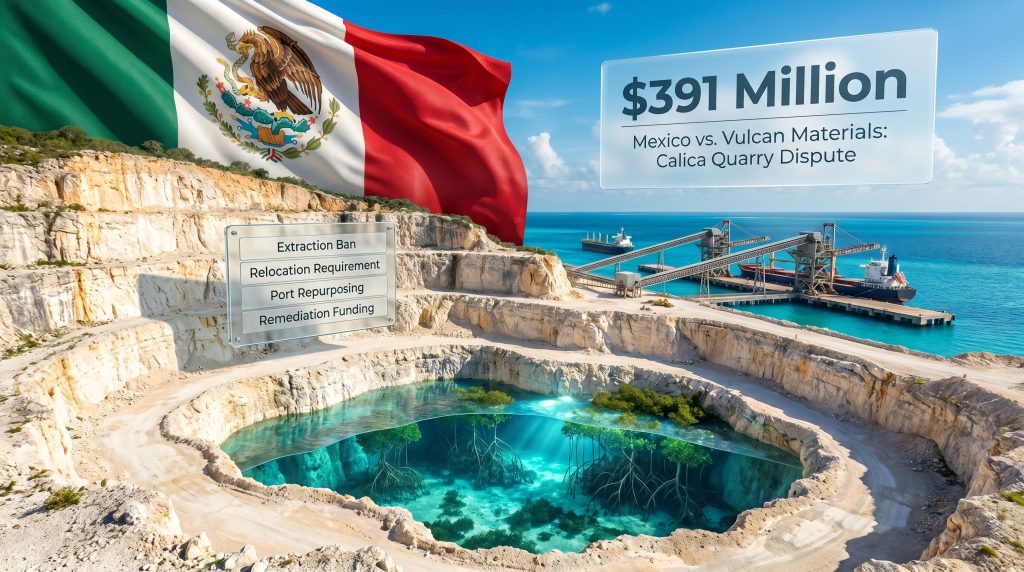
During the administration of former President Andrés Manuel López Obrador, the dispute escalated further when the government formally offered to purchase the site for $391 million. Vulcan rejected that valuation as materially inadequate relative to the asset's commercial worth, and no transaction was completed. This kind of government intervention in mining reflects a broader pattern visible across multiple jurisdictions.
What the Sheinbaum Administration Is Proposing
Has the negotiating tone shifted under the new government?
Under President Claudia Sheinbaum, the approach has shifted from confrontational rhetoric toward structured negotiation. The government has publicly confirmed that it is seeking a permanent end to limestone extraction in the protected area, and that any agreement will require Vulcan to meet specific conditions in exchange for continued access to its commercial port infrastructure.
The proposed settlement framework, as understood from publicly available information as of mid-2026, contains four core components:
| Settlement Component | Proposed Terms |
|---|---|
| Extraction Prohibition | Permanent ban on limestone mining within the ecologically designated natural area near Playa del Carmen |
| Operational Relocation | Conditional permission for future extraction only at an environmentally approved alternative site |
| Volume Restrictions | Reduced extraction volumes at any relocated operation compared to historical Calica output |
| Remediation Obligation | Vulcan required to fund cleanup of damaged wetland and underground aquifer systems |
The commercial complexity of this framework is significant. Identifying an alternative extraction site that simultaneously satisfies Mexican environmental regulators, meets Vulcan's minimum commercial viability thresholds, and can realistically support the company's supply commitments to U.S. construction markets is not a straightforward task. Meanwhile, the proposal to repurpose the deep-water port for non-limestone commercial uses fundamentally alters the asset's balance sheet value, since the infrastructure was purpose-built for a single commodity flow.
The proposed deal is not a simple shutdown order. It is a structured compromise that introduces environmental remediation liability as a condition of commercial settlement, establishing a potential template for how Mexico resolves future disputes involving foreign extractive operations in protected zones.
International Arbitration and Diplomatic Escalation
Parallel to the bilateral negotiation process, Vulcan Materials has been pursuing international arbitration under USMCA investor-state dispute settlement provisions. The core legal question before any arbitral panel would be whether Mexico's actions, taken together, constitute indirect expropriation in violation of the treaty's investment protection obligations.
The diplomatic dimension of the dispute has added further pressure. U.S. Senators Bill Hagerty and Tim Kaine formally urged the Mexican government to address what they characterised as unfair treatment of an American company. The U.S. House of Representatives also passed legislation targeting foreign seizures of American-owned assets, with potential sanction mechanisms applicable to Mexico. The Mexican government has rejected the expropriation characterisation and maintained that its actions are grounded in domestic environmental law.
If bilateral negotiations break down and ISDS arbitration produces a final binding ruling, Mexico could face a compensation order substantially exceeding the original $391 million acquisition offer. That fiscal exposure creates a powerful incentive for the Sheinbaum administration to reach a negotiated settlement before any tribunal renders judgment.
This dual-track dynamic, where arbitration and negotiation run simultaneously, is itself a well-established feature of complex investment disputes. Each track strengthens the other party's leverage at the table, making both sides more attentive to the costs of failure. Consequently, shifts in mining policy in America add yet another layer of pressure to the bilateral relationship.
The Legal Architecture Driving Mexico's Regulatory Shift
How has Mexico's regulatory framework evolved?
The Vulcan case does not exist in isolation. It reflects a deeper structural transformation in how Mexico's legal system treats mining operations that intersect with water resources, wetlands, and land-use protected areas.
Joel González, Senior Partner at ALN Abogados, has observed that the growing interconnection between water legislation, environmental impact assessment requirements, and land-use planning frameworks has fundamentally changed what corporate counsel must do to protect mining investments in Mexico. The traditional reactive model, in which legal teams respond to disputes after they arise, is no longer adequate.
The integrated nature of Mexico's regulatory framework means that structural halt risk can emerge even for operations carrying historically valid permits, because the regulatory floor beneath those permits has risen significantly over time. This insight carries a critical practical implication: the validity of a permit at the moment of grant does not guarantee its effective durability as environmental and land-use frameworks evolve. Foreign operators who designed their legal strategies around permit compliance alone, without mapping the surrounding regulatory ecosystem, face precisely the kind of exposure that the Calica dispute illustrates. The importance of thorough definitive feasibility studies — encompassing regulatory risk — has never been greater.
The next major ASX story will hit our subscribers first
Capital Allocation Behaviour in a High-Uncertainty Regulatory Environment
The practical corporate response to this kind of regulatory risk is already visible in how heavy industry decision-makers are restructuring their investment approval processes. Diego Torroella, Managing Director at TAKRAF Mexico, has noted that persistent macroeconomic and geopolitical uncertainty has not paralysed capital deployment in the mining sector, but it has made it substantially more deliberate. Project approval timelines are extending, and the weight assigned to rigorous technical engineering studies and environmental risk assessments has increased correspondingly.
For investors evaluating exposure to Mexican mining assets, this behavioural shift has several measurable consequences:
- Extended pre-approval timelines increase project development costs and delay revenue generation.
- Higher evidentiary standards for environmental compliance raise upfront legal and technical expenditure.
- The Calica precedent introduces environmental remediation liability as a potential exit cost variable for any foreign operator in an ecologically sensitive zone.
- Capital that was previously allocated based on permit status alone now requires multi-framework regulatory viability assessment before commitment.
In addition, the evolving mining claims framework in other jurisdictions offers useful comparative context for understanding how governments worldwide are redefining the boundaries of permissible extractive activity.
Mexico's Mining Sector in Mid-2026: Contrasting Signals
The Vulcan dispute sits alongside several other significant developments that together paint a nuanced picture of Mexico's mining investment climate in mid-2026.
Copper's strategic moment: Global forecasters are flagging a structural copper supply deficit as demand from power grids, data centres, and electric vehicle fleets accelerates. Mexico's expanding copper output positions the country as a meaningful beneficiary of this shift, drawing international capital toward copper assets across multiple states. This dynamic stands in deliberate contrast to the tightening regulatory environment affecting ecologically sensitive extraction zones.
Los Filos restart formalised: On June 25, 2026, Mexican federal and state authorities, alongside Equinox Gold, formalised land access agreements enabling the restart of the Los Filos gold mine in Guerrero under a 20-year land access arrangement. The operation had faced more than a year of disrupted activity. The Los Filos agreement demonstrates that successful resolution is achievable through sustained community and regulatory engagement, offering a constructive parallel to the Vulcan situation.
Corporate consolidation continuing: Canada-based Goldgroup Mining secured shareholder approval for its business combination with Gold Resource Corporation at meetings held on July 2, 2026, with a target closing date of July 17. The fact that merger activity is proceeding at pace despite the regulatory headwinds visible in the Vulcan case suggests that institutional confidence in Mexico's mining sector, taken in aggregate, remains intact even as specific sub-sectors face heightened scrutiny.
Structural Risk Factors for Foreign Operators in Ecologically Sensitive Zones
The Calica dispute is precedent-setting in a specific and important way. It demonstrates that Mexico seeks a permanent halt to Vulcan Materials mining operations through regulatory action alone, without requiring formal expropriation, provided environmental damage within a protected natural area can be established. Several structural risk factors now appear embedded in Mexico's approach to foreign-operated extractive projects in ecologically classified terrain:
- Environmental remediation liability is being introduced as a condition of commercial settlement, not merely as a penalty following a finding of violation.
- Relocation requirements at reduced extraction volumes represent a net commercial impairment that does not require formal expropriation under treaty law.
- Port infrastructure repurposing away from its original commodity purpose alters asset valuation independently of any land-use determination.
- Multi-framework regulatory overlap between water law, environmental impact assessment, and land-use planning creates exposure windows that single-permit compliance strategies cannot close.
For legal advisors, project financiers, and corporate boards evaluating new or existing positions in Mexico's extractive sector, the Calica case functions less as an outlier and more as a preview of the compliance standard that ecologically sensitive operations will face going forward.
Frequently Asked Questions: Mexico's Permanent Halt on Vulcan Materials
What is the Calica quarry dispute?
The Sac-Tun (Calica) quarry is a large-scale limestone extraction operation near Playa del Carmen in Quintana Roo, run by U.S.-based Vulcan Materials for over 30 years. Mexican authorities halted extraction in 2022 and closed the associated port in 2023, citing environmental permitting violations and damage to protected wetlands and underground water systems.
Has Mexico expropriated Vulcan's assets?
Mexico formally denies expropriation and characterises its actions as a regulatory shutdown grounded in environmental law. Vulcan contests this framing and is pursuing USMCA arbitration on the basis that the practical effect of the closure constitutes indirect expropriation.
What would Vulcan receive under a negotiated settlement?
Under the terms being discussed as of mid-2026, Vulcan would retain access to its deep-water port for non-limestone commercial purposes and would be permitted to relocate limestone operations to an environmentally approved alternative site at reduced volumes. Vulcan would also be required to fund ecological remediation of the affected wetlands and aquifer systems.
What is the financial risk if negotiations fail?
A final ISDS arbitration ruling could impose a binding compensation obligation on Mexico that substantially exceeds the original $391 million acquisition offer that Vulcan previously rejected. This exposure is a central driver of Mexico's motivation to reach a bilateral settlement.
What does this case mean for other foreign mining operators in Mexico?
The Calica dispute signals that permit validity at the time of grant does not guarantee operational continuity in ecologically sensitive zones. Foreign operators are increasingly advised to treat proactive environmental risk mapping and community engagement as foundational investment requirements rather than supplementary compliance exercises.
Disclaimer: This article is intended for informational purposes only and does not constitute legal, financial, or investment advice. Negotiations between the Mexican government and Vulcan Materials were ongoing as of the time of writing, and no final agreement had been publicly confirmed. Readers should consult qualified legal and financial professionals before making any decisions based on the information contained herein. Forecasts and scenario projections referenced in this article represent analytical perspectives and not guaranteed outcomes.
Want to Stay Ahead of Major Mineral Discoveries Before the Broader Market Reacts?
As geopolitical and regulatory pressures reshape extractive investment globally, Discovery Alert's proprietary Discovery IQ model delivers real-time ASX mineral discovery alerts, cutting through complex data across 30+ commodities to surface actionable opportunities the moment they emerge — explore Discovery Alert's discoveries page to see how historic finds have generated substantial returns, and begin your 14-day free trial at discoveryalert.com.au to position yourself ahead of the market.