July 11, 2026
When Mining Empires Divide: The Strategic Logic Behind Large-Scale Asset Separations
The history of natural resources is punctuated by moments when sprawling industrial empires reach an inflection point. Conglomerates that once derived strategic advantage from geographic diversification eventually find that same breadth becoming a constraint, limiting their ability to attract targeted capital, form focused partnerships, or respond nimbly to jurisdiction-specific opportunities. The proposed ERG breakup to split assets between owners represents precisely this kind of inflection point, unfolding against a backdrop of shifting geopolitical alliances, generational wealth transitions, and an accelerating global race to secure critical mineral supply chains.
Understanding why this restructuring is being seriously considered requires looking well beyond the corporate balance sheet. The forces shaping this decision stretch from the political realignment of Central Asia to Washington's strategic competition with Beijing over the mineral heartland of sub-Saharan Africa.
When big ASX news breaks, our subscribers know first
The Architecture of ERG's Industrial Empire
Eurasian Resources Group operates one of the most geographically and commoditarily diverse private mining portfolios in the world. Its Kazakh operations form the financial backbone of the group, encompassing large-scale production of iron ore, ferrochrome, and aluminium. These are mature, revenue-generating assets with established infrastructure and long-term customer relationships across Asian and European markets.
The international portfolio, however, tells a different story. ERG's presence in the Democratic Republic of Congo centres on assets that sit at the intersection of two of the most consequential supply chain narratives of the current decade: the electrification of transport and the Western push to reduce dependence on Chinese-controlled mineral flows. The scale of DRC mineral wealth in this region cannot be overstated.
Key assets within the ERG portfolio include:
- Iron ore, ferrochrome, and aluminium production facilities across Kazakhstan
- Metalkol, one of the world's largest cobalt-producing operations, located in the DRC's Copperbelt
- Boss Mining SAS, a secondary DRC-based copper and cobalt operation
- Mining and development interests in Brazil
The group was previously listed in London as Eurasian Natural Resources Corp before its founders chose to delist in 2013 amid a UK Serious Fraud Office investigation into corruption allegations. That probe was formally discontinued in 2023, closing a decade-long legal chapter and setting the stage for the group's next structural evolution.
Who Holds the Cards: The Ownership Dynamics Driving the Split
The proposed restructuring is fundamentally a negotiated realignment between ERG's two dominant private shareholders, each of whom has a compelling reason to pursue focused, independent control over their preferred asset geography.
| Shareholder | Approximate Stake | Strategic Interest |
|---|---|---|
| Kazakh Government | 40% | Industrial policy, domestic employment |
| Shakhmurat Mutalip | 39.3% | Kazakh industrial consolidation |
| Shukhrat Ibragimov | ~20% | DRC critical minerals exposure |
Shakhmurat Mutalip, aged 35, is a construction industry figure who acquired his 39.3% stake in ERG in May 2026, purchasing the interest from the families of Patokh Chodiev and Alexander Mashkevich. They co-founded ERG's predecessor alongside Alijan Ibragimov, Shukhrat's father. This transaction is widely read as emblematic of the generational wealth transition occurring in Kazakhstan following President Kassym-Jomart Tokayev's consolidation of political authority after the civil unrest of January 2022.
The speed with which Mutalip has moved to establish operational influence is notable. In June 2026, the chairman of his construction company was appointed as chief executive of ERG's Kazakhstan business unit. This signals that the transition from financial stakeholder to operational controller is already underway, regardless of whether the formal split is finalised.
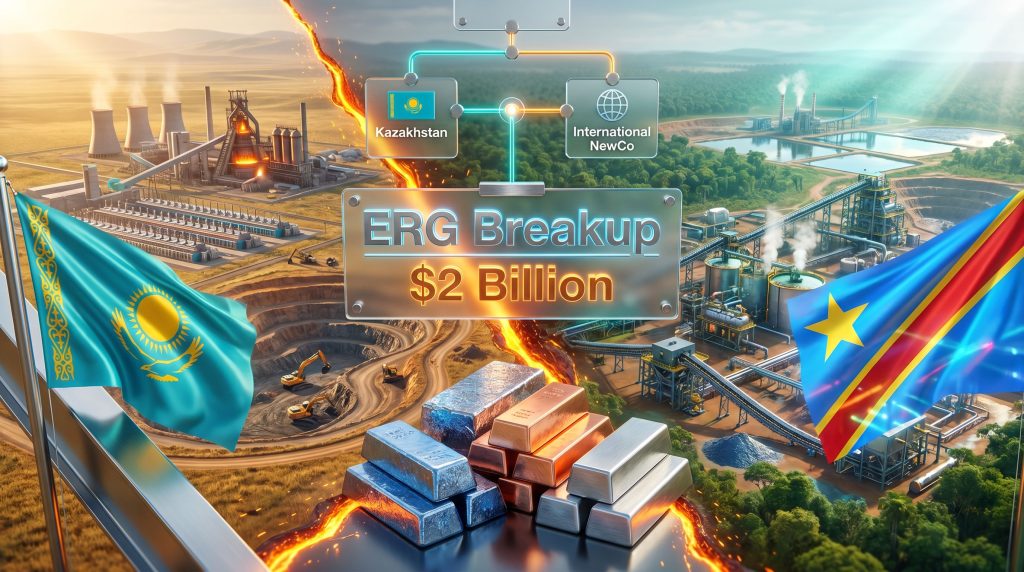
Shukhrat Ibragimov, who has served as ERG's chief executive and chairman since 2024, would under the proposed arrangement exchange his family's approximately 20% stake in the combined group for full ownership of a newly incorporated international holding company. That new entity would inherit ERG's African and Brazilian assets, along with approximately $2 billion in transferred group debt.
The Metalkol Factor: Why the DRC Assets Command Serious Attention
The crown jewel of the proposed international entity is Metalkol, an asset that requires contextual understanding to appreciate fully. The DRC accounts for roughly 70% or more of global cobalt mine supply, a concentration of critical mineral production with few parallels anywhere in the resource world. Within that dominant jurisdiction, Metalkol ranks among the premier producing operations by output volume.
Cobalt's strategic relevance has intensified dramatically over the past decade. It is a core component of the cathode chemistry in nickel manganese cobalt (NMC) lithium-ion batteries, which power the majority of electric vehicles produced globally. Furthermore, while battery chemists have been working to reduce cobalt intensity per kilowatt-hour of capacity, the absolute volume required by the EV industry continues to climb as overall production scales. This surge forms part of a broader critical minerals demand story reshaping global supply chains.
What makes the DRC's cobalt endowment particularly significant from a metallurgical standpoint is the co-occurrence of cobalt with copper in the Copperbelt's oxidised ore bodies. Operations like Metalkol process what are known as tailings and mixed oxide ores, extracting both copper and cobalt through hydrometallurgical techniques including solvent extraction and electrowinning. This processing approach differs from the sulfide-ore-focused methods common in Chilean copper production and requires specific operational expertise that ERG has developed over years of DRC operations.
"The DRC Copperbelt's oxide ore profile means that cobalt is often recovered as a byproduct of copper processing rather than as a primary target, giving vertically integrated operators like ERG's DRC business a dual-revenue structure that partially buffers against single-commodity price swings."
How Does Global Cobalt Production Compare?
Understanding global cobalt production concentration is essential context here. No other jurisdiction comes close to matching the DRC's output dominance, which consequently means that any significant supply disruption — whether political, operational, or regulatory — carries outsized implications for battery manufacturers worldwide.
Illegal Mining: The Operational Shadow Over the International Portfolio
Any assessment of the ERG breakup to split assets between owners must grapple honestly with the significant operational risks that would fall to Ibragimov's new entity. The most pressing of these involves illegal mining activity on ERG's DRC concessions.
Military-backed illegal mining operations have been documented occupying portions of ERG's concession areas, including at both Metalkol and Boss Mining SAS. This is not a peripheral concern. In artisanal and small-scale mining (ASM) intensive jurisdictions like the DRC, illegal incursions into formal mining concessions represent a material threat to production continuity, resource recovery rates, and site safety.
The challenge of reclaiming occupied concession areas in the DRC typically requires:
- Formal engagement with national and provincial government authorities
- Coordination with the DRC's mining regulator, the Direction de Gestion des Carrières et des Mines (DGCAM)
- Potential involvement of the Forces Armées de la République Démocratique du Congo (FARDC)
- International legal mechanisms in cases involving cross-border organised criminal networks
Resolving these situations can take years and requires sustained political and financial capital, neither of which will be in easy supply for a newly independent entity simultaneously managing $2 billion in inherited debt. The recent DRC cobalt export suspension further illustrates just how rapidly the regulatory environment can shift, adding another layer of complexity to operational planning.
Financial Stress Testing the International NewCo
The debt transfer is the single most consequential financial variable in the proposed separation. Inheriting $2 billion in obligations at the point of structural independence, while simultaneously facing elevated operational costs from illegal mining disruptions and the need to establish new corporate infrastructure, creates a demanding liquidity environment.
| Risk Factor | Kazakhstan Entity | International NewCo |
|---|---|---|
| Debt burden | Minimal post-split | $2 billion transferred |
| Revenue maturity | High (established operations) | Mixed (operational + development) |
| Illegal mining disruption | Not applicable | Significant at Metalkol and Boss Mining SAS |
| Cobalt/copper price exposure | Indirect | Direct and material |
| Geopolitical complexity | Moderate | Elevated (DRC + Brazil) |
| Partnership opportunity | Strong (Asian/European offtake) | Strong (US critical minerals vehicles) |
Analysts and investors familiar with similar post-separation debt structures in the mining sector would likely anticipate one of three resolution pathways for the international entity within 12 to 24 months of formation:
- Strategic equity placement to a cornerstone investor seeking DRC cobalt and copper exposure, potentially a Western trading house or sovereign-backed fund
- Asset monetisation, selling non-core interests such as the Brazilian portfolio to reduce leverage
- Structured debt refinancing, potentially with commodity-linked instruments that align repayment with cobalt and copper revenue cycles
The next major ASX story will hit our subscribers first
Kazakhstan's Parallel Opportunity: What the Kazakh Entity Stands to Gain
While much of the geopolitical narrative around this restructuring centres on the DRC, the Kazakhstan entity also stands at a commercially interesting juncture. Kazakhstan is the world's largest producer of ferrochrome, a critical input for stainless steel manufacturing, and holds significant competitive advantages in aluminium production relative to European alternatives.
The country's political stabilisation under President Tokayev, combined with Western interest in diversifying industrial supply chains away from Russian and Chinese dependence, has created an unusual window of opportunity for Kazakh industrial assets. European steelmakers, in particular, have been actively seeking ferrochrome supply arrangements outside of South Africa and China following logistics disruptions and geopolitical concerns over concentration risk.
A standalone Kazakh entity with clear domestic ownership between Mutalip and the government's 40% holding would be structurally better positioned to negotiate long-term offtake agreements with these counterparties. A complex multinational conglomerate with unresolved governance questions, by contrast, would find such negotiations considerably more challenging.
The US-DRC Strategic Dimension and What It Means for the NewCo
The Trump administration's strategic minerals partnership with the Congolese government, formalised in December 2025, fundamentally altered the competitive landscape for DRC mining assets. The broader US-DRC minerals partnership framework provides American investors with preferential access to certain DRC mining and infrastructure opportunities, creating a policy environment in which a Western-aligned, independently governed DRC mining entity becomes considerably more attractive as a potential partner or acquisition candidate.
Chinese companies currently dominate DRC copper and cobalt output by a substantial margin, controlling the processing, offtake, and logistics infrastructure for much of what the Copperbelt produces. This dominance, as Reuters has reported, represents both a competitive challenge and a market gap: any credible non-Chinese cobalt and copper platform in the DRC commands a structural premium among Western buyers and policymakers.
An independently structured ERG international entity, freed from the governance complexities of a Kazakhstan-headquartered conglomerate, would consequently be far better placed to engage US counterparties, development finance institutions, and Western trading houses than the current combined structure.
What Investors and Industry Observers Should Watch
The ERG breakup to split assets between owners, if finalised, would represent one of the most structurally significant private mining reorganisations of 2026. Several forward-looking indicators are worth monitoring closely:
- Debt restructuring announcements from the international NewCo within the first year of operation
- New offtake or partnership agreements from the Kazakhstan entity targeting European or Asian industrial buyers
- Resolution of illegal mining disputes at Metalkol and Boss Mining SAS as a proxy for the new entity's operational control
- Potential capital raises or cornerstone investor announcements from the international holding company
- Further consolidation of Mutalip's influence over ERG Kazakhstan as management appointments continue to align with his construction industry network
The broader signal this transaction sends to the global mining industry is equally important. The shift from diversified conglomerate structures toward focused, single-jurisdiction operators reflects a capital market reality: investors increasingly reward clarity of mandate and geographic focus with higher valuation multiples. For a sector where asset-level complexity has historically been a barrier to institutional participation, the ERG restructuring may serve as a template for similar reorganisations elsewhere.
According to the Australian Government's Attorney-General's Department, structured asset divisions that clearly delineate ownership responsibilities tend to produce more durable outcomes than those leaving obligations ambiguous — a principle that applies equally well in corporate restructuring contexts.
Disclaimer: This article is intended for informational purposes only and does not constitute financial or investment advice. The ERG breakup remains under private discussion as of July 2026 and no binding agreement has been confirmed. Readers should conduct independent research before making any investment decisions related to companies, commodities, or jurisdictions discussed in this article.
Want to Stay Ahead of the Next Major Critical Minerals Discovery?
Discovery Alert's proprietary Discovery IQ model delivers real-time alerts on significant ASX mineral discoveries in cobalt, copper, and other critical minerals — turning complex resource data into actionable investment insights the moment they hit the market. Explore historic examples of major mineral discoveries and their returns, then start your 14-day free trial at Discovery Alert to position yourself ahead of the broader market.