June 17, 2026
Infrastructure as a Strategic Currency: The New Mining Playbook
The mining industry has long operated under a model of vertical integration, where companies controlled not just the ore body but every piece of infrastructure required to extract, process, and export their product. Power lines, water pipelines, port facilities, and rail corridors were considered strategic necessities, not balance sheet liabilities. That thinking is changing rapidly, and the reported BHP Chile power transmission line sale, valued at approximately $1.5 billion, is one of the clearest illustrations of this structural shift in how Tier-1 miners think about capital.
Understanding why this transaction matters requires stepping back from the headline figure and examining the deeper logic at work: what assets a mining company needs to own versus what assets it merely needs to access. Furthermore, the broader implications for copper supply crunch dynamics make this story particularly relevant to investors tracking the energy transition.
When big ASX news breaks, our subscribers know first
The Anatomy of an Asset-Light Copper Strategy
Separating Utility Infrastructure from Value-Creating Assets
Within modern mining capital allocation frameworks, assets are increasingly categorised by their return profile relative to their replacement cost. Ore bodies, concentrators, and smelters sit at the high end of this spectrum because they are irreplaceable, geologically unique, and directly tied to revenue generation. Transmission lines, by contrast, behave like regulated utility infrastructure: they generate predictable, contracted cash flows but do not benefit from commodity price upside.
This distinction matters enormously for how a miner like BHP allocates its balance sheet. Holding $1.5 billion in transmission assets means tying up capital that could otherwise be deployed into ore body extensions, processing upgrades, or water efficiency systems that directly improve copper output. The opportunity cost of ownership, particularly during a period when copper demand is structurally accelerating, is consequently significant.
The asset-light model solves this problem by separating ownership from access. Under a typical sale-and-leaseback or long-term transmission service agreement structure, BHP can divest the physical infrastructure while retaining guaranteed access to the power those lines carry. The capital is freed; the operational continuity is preserved.
Precedent From the Australian Iron Ore Sector
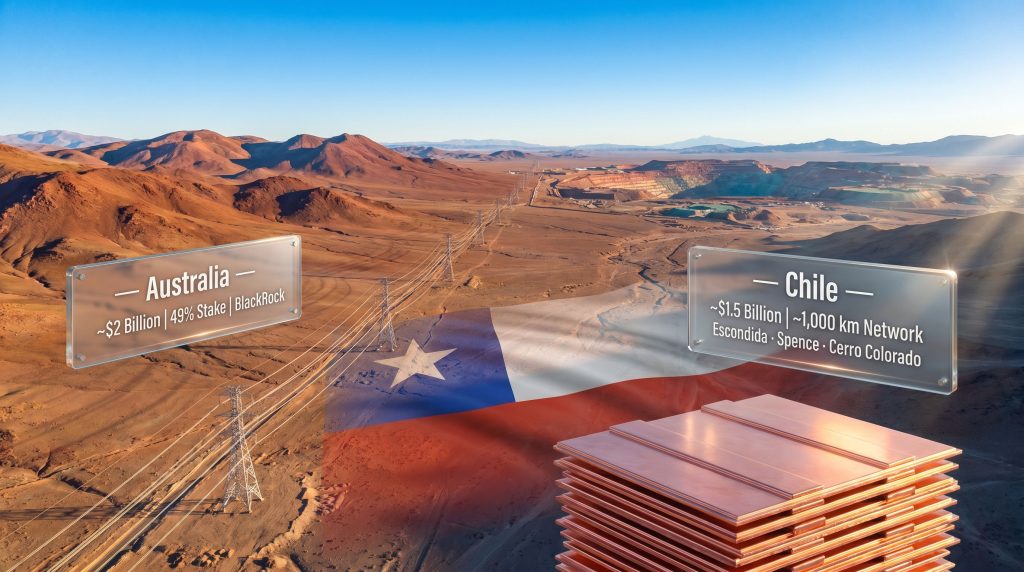
This is not theoretical for BHP. The company executed a structurally comparable transaction in the prior year, divesting a 49% stake in transmission assets connected to its Australian iron ore operations to a unit of BlackRock for approximately $2 billion. BHP's $3B infrastructure deal with BlackRock established several important benchmarks:
- Mining-linked transmission infrastructure commands strong institutional demand
- Long-duration contracted cash flows are highly attractive to infrastructure-focused asset managers
- Partial stake sales can achieve full strategic objectives without complete ownership transfer
The Chile transaction, if completed at approximately $1.5 billion, would represent BHP's second major infrastructure monetisation in successive years, suggesting this is a deliberate, repeatable portfolio strategy rather than an opportunistic one-off.
What the BHP Chile Transmission Assets Actually Cover
Scale, Geography, and Operational Complexity
The transmission network under consideration spans roughly 1,000 kilometres across Chile, linking coastal energy generation sources to high-altitude mining operations across some of the country's most geographically demanding terrain. The Atacama Desert, where several of these operations sit, is characterised by extreme elevation changes, seismic activity, and temperature variability, all of which elevate both the construction cost and the operational complexity of maintaining transmission infrastructure in the region.
Three BHP copper operations are connected to this network:
| BHP Chilean Operation | Operational Status | Significance |
|---|---|---|
| Escondida | Active | World's largest copper mine by output |
| Spence | Active | Major copper and molybdenum producer |
| Cerro Colorado | Currently shuttered | Included in transmission network |
Escondida alone is responsible for a substantial share of Chile's copper output, and Chile itself accounts for approximately 25 to 27% of global mined copper supply, according to data from the International Copper Study Group. The strategic importance of keeping Escondida powered reliably cannot be overstated; any interruption to transmission would have consequences that extend well beyond BHP's balance sheet.
The Cerro Colorado Complication
The inclusion of the currently non-operational Cerro Colorado site in the asset package introduces a layer of valuation complexity that prospective buyers will need to model carefully. Transmission infrastructure servicing a shuttered mine carries an uncertain utilisation profile. Buyers face a scenario analysis problem:
- If Cerro Colorado remains dormant indefinitely, that segment of the network generates limited or no transmission revenue
- If BHP or a future operator reactivates the mine, transmission demand increases and asset value improves
- If the infrastructure can be repurposed or connected to other energy users in the region, stranded asset risk diminishes
Risk consideration: The Cerro Colorado segment adds genuine valuation uncertainty to the overall package. Sophisticated infrastructure investors will need to apply scenario-weighted valuations to this portion of the network, potentially resulting in a price adjustment relative to the reported $1.5 billion headline figure.
Chile's Copper Position and the Demand Thesis Driving Reinvestment
Why BHP Is Betting Bigger on Chilean Copper
The decision to monetise Chilean infrastructure assets and redeploy those proceeds back into Chilean copper operations reflects a high-conviction view on the metal's long-term demand trajectory. Copper is the connective tissue of the global energy transition. Every electric vehicle requires roughly 2.5 to 4 times more copper than a conventional internal combustion vehicle. Offshore wind installations are among the most copper-intensive energy generation technologies per megawatt.
Grid modernisation programmes across Europe, North America, and Asia represent a structural demand floor that analysts widely believe will persist for decades. The Chile copper outlook reflects precisely this long-term conviction, reinforcing why capital redeployment into Chilean copper assets makes strategic sense.
For BHP, this creates a clear capital deployment logic, which is also consistent with its broader copper expansion strategy across the sector:
- Non-core infrastructure assets are sold at utility-level valuation multiples
- Proceeds are reinvested into copper extraction capacity that benefits from commodity price upside
- The net result is a portfolio that is more leveraged to copper's structural demand thesis
Potential reinvestment targets at Escondida and Spence could include ore body extensions at depth, throughput expansions at concentrator facilities, desalination and water recycling infrastructure (a critical regulatory requirement in Chile's water-scarce north), and energy transition upgrades to reduce the carbon intensity of operations.
Chile's Regulatory Environment for Transmission Assets
Chile operates one of Latin America's most developed and transparent frameworks for transmission asset regulation. Tariffs are set under a structured regulatory process, and long-term transmission contracts provide the kind of cash flow visibility that institutional infrastructure investors specifically seek. This regulatory stability is a key reason why the asset is expected to attract competitive bidding interest from international capital.
The broader Chilean energy sector has attracted significant cross-border infrastructure investment in recent years. BHP's renewable energy operations in Chile have already demonstrated the company's commitment to the country's evolving energy landscape. European utilities, North American pension funds, and Asian energy companies have all been building positions in Chile's transmission and renewable generation sectors.
Who Will Buy These Assets and Why It Matters
Mapping the Buyer Universe
Three distinct categories of buyers are likely to participate in any formal sale process:
- Specialist transmission operators already active in Chile's regulated network, for whom these assets represent a bolt-on addition to existing infrastructure
- Diversified energy utilities with South American exposure seeking to grow regulated asset bases and smooth earnings volatility
- Institutional infrastructure funds, including pension vehicles and sovereign wealth managers, drawn by long-duration contracted cash flows and investment-grade counterparty exposure through BHP
The BlackRock precedent from Australia is instructive here. Global infrastructure asset managers have explicitly increased allocations to mining-linked infrastructure in recent years, recognising that these assets combine the cash flow predictability of regulated utilities with a degree of insulation from commodity price cycles.
What the Sale Price Signal Tells Investors
A completed transaction at or near the $1.5 billion reported valuation would carry significant signalling value for the broader mining infrastructure monetisation theme. It would confirm that:
- Mining-linked transmission assets in emerging market jurisdictions can command institutional-quality valuations
- BHP's repeatable divestment model is scalable across geographies and commodity types
- There is deep and liquid demand from long-duration capital for infrastructure assets with mining sector counterparties
For BHP shareholders, the more important number is not the sale price itself but what happens to the proceeds. Capital recycled from a utility-return asset into a copper growth project at a period of structurally elevated copper demand expectations is, by definition, accretive to long-term value, provided execution risk is managed carefully. In addition, understanding the full range of copper investment strategies helps contextualise how this capital redeployment fits within the wider opportunity set.
Comparing BHP's Two Major Infrastructure Divestments
| Dimension | Australia Iron Ore Transaction | Chile Copper Transaction |
|---|---|---|
| Transaction value | ~$2 billion | ~$1.5 billion |
| Stake structure | 49% partial sale | TBC |
| Buyer | BlackRock infrastructure unit | Open process |
| Network length | Not publicly disclosed | ~1,000 km |
| Underlying commodity | Iron ore | Copper |
| Operational mines served | Multiple Pilbara operations | Escondida, Spence, Cerro Colorado |
| Completion timeline | Prior year | Expected current fiscal year |
The pattern across both transactions is consistent: non-core utility infrastructure is converted into deployable capital, with BHP retaining operational access through contractual arrangements. The scale of the two deals combined, approaching $3.5 billion in total asset value, underscores how material this infrastructure monetisation programme has become as a component of BHP's overall capital strategy.
The next major ASX story will hit our subscribers first
What This Means for the Broader Mining Sector
BHP's approach is likely to influence strategic thinking across the Tier-1 and Tier-2 mining landscape. Companies with significant self-owned infrastructure, particularly in jurisdictions with developed institutional capital markets, will increasingly face pressure from investors to assess whether infrastructure ownership is genuinely value-accretive or simply a legacy of an earlier era of vertical integration.
The emergence of infrastructure-focused institutional capital as a natural acquirer for these assets creates what amounts to a new capital markets bridge between the mining sector and the long-duration investment community. This dynamic is still relatively early in its development, but transactions like the BHP Chile power transmission line sale are accelerating its maturation.
Furthermore, how commodity price impacts flow through to mining company performance will ultimately determine whether this capital recycling model delivers the shareholder value it promises. The key question is not whether this specific transaction closes at a particular price. It is whether the reinvestment of those proceeds into copper development capacity ultimately generates the returns that justify the strategic shift. The answer to that question will depend heavily on copper's demand trajectory, BHP's execution at Escondida and Spence, and the terms under which transmission access is retained post-sale.
Disclaimer: This article is intended for informational purposes only and does not constitute financial advice or a recommendation to buy or sell any security. All figures referenced are based on publicly reported information and carry inherent uncertainty. Investors should conduct independent due diligence before making any investment decisions.
Want to Track the Next Major Copper Discovery Before the Market Moves?
Discovery Alert's proprietary Discovery IQ model scans ASX announcements in real time, instantly identifying significant mineral discoveries — including copper — and converting complex data into actionable insights for investors at every level. Explore how historic discoveries have delivered substantial returns on Discovery Alert's dedicated discoveries page, and begin your 14-day free trial today to position yourself ahead of the broader market.