June 17, 2026
The Midstream Gap Nobody Talks About: Why Graphite Processing Is Europe's Most Urgent Supply Chain Problem
Most conversations about critical mineral security focus on mining. Who controls the ore body, which nation holds the reserves, and how quickly new deposits can be brought online. But for graphite, the conversation is more nuanced. Europe does not simply lack graphite mines. It lacks the industrial infrastructure to turn raw graphite concentrate into something a battery factory can actually use.
This distinction matters enormously. Raw flake graphite concentrate is commercially useless to a gigafactory without downstream processing into micronized, spheronized, or purified forms. That transformation, which occurs in the midstream phase of the supply chain, is where China's dominance is most entrenched and where Europe's vulnerability is most acute. The graphite shortage risks facing Western manufacturers are therefore as much a processing problem as a mining one.
The International Graphite Alkeemia Italy graphite processing hub, announced in June 2026, is one of the most structurally interesting responses to this problem to emerge from the private sector in recent years. It does not attempt to replicate a Chinese-style vertically integrated processing complex from scratch. Instead, it grafts new graphite processing capability onto an existing licensed chemical manufacturing facility in northern Italy, compressing timelines and capital requirements in ways that most standalone projects cannot match.
When big ASX news breaks, our subscribers know first
Understanding the Graphite Processing Chain and Where Europe Falls Short
What Micronization and Purification Actually Involve
To appreciate why the Porto Marghera facility is technically significant, it helps to understand what graphite processing actually requires at an industrial scale.
Natural flake graphite concentrate typically contains between 90% and 96% carbon after initial flotation and beneficiation at the mine site. That sounds high, but battery-grade anode material requires carbon purity of 99.95% or above, a threshold that demands chemical purification rather than mechanical processing alone.
The two primary purification routes are:
-
Thermal purification, which heats graphite to temperatures exceeding 2,800 degrees Celsius to volatilize impurities. This method is extremely energy-intensive and requires specialised high-temperature furnaces.
-
Chemical purification using hydrofluoric acid (HF), which reacts with silicate and oxide impurities in the graphite matrix, dissolving them without damaging the graphite crystal structure. This method is faster, more capital-efficient, and produces consistently high purity output.
The presence of hydrofluoric acid on-site at Alkeemia's Porto Marghera facility is not a minor operational footnote. It is a genuine structural advantage. HF is a highly regulated, hazardous chemical that requires specialised handling infrastructure, trained personnel, and existing regulatory permits. Building that capability from scratch at a greenfield site adds years and significant capital expenditure to any project timeline.
Technical insight: The choice between thermal and chemical purification has significant implications for both product quality consistency and production economics. Chemical HF purification at existing licensed facilities offers lower capital cost per tonne of output, but requires rigorous occupational health and environmental compliance frameworks that are already established at Porto Marghera.
Micronization, the second key processing step, refers to reducing graphite particle size to controlled distributions typically in the range of 5 to 25 microns for battery anode applications, and finer still for certain industrial lubricant and refractory uses. Particle size distribution and morphology directly affect electrochemical performance in lithium-ion cells, meaning even small deviations in processing quality can render material unsuitable for premium battery contracts.
What the International Graphite and Alkeemia Joint Venture Actually Establishes
Joint Venture Structure and Financial Architecture
The binding joint venture between International Graphite (ASX: IG6) and Alkeemia, announced on 17 June 2026, creates a dedicated graphite processing entity within Alkeemia's established Porto Marghera complex. The key structural parameters are:
| Parameter | Detail |
|---|---|
| JV Partner 1 | Alkeemia (Italian chemical manufacturer) |
| JV Partner 2 | International Graphite (ASX: IG6, Australia) |
| Alkeemia Ownership Stake | 51% |
| International Graphite Stake | 49% |
| Profit Distribution | 50/50 equal split |
| Capital Contribution (IG) | A$12 million (~USD $8.48 million) |
| Target Final Investment Decision | Q3 2026 |
| First Production Target | H2 2027 |
The ownership asymmetry, with Alkeemia holding 51% and International Graphite holding 49%, while profits are split equally, reflects a deliberate structuring decision. Alkeemia's majority stake aligns governance control with its existing site infrastructure, regulatory relationships, and operational expertise, while the equal profit-sharing arrangement ensures International Graphite receives proportional economic benefit relative to its capital contribution.
This structure also has implications for how the facility is perceived by European offtake customers. A majority-Italian-owned processing entity embedded within an established European chemical complex carries different supply chain optics than a foreign-majority-owned greenfield project. Furthermore, this may matter significantly in commercial negotiations with European battery manufacturers prioritising locally anchored supply, particularly given the focus on Europe's critical minerals supply chain resilience.
Why Porto Marghera Was the Right Location
Porto Marghera's selection was not arbitrary. The site sits within the Venice metropolitan industrial zone in northeastern Italy, one of the country's most developed chemical manufacturing corridors. Beyond the Alkeemia infrastructure advantage, the location offers:
- Deep-water port access enabling cost-effective import of graphite concentrate from Australia and other supply origins
- Rail connectivity to Central European automotive and battery manufacturing clusters in Germany, Austria, and the Czech Republic
- Proximity to gigafactory developments across the broader European battery manufacturing belt
- Italian regulatory familiarity for chemical processing operations, reducing bureaucratic friction compared to establishing a new industrial site in a less industrially developed region
Production Targets, Capacity Expansion, and End Markets
Processing Scale and Ramp Timeline
| Phase | Annual Capacity Target | Timeline |
|---|---|---|
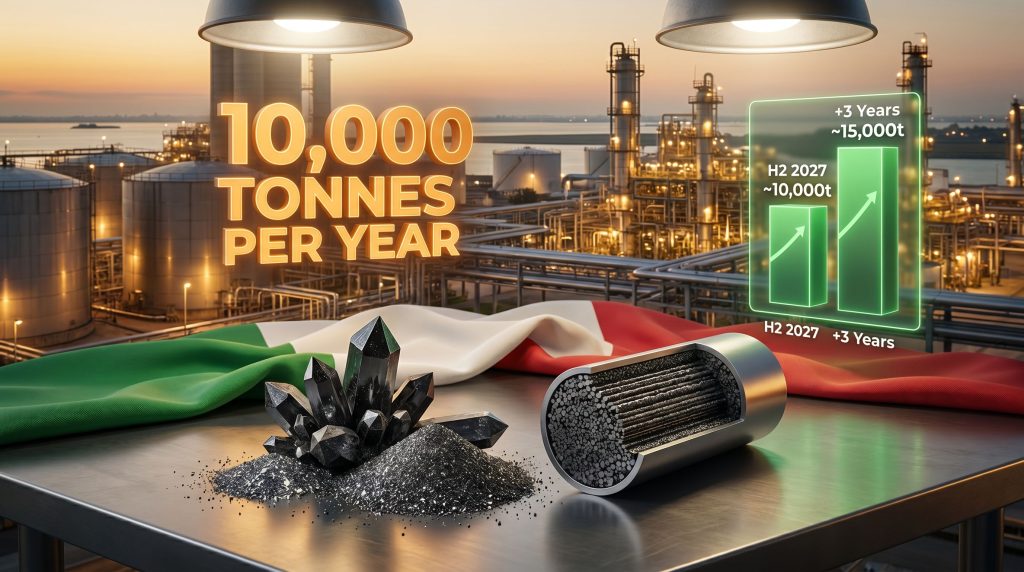
| Initial Production Phase | ~10,000 tonnes per year | H2 2027 |
| Expanded Capacity | ~15,000 tonnes per year | Within 3 years of commissioning |
A 10,000-tonne annual capacity at commissioning represents a meaningful contribution to European graphite processing supply, particularly given that current Western-aligned processing capacity across all of Europe remains negligible by comparison to demand projections for the late 2020s.
The expansion pathway to 15,000 tonnes per annum within three years of commissioning assumes successful process optimisation and sustained commercial demand growth, both of which carry execution uncertainty. However, the embedded facility model does provide one advantage in scaling. Additional processing lines can be added within the existing licensed site footprint without triggering fresh environmental impact assessments or construction permits.
Who Will Buy the Output?
The facility's production is designed to serve three distinct end markets, each with different technical specifications and pricing dynamics:
-
Industrial applications: Micronized graphite serves as a dry lubricant in heavy machinery, a refractory lining material in steel furnaces, and a component in speciality gaskets and thermal management coatings. This market is less technically demanding in terms of purity but values consistent particle size distribution and reliable European supply.
-
Energy storage: Battery-grade purified graphite with carbon purity exceeding 99.9% is required for lithium-ion anode manufacture. The broader battery raw materials market continues to tighten, and European gigafactories operated by manufacturers including Volkswagen Group, Stellantis, and BMW supply chain partners represent the high-value end of this demand pool.
-
Defence and aerospace: Advanced graphite materials are used in electromagnetic shielding, thermal management composites, and structural applications for defence platforms. European defence procurement budgets have increased substantially in the 2025–2026 period, adding a strategically significant demand pillar that was less prominent in earlier graphite market projections.
International Graphite's Dual-Hub Continental Strategy
Two Processing Hubs, Two Geographies, One Commercial Window
The Porto Marghera venture is not International Graphite's only processing initiative under development. The company is simultaneously advancing a graphite processing hub in Western Australia, creating a dual-continent processing architecture with the following profile:
| Processing Hub | Location | Status | Target Operational Date |
|---|---|---|---|
| European Hub | Porto Marghera, Italy | JV signed, FID Q3 2026 | H2 2027 |
| Asia-Pacific Hub | Western Australia | Under development | 2027 |
The strategic logic of operating two processing hubs within the same approximate commissioning window is worth examining carefully. Rather than pursuing a sequential development model, where one hub is built, de-risked, and then a second is initiated, International Graphite appears to be pursuing parallel development. This approach accelerates market entry but multiplies execution risk and capital management complexity.
For a junior ASX-listed company, managing two simultaneous development programmes across two continents requires disciplined capital allocation and clear milestone sequencing. The A$12 million committed to the Italy JV represents a significant portion of the company's development budget, and investors should monitor both hubs' progress against stated milestones through the second half of 2026.
The G7 Policy Backdrop and What It Actually Means for This Project
Diversification Targets, Bilateral Diplomacy, and Processing Benchmarks
G7 nations formally agreed in mid-2026 to target a ceiling of 60% supply concentration from any single country for critical mineral imports by 2030. This target encompasses graphite, which the European Commission has classified as a critical raw material given its centrality to battery manufacturing and the near-total dominance of Chinese processing in global supply chains.
Separately, Canada's Prime Minister Mark Carney offered Italy priority access to Canadian critical minerals during G7 discussions in France in June 2026, signalling that bilateral mineral security partnerships have become an active instrument of economic diplomacy among Western allies. While this bilateral offer is not directly linked to the International Graphite Alkeemia venture, it reflects the broader diplomatic environment in which European graphite processing investment is occurring.
Important distinction: The regulatory and diplomatic frameworks described above represent industry-wide policy tailwinds. They do not constitute project-specific government support, funding, or strategic designation for the Porto Marghera facility. Investors should not interpret these macro-level policy signals as confirmation of government backing for this particular venture.
The EU Critical Raw Materials Act sets benchmarks requiring at least 10% of annual consumption of strategic materials to be processed domestically within Europe by 2030. In addition, the establishment of an European raw materials facility underscores the institutional seriousness with which Brussels is approaching supply chain independence. Facilities like Porto Marghera consequently form part of the private-sector response to these structural policy demands.
The next major ASX story will hit our subscribers first
How Porto Marghera Compares to Other European Graphite Processing Approaches
The Capital Efficiency Argument in Numbers
| Factor | Porto Marghera JV | Typical Greenfield European Processing Project |
|---|---|---|
| Site Infrastructure | Existing licensed chemical complex | Full construction required |
| Permitting Status | Leverages Alkeemia's existing approvals | Multi-year permitting process |
| HF Acid Access | On-site availability | Requires dedicated supply chain |
| Capital Requirement (IG contribution) | A$12 million | Typically $50M to $200M+ |
| Estimated Time to First Production | ~12 to 18 months post-FID | 3 to 7 years |
| Ownership Model | 49/51 JV with 50/50 profit share | Typically 100% ownership or pure offtake |
The capital efficiency differential is striking. By embedding new processing capacity within Alkeemia's existing infrastructure rather than constructing a standalone plant, the total capital requirement is compressed by an order of magnitude compared to most greenfield alternatives. This matters not just for International Graphite's balance sheet but for the broader question of how quickly European graphite processing capacity can be scaled to meet demand growth. Furthermore, the critical minerals recycling transition adds another dimension to the supply landscape that European planners must also account for.
Key Risk Factors Investors Should Monitor
Technical, Commercial, and Capital Execution Risks
No investment analysis of this project would be complete without a clear-eyed assessment of the risks involved. The International Graphite Alkeemia Italy graphite processing hub faces several material uncertainties:
Technical risks:
-
Achieving battery-grade purity consistently at production scale requires precise process control. Early-stage process deviations can result in off-spec product that cannot command premium pricing.
-
HF handling introduces occupational health and environmental liability that must be managed within stringent Italian and EU regulatory frameworks. Any incident could trigger operational suspension and reputational damage.
-
The expansion from 10,000 to 15,000 tonnes per annum assumes process optimisation progresses on schedule, which is not guaranteed.
Commercial risks:
-
European gigafactory construction timelines have been revised repeatedly since 2022. If battery manufacturing capacity expansion is delayed further, near-term demand for domestically processed graphite anode material may be softer than projected.
-
Chinese graphite export policy remains a wildcard. Any significant relaxation of export restrictions could compress pricing margins for Western processors competing on cost.
-
The company has not yet disclosed confirmed offtake agreements. Securing binding commercial commitments prior to or concurrent with the Q3 2026 final investment decision would materially reduce demand-side risk.
Capital risks:
-
The A$12 million capital commitment is substantial for a junior company. Cost overruns during construction or process commissioning could require additional capital raising, potentially diluting existing shareholders.
-
Cross-border JV governance between an Australian listed company and an Italian privately held chemical manufacturer introduces jurisdictional complexity that could slow decision-making during critical development phases.
Disclaimer: This article contains forward-looking statements and analysis based on publicly available information. It does not constitute financial advice. Investors should conduct their own due diligence and consult a licensed financial adviser before making investment decisions related to International Graphite or any other securities discussed.
Frequently Asked Questions
What is the International Graphite Alkeemia Italy graphite processing hub?
It is a joint venture between ASX-listed International Graphite (49%) and Italian chemical manufacturer Alkeemia (51%) to develop a graphite processing facility at Porto Marghera in northeastern Italy. The facility will convert graphite concentrate into micronized and purified products for industrial, battery, and defence applications, with profits distributed equally between both partners.
Why is Porto Marghera considered strategically valuable for graphite processing?
Porto Marghera offers a combination of existing industrial infrastructure, on-site hydrofluoric acid availability for chemical purification, deep-water port access, and rail connectivity to major European manufacturing markets. Embedding the new facility within Alkeemia's licensed complex eliminates the need for fresh environmental permits and greenfield construction.
When will the facility begin production?
A final investment decision is targeted for the third quarter of 2026, with first production expected during the second half of 2027.
What production capacity is planned?
Initial annual capacity is targeted at approximately 10,000 tonnes of processed graphite products, with an expansion pathway to around 15,000 tonnes per annum within three years of commissioning.
How does this project contribute to European graphite supply chain independence?
By processing graphite within the European Union using Western-aligned supply chains, the facility provides European battery manufacturers and industrial users with a non-Chinese sourcing option for processed graphite. This supports the broader G7 and EU objective of reducing critical mineral supply concentration below 60% from any single country by 2030.
Want to Track the Next Major ASX Mineral Discovery Before the Market Moves?
Discovery Alert's proprietary Discovery IQ model scans ASX announcements in real time, instantly identifying significant mineral discoveries across graphite, lithium, and more than 30 other commodities — delivering actionable insights to subscribers before the broader market reacts. Explore how historic discoveries have generated substantial returns on Discovery Alert's dedicated discoveries page, and begin your 14-day free trial today to position yourself ahead of the next major find.