June 17, 2026
The Grid Flexibility Crisis Hidden Inside the World's Fastest Renewable Expansion
Every energy transition reaches an inflection point where the pace of clean capacity addition outstrips the grid's ability to absorb it. Most energy planners treat this as a distant theoretical problem. For India in 2026, it has become an operational reality playing out in real-time dispatch intervals, every single day.
The counterintuitive truth at the centre of this crisis is that building more solar can, under current grid conditions, produce less usable clean energy. As renewable output floods the midday grid, the system's inability to absorb that surplus forces operators to deliberately switch it off. The technical term is curtailment. The practical consequence is that clean electricity generated at zero marginal cost is wasted, stranded investment returns evaporate, and the coal fleet continues running regardless.
Understanding why India needs 10 GWh of battery storage to avoid renewable curtailment requires unpacking a structural constraint that sits at the heart of the coal-solar conflict: the minimum technical load.
When big ASX news breaks, our subscribers know first
What Minimum Technical Load Actually Means and Why It Controls Everything
The Hidden Ceiling on India's Renewable Integration
Minimum technical load (MTL) is the lowest generation level at which a coal-fired thermal plant can operate safely and continuously without shutting down entirely. For India's coal fleet, this threshold sits at approximately 55% of rated capacity. Below that point, combustion stability deteriorates, turbine stresses increase, and the plant risks an unplanned trip that could destabilise the broader grid.
This creates a structural ceiling that is invisible to most observers but governs every dispatch decision during daylight hours. Coal plants cannot simply be switched off when solar generation peaks at midday. They must remain online because:
- The evening demand surge, which arrives within hours of solar output collapsing, requires coal to be available and warmed up for rapid ramping
- Coal currently provides the majority of India's spinning reserves and ancillary services, meaning its presence on the grid is required for frequency stability even when its energy output is unwanted
- Cold-starting a coal unit that has been shut down takes many hours, making it operationally impractical to cycle plants off and on within a single day
The consequence of this physical reality is that when solar generation rises high enough to push coal toward its MTL floor, the only available response is to curtail renewables. The grid has no other lever to pull.
Key Structural Insight: India's curtailment problem is not fundamentally a transmission bottleneck or a demand shortfall. It is a thermal fleet inflexibility problem. Every megawatt of battery storage that can charge during peak solar hours directly displaces a megawatt of otherwise-curtailed renewable generation, while simultaneously allowing coal plants to operate above their MTL without contributing energy to an already-saturated system.
Quantifying the Scale of India's Curtailment Problem in 2025-26
The Numbers Behind a Structural Warning
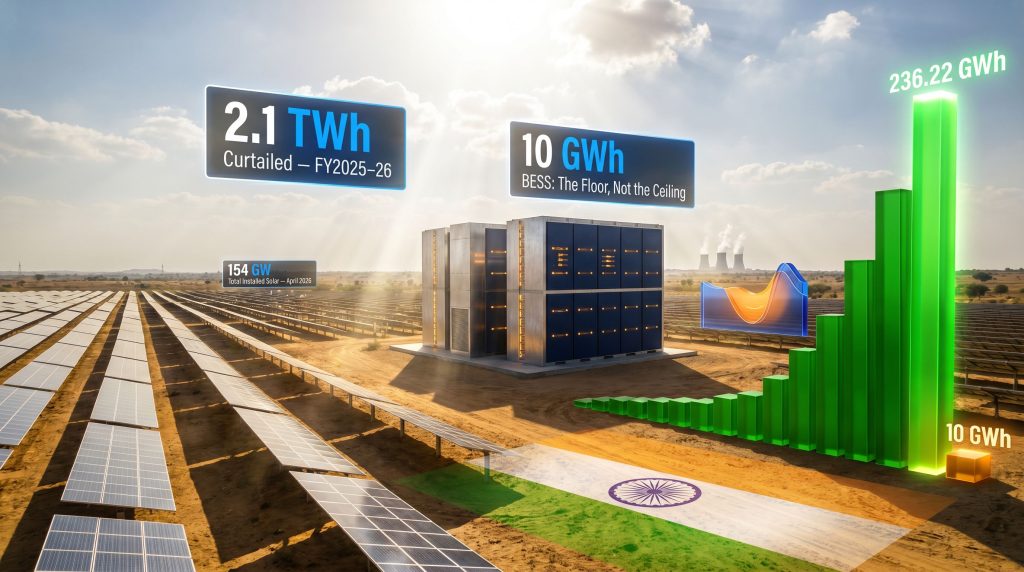
Analysis by Ember found that approximately 2.1 TWh of renewable electricity was curtailed during fiscal year 2025-26, equivalent to 1.3% of total renewable generation for the period. That figure alone might sound manageable. The trajectory it represents is far more alarming.
| Metric | Value |
|---|---|
| Renewable electricity curtailed (FY 2025-26) | ~2.1 TWh |
| Curtailment as share of total renewable generation | ~1.3% |
| Solar capacity added (Oct 2025 to Apr 2026) | ~24 GW |
| Total installed solar capacity by April 2026 | ~154 GW |
| Peak-hour curtailment rate (April 2026) | ~4% of solar and wind generation |
| Coal MTL breaches during midday intervals (April 2026) | Over 50% of dispatch intervals |
| Curtailment share of down-regulation (April 2026) | 37% (up from near zero one year prior) |
The April 2026 data point carries particular weight. April falls outside India's historically most constrained seasonal window, yet curtailment rates during that month matched levels previously seen only in the most challenging months of late 2025. The curtailment share of down-regulation climbing from near zero to 37% within a single year is not a linear progression. It is an exponential acceleration signal.
The March 6, 2026 Case Study: A Grid Under Stress
A single day in early 2026 illustrates the daily balancing act India's grid operators now face. On March 6, solar and wind together reached 41% of the total generation mix at midday. To accommodate that output, coal generation had to be reduced by approximately 49 GW across a six-hour window. By evening, as solar output collapsed, coal had to ramp back up by roughly 51 GW to meet the surge in household and industrial demand.
Coal infrastructure was engineered for sustained high-output baseload operation, not daily cycling of this magnitude and speed. Deep daily cycling accelerates wear on boiler components, turbine blades, and heat exchangers, progressively increasing maintenance costs and unplanned outage risk across a fleet that still generates the majority of India's electricity. The grid is effectively consuming its own baseload reliability to accommodate renewable growth it cannot yet absorb.
Is 10 GWh of Battery Storage Actually Enough? Scenario Analysis
What the 10 GWh Figure Solves and What It Does Not
The Ember analysis concludes that 10 GWh of grid-scale battery storage, charged during peak midday solar generation hours, would have been sufficient to absorb the surplus renewable output recorded in FY2025-26, maintain coal plants above their MTL, and eliminate the observed curtailment entirely.
This is a precise and narrow claim. The 10 GWh figure addresses a specific, historically observed curtailment volume. It does not represent the storage capacity required to accommodate India's full renewable buildout trajectory or to displace coal's flexibility role more broadly. Furthermore, the broader push for battery storage expansion across emerging markets signals that India is far from alone in confronting this challenge.
Analytical Caveat: The 10 GWh requirement should be understood as a minimum intervention threshold for curtailment volumes recorded in a single fiscal year. As India continues adding solar capacity at the pace observed through 2025-26, this storage requirement will grow substantially and rapidly. The 10 GWh target is a floor, not a ceiling.
How 10 GWh Compares to India's Official Storage Projections
| Planning Horizon | Storage Requirement | Source or Framework |
|---|---|---|
| Near-term curtailment fix (FY2025-26 volumes) | ~10 GWh BESS | Ember analysis |
| Official BESS target (2026-27) | 34.72 GWh | Central Electricity Authority (CEA) |
| Official BESS target (2031-32) | 236.22 GWh | Central Electricity Authority (CEA) |
| Total storage need (2031-32, all technologies) | 411.4 GWh | CEA National Electricity Plan |
| Cost-effective BESS by 2030 (independent analysis) | 51 GW / 164 GWh | Independent research estimates |
The order-of-magnitude gap between the 10 GWh curtailment fix and the 164 to 236 GWh range identified as necessary for full renewable integration by 2030-32 underscores a critical point: the immediate storage need is tractable, but it is only the entry point to a far larger deployment programme.
Three Scenarios for India's Storage Trajectory
Scenario A: No New Storage Deployed
Curtailment accelerates in line with solar capacity growth, potentially reaching 8-10% of renewable generation by 2027-28. Coal cycling damage compounds, raising plant maintenance costs and reducing thermal fleet reliability. Renewable developer revenue uncertainty increases, deterring new project financing.
Scenario B: 10 GWh BESS Deployed by 2026-27
Near-term curtailment volumes are absorbed. Coal plants are relieved of their deepest cycling requirements. The storage model is proven commercially, providing the confidence needed to accelerate larger procurement rounds toward the CEA's 34.72 GWh target.
Scenario C: 50-plus GWh BESS Operational by 2028
Meaningful displacement of coal's ancillary services role begins. The renewable integration ceiling rises substantially. India's 500 GW non-fossil capacity target by 2030 transitions from aspirational to structurally achievable.
The Technical Case for Battery Storage: Why Duration Matters as Much as Capacity
GW vs. GWh: A Critical Distinction for Grid Planning
A common source of confusion in storage policy discussions is the conflation of power capacity with energy capacity. These are distinct and equally important metrics:
- GW (gigawatts) measures the rate at which a battery system can charge or discharge energy, equivalent to power output at any given moment
- GWh (gigawatt-hours) measures the total volume of energy a battery system can store and deliver before requiring recharging
A 5 GW system with 10 GWh of storage capacity delivers two hours of storage duration. The same 10 GWh spread across a 2.5 GW system provides four hours of duration. For India's specific grid challenge, duration matters enormously because the midday solar surplus typically extends across four to six hours, and the evening demand ramp that follows requires sustained discharge over a comparable period.
Matching Storage Technology to India's Use Cases
| Technology | Typical Duration | Strengths for India | Limitations |
|---|---|---|---|
| Lithium-ion BESS (LFP chemistry) | 2-4 hours | Proven at scale, rapidly deployable, rapidly falling costs | Limited suitability for overnight or multi-day shifting |
| Flow batteries (vanadium or iron-based) | 4-12 hours | Long duration, high cycle stability, scalable energy capacity | Higher upfront capital cost, less mature Indian supply chain |
| Pumped hydro storage | 8-24 hours plus | Very large scale, multi-decade operational life | Geography-constrained, development timelines of 5-10 years |
| Sodium-ion BESS | 2-4 hours | Emerging cost advantage, no lithium dependency | Technology still scaling commercially globally |
In addition, the sourcing of battery raw materials remains a critical upstream consideration for scaling any of these technologies at the pace India requires. Separately from MTL-driven curtailment, approximately 300 GWh of renewable generation was lost to transmission bottlenecks in Q1 2026 alone. Research suggests that 3-4 GW of two-hour storage, strategically positioned near congestion points, could absorb the majority of transmission-constrained curtailment.
India's Storage Policy Architecture and the Gaps That Are Slowing Deployment
The Regulatory Framework Supporting BESS Procurement
India's battery storage procurement framework operates primarily through the Ministry of Power and the Central Electricity Authority, with the Solar Energy Corporation of India (SECI) issuing grid-scale BESS tenders at the national level. State-level distribution companies (DISCOMs) have also issued independent storage tenders, creating a multi-layer procurement architecture.
The Viability Gap Funding (VGF) scheme has been the primary mechanism for bridging the gap between storage project economics and commercial viability, effectively subsidising the cost difference between BESS deployment costs and the revenue available in current market structures. India's policy and regulatory readiness for energy storage continues to evolve as these pressures intensify.
The Policy Gaps That Must Be Addressed
Despite this framework, several structural gaps are constraining the pace of storage deployment:
- No mandatory storage obligation for new renewable projects, meaning developers can connect solar capacity to the grid without providing corresponding flexibility
- Absence of a standardised ancillary services market that would allow BESS operators to monetise frequency regulation, spinning reserve replacement, and other flexibility services at transparent market prices
- Grid code limitations that currently restrict BESS from participating fully in all flexibility service categories, reducing the revenue stack available to project developers
- Procurement fragmentation across SECI and multiple state DISCOMs, creating inconsistent tender terms and complicating project financing
Policy Urgency Signal: India's Central Electricity Authority has established a BESS target of 34.72 GWh by 2026-27. With curtailment already at 2.1 TWh annually and accelerating non-linearly, the pace of storage procurement relative to ongoing solar capacity addition will determine whether India's renewable ambitions remain achievable or become self-limiting through curtailment-induced investment deterrence.
The next major ASX story will hit our subscribers first
How India Compares to Markets That Have Navigated Similar Grid Inflection Points
Global Precedents and Their Transferable Lessons
Australia (National Electricity Market): Australia experienced analogous curtailment pressure as rooftop solar penetration exceeded the ramp-rate flexibility of its thermal fleet. The response combined grid-scale BESS deployment, demand response programmes, and interconnector investment between states. The South Australian experience demonstrated that fast-responding battery storage could replace traditional synchronous generation for frequency regulation purposes, fundamentally expanding the revenue stack available to storage developers.
California (CAISO): California's duck curve challenge was managed through a combination of storage procurement mandates imposed on utilities, real-time pricing signals that created financial incentives for battery charging during surplus solar periods, and aggressive demand response programmes that shifted industrial load toward midday solar peaks.
Germany: Germany's coal-to-renewables transition relied more heavily on pumped hydro and cross-border interconnection with neighbouring European grids than on grid-scale BESS. This model is not directly replicable for India given the scale of its grid, limited geography for new pumped hydro, and absence of interconnected neighbouring grids of comparable capacity.
The most transferable lesson from all three markets is a timing principle: storage deployment must lead renewable capacity addition, not follow it. Every gigawatt of solar installed without corresponding storage increases curtailment probability, degrades developer revenue certainty, and compounds the coal cycling damage that ultimately threatens baseload reliability.
India holds one structural advantage that its predecessors did not. Lithium-ion battery pack prices are approaching the sub-$100/kWh threshold at which BESS becomes cost-competitive with new peaking gas capacity in most markets. Consequently, the critical minerals transition underpinning battery supply chains has become as strategically significant as the grid infrastructure itself. At that price point, the financial case for storage deployment no longer requires policy subsidy to be commercially viable.
The Self-Reinforcing Constraint: Why Inaction Compounds the Problem
The Investment Deterrence Loop
High curtailment rates do not simply represent wasted generation. They actively deter the next wave of renewable investment through a feedback mechanism that is rarely discussed in policy forums:
- Curtailment reduces the actual generation hours available to a renewable project, cutting revenue below projected levels used in project financing models
- Lenders and equity investors respond by requiring higher risk premiums or reducing their willingness to finance new projects in high-curtailment zones
- Slower renewable capacity addition reduces the urgency and scale justification for storage procurement
- Without storage deployment, curtailment continues to rise as existing solar capacity grows, returning to step one at a higher intensity
Breaking this loop requires either mandatory co-location requirements linking new renewable project approvals to storage provision, curtailment compensation mechanisms that reimburse developers for dispatched-but-curtailed generation, or sufficient storage tender volume to create a self-sustaining commercial market for grid flexibility services. Technologies like direct lithium extraction are also emerging as important enablers of the faster, more scalable battery supply chains that India's storage ambitions will depend on.
The Phased Investment Framework India Needs
| Phase | Timeline | BESS Target | Primary Grid Function |
|---|---|---|---|
| Phase 1: Curtailment Elimination | 2026-27 | ~35 GWh | Absorb MTL-driven curtailment, validate storage model commercially |
| Phase 2: Flexibility Transition | 2027-29 | ~100-165 GWh | Begin displacing coal's ancillary services role, extend renewable integration ceiling |
| Phase 3: Deep Decarbonisation | 2030-32 | ~236 GWh BESS plus | Enable coal exit from flexibility markets, support 500 GW renewable target |
Frequently Asked Questions: India Battery Storage and Renewable Curtailment
Why is India curtailing renewable energy when it still has a power deficit?
The confusion arises from a temporal mismatch. India's power deficit is most acute during evening hours when demand peaks. Renewable generation peaks at midday when demand is lower. The coal fleet, which must remain online to meet the evening surge, cannot ramp down fast enough during the midday solar peak without breaching its minimum technical load floor. The result is curtailment not because there is too much electricity overall, but because there is too much electricity at the wrong time and the system lacks the storage to shift it.
What does 10 GWh of battery storage actually represent in practical terms?
Ten gigawatt-hours of storage capacity could power approximately 10 million average Indian households for one hour, or provide meaningful grid-level absorption of surplus midday solar generation across multiple high-curtailment states simultaneously. At a system level, it represents the difference between 2.1 TWh of clean electricity being wasted annually and that same energy being stored and dispatched during the evening demand peak. India needs 10 GWh of battery storage to avoid renewable curtailment, and this figure provides the clearest possible illustration of what that means in human terms.
How quickly could India realistically deploy 10 GWh of grid-scale BESS?
Current BESS project development timelines in India typically run between 18 and 30 months from tender award to commissioning. With SECI and state-level tenders already in the procurement pipeline, the 10 GWh threshold is technically achievable within 2-3 years if procurement volumes are maintained and accelerated. The faster pathway involves co-location with existing solar parks, which leverages established grid connection infrastructure and eliminates a significant portion of development timeline risk. Renewable energy solutions increasingly incorporate storage co-location as a standard feature of project design, which further supports this accelerated timeline.
Will 10 GWh of storage be sufficient long-term?
No. The 10 GWh figure addresses curtailment volumes recorded during FY2025-26 under current solar penetration levels. India's Central Electricity Authority projects a BESS requirement of 236.22 GWh by 2031-32, with total storage needs across all technologies reaching 411.4 GWh under the National Electricity Plan. However, independent assessments, such as this strategic pathways analysis, suggest the deployment challenge is as much about execution as it is about targets. The 10 GWh deployment threshold should be understood as the proof-of-concept milestone that, if achieved, validates the storage model and accelerates the investment pipeline toward these larger targets. The destination is an order of magnitude beyond the starting point.
Disclaimer: This article contains forward-looking projections, scenario modelling, and market forecasts derived from third-party research organisations including Ember and the Central Electricity Authority of India. These projections are subject to change based on policy developments, technology cost trajectories, and grid operational conditions. Nothing in this article constitutes financial or investment advice.
Want to Stay Ahead of the Critical Minerals Driving India's Battery Storage Revolution?
Discovery Alert's proprietary Discovery IQ model scans ASX announcements in real time, instantly identifying significant discoveries in lithium, vanadium, and other minerals central to the grid-scale storage technologies India's energy transition depends on — explore historic examples of how major mineral discoveries translate into substantial market returns and begin your 14-day free trial to position yourself ahead of the market.