June 17, 2026
Europe's Graphite Processing Gap: Why Industrial Co-Location Is Becoming the Model of Choice
The economics of critical mineral supply chains rarely shift overnight. They erode quietly, through decades of offshoring decisions, until a single geopolitical disruption makes the structural dependency impossible to ignore. For Europe's battery and industrial manufacturing sector, that moment arrived with the realisation that virtually every tonne of processed graphite consumed on the continent originates from a single external source. The response now taking shape across European industrial zones is not simply about signing new supply agreements. It is about physically rebuilding processing capability inside Europe's own borders, using the infrastructure that already exists.
The International Graphite Alkeemia graphite hub in Italy represents exactly this kind of response: a deliberate effort to combine complementary industrial assets into a processing operation that can compete on cost, quality, and geography simultaneously.
When big ASX news breaks, our subscribers know first
The Structural Problem Driving European Graphite Investment
Graphite occupies a peculiar position in the critical minerals conversation. Unlike lithium or cobalt, it rarely receives the same level of investor attention, yet it constitutes the single largest component by weight in a lithium-ion battery anode. A standard electric vehicle battery requires roughly ten times more graphite than lithium by mass, making it a volume-critical input rather than a boutique specialty material.
Europe currently relies on China for the overwhelming majority of its processed graphite supply. This dependency contributes directly to the global graphite shortage that has drawn urgent attention from policymakers and industrial buyers alike. Furthermore, this is not simply a trade statistic; it represents a structural vulnerability embedded in the automotive, energy storage, and advanced materials sectors simultaneously.
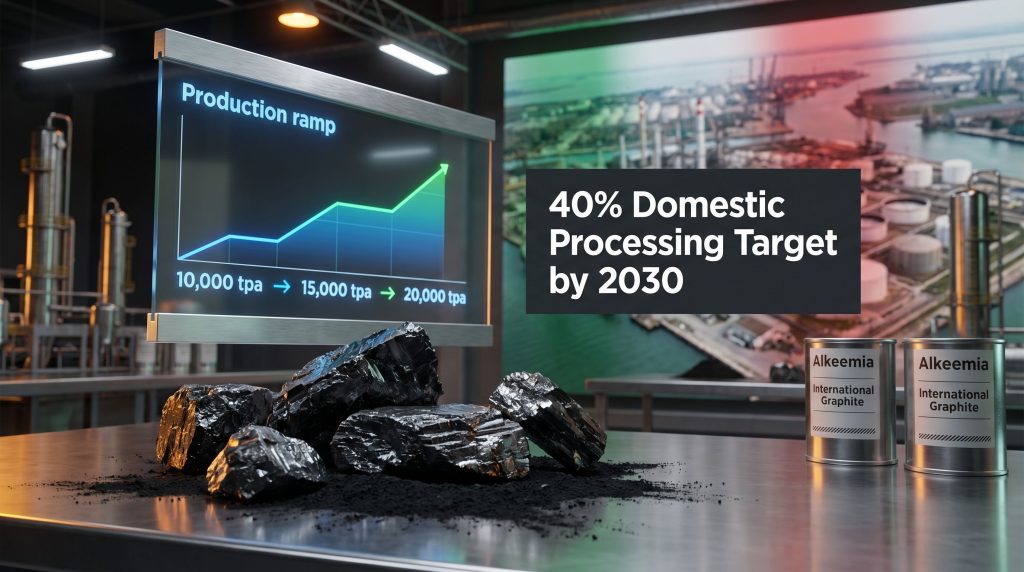
The EU Critical Raw Materials Act, which formally classifies graphite as a strategic raw material, sets a benchmark requiring that 40% of EU consumption of strategic raw materials be processed domestically by 2030. That target demands a significant volume of new processing infrastructure to be built and operational within a compressed timeframe. Against current European processing capacity, the gap is substantial.
What is less commonly understood is that graphite processing involves multiple distinct stages, each with different infrastructure requirements. Purification to battery-grade specifications, for example, typically demands either high-temperature thermal treatment above 2,800°C or chemical purification using hydrofluoric acid. The latter approach, while chemically intensive, is generally faster and more energy-efficient at scale, which is precisely why access to existing HF production infrastructure changes the economics of European graphite processing fundamentally.
Porto Marghera: An Industrial Asset That Took Decades to Build
Porto Marghera, the industrial port zone located near Venice in northeastern Italy, is not a new site. It has operated as a heavy chemical manufacturing precinct for decades, accumulating exactly the kind of specialised infrastructure that cannot be replicated quickly or cheaply on a greenfield basis.
Alkeemia's existing operations at Porto Marghera centre on hydrofluoric acid and fluoro derivatives manufacturing. HF is a highly controlled industrial chemical with stringent handling requirements, and facilities capable of producing and working with it safely are genuinely scarce across Europe. For graphite purification at high purity levels, HF access is not optional; it is the chemical backbone of the process.
Beyond the chemistry, the Porto Marghera site offers a combination of advantages that few European locations can match:
- Direct multimodal logistics connectivity, with access to shipping, rail, and road networks enabling efficient import of graphite concentrate feedstock from international sources
- An established industrial workforce already trained in chemical handling and safety protocols applicable to graphite processing operations
- Shared utilities infrastructure, reducing the capital and operational cost burden compared with standalone greenfield facilities
- Alkeemia's 99-year land lease over the site, providing long-term tenure certainty that underpins investment decision-making
The site's emergence as what may become a multi-tenant graphite processing precinct, with additional purification capacity being developed alongside the joint venture, further reinforces its strategic positioning as a European graphite processing node.
Breaking Down the International Graphite and Alkeemia Joint Venture Structure
Ownership, Profit-Sharing, and Scope
The binding joint venture agreement between International Graphite and Alkeemia establishes a partnership structure that balances site control with commercial incentive alignment in a deliberate way. Proactive Investors has reported on the commercial logic underpinning this structure, noting its potential to deliver low-cost graphite growth within Europe's emerging supply chain framework.
| Structural Element | Detail |
|---|---|
| Alkeemia equity interest | 51% |
| International Graphite equity interest | 49% |
| Profit-sharing arrangement | 50/50 split |
| Land tenure | 99-year lease held by Alkeemia |
| Agreement scope | Land lease, operations management, product sales, technical services |
The asymmetric equity split with symmetric profit-sharing is a commercially nuanced arrangement. Alkeemia holds majority ownership, which reflects its contribution of physical site control and existing infrastructure. International Graphite holds a near-equal equity stake while contributing processing expertise, feedstock sourcing capability, and technical services. The 50/50 profit division ensures both parties share equally in commercial outcomes regardless of the equity weighting, aligning long-term incentives throughout the project lifecycle.
What Each Partner Contributes
| Partner | Core Contribution |
|---|---|
| International Graphite | Graphite processing expertise, technical services, feedstock sourcing knowledge |
| Alkeemia | 99-year site lease, existing chemical infrastructure, HF access, skilled industrial workforce |
The co-location model within an active chemical manufacturing precinct is a structural cost and capability advantage that greenfield graphite processing facilities in Europe cannot easily replicate. The question for most greenfield critical mineral processing projects is not whether the technology works, it is whether the supporting infrastructure around it can be assembled economically and on schedule. At Porto Marghera, that infrastructure already exists.
Phase-by-Phase Production Capacity and Product Strategy
Planned Output Targets
The production roadmap for the International Graphite Alkeemia graphite hub in Italy is structured across distinct phases, with each stage intended to demonstrate commercial viability before triggering expansion capital commitment.
| Phase | Planned Capacity | Timing |
|---|---|---|
| Phase 1 | ~10,000 tpa processed graphite products | Target: H2 2027 first production |
| Phase 2 | ~15,000 tpa | Post Phase 1 ramp-up |
| Full site ambition | ~20,000 tpa graphite purification output | By end of decade |
The 200 tpa graphite purification pilot plant currently under construction by Alkeemia serves as the critical technical validation step ahead of full commercial scale. International Graphite has been allocated 50% of the pilot plant's initial capacity, providing direct access to process data and product quality confirmation ahead of the final investment decision.
Feedstock Flexibility as a De-Risking Strategy
One of the less-discussed but commercially important aspects of the project's technical preparation is the deliberate use of multiple commercially available feedstocks during testwork. Laboratory and pilot-scale testing has been conducted across various graphite concentrate sources from third-party suppliers, with the process confirmed to produce products meeting target specifications across different feedstock types.
This feedstock-agnostic approach carries significant implications for supply chain resilience:
- It avoids single-source dependency, which is a procurement vulnerability that European industrial buyers are increasingly unwilling to accept
- It positions the facility to source graphite concentrate from emerging producers in Africa, Australia, and Scandinavia as those supply chains develop
- It creates commercial optionality in feedstock procurement, allowing the operation to respond to price and availability conditions across multiple geographies
- It demonstrates that the processing route itself is robust rather than optimised for a specific ore chemistry, which reduces technical risk in the eyes of offtake customers and project financiers
Project Timeline and Key Decision Points
Development Schedule
| Milestone | Target Timing |
|---|---|
| Final Investment Decision (FID) | Q3 2026 |
| Permit Approvals | Q3 2026 |
| Construction Commencement | Post-permit, Q3 2026 |
| First Production | H2 2027 |
| Phase 2 Expansion Consideration | Post Phase 1 ramp-up |
| Full Site Purification Capacity (20,000 tpa) | By end of decade |
Risk Factors That Could Affect This Timeline
Several path dependencies warrant monitoring between now and the FID in Q3 2026:
- Regulatory permitting within Italy's industrial zone framework and EU environmental compliance requirements represents a procedural risk that, while manageable at an established industrial site, is rarely fully predictable in timing
- Feedstock supply agreements with third-party graphite concentrate producers are a critical path dependency; commercial processing operations require secured concentrate supply ahead of construction commitment
- Capital availability for construction, given the current macro environment for critical minerals investment where project financing timelines have extended across the sector
- Pilot plant performance data from the 200 tpa Alkeemia facility will serve as a technical proof point that underpins both FID confidence and early customer engagement
The next major ASX story will hit our subscribers first
How This Project Fits Within Europe's Broader Critical Minerals Architecture
Understanding the EU Critical Raw Materials Act in Practice
The EU Critical Raw Materials Act, which came into force in 2024, establishes binding benchmarks for domestic processing of strategic materials. Graphite's classification as a strategic raw material under the Act reflects its irreplaceable role in battery anode manufacturing and its extreme geographic concentration of processing. The broader challenge of sourcing critical raw materials transition inputs domestically has become a defining policy priority across the continent.
The 40% domestic processing target by 2030 is often cited but rarely contextualised. In practical terms, Europe would need to build processing capacity sufficient to handle 40% of its projected consumption of each strategic material within approximately six years. For graphite, where processing involves chemically and thermally intensive industrial operations, this represents a significant infrastructure challenge that cannot be met through policy statements alone.
The important distinction that policy discussions often obscure is the difference between graphite mining and graphite processing. Europe has some natural graphite occurrences, particularly in Scandinavia and Central Europe. However, the critical bottleneck is not mining; it is the chemical and thermal purification stage that converts graphite concentrate into battery-grade material meeting specifications of 99.95% carbon purity or higher. This is where European industrial capacity is most deficient, and where projects like the Porto Marghera hub create the most strategic value.
Geopolitical Exposure and the China Dependency Problem
Europe's near-total reliance on China-origin processed graphite creates a concentration risk that extends beyond simple supply disruption scenarios. China controls an estimated 70-80% of global natural graphite mining output and an even higher share of processed battery-grade graphite production. Export restriction mechanisms, which China has demonstrated willingness to deploy across multiple critical mineral categories, represent a tangible policy risk for European manufacturers.
The response from European industrial policy and private sector actors is shifting from demand-side diversification toward supply-side localisation: physically building processing capacity within Europe. Consequently, Europe's critical minerals supply chain is being redesigned from the ground up, with projects like the International Graphite Alkeemia graphite hub in Italy serving as concrete examples of this supply-side approach.
International Graphite's Multi-Node European Strategy
The Porto Marghera joint venture does not exist in isolation. In mid-2025, International Graphite entered a separate partnership with Arctic Graphite and Graphite Investment Partners to establish an expandable graphite processing facility in Germany. If both facilities progress to production, they would create a geographically distributed European processing capability serving different regional markets and industrial end-use segments.
The strategic logic of processing graphite in Europe rather than shipping finished product from Australia or elsewhere rests on several interconnected factors:
- Proximity to gigafactories reduces logistics costs and working capital requirements for European battery cell manufacturers, who typically require just-in-time delivery of processed materials
- Regulatory compliance alignment means product specifications can be continuously calibrated against EU battery regulation requirements without international time zone and communication friction
- Carbon footprint credentials for processed material manufactured within the EU carry growing commercial value as European battery manufacturers face Scope 3 emissions reporting obligations
- Existing chemical infrastructure, specifically Alkeemia's Porto Marghera precinct, makes European processing economically competitive against established Asian processors in a way that purpose-built greenfield facilities typically cannot achieve
Furthermore, the battery raw materials market is evolving rapidly, and the parallel development in Germany suggests a deliberate geographic distribution of processing nodes across Northern and Southern Europe. This would reduce single-location risk while serving distinct industrial clusters in the German automotive corridor and the Northern Italian manufacturing belt simultaneously.
The mineral processing challenges that have historically hindered European self-sufficiency are, however, not insurmountable. The International Graphite and Alkeemia model demonstrates that co-locating within an established chemical precinct can sidestep many of the infrastructure barriers that stall greenfield projects. International Graphite's official announcement provides further detail on how the two partners intend to operationalise this advantage across the project's development phases.
Frequently Asked Questions: International Graphite Alkeemia Graphite Hub Italy
What is the International Graphite and Alkeemia graphite hub in Italy?
A binding joint venture between Australian graphite developer International Graphite and Italian chemical manufacturer Alkeemia to establish a graphite processing facility at Porto Marghera, near Venice. The hub is designed to produce processed graphite for European industrial and battery supply chains, with an initial capacity of approximately 10,000 tpa.
Where exactly is the Porto Marghera graphite hub located?
The facility will be co-located within Alkeemia's existing chemical manufacturing precinct at Porto Marghera, an industrial port zone near Venice in northeastern Italy. The site benefits from a 99-year land lease held by Alkeemia and existing chemical processing infrastructure including hydrofluoric acid production capability.
What is the ownership split between International Graphite and Alkeemia?
Alkeemia holds a 51% interest in the joint venture, with International Graphite holding the remaining 49%. Despite the unequal equity split, profit sharing is structured on a 50/50 basis, aligning commercial incentives for both partners.
When will the graphite hub begin production?
Subject to a final investment decision and permit approvals, both targeted for Q3 2026, construction is expected to commence in the second half of 2026, with first production anticipated in H2 2027.
What is the long-term production capacity planned for the site?
Phase 1 targets approximately 10,000 tpa, with Phase 2 expansion planned to reach approximately 15,000 tpa. The broader Porto Marghera site has a stated ambition to scale graphite purification output to 20,000 tpa by the end of the decade.
Why does access to hydrofluoric acid matter for graphite processing?
Chemical purification using hydrofluoric acid is one of the primary industrial methods for producing high-purity graphite meeting battery-grade specifications. Facilities capable of safely handling and utilising HF at industrial scale are relatively rare in Europe, making Alkeemia's existing HF manufacturing capability a genuinely differentiated infrastructure asset for this project.
This article contains forward-looking statements and projections based on publicly available information including ASX announcements and industry data. Timelines, production targets, and financial outcomes are subject to change based on permitting outcomes, capital availability, feedstock agreements, and broader market conditions. This article does not constitute financial advice. Readers should conduct their own due diligence before making investment decisions.
Want To Capitalise On The Next Major Mineral Discovery Before The Broader Market?
Discovery Alert's proprietary Discovery IQ model scans ASX announcements in real time, instantly transforming complex mineral data into actionable opportunities across graphite, battery materials, and more than 30 other commodities — ensuring subscribers are positioned ahead of the curve. Explore historic discoveries and their returns to understand the potential at stake, then begin your 14-day free trial at Discovery Alert to secure your market-leading advantage.