June 17, 2026
The Economics of Letting Go: Why Independent E&Ps Are Recycling West African Offshore Assets
Across the global upstream oil and gas sector, a quiet but consequential portfolio restructuring cycle has been unfolding. Independent exploration and production companies that aggressively accumulated African offshore positions during the commodity supercycle are now systematically shedding assets that no longer align with their evolving capital frameworks. The driving forces are not simply volatility in the current oil price environment or energy transition anxiety. They are grounded in something more precise: the arithmetic of cost-per-barrel economics on aging infrastructure, the covenant mechanics of reserves-based lending facilities, and the compounding drag of asset retirement liabilities on long-term net asset value.
The Kosmos Equatorial Guinea asset divestment, completed on June 16, 2026, is a textbook illustration of this dynamic. However, to understand why this transaction matters beyond its headline figures, it is worth examining the structural mechanics that made it not just logical, but financially necessary.
When big ASX news breaks, our subscribers know first
Understanding High Unit Operating Costs in Mature Offshore Fields
Not all barrels are created equal. In upstream oil and gas, the concept of unit operating cost refers to the total expenditure required to produce a single barrel of oil equivalent, encompassing lifting costs, maintenance, workovers, and facility upkeep. On aging offshore platforms, this figure tends to escalate in a non-linear fashion as reservoirs deplete and equipment requires increasingly intensive intervention to sustain output.
West African offshore fields, particularly those developed in the early 2000s across the Gulf of Guinea, were designed around production plateau assumptions that have long since passed. The Ceiba Field and the Okume Complex in Block G offshore Equatorial Guinea are representative of this generation of assets. They were productive and commercially significant in their prime, but by 2026 their mature production profiles placed them in the category that portfolio strategists refer to as high unit operating cost production.
For an independent operator like Kosmos Energy, carrying such assets creates a measurable drag on portfolio-wide return metrics. Furthermore, when the capital required to sustain a barrel of production from a mature field could instead be deployed into assets with lower break-even thresholds, the case for divestment becomes less a choice and more a financial obligation.
The threshold at which mature production becomes a strategic liability rather than a strategic asset is rarely a single data point. It reflects a confluence of declining reservoir pressure, rising maintenance intensity, escalating decommissioning timelines, and the opportunity cost of capital that could be allocated to higher-return alternatives.
The Ceiba and Okume Transaction: Structural Mechanics and Financial Architecture
The assets at the centre of the Kosmos Equatorial Guinea asset divestment were Kosmos Energy's 40.375% non-operating interest in the Ceiba Field and Okume Complex, located in Block G offshore Equatorial Guinea. Through the first half of 2026, up to the June 16 closing date, these assets contributed an average of approximately 5,800 barrels of oil per day (bopd) net to Kosmos.
The buyer was Panoro Energy, an Oslo-listed independent with an established focus on African upstream production. The transaction structure combined immediate cash consideration with contingent upside mechanisms, a structure increasingly common in West African upstream M&A where both parties seek to balance near-term certainty with longer-term price exposure.
Transaction Milestones and Key Financial Terms
| Milestone | Detail |
|---|---|
| Effective Date | January 1, 2025 |
| Announced Deal Value | Up to $219.5 million |
| Upfront Payment (Announced) | $180 million |
| Contingent Payments | Up to $39.5 million (price/production-linked) |
| Transaction Close | June 16, 2026 |
| Final Cash Consideration (Post-Adjustments) | Approximately $127 million |
| Asset Retirement Obligation Removed | Approximately $140 million |
The gap between the $180 million announced upfront payment and the $127 million final cash consideration reflects the operation of effective date economics. In upstream M&A, when a transaction has an effective date that precedes the closing date, all revenues and costs generated in the intervening period are attributed to the buyer. Because the effective date in this transaction was January 1, 2025, a substantial period of interim production revenue was credited against the purchase price, reducing the net cash Kosmos received at close. This is standard practice, not an indication of deal deterioration.
Effective date mechanics explained: When an oil and gas asset sale has a retrospective effective date, the seller essentially operates the asset as the buyer's agent during the gap period. Interim production cash flows are netted against the closing payment, which is why announced and final consideration figures in upstream transactions regularly diverge by material amounts.
The Dual-Lever Balance Sheet Impact: Cash Plus Liability Removal
Evaluating the Kosmos Equatorial Guinea asset divestment purely on its cash proceeds understates the transaction's total financial significance. The more complete picture requires incorporating the simultaneous removal of approximately $140 million in asset retirement obligation (ARO) liability from Kosmos' balance sheet.
Asset retirement obligations represent the estimated future cost of decommissioning offshore infrastructure at the end of field life. On mature fields with aging topsides, subsea equipment, and wellbore infrastructure, these estimates can be substantial. Transferring an ARO to a buyer through an asset sale is, from an accounting and financial flexibility perspective, functionally equivalent to receiving additional cash consideration.
Total Financial Impact Framework
| Financial Lever | Value |
|---|---|
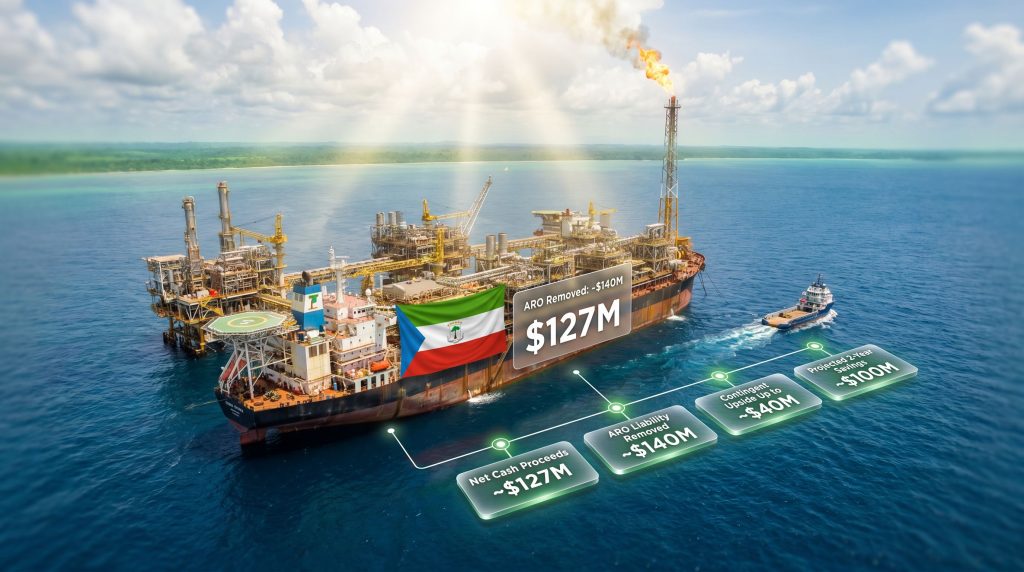
| Net Cash Proceeds (Post-Adjustments) | ~$127 million |
| Asset Retirement Obligation Removed | ~$140 million |
| Contingent Upside (Price/Production-Linked) | Up to ~$40 million |
| Projected Two-Year Cost Savings | ~$100 million |
| Total Potential Financial Benefit | ~$407 million |
The ARO removal is frequently overlooked in deal coverage because it does not appear in headline cash figures. Yet for upstream operators managing long-dated decommissioning liabilities, eliminating $140 million in future obligations can be as strategically significant as the cash consideration itself.
Proceeds from the transaction were directed toward repaying borrowings under Kosmos Energy's reserves-based lending (RBL) credit facility. RBL facilities are secured against the net present value of a company's proven and probable reserves, and the drawn balance directly influences borrowing base headroom and covenant compliance. Reducing this balance not only lowers ongoing interest costs but restores capital availability for future investment decisions, a critical capability for an independent operator with a clearly defined capital allocation strategy.
The projected $100 million in cost savings over the two years following completion reflects the elimination of ongoing operating expenditure, maintenance obligations, and overhead allocation previously required to support the Equatorial Guinea position.
Portfolio High-Grading: Strategy, Not Retreat
The term portfolio high-grading is used frequently in E&P corporate communications, but its practical meaning is often imprecisely understood. In its most rigorous form, high-grading refers to a disciplined process of removing assets whose risk-adjusted return profiles fall below a company's internal hurdle rate, and concentrating the resulting freed capital into positions with superior break-even economics, longer reserve life, or stronger production growth trajectories.
For Kosmos Energy, the Equatorial Guinea assets represented mature, non-operated production that required capital allocation without offering the upside leverage available in the company's core portfolio. By divesting them, Kosmos reduces its exposure to a category of assets where operational influence is limited, cost trajectories are unfavourable, and reserve replacement potential is constrained.
The contingent payment structure, offering up to approximately $40 million tied to future oil price and production milestones, is a sophisticated element of the transaction design. It allows Kosmos to retain partial economic exposure to asset upside without carrying the operational and capital responsibilities of continued ownership. This mechanism is becoming standard practice in West African upstream M&A, reflecting seller reluctance to fully surrender commodity price optionality in an uncertain pricing environment. In addition, understanding broader commodity price impacts on asset valuations is essential context for evaluating why such structures have become so prevalent.
Panoro Energy's Perspective: Why Mature Assets Attract Specialist Acquirers
The same assets that create portfolio drag for a mid-tier independent with higher overhead structures and capital allocation priorities elsewhere can represent compelling value for a focused specialist operator. Panoro Energy's acquisition rationale illustrates this asymmetry clearly.
As an Oslo-listed independent with a concentrated African upstream portfolio, Panoro operates with a leaner organisational structure and lower corporate overhead relative to larger peers. The addition of approximately 5,800 bopd net from the Ceiba and Okume assets represents a meaningful production increment for a company of Panoro's scale. Furthermore, specialist operators focused on a specific basin or region can often extract efficiencies from mature assets through operational familiarity, shared infrastructure, and targeted intervention programmes that would not justify the attention of a larger operator managing a globally diversified portfolio.
This buyer-seller asymmetry is a structural feature of the African offshore M&A market. It enables a continuous recycling of mature assets from operators for whom they are non-core to specialists for whom they are strategically central.
The next major ASX story will hit our subscribers first
Regulatory Approval: CEMAC and the Equatorial Guinea Framework
Completing an upstream asset transfer in Equatorial Guinea requires navigating a multi-layered regulatory approval process. The Central African Economic and Monetary Community (CEMAC) must review and sanction cross-border upstream transactions involving member states, and the Government of Equatorial Guinea must separately grant consent for the transfer of block interests.
The receipt of approvals from both CEMAC and the Equatorial Guinea government was a prerequisite for the June 16 close. These processes introduce timing uncertainty into upstream transactions in the region, which explains why transactions with retrospective effective dates often carry relatively long gaps between announcement and completion.
The successful navigation of this approval process reflects continued regulatory openness to upstream M&A activity in Equatorial Guinea, a country that has sought to maintain foreign investment interest in its offshore sector despite post-peak production challenges across the broader Gulf of Guinea province. Consequently, a robust risk management framework remains essential for operators managing these complex multi-jurisdictional approval timelines.
Modelling Production Guidance Revisions Post-Divestment
The removal of approximately 5,800 bopd net from Kosmos Energy's production base has direct implications for full-year 2026 guidance. Because the transaction closed on June 16, the assets contributed to H1 2026 production but will not feature in H2 2026 figures. Kosmos indicated it would provide updated full-year guidance alongside its Q2 2026 results in August.
Analysts modelling the production impact should work through the following sequence:
- Identify the removal date – all production attribution from the Equatorial Guinea assets ceases from June 16, 2026 onwards.
- Calculate the H1 contribution – at approximately 5,800 bopd net over the H1 2026 period through close, the assets contributed a meaningful but time-limited production increment.
- Zero out H2 volumes – no further contribution from these assets should be included in second-half production models.
- Assess capital redeployment potential – debt repayment via RBL facility paydown reduces interest costs but does not directly generate production. The question of whether freed capital is redeployed into growth-oriented projects within the core portfolio will determine whether the volume loss is partially offset.
- Net guidance recalibration – the revised full-year figure will reflect lower absolute production volumes, but potentially improved per-barrel margins across the retained portfolio given the removal of high unit operating cost barrels.
Investor note: Volume reduction post-divestment is not inherently negative from a returns perspective. Removing high-cost barrels from a production base can improve reported operating netback per barrel even as total volumes decline. Investors focused solely on production guidance revisions may undervalue the margin quality improvement embedded in the transaction.
What This Deal Signals for African Offshore M&A Trajectory
The Kosmos Equatorial Guinea asset divestment sits within a discernible pattern of portfolio rationalisation across the Gulf of Guinea basin. Several structural forces are converging to accelerate this cycle, and the shifting geopolitical landscape adds a further layer of complexity for operators evaluating asset positions across the region:
- RBL facility pressure: As commodity price cycles influence borrowing base redeterminations, operators carrying elevated drawn balances face mounting pressure to monetise non-core assets to restore headroom.
- Decommissioning liability accumulation: As fields age, ARO estimates grow, creating balance sheet headwinds that incentivise early asset transfers before liabilities become more difficult to value and more costly to transfer.
- Energy transition capital reallocation: While the energy transition has not eliminated investment appetite for African offshore production, it has raised the internal hurdle rate many operators apply to incremental spending on mature, high-cost assets.
- Specialist buyer depth: The emergence of Africa-focused independents like Panoro as credible acquirers ensures that a liquid secondary market exists for non-core assets, enabling portfolio recycling at commercially viable valuations.
Balance sheet resilience has demonstrably replaced production growth as the primary strategic metric for independent E&P companies navigating the current environment. The architecture of the Kosmos transaction, combining cash proceeds, ARO liability transfer, contingent upside retention, and projected cost savings, offers a replicable template for how mature offshore asset monetisation can generate multi-dimensional financial value well beyond what headline deal figures suggest.
This article is intended for informational purposes only and does not constitute financial advice. Statements regarding contingent payments, projected cost savings, and future production guidance are forward-looking in nature and subject to material uncertainty. Readers should conduct independent research before making investment decisions.
For further reading on upstream portfolio strategy, African offshore oil markets, and E&P balance sheet management, visit World Oil, a leading source of upstream energy news and analysis covering offshore Africa and global exploration and production trends.
Want to Track the Next Major Resource Discovery Before the Market Moves?
Discovery Alert's proprietary Discovery IQ model scans ASX announcements in real time, transforming complex mineral and resource data into clear, actionable insights for both short-term traders and long-term investors — explore historic discoveries and their exceptional returns, then begin your 14-day free trial at Discovery Alert to position yourself ahead of the market.