May 14, 2026
Understanding BHP's Coal Asset Evaluation Framework
The global mining industry operates within increasingly complex frameworks where traditional asset evaluation models face unprecedented challenges from regulatory evolution, market volatility, and shifting investor expectations. Mining conglomerates must now navigate sophisticated decision matrices that balance operational efficiency against policy landscapes that can fundamentally alter project economics within regulatory cycles.
Modern mining companies employ multi-dimensional assessment protocols that examine assets through operational cost structures, regulatory burden calculations, and strategic alignment with long-term commodity outlooks. These evaluation systems have become essential tools for capital allocation decisions, particularly when commodity price volatility intersects with evolving state-level taxation regimes. Furthermore, the ongoing mining industry evolution demonstrates how companies must adapt their asset evaluation frameworks to remain competitive.
What Drives Mining Giants to Reassess Their Coal Holdings?
Portfolio optimization in the mining sector responds to three primary trigger mechanisms that create systematic pressure on asset performance evaluation. Market volatility creates uncertainty in revenue projections, while regulatory pressures introduce additional cost burdens that can shift operational economics dramatically. Capital allocation efficiency becomes critical when companies must choose between maintaining existing operations and investing in alternative commodity exposures.
Portfolio optimization triggers include:
• Market volatility affecting revenue predictability and cash flow modeling
• Regulatory pressures introducing compliance costs and taxation burdens
• Capital allocation efficiency requirements for competitive returns
• Strategic alignment with energy transition commitments and ESG mandates
Financial performance metrics in modern mining operations extend beyond traditional cash flow analysis to incorporate regulatory impact assessments. When Queensland coal operations generated zero profit during the first half of 2025 despite producing 9.2 million tons through the BHP Mitsubishi Alliance, this represented a fundamental breakdown in the traditional mining economics model. Production volumes at this scale historically generated substantial returns, but the intersection of operational costs, market pricing, and regulatory burdens created a scenario where revenue could not translate into profit.
How Do Modern Mining Companies Rank Asset Profitability?
Contemporary asset ranking systems employ sophisticated analytical frameworks that separate operational performance from regulatory impact to identify specific value destruction mechanisms. Cost-per-tonne analysis distinguishes between underground and open-cut operational methodologies, recognizing that these approaches have fundamentally different capital requirements, labor intensities, and geological risks.
Underground mining operations typically require higher capital investment per ton of production capacity but can access higher-grade ore bodies with premium market positioning. Open-cut operations involve lower per-unit operational costs but require substantial overburden removal and face larger environmental rehabilitation obligations. This distinction becomes critical when regulatory frameworks impose revenue-based taxation rather than profit-based models.
Asset profitability ranking considers:
• Cost-per-tonne variations between extraction methodologies
• Quality premiums for metallurgical coal grades in global markets
• Regulatory burden assessment including taxation and compliance costs
• Infrastructure utilisation efficiency and transportation cost optimization
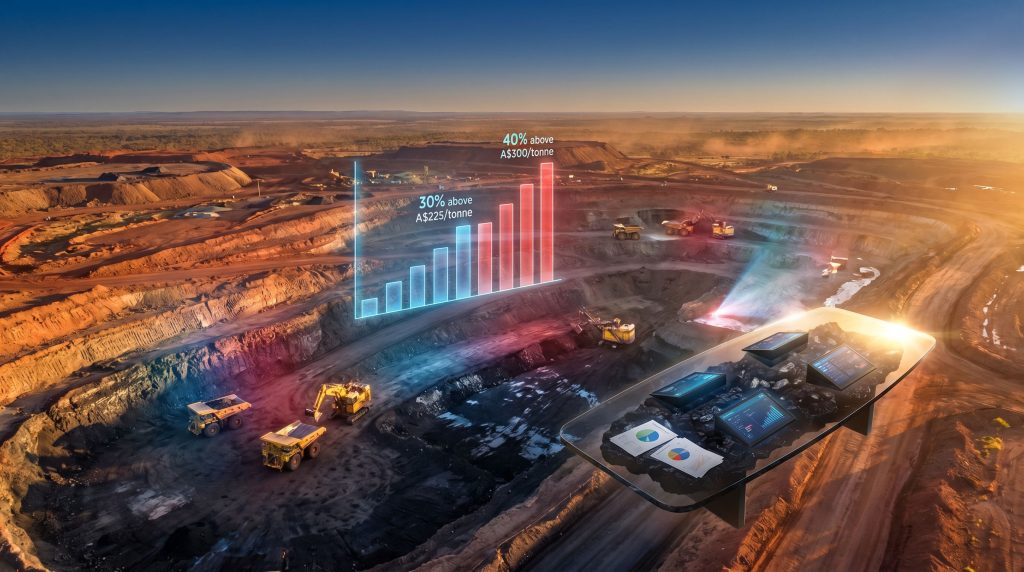
Regulatory burden assessment has emerged as a distinct analytical category following Queensland's 2022 royalty regime implementation. The state's tiered revenue structure imposes 30% taxation on coal sales above A$225 per tonne, escalating to 40% above A$300 per tonne. With seaborne metallurgical coal trading above A$230 per tonne in April 2026, operations face immediate exposure to the elevated taxation tier. Additionally, the broader context of global taxes and royalties across mining jurisdictions highlights how regional taxation policies impact international competitiveness.
When big ASX news breaks, our subscribers know first
Queensland's Royalty Regime: A Case Study in Resource Taxation Impact
Revenue-based taxation represents a fundamental departure from traditional profit-based models that have historically governed mining taxation in developed jurisdictions. Queensland's 2022 implementation created a taxation structure that extracts a fixed percentage of gross revenue regardless of operational costs, capital requirements, or profit margins.
What Makes Queensland's 2022 Royalty Changes Controversial?
The controversy surrounding Queensland's royalty restructuring stems from its departure from established taxation principles that typically account for operational complexity and capital intensity in extractive industries. Traditional profit-based models allow operators to recover operational expenses and capital investments before taxation calculations, providing operational flexibility during periods of cost inflation or market volatility.
Queensland's tiered revenue structure operates on gross revenue calculations that ignore cost structures entirely. This creates scenarios where high-cost operations face identical taxation burdens to low-cost producers, fundamentally altering competitive dynamics within the industry.
| Price Threshold | Royalty Rate | Revenue Impact |
|---|---|---|
| Below A$225/t | Standard rate | Minimal additional burden |
| A$225-300/t | 30% of revenue | Significant margin compression |
| Above A$300/t | 40% of revenue | Severe profitability challenges |
How Do Royalty Increases Affect Mining Investment Decisions?
Investment decision frameworks in mining require long-term capital commitment against uncertain commodity price trajectories and regulatory evolution. Queensland's revenue-based structure introduces taxation risk that compounds traditional market risks, creating scenarios where favourable commodity pricing cannot guarantee operational profitability.
The mathematical impact of revenue-based taxation becomes apparent when examining operational economics at current price levels. With metallurgical coal trading above A$230 per tonne, operations face immediate 30% revenue extraction before accounting for operational costs, capital recovery, or profit margins. For mines with production costs ranging from A$100-140 per tonne, this taxation structure can eliminate profit margins entirely during periods of moderate pricing.
Capital investment decisions must now incorporate scenarios where favourable market conditions cannot overcome regulatory burden calculations. This has led to systematic capital allocation reviews where traditional mining economics no longer support expansion or maintenance investment decisions. The broader implications of such policy changes can be understood through examining tariffs' investment impact in related sectors.
The Economics of Coal Mine Viability in 2026
Contemporary coal mine viability requires sophisticated financial modelling that accounts for the intersection of operational costs, commodity pricing volatility, regulatory burden calculations, and joint venture governance structures. The traditional break-even analysis framework has evolved to incorporate regulatory taxation as a fixed cost component rather than a variable expense.
What Factors Determine Mine Closure vs. Continuation?
Mine viability assessment in 2026 operates through multi-factorial analysis that weighs immediate operational economics against long-term strategic positioning and capital opportunity costs. The BHP review of Australian coal mines currently underway exemplifies this comprehensive evaluation approach. Break-even calculations must account for Queensland's revenue-based taxation structure, which creates scenarios where positive cash flow operations may generate negative returns after royalty obligations.
Viability assessment factors include:
• Break-even analysis incorporating regulatory taxation as fixed costs
• Capital investment requirements for maintenance and compliance obligations
• Alternative opportunity costs for capital deployment in copper and iron ore
• Joint venture governance requirements for major operational decisions
The closure of BHP's Saraji South mine in September 2024 provides a practical case study in modern mine viability assessment. According to Bloomberg's coverage of this systematic evaluation, the operation eliminated approximately 750 positions based on management assessment that high royalties and market conditions created unsustainable operational economics. This decision preceded the current comprehensive portfolio review, indicating that individual asset rationalisation had already begun based on specific economic thresholds.
How Do Joint Venture Structures Complicate Asset Decisions?
The 50:50 BHP Mitsubishi Alliance structure creates additional complexity in asset evaluation and operational decision-making. Both stakeholders must reach consensus on major operational changes, including mine closures, operational modifications, or capital investment decisions. This governance requirement can delay or complicate asset rationalisation when stakeholders have different strategic priorities or risk tolerances.
Mitsubishi's position as a Japanese corporation with long-term supply agreement requirements may create different strategic calculations compared to BHP's globally diversified portfolio optimisation objectives. This stakeholder dynamic can influence timing and scope of operational changes, particularly when asset divestment or closure decisions require unanimous agreement.
Joint venture complications include:
• Consensus requirements for major operational modifications
• Stakeholder alignment challenges with different strategic priorities
• Risk distribution models affecting individual decision-making frameworks
• Capital commitment requirements for shared infrastructure and obligations
Strategic Implications for Australia's Coal Industry
The systematic evaluation of coal assets within major mining conglomerates signals broader structural changes affecting Australia's coal industry positioning in global markets. When major producers with world-class assets face profitability challenges, this creates implications for industry consolidation patterns, regional economic development, and global supply chain dynamics.
What Does BHP's Review Signal for Sector-Wide Trends?
BHP's formal asset review process represents a significant development in Australian coal industry evolution, particularly given the company's positioning with some of the largest and highest-quality metallurgical coal operations globally. The BHP review of Australian coal mines signals that quality positioning and operational scale provide insufficient protection against regulatory and market headwinds.
The zero capital investment commitment articulated by BHP Chairperson Ross McEwen indicates fundamental strategic repositioning rather than cyclical adjustment. This represents managed decline rather than operational optimisation, suggesting systematic rather than temporary challenges. Moreover, concerns about energy transition risks further complicate strategic planning for coal operations.
Industry consolidation indicators include:
• Major producers rationalising portfolios through systematic asset review
• Capital investment freezes affecting expansion and maintenance programmes
• Asset divestment opportunities for mid-tier operators with different cost structures
• Regional economic impact from employment reductions and operational changes
How Might Other Mining Companies Respond?
The broader mining industry faces similar challenges from Queensland's regulatory framework, creating potential for coordinated strategic responses or systematic asset redistribution. Mid-tier mining companies with lower overhead structures and different capital allocation requirements may identify acquisition opportunities as major producers divest non-core assets.
Potential strategic responses include:
• Asset acquisition targeting by specialised coal operators
• Operational efficiency improvements through technology adoption
• Political engagement for regulatory framework modifications
• Portfolio diversification toward alternative commodity exposures
Industry consolidation patterns typically see asset redistribution rather than capacity elimination when operational assets remain economically viable under different ownership structures. Smaller operators may achieve profitability through lower overhead costs, specialised operational focus, or different capital return requirements.
Investment and Market Dynamics
Investment patterns in Australian coal operations reflect the intersection of regulatory uncertainty, commodity price volatility, and evolving investor sentiment toward fossil fuel exposure. The traditional investment framework that emphasised operational efficiency and market positioning must now incorporate regulatory risk assessment and ESG compliance considerations.
What Are the Broader Market Implications?
Market dynamics in metallurgical coal face disruption from both supply-side constraints and demand-side evolution as steel production technologies evolve toward lower carbon intensity processes. Australian operations that face regulatory challenges may create supply constraints that affect global pricing dynamics, particularly given Australia's significant market share in seaborne metallurgical coal markets.
Investment considerations include:
• Metallurgical coal supply constraints affecting global steel markets
• ESG-driven portfolio decisions reducing investor interest in coal exposure
• Transition timeline clarity for company commitments to alternative commodities
• Stranded asset risks from regulatory evolution and market demand changes
With metallurgical coal trading above A$230 per tonne in April 2026, market pricing suggests continued demand for quality Australian production. However, the inability to achieve profitability at these price levels indicates structural rather than cyclical challenges affecting operational economics. These challenges mirror broader concerns about US tariffs and inflation outlook affecting commodity markets globally.
How Do Investors Evaluate Coal Asset Exposure in 2026?
Modern investment analysis incorporates multiple risk factors beyond traditional commodity cycle assessment. Regulatory risk assessment has emerged as a distinct analytical category, particularly when revenue-based taxation creates scenarios where favourable commodity pricing cannot guarantee operational profitability.
Investment evaluation metrics include:
• Regulatory risk assessment and taxation burden analysis
• Transition timeline clarity for energy commodity portfolio evolution
• Capital reallocation efficiency toward critical minerals and alternative commodities
• ESG compliance integration and institutional investor requirements
Investor sentiment increasingly favours mining companies with clear transition strategies toward critical minerals exposure while maintaining operational excellence in traditional commodities. BHP's capital investment freeze provides clarity on strategic direction but creates uncertainty about medium-term operational intent.
Regulatory and Policy Landscape Analysis
The intersection of state-level resource taxation and federal climate policy creates complex policy frameworks that affect mining investment decisions and operational viability. Queensland's revenue-based royalty structure represents one component of broader regulatory evolution affecting extractive industries across Australia.
What Role Do State Governments Play in Mining Viability?
State government policy decisions directly affect mining operational economics through taxation structures, regulatory compliance requirements, and infrastructure planning. Queensland's 2022 royalty changes demonstrate how state-level decisions can fundamentally alter project economics within existing operational frameworks.
State government influence includes:
• Revenue generation through royalty structures and taxation policy
• Employment considerations affecting regional economic development
• Environmental compliance requirements and rehabilitation obligations
• Infrastructure planning for transportation and port facility development
The balance between revenue generation and industry competitiveness creates ongoing tension in resource policy development. State governments require mining revenue for public finances while maintaining competitive positioning to attract investment and preserve employment.
How Might Federal Policy Influence State-Level Decisions?
Federal climate commitments and energy transition policies create additional complexity for state resource policy decisions. National emission reduction targets and energy transition goals may influence state-level taxation and regulatory decisions affecting coal operations.
Federal policy considerations include:
• National energy transition goals affecting state resource policy alignment
• Interstate competition between mining jurisdictions for investment attraction
• Infrastructure investment coordination for transportation and port facilities
• Employment transition planning for coal-dependent regional economies
The next major ASX story will hit our subscribers first
Future Scenarios and Strategic Planning
Strategic planning for Australian coal operations must incorporate multiple scenario analyses that account for regulatory evolution, market demand changes, and technological development in steel production processes. The systematic challenges facing Queensland operations create planning requirements that extend beyond traditional commodity cycle analysis.
What Are Potential Outcomes from BHP's Review Process?
The asset review process will likely produce strategic decisions that reflect broader industry evolution toward managed portfolio optimisation rather than expansion-focused growth strategies. The ongoing BHP review of Australian coal mines represents a critical juncture for the industry. Several potential outcomes reflect different approaches to balancing operational efficiency against regulatory challenges.
Scenario Analysis Framework:
Selective Divestment Approach:
- Targeted asset sales to specialised coal operators with lower overhead structures
- Retained operations focusing on highest-quality deposits with premium market positioning
- Gradual portfolio optimisation extending over 3-5 year timeline
- Joint venture restructuring to optimise operational efficiency
Accelerated Exit Strategy:
- Comprehensive coal portfolio divestment to eliminate regulatory exposure
- Strategic focus redirection toward critical minerals and renewable energy materials
- Complete operational transition within 2-3 year accelerated timeline
- Capital reallocation toward copper and alternative commodity development
Operational Restructuring Model:
- Joint venture renegotiation with Mitsubishi for operational optimisation
- Cost reduction initiatives through technology adoption and efficiency improvements
- Continued operations under modified financial and operational frameworks
- Regulatory engagement for taxation structure modifications
How Should Industry Stakeholders Prepare for Change?
Industry transformation requires coordinated strategic planning across multiple stakeholder categories, including mining companies, investors, regulatory authorities, and regional communities. Successful adaptation requires sophisticated planning frameworks that account for operational, financial, and social considerations.
Mining Company Strategies:
• Portfolio diversification reducing coal exposure while expanding critical minerals operations
• Operational excellence programmes implementing cost reduction and efficiency technologies
• Strategic partnerships exploring joint ventures and asset-sharing arrangements
• Regulatory engagement advocating for taxation structure modifications
Investor Preparation:
• Enhanced due diligence incorporating regulatory and environmental risk assessment
• Sector rotation strategies balancing traditional resources with energy transition materials
• ESG integration incorporating sustainability factors into investment decision frameworks
• Scenario planning for portfolio optimisation under different regulatory evolution paths
The transformation of Australian coal operations reflects broader industry evolution where traditional resource extraction must adapt to changing regulatory, environmental, and market conditions. As highlighted by The Australian's analysis of current market pressures, success requires sophisticated strategic planning, stakeholder alignment, and adaptive operational frameworks that can respond to evolving policy landscapes.
Stakeholder preparation must account for multiple potential outcomes while maintaining operational flexibility for strategic adaptation. The systematic challenges facing Queensland operations provide important case study material for industry planning across other jurisdictions facing similar regulatory evolution pressures. The BHP review of Australian coal mines serves as a bellwether for how major mining companies will navigate these complex challenges moving forward.
Disclaimer: This analysis incorporates publicly available information and industry developments as of April 2026. Mining operations involve inherent risks including commodity price volatility, regulatory changes, and operational challenges. Investment decisions should incorporate comprehensive due diligence and professional financial advice. Forward-looking statements and scenario analyses represent potential outcomes based on current information and may not reflect actual future developments.
Ready to Invest in the Next Major Mineral Discovery?
Discovery Alert instantly alerts investors to significant ASX mineral discoveries using its proprietary Discovery IQ model, turning complex mineral data into actionable insights. Understand why major mineral discoveries can lead to significant market returns whilst exploring opportunities beyond traditional coal investments through Discovery Alert's comprehensive platform.