June 5, 2026
The Metal That Powers Everything: Understanding BHP's Copper Transformation
The global mining industry is undergoing a quiet but profound reordering of priorities. For most of the past two decades, institutional capital flowed toward iron ore as the dominant commodity thesis in the ASX resources sector, riding China's unprecedented urbanisation wave. That era has not ended, but it has fundamentally matured. What is replacing it at the centre of the investment conversation is copper, and the reasons are structurally different from anything the mining industry has experienced before. Unlike previous commodity cycles, which were primarily construction-driven and geographically concentrated, the current copper demand story draws simultaneously from the physical buildout of clean energy systems, the digital expansion of AI and cloud infrastructure, and the electrification of global transport. For investors seeking BHP copper exposure, this shift represents one of the most significant portfolio reframings in the company's history.
When big ASX news breaks, our subscribers know first
A Historic Shift in BHP's Earnings Architecture
From Iron Ore Giant to Copper-Dominant Producer
For the better part of two decades, BHP Group Ltd (ASX: BHP) was understood by the market through a single lens: iron ore. The company's financial identity was inseparable from the commodity, and during periods of Chinese infrastructure-led demand, iron ore could account for the overwhelming majority of earnings. That concentration made BHP sensitive to a single demand cycle, a single geography, and a single end market.
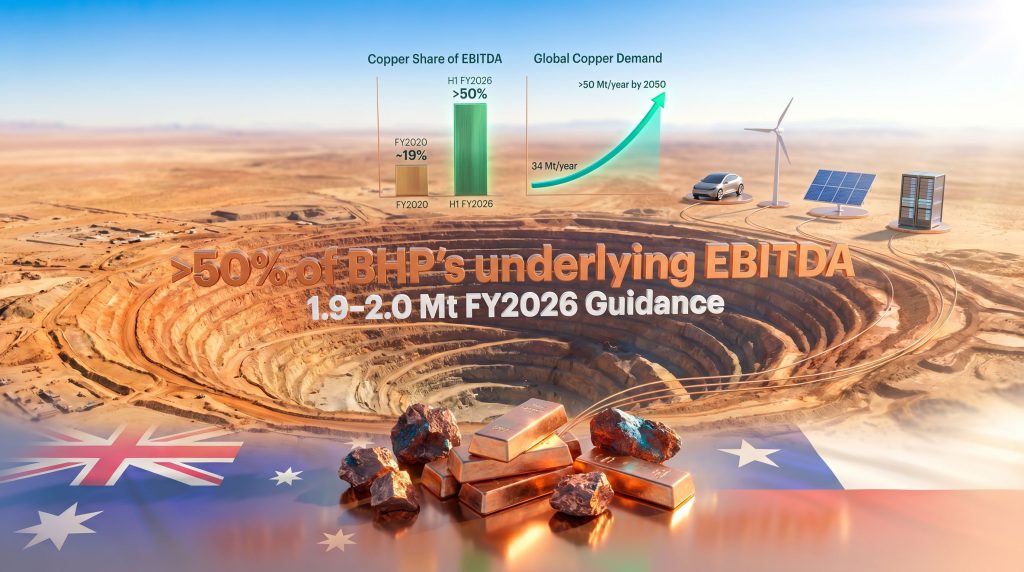
That structural identity has now been materially altered. In the first half of FY2026, covering the six months to December 2025, copper contributed more than 50% of BHP's underlying EBITDA, surpassing iron ore's contribution of approximately $7.5 billion for the same period. Based on available analysis, copper's half-year EBITDA contribution is estimated at approximately $7.95 billion, representing the first time in BHP's modern corporate history that copper has eclipsed its traditional earnings engine.
To appreciate the magnitude of this shift, consider that as recently as FY2020, iron ore accounted for approximately 81% of BHP's half-year underlying earnings. That single-commodity concentration was both a strength and a vulnerability. The transition to copper as the primary earnings driver is not an accident or a price spike — it reflects a deliberate decade-long capital reallocation strategy that is now materialising in reported results.
BHP's copper production has grown approximately 30% between 2021 and 2025, with FY2026 annual production guidance set at 1.9 to 2.0 million tonnes. The company's own positioning as the world's largest copper producer, backed by operational assets across four continents, gives this earnings pivot a credibility that cannot be easily replicated.
| Metric | FY2020 (Iron Ore Era) | H1 FY2026 (Copper Era) |
|---|---|---|
| Iron Ore Share of H1 EBITDA | ~81% | ~47% |
| Copper Share of H1 EBITDA | ~19% | >50% |
| Copper H1 EBITDA (approx.) | Not disclosed | ~$7.95 billion |
| Copper Annual Production | ~1.5 Mt | 1.9–2.0 Mt (FY26 guidance) |
The shift from iron ore dominance to copper leadership in BHP's earnings mix is not a short-term anomaly driven by price movements. It reflects a sustained capital reallocation strategy that has been building for years and is now visible in the company's reported financial results.
What Is Driving Structural Copper Demand Through 2050?
The Electrification Supercycle: A Demand Profile Unlike Any Other Commodity
Iron ore demand is fundamentally tied to one activity: the production of steel for construction and manufacturing. When construction slows, iron ore demand contracts. Copper's demand profile operates on an entirely different logic, drawing from multiple simultaneous and largely uncorrelated growth vectors.
At the most basic level, copper is the conductor through which the modern electrified economy flows. Every incremental unit of electricity generated, transmitted, stored, or consumed requires copper at some point in the chain. As global electricity consumption rises, as renewable energy replaces thermal generation, and as electric vehicles displace internal combustion engines, the copper price growth drivers behind each transition scale accordingly.
The primary demand drivers include:
- Electric vehicles: EVs require approximately 3 to 4 times more copper per unit than conventional internal combustion engine vehicles, owing to battery wiring, electric motors, and charging system components
- Renewable energy systems: Utility-scale solar and wind installations are highly copper-intensive across generation, transmission infrastructure, and energy storage systems
- Power grid modernisation: Ageing electricity grids across the United States, Europe, and Asia require substantial copper-based rewiring to handle increased loads and bidirectional power flows
- Data centres and AI infrastructure: Hyperscale computing facilities require extensive copper cabling, transformer systems, and cooling infrastructure at a scale that has no historical precedent
BHP's own market analysis projects that global copper demand will grow from approximately 34 million tonnes per year today to more than 50 million tonnes per year by 2050, representing roughly a 70% increase over the next quarter-century.
Data Centres: The Overlooked Copper Demand Vector
Perhaps the most underappreciated component of the long-term copper demand story is digital infrastructure. Data centres, AI computing clusters, and cloud infrastructure facilities are not commonly associated with commodity demand in the public investment discourse, but their copper intensity is substantial.
BHP's research indicates that copper demand from data centres alone could reach approximately 3 million tonnes per year by 2050, representing a roughly six-fold increase from estimated current consumption. This demand channel essentially did not exist in its modern form a decade ago, meaning the copper market is absorbing an entirely new category of structural demand that was not present in any prior supply planning cycle.
The combination of AI model training workloads, cloud storage infrastructure, and the physical buildout of hyperscale facilities creates a sustained multi-decade demand profile for copper that operates independently of traditional economic cycles.
| Demand Driver | Current Contribution | Projected 2050 Contribution |
|---|---|---|
| Total Global Copper Demand | ~34 Mt/year | >50 Mt/year |
| Data Centres | ~0.5 Mt/year (est.) | ~3 Mt/year |
| EVs and Transport Electrification | Growing | Major structural contributor |
| Renewable Energy Systems | Growing | Major structural contributor |
| Grid Modernisation | Growing | Major structural contributor |
BHP's own analysis projects global copper demand growing from roughly 34 million tonnes per year today to more than 50 million tonnes per year by 2050. Data centre demand alone is expected to account for approximately 3 million tonnes of that total by mid-century. These projections originate from BHP's copper growth research and have not been independently verified in this article.
Why the Supply Side Defines the Investment Thesis
Structural Supply Constraints: The Problem That Cannot Be Solved Quickly
Rising demand is a necessary but insufficient condition for a compelling commodity investment case. The other side of the equation — supply — is where the copper thesis becomes particularly compelling for long-duration investors. Furthermore, the copper supply crunch looming over the next decade adds considerable urgency to this conversation.
The global copper mining industry faces a set of structural constraints that are largely immune to short-term capital responses. BHP estimates that the world will require 10 million tonnes of additional new copper supply by 2035 to balance demand against projected consumption growth. That figure is significant not only in its scale but in its timeline: 2035 is less than a decade away.
The reasons new supply is extraordinarily difficult to bring online quickly include:
- Extended development timelines: Large copper projects typically require 10 to 20 years from initial discovery through permitting, feasibility, construction, and first production. Projects approved today will not contribute meaningfully to the 2035 supply balance.
- Capital intensity: Greenfield copper deposits demand billions of dollars in upfront capital with long payback periods that challenge the return hurdles of most institutional investors.
- Declining ore grades: As existing mines mature, the average grade of ore being processed falls, meaning more material must be mined, crushed, and processed per tonne of copper produced. This structural grade decline increases per-unit production costs over time.
- Declining discovery rates: The frequency of significant new copper discoveries has decreased materially over the past two decades. The industry is consuming reserves faster than it is replacing them through exploration.
- Geopolitical and social complexity: Many of the world's highest-grade undeveloped copper deposits sit in jurisdictions with complex permitting environments, indigenous land rights considerations, or sovereign risk profiles that extend development timelines.
Investors should note that supply tightness is a double-edged dynamic. While constrained supply supports copper prices and benefits producers like BHP, it simultaneously increases capital costs and execution complexity for BHP's own expansion projects. Higher copper prices do not automatically translate into proportionally higher project returns if construction costs and energy inputs are also inflating.
How BHP Is Positioning Its Copper Portfolio for Multi-Decade Growth
A Four-Continent Production and Growth Platform
BHP copper exposure is not a single-asset bet. The company has assembled a geographically diversified production and development platform that spans multiple geological settings, political jurisdictions, and project maturity stages.
Key assets and growth initiatives include:
- Escondida, Chile: The world's largest copper mine by annual production volume, Escondida is BHP's flagship copper asset and the foundation of its production base. Located in the Atacama Desert in northern Chile, it operates as a majority-owned, large-scale porphyry copper system. Expansion pathways are actively being evaluated.
- Copper South Australia: BHP has outlined plans to double Copper South Australia's annual production capacity to 650,000 tonnes by the mid-2030s, drawing on assets including Olympic Dam, Prominent Hill, and Carrapateena.
- Filo del Sol and Josemaria, Argentina: BHP holds 50% stakes in both projects in the Vicuña district, representing two large-scale development-stage porphyry copper systems. These assets offer significant future production optionality but carry the typical development-stage risks of remote, capital-intensive projects.
- United States: BHP maintains exploration and development options in Arizona, providing early-stage exposure to the North American copper belt.
- Serbia: A drilling partnership covering approximately 950 square kilometres with multiple porphyry copper targets, representing early-stage exploration optionality in a region with prospective geology.
| Project / Initiative | Location | Status | Key Metric |
|---|---|---|---|
| Escondida Expansion | Chile | Active / Ongoing | World's largest copper mine |
| Copper South Australia Expansion | South Australia | Development | Target: 650,000 t/year by mid-2030s |
| Filo del Sol and Josemaria | Argentina | Development-Stage | 50% stake; porphyry systems |
| Arizona JV | United States | Exploration | Early-stage optionality |
| BHP-Mundoro Partnership | Serbia | Drilling (2026) | 950 km², porphyry targets |
| OZ Minerals Integration | South Australia | Complete (2023) | $9.6 billion acquisition |
$21 to $26 Billion in Capital: The Scale of BHP's Copper Commitment
Following its unsuccessful bid for Anglo American, BHP committed to investing $21 to $26 billion in copper projects over the next decade, one of the largest single-commodity growth capital programs in the global mining industry.
Key financial transactions underpinning this strategy include:
- The $9.6 billion acquisition of OZ Minerals in 2023, which added Olympic Dam expansion optionality and the Prominent Hill and Carrapateena copper-gold assets in South Australia to BHP's portfolio
- A $4.3 billion silver streaming agreement with Wheaton Precious Metals, which monetises silver byproduct streams from copper operations to fund growth without proportional balance sheet strain
- A $35 million exploration partnership with Mundoro Capital covering a 950-square-kilometre porphyry copper target package in Serbia
The streaming agreement with Wheaton deserves particular attention as a financial innovation. Copper ore bodies frequently contain economically significant quantities of silver as a co-product. Rather than treating this silver as incidental income, BHP has effectively forward-sold a portion of future silver production to generate upfront capital at a predictable cost, reducing the need to issue equity or increase debt to fund copper expansion. This approach reflects a sophisticated understanding of byproduct monetisation that goes beyond conventional mining finance.
Portfolio Diversification: Why the Broader Business Matters
Iron Ore, Coal, and Potash as Financial Complements to Copper Growth
BHP's copper expansion strategy is financially underpinned by the earnings resilience of its broader portfolio. Iron ore, despite no longer representing the majority of EBITDA, continues to generate substantial operating cash flow that can be recycled into copper development. Steelmaking coal provides additional diversification tied to infrastructure demand in emerging markets.
The Jansen potash project in Saskatchewan, Canada adds a fourth major commodity pillar over the longer term, with structural demand tied to global food production and agricultural productivity rather than construction or electrification cycles. Potash and copper demand are largely uncorrelated, providing BHP with earnings protection across a wider range of macroeconomic scenarios.
For income-oriented ASX investors, this portfolio depth matters enormously. A pure-play copper miner offers concentrated commodity upside but no earnings buffer when copper prices contract. BHP's multi-commodity structure means that copper upside is accessible while short-term commodity volatility is partially absorbed by the other segments, supporting the company's capacity to sustain dividends through the capital-intensive copper growth phase. In addition, exploring copper investment strategies that leverage this portfolio diversification can help investors manage risk more effectively.
The next major ASX story will hit our subscribers first
BHP vs. ASX Peers: Copper Exposure Compared
How BHP Stacks Up Against Rio Tinto and South32
Among the ASX Top 200, BHP currently offers the deepest and most financially scaled copper exposure of any major diversified miner. However, Rio Tinto copper expansion efforts are gaining momentum and warrant close attention from investors comparing the two majors.
| Attribute | BHP (ASX: BHP) | Rio Tinto (ASX: RIO) | South32 (ASX: S32) |
|---|---|---|---|
| Primary Copper Asset | Escondida + OZ Minerals assets | Oyu Tolgoi, Mongolia | Hermosa, Arizona (development) |
| Copper as % of Earnings | >50% (H1 FY2026) | Growing but minority | Emerging exposure |
| Annual Copper Production | 1.9–2.0 Mt (FY2026) | Scaling up | Pre-production |
| 10-Year Copper Capex Commitment | $21–26 billion | Significant but lower | Early-stage |
| Scale Position | World's largest producer | Tier-1 single asset | Smaller scale |
Rio Tinto's Oyu Tolgoi mine in Mongolia is scaling toward full underground production capacity and represents a genuine Tier-1 copper asset. Consequently, majors-juniors copper partnerships are also reshaping the competitive landscape as both major miners seek to secure future production pipelines through collaborative arrangements. Nevertheless, BHP's production scale, portfolio depth, and committed capital program place it in a structurally different position relative to copper earnings contribution and growth optionality.
Key Risk Factors Every Investor Should Understand
What Could Disrupt BHP's Copper Growth Narrative?
No investment thesis is complete without an honest assessment of the risks. BHP's copper strategy faces several material challenges:
- Capital cost escalation: Large-scale copper projects in remote locations are historically prone to construction cost overruns. The simultaneous development of Copper South Australia and Filo del Sol creates significant project management complexity.
- Commodity price volatility: Copper prices rallied approximately 32% to record highs entering 2026. A material reversal would compress project economics and potentially delay expansion decisions.
- China demand concentration: Despite the diversification of copper's demand profile toward EVs, renewables, and digital infrastructure, China remains the world's dominant copper consumer. Any structural deceleration in Chinese industrial activity would weigh on near-term copper pricing.
- Permitting and social licence: BHP's copper projects in Argentina, Serbia, and the United States each face jurisdiction-specific regulatory and community engagement challenges that could extend timelines beyond current projections.
- Ore grade deterioration: As Escondida and other mature assets age, declining ore grades will require higher throughput volumes to maintain production levels, placing upward pressure on operating costs.
BHP's financial strength, geographic diversification, and innovative financing structures such as the Wheaton streaming agreement provide partial mitigation against these risks. However, investors with shorter time horizons should be aware that near-term copper price movements can create significant earnings volatility even within a structurally positive long-term demand environment. For a broader perspective on how copper will shape our future, BHP's own analysis offers useful context on the long-term trajectory of the metal.
This article contains general information only and does not constitute financial advice. Past performance is not indicative of future returns. Investors should consider their own financial circumstances and seek independent professional advice before making investment decisions.
Frequently Asked Questions About BHP Copper Exposure
How much copper does BHP produce annually?
BHP's FY2026 copper production guidance is 1.9 to 2.0 million tonnes, representing approximately 30% growth from the 1.717 million tonnes produced in FY2023. Escondida in Chile contributes the largest share of this annual output.
What percentage of BHP's earnings comes from copper?
In the first half of FY2026, copper contributed more than 50% of BHP's underlying EBITDA, estimated at approximately $7.95 billion, surpassing iron ore for the first time in the company's history.
Why is long-term copper demand expected to grow so strongly?
Copper is an essential material in electric vehicles, renewable energy systems, power grid upgrades, and digital infrastructure including data centres and AI computing hardware. BHP forecasts global copper demand growing from approximately 34 million tonnes per year today to over 50 million tonnes per year by 2050, according to BHP's dedicated copper growth resource page.
What is BHP's biggest copper mine?
Escondida, located in the Atacama Desert of northern Chile, is BHP's flagship copper asset and the world's largest copper mine by annual production volume.
How is BHP funding its copper growth strategy?
BHP has committed $21 to $26 billion in copper project investment over the next decade, funded through operating cash flows, asset recycling, and innovative financing structures including the $4.3 billion silver streaming agreement with Wheaton Precious Metals.
Does BHP still pay dividends during its copper investment phase?
BHP's multi-commodity portfolio, which continues to generate substantial free cash flow from iron ore and steelmaking coal, supports ongoing dividend payments even as the company accelerates copper capital expenditure. Dividend sustainability remains subject to commodity price cycles and should not be treated as guaranteed.
For BHP's own analysis of copper demand, supply dynamics, and project pipeline data, the company maintains a dedicated copper growth resource page at bhp.com/about/coppergrowth.
Want to Know Which ASX Copper Discoveries Could Deliver the Next Major Return?
Discovery Alert's proprietary Discovery IQ model scans ASX announcements in real time, instantly identifying significant copper and mineral discoveries before the broader market reacts — the same type of early-mover intelligence behind historic finds like those by De Grey Mining and WA1 Resources. Explore Discovery Alert's dedicated discoveries page to see what transformative mineral discoveries have historically returned, and begin a 14-day free trial to position yourself ahead of the next major copper announcement.