July 7, 2026
The Ore Grade Problem That Makes Escondida's Environmental Win So Significant
Copper mining is caught in a slow-motion squeeze. Across the world's most productive porphyry deposits, ore grades have been declining for decades. Where mines once processed rock containing 1.5% to 2% copper by weight, many now operate on grades closer to 0.5% or lower. This means more rock must be moved, more water consumed, more energy expended, and more tailings managed to produce the same volume of refined metal. For investors and supply analysts, this grade deterioration is not a footnote — it is the central challenge shaping every major copper capital decision being made today.
This is the context in which the BHP Escondida expansion environmental clearance must be understood. The permit is not simply a regulatory tick box. It represents the opening of a pathway through which one of the world's most consequential brownfield copper investments can begin to take shape — at a time when new copper supply is genuinely difficult to bring online at scale. Furthermore, the copper supply crunch facing global markets makes this development all the more strategically significant.
When big ASX news breaks, our subscribers know first
Escondida's Position in the Global Copper Landscape
Scale, Ownership, and Processing Capacity
The Escondida mine sits roughly 170 kilometres south-east of Antofagasta in Chile's Atacama Desert, occupying a landscape defined by extreme aridity, high altitude, and fragile ecological systems. As a copper porphyry deposit, it represents the geological archetype of large-scale, low-to-moderate grade copper mineralisation — vast tonnages of disseminated copper sulphide ore that reward bulk mining methods.
At current processing rates of approximately 460,000 tonnes of ore per day, Escondida is in a category of its own among copper operations globally. Indeed, when considering the largest copper mines worldwide, Escondida consistently stands apart in terms of sheer scale. Its ownership is shared across three parties:
| Shareholder | Ownership Stake |
|---|---|
| BHP Group | 57.5% |
| Rio Tinto Group | 30.0% |
| Japanese Consortium | ~12.5% |
BHP's majority position means Escondida's production trajectory has an outsized influence on the group's copper output targets, making every permitting decision at the site a material event for the company's long-term strategy.
Why Declining Ore Grades Are Driving This Investment
A critical and often underappreciated dimension of the Escondida expansion is that a substantial portion of the capital commitment is defensive in nature. The mine's ore grades have been trending downward over time, as is typical of large porphyry systems when higher-grade zones are progressively exhausted. Without sustained capital reinvestment in processing infrastructure, throughput volumes would decline materially even if mining rates remained constant.
The planned new concentrator is designed to replace the ageing Los Colorados facility and maintain processing capacity at current approved levels rather than dramatically expanding it. This distinction is strategically significant: it makes the environmental case more defensible before Chilean regulators, and it reframes the investment as sustaining rather than purely expansionary.
Industry Insight: In porphyry copper mining, the relationship between ore grade and processing infrastructure is tightly coupled. As grades fall, mills must process greater volumes of rock to maintain metal output, placing increasing stress on concentrator capacity, water consumption, and tailings storage. Capital reinvestment in processing is therefore a continuous requirement for any long-life porphyry operation — not an optional growth decision.
Understanding Chile's Environmental Assessment Architecture
Two Pathways, Very Different Timelines
Chile's environmental permitting system operates under the Environmental Assessment System, known by its Spanish acronym SEA. Large-scale projects must pass through one of two formal review processes:
-
Environmental Impact Study (EIS): A comprehensive multi-year review process involving technical assessment, indigenous community consultation, and broad regulatory scrutiny. Typically used for projects with significant or novel environmental risk profiles.
-
Environmental Impact Declaration (DIA): A faster-track mechanism available for projects assessed as lower environmental risk. While still rigorous, the DIA pathway can compress approval timelines considerably relative to a full EIS process.
BHP submitted the new Escondida concentrator application via the DIA pathway in March 2026. This choice signals the company's confidence that the project's environmental risk profile — particularly given its brownfield nature and the voluntary measures already implemented — is manageable within the faster review framework.
The Antofagasta Commission's Role and Staged Approval Structure
The Antofagasta Environmental Assessment Commission granted BHP an initial environmental permit in July 2026, authorising early-works commencement on sulphide leaching infrastructure and electricity system upgrades. This phase carries an estimated cost of approximately US$1.3 billion.
It is important to understand what this approval does and does not represent. It is a staged clearance enabling specific, lower-risk preliminary works to begin — not a blanket authorisation for the full capital programme. Subsequent regulatory decisions on the concentrator plant and further processing upgrades will each require their own approval milestones.
Indicative Timeline for Key Approval and Construction Milestones
| Milestone | Estimated Timing |
|---|---|
| Environmental permit for early works granted | July 2026 |
| New concentrator DIA submitted | March 2026 |
| Construction commencement (if approved) | Early 2027 |
| First production from new concentrator | 2031–2032 |
The Atacama's Ecological Sensitivity and BHP's Regulatory History
A Precedent That Shapes Every Future Application
The Atacama Desert is one of the driest environments on Earth, but it is far from lifeless. High-altitude wetlands, salt flats including the Punta Negra system, and unique endemic species occupy a landscape that receives almost no rainfall yet sustains complex hydrological systems fed by Andean groundwater flows. These ecosystems are extraordinarily sensitive to groundwater drawdown — even small reductions in water table levels can destabilise vegetation communities and affect species that exist nowhere else on the planet.
In July 2020, Chile's Superintendencia del Medio Ambiente (SMA) determined that Escondida's operations had caused a water table reduction exceeding 25 centimetres in permitted zones — a violation of the mine's environmental authorisation. BHP was subsequently required to implement 19 corrective measures and faced penalty exposure of up to US$93 million. The affected ecosystems included the Punta Negra salt flat and surrounding high-altitude wetland systems.
This enforcement history is not merely background. It creates a regulatory burden of proof that BHP must actively discharge with every subsequent application. Regulators, indigenous community groups, and environmental organisations are well aware of the precedent, and it shapes the political and legal environment in which any new Escondida clearance is granted.
How BHP Is Rebuilding Its Environmental Social Licence
In response, BHP has pursued a set of voluntary commitments that go beyond minimum regulatory requirements:
-
The company ceased groundwater extraction for operational purposes a full decade ahead of its regulatory deadline, a highly visible voluntary gesture that strengthens its credibility before regulators.
-
Escondida is transitioning to 100% renewable energy supply, reducing both its carbon footprint and its energy infrastructure footprint in a region where power transmission has historically relied on fossil fuel generation.
-
The new concentrator design incorporates underground pipeline infrastructure and enhanced tailings management systems, specifically to reduce surface environmental disruption relative to the existing facility.
Regulatory Watch: The combination of prior enforcement action and the Atacama's status as one of the world's most ecologically sensitive mining jurisdictions means that even a DIA-pathway submission for the new concentrator will face intense technical scrutiny. BHP's voluntary commitments represent a calculated effort to accumulate regulatory goodwill ahead of those future decisions.
Capital Structure and Production Economics of the Full Expansion Programme
Breaking Down the Investment Components
The scale of BHP's Chilean investment programme is substantial by any measure. The full capital commitment across Escondida and related operations spans a wide range, reflecting the uncertainty inherent in multi-year, multi-stage capital programmes of this complexity. The Chile copper outlook remains broadly constructive, which underpins the strategic logic of committing capital at this scale and timeline.
| Investment Component | Estimated Cost (USD) |
|---|---|
| Early works (sulphide leaching + electricity infrastructure) | ~US$1.3 billion |
| New concentrator plant | US$4.4bn – US$5.9bn |
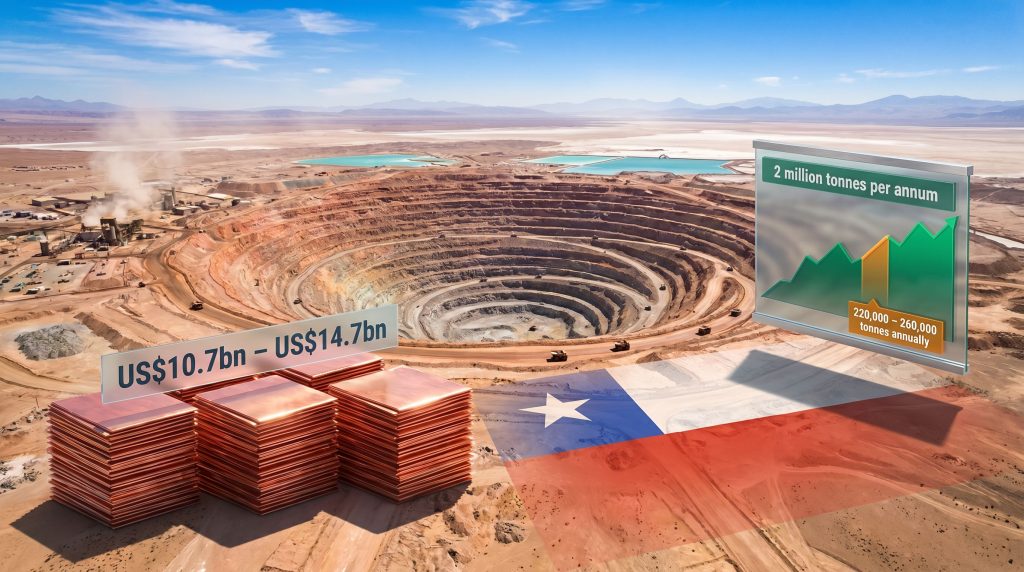
| Total Chilean operations capital programme | US$10.7bn – US$14.7bn |
| Cerro Colorado restart and expansion (separate application) | ~US$1.5bn |
The Production Math Behind the Capital Case
The new concentrator is projected to deliver between 220,000 and 260,000 tonnes of copper annually once operational. That production volume is central to BHP's group-level ambition of surpassing 2 million tonnes per annum of copper output globally by the mid-2030s — a figure that would represent close to a doubling of current group production levels.
The economics here require careful interpretation. Because a meaningful share of this investment is sustaining capital, the incremental copper output from the new concentrator represents value that would otherwise be lost to grade decline rather than purely new supply being added to the global market. The investment case is therefore partly about growth and partly about preventing production deterioration — a distinction that changes how analysts should model BHP's copper unit cost trajectory over the coming decade.
Copper's Demand Fundamentals and the Supply Gap Thesis
Why This Expansion Lands at the Right Moment
The structural copper demand drivers are built on several reinforcing pillars that are now converging simultaneously:
-
Electric vehicles require significantly more copper per unit than internal combustion equivalents, driven by battery systems, motor windings, and charging infrastructure.
-
Electrical grid expansion and upgrades in both developed and emerging economies demand substantial copper for transmission and distribution infrastructure.
-
Renewable energy installations — wind turbines and solar arrays in particular — are copper-intensive relative to conventional generation capacity.
-
Data centre construction, increasingly driven by artificial intelligence infrastructure buildout, is emerging as a meaningful incremental copper demand source through wiring, cooling systems, and power distribution networks.
Against this demand backdrop, the supply side faces a structural challenge: the world's largest known copper deposits are ageing, grades are declining, and the pipeline of new greenfield projects capable of meaningful production before 2035 is thin. Analysts broadly identify a structural copper supply deficit emerging through the late 2020s and deepening into the 2030s.
The 2031 to 2032 first-production target for Escondida's new concentrator aligns with the period during which the projected supply-demand imbalance is expected to be most acute — giving the project a timing advantage that few competing supply additions can match.
The Brownfield Advantage Over Greenfield Rivals
A point that is frequently underweighted in copper supply discussions is the structural difference between brownfield expansions and greenfield developments in terms of execution timeline and risk profile. Consequently, BHP's copper expansion plans at an established site carry meaningful advantages over competing greenfield projects:
-
Greenfield copper projects typically require 10 to 15 years from discovery through permitting to first production, even under favourable conditions.
-
Brownfield expansions at existing operations like Escondida can leverage established infrastructure, trained workforces, existing tailings facilities, and pre-existing community and regulatory relationships.
-
The DIA pathway, if successfully navigated, further compresses the Escondida timeline relative to peer projects subject to full EIS processes.
This brownfield premium is particularly valuable in the current environment, where capital costs for new mining infrastructure have risen sharply and regulatory timelines in many jurisdictions have extended significantly.
The next major ASX story will hit our subscribers first
Supply Chain and Regional Economic Implications
What the Construction Phase Means for the Antofagasta Region
Beyond the copper market implications, the BHP Escondida expansion environmental clearance carries material economic weight for northern Chile. Construction employment is expected to average approximately 2,500 workers per month, with peak workforce requirements reaching 6,000 workers during the most intensive construction phases. For the Antofagasta region, where the mining sector is the dominant economic driver, an investment programme of this scale represents a multi-year stimulus to local employment, contractor activity, and services demand.
Portfolio Rationalisation: The San Manuel Divestment in Context
BHP's agreement to sell its San Manuel property in Arizona to Faraday Copper, executed through a wholly owned subsidiary, adds an important dimension to understanding the company's strategic logic. Rather than expanding its copper asset base geographically, BHP is concentrating exposure in its highest-confidence, longest-life positions. Escondida and Cerro Colorado together represent the core of that concentration strategy in Chile.
The divestment of a development-stage asset in favour of deepening investment in a proven operating mine reflects a capital allocation philosophy centred on resource quality, infrastructure leverage, and jurisdictional familiarity rather than portfolio diversification for its own sake. BHP's environmental permit submission for the new concentrator further reinforces this concentrated, long-term approach to its Chilean portfolio.
Frequently Asked Questions: BHP Escondida Expansion Environmental Clearance
What has BHP been approved to begin at Escondida?
The Antofagasta Environmental Assessment Commission granted BHP an initial environmental permit authorising early-works activity on sulphide leaching infrastructure and electricity system upgrades. This phase carries an estimated cost of approximately US$1.3 billion and is the first stage of a broader, multi-billion-dollar capital programme.
What is the total investment BHP is planning at Escondida?
The full capital programme across BHP's Chilean operations is estimated between US$10.7 billion and US$14.7 billion. The new concentrator plant alone is projected to cost between US$4.4 billion and US$5.9 billion, with a separate Cerro Colorado restart application estimated at approximately US$1.5 billion.
When will the Escondida expansion be completed?
If environmental approvals proceed as anticipated through the DIA process, construction on the new concentrator could commence in early 2027, with first production targeted for 2031 to 2032.
Why is the Atacama Desert a uniquely sensitive location for mining expansion?
The Atacama hosts rare high-altitude wetland ecosystems and salt flat systems that depend on Andean groundwater flows. Mining-related groundwater drawdown has previously been found to reduce the local water table beyond permitted thresholds at Escondida, triggering formal enforcement action, remediation orders, and significant financial penalties.
What voluntary environmental measures has BHP implemented?
BHP has voluntarily ceased groundwater extraction for operational purposes a decade ahead of its regulatory deadline and is transitioning Escondida to 100% renewable energy supply. The new concentrator design also incorporates underground pipeline infrastructure and improved tailings management to reduce surface environmental disturbance.
Key Takeaways for Investors and Copper Market Participants
The July 2026 environmental permit represents a meaningful de-risking event for BHP's most capital-intensive growth programme, but it is the beginning of a regulatory journey rather than its conclusion. Several considerations warrant attention:
-
The staged approval architecture means execution risk remains real — the concentrator DIA and subsequent processing upgrade approvals each represent discrete decision points where the programme could face delays.
-
BHP's voluntary environmental commitments function as strategic capital, not just compliance measures. They build the goodwill that future approval decisions will depend on.
-
The 2031 to 2032 production timeline places Escondida's new concentrator output directly in the window most analysts associate with the deepest phase of the projected copper supply deficit.
-
The defensive nature of much of this capital spending means investors should not model it purely as new production growth — a portion represents supply that would otherwise be lost to grade deterioration.
-
For the broader copper market, whether the BHP Escondida expansion environmental clearance process runs to schedule will materially influence supply-side forecasts through the 2030s and affect the trajectory of copper prices during what many analysts expect to be a structurally tight market period.
This article contains forward-looking statements, production estimates, and capital expenditure projections that are inherently uncertain. Timelines and cost figures are subject to regulatory, technical, and market factors that may cause actual outcomes to differ materially from those described. This content does not constitute financial advice.
Want to Capitalise on the Next Major Copper Discovery Before the Market Catches On?
The structural copper supply deficit driving BHP's multi-billion-dollar Escondida commitment creates compelling opportunities further down the market cap spectrum — and Discovery Alert's proprietary Discovery IQ model scans ASX announcements in real time, instantly alerting subscribers to significant copper and mineral discoveries the moment they hit the exchange. Explore historic discovery returns on Discovery Alert's dedicated discoveries page and begin your 14-day free trial to position yourself ahead of the broader market.