June 5, 2026
The Hidden Bottleneck Slowing Maritime Decarbonisation
Scaling sustainable marine fuels is not primarily a technology problem. It is a supply chain problem. The global shipping industry has made meaningful progress trialling lower-emission fuel alternatives over the past decade, yet one structural constraint continues to undermine ambitions for large-scale adoption: an overwhelming dependence on a single feedstock. Used cooking oil (UCO) now dominates the marine biofuel market to such a degree that competition from aviation, road transport, and shipping sectors is already driving price volatility and periodic supply shortages in key trading hubs.
This concentration risk sits at the heart of why the BHP and GCMD biofuel trial for bulk carriers, conducted aboard the Berge Lyngor in May 2026, carries significance well beyond a single voyage. By incorporating tallow-derived biodiesel alongside UCO in a purpose-designed blend, the trial is testing whether waste animal fats can meaningfully expand the total available pool of sustainable marine fuels, without compromising fuel quality, engine performance, or the traceability standards increasingly demanded by regulators.
Understanding why this matters requires stepping back from the trial itself and examining the structural forces reshaping maritime energy strategy across the mining sector. Indeed, the broader push toward clean energy transition in mining provides important context for why initiatives like this are accelerating.
When big ASX news breaks, our subscribers know first
The Decarbonisation Pressure Facing Mining's Maritime Supply Chain
Why Bulk Carrier Emissions Are Under Increasing Regulatory Scrutiny
Shipping contributes approximately 2.89% of global greenhouse gas emissions annually, a figure that, while seemingly modest in isolation, represents a larger absolute volume than the aviation sector and has grown steadily alongside expanding global trade. For mining companies, the challenge is particularly acute because bulk carriers transporting iron ore, coal, and other commodities account for a disproportionately large share of maritime emissions relative to the overall commercial fleet.
The International Maritime Organization's revised 2023 strategy now targets net-zero shipping emissions by or around 2050, with an interim commitment to reduce total annual greenhouse gas emissions by at least 20% from 2008 levels by 2030. These targets are no longer aspirational benchmarks. The EU Emissions Trading System expansion, which incorporated maritime emissions from January 2024, now requires shipping companies to surrender allowances covering a progressively increasing share of their voyage emissions, rising from 40% in 2024 to 100% by 2026 for voyages between EU ports.
For mining companies like BHP, the pressure compounds further when examined through a Scope 3 lens. Indirect emissions from a company's value chain, including maritime transport of finished commodities, can account for as much as 90% of total reported emissions for major mining operators. This means addressing shipping emissions is no longer a peripheral sustainability consideration but a core element of investor relations, ESG ratings, and regulatory compliance. Furthermore, the mining decarbonisation benefits extend well beyond regulatory compliance, encompassing meaningful long-term cost advantages.
Institutional investors and ESG frameworks are increasingly incorporating carbon-adjusted freight costs into mining company valuations, effectively penalising those with higher-emission supply chains regardless of whether the mining company directly controls the vessels.
What Is Well-to-Wake Emissions Accounting and Why Does It Matter?
Traditional maritime emissions measurement focused on what happens inside the vessel's engine room: combustion. The well-to-wake (WtW) methodology changes this entirely by capturing the full lifecycle of a marine fuel, from feedstock extraction and processing through transportation, blending, and final combustion onboard.
The practical difference is substantial. A biofuel that appears carbon-neutral at the point of combustion may carry significant upstream emissions if the feedstock was cultivated on converted agricultural land or processed using coal-fired energy. Conversely, waste-derived feedstocks like UCO and tallow carry much lower upstream carbon burdens precisely because they are by-products of existing processes rather than purpose-grown crops.
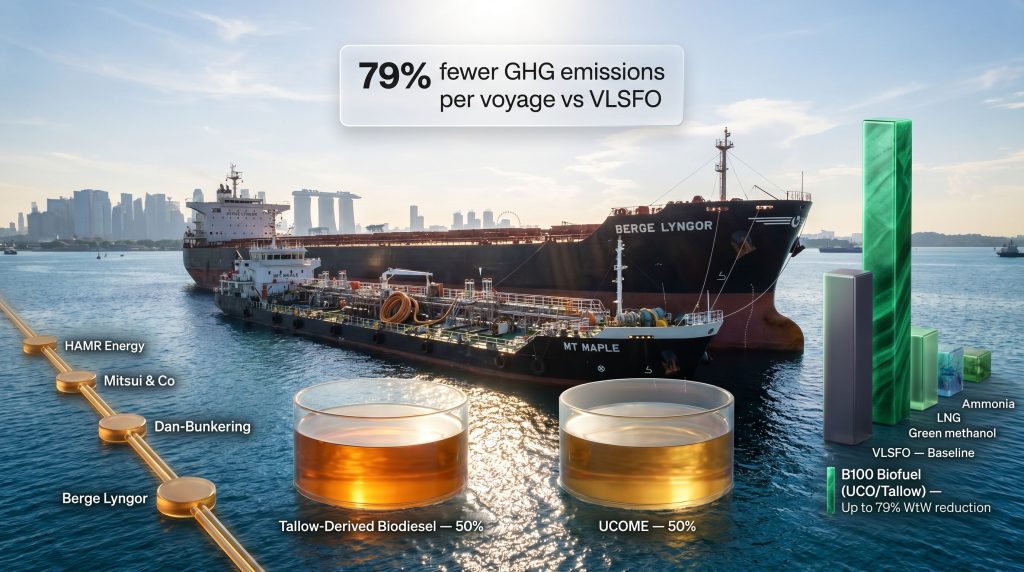
The BHP and GCMD biofuel trial for bulk carriers uses WtW as its primary emissions benchmark, with the blended biofuel projected to deliver approximately 79% fewer greenhouse gas emissions per voyage compared to Very Low Sulphur Fuel Oil (VLSFO), the current conventional marine fuel standard. This figure is significant not only in absolute terms but because it is calculated using the same methodology increasingly mandated by the EU ETS, the FuelEU Maritime regulation, and the IMO's updated Life Cycle GHG Assessment Guidelines.
Key Insight: A 79% well-to-wake GHG reduction versus VLSFO positions multi-feedstock biofuels as one of the most immediately deployable decarbonisation tools available to bulk shipping operators today, without requiring engine retrofits or new vessel builds.
What Is the BHP and GCMD Biofuel Trial? A Technical Breakdown
The Vessel, the Route, and the Fuel
The trial was conducted aboard the Berge Lyngor, a bulk carrier owned and operated by Berge Bulk and chartered by BHP for the carriage of iron ore. Bunkering took place in Singapore during early May 2026, positioning the trial within the world's most strategically significant bunkering environment.
The fuel used was a B100 biofuel blend, meaning the bunkered portion contained no conventional fossil fuel component whatsoever. The blend composition was precisely:
- 50% tallow-derived biodiesel sourced from waste animal fats, supplied by HAMR Energy
- 50% used cooking oil methyl ester (UCOME), supplied by Mitsui & Co Energy Trading Singapore
This 50:50 split was deliberate. Rather than defaulting to the higher-UCO blends common in earlier trials, the formulation was designed to test whether tallow-based material could constitute an equal proportion of a commercially viable blend without introducing handling, stability, or performance complications.
Who Supplied and Handled the Fuel? The Full Supply Chain Breakdown
The trial involved a carefully coordinated network of commercial partners, each responsible for a distinct element of the fuel supply chain:
| Role | Organisation |
|---|---|
| Tallow-derived biodiesel supplier | HAMR Energy |
| UCOME supplier | Mitsui & Co Energy Trading Singapore |
| Fuel blending | Mitsui & Co Energy Trading Singapore |
| Bunkering coordination and execution | Dan-Bunkering |
| Bunkering barge | Global Energy's MT Maple |
| Research and trial co-lead | Global Centre for Maritime Decarbonisation (GCMD) |
| Charterer | BHP |
| Vessel owner and operator | Berge Bulk |
| Funding body | Maritime and Port Authority of Singapore (MPA) |
The involvement of this many distinct commercial entities is itself noteworthy. Unlike simpler single-supplier biofuel bunkering operations, this configuration mirrors the complexity that would be required for large-scale commercial deployment, making it a realistic stress test of real-world feasibility. For further detail on the bunkering logistics and HAMR Energy's role in the supply chain, BHP's partnership with HAMR Energy provides useful background on the feedstock sourcing process.
What Is the Maritime Innovation and Technology (MINT) Fund?
The MINT Fund is administered by the Maritime and Port Authority of Singapore (MPA) and provides co-funding for research, development, and trials targeting maritime decarbonisation technologies. The BHP and GCMD biofuel trial for bulk carriers is among the initiatives receiving support through this mechanism.
Singapore's position as the world's largest bunkering hub, handling approximately 50 million tonnes of bunker fuel annually and representing roughly 22% of the global bunkering market by volume, gives trials conducted there outsized global influence. Fuel standards validated in Singapore tend to be adopted as reference benchmarks across Asian and European bunkering hubs due to the port's regulatory credibility and scale.
Why Animal Fat? The Case for Tallow-Derived Biodiesel in Marine Fuels
The Feedstock Diversity Problem in Marine Biofuels
The global shipping industry's current biofuel consumption is structurally fragile in one important respect: it relies overwhelmingly on used cooking oil as its primary feedstock. UCO is finite in supply, geographically concentrated in a relatively small number of collection markets, and increasingly contested across three competing sectors: aviation, road transport, and maritime shipping.
This competition is already measurable in price data. UCO prices on key trading routes have exhibited significant volatility, creating uncertainty for shipping companies attempting to build long-term decarbonisation strategies around a single-feedstock fuel pathway. Over-reliance on UCO introduces precisely the kind of supply chain fragility that undermines the commercial viability of biofuels as a mainstream alternative. In addition, the broader challenge of critical minerals and energy transition illustrates how feedstock concentration risks mirror wider resource security concerns affecting the entire mining and energy sector.
What Is Tallow-Derived Biodiesel and Where Does It Come From?
Tallow is rendered animal fat, typically produced as a by-product of meat processing operations in the food industry. When processed into biodiesel through transesterification, it produces a fuel with chemical properties broadly compatible with marine diesel engines. Its classification as a waste-derived feedstock means it carries a strong sustainability credential under most lifecycle assessment frameworks, with minimal competition from food or feed applications.
Several characteristics make tallow an attractive complement to UCO in marine fuel blending:
- It is available in substantial volumes across major agricultural economies including Australia, Brazil, the United States, and parts of Europe
- As a solid or semi-solid at ambient temperatures, it requires processing considerations that differ from UCO, adding technical complexity but also opportunities for refining innovation
- Its upstream carbon intensity is lower than most virgin vegetable oils because it requires no dedicated agricultural land
- The processing infrastructure for tallow-to-biodiesel conversion is well-established in several markets, meaning supply chains can be activated relatively quickly
Comparing Biofuel Feedstocks for Marine Applications
| Feedstock | Availability | Carbon Intensity | Supply Competition | Maturity |
|---|---|---|---|---|
| Used Cooking Oil (UCO) | Moderate | Low | High (aviation, road) | High |
| Tallow (Animal Fat) | Moderate | Very Low | Lower | Emerging |
| Vegetable Oil (palm, soy) | High | Moderate to High | Moderate | High |
| Algae-based | Low | Very Low | Low | Early-stage |
| Synthetic e-fuels | Very Low | Near-zero (green) | Low | Pre-commercial |
Strategic Note: Blending tallow-derived biodiesel with UCOME is not merely a technical exercise. It is a supply chain diversification strategy designed to reduce feedstock concentration risk across the marine biofuel ecosystem, potentially unlocking significantly larger total volumes of sustainable fuel at competitive cost structures.
What Does the Trial Actually Test? Operational and Compliance Objectives
Four Core Areas Under Evaluation
The BHP and GCMD biofuel trial for bulk carriers is structured around four distinct but interconnected assessment objectives:
- Fuel Quality Verification – Confirming that the blended B100 meets ISO 8217 marine fuel quality standards, with particular attention to parameters including oxidation stability, acid value, and cetane number, which can behave differently in multi-feedstock blends compared to single-source fuels
- Handling and Bunkering Logistics – Assessing whether the blended fuel can be safely and efficiently transferred through standard bunkering infrastructure, including storage tanks, transfer lines, and the bunkering barge interface, without separation, degradation, or safety complications
- Onboard Vessel Performance – Monitoring engine performance metrics, fuel consumption rates, and any operational anomalies throughout the voyage to confirm that the multi-feedstock blend does not introduce complications for propulsion systems designed and certified primarily for conventional marine fuel
- Traceability and Chain of Custody – Verifying that the fuel's feedstock origin, blend ratio, and carbon intensity can be accurately and independently documented at each stage of the supply chain, from raw material collection through to combustion
Why Traceability Is the Critical Bottleneck for Biofuel Scaling
Among these four objectives, traceability arguably represents the most consequential challenge for the industry's long-term trajectory. Without robust chain-of-custody documentation, emissions reduction claims from biofuel use cannot be independently verified, exposing companies to regulatory risk, greenwashing allegations, and potential financial penalties under frameworks like the EU ETS.
The complexity intensifies when waste-derived feedstocks pass through multiple commercial intermediaries before reaching the blending stage. Each change of custody introduces a potential documentation gap. For tallow specifically, which moves from meat processors to rendering operations to biodiesel producers before reaching fuel blenders, the chain can involve five or more distinct entities across multiple jurisdictions.
This is why the trial is as much a compliance infrastructure test as a technical fuel performance assessment. The outcomes will inform whether current documentation and verification systems are adequate for multi-feedstock blends, or whether more sophisticated solutions including digital tracking platforms and blockchain-based provenance systems need to be integrated into commercial-scale operations. For a detailed account of the bunker handling lessons emerging from this type of multi-feedstock trial, geomechanics.io's coverage of the trial offers useful technical perspective.
Regulatory frameworks including the EU ETS, IMO's Carbon Intensity Indicator (CII), and FuelEU Maritime all require verifiable fuel provenance data, and the bar for verification is rising steadily. Early trials that establish robust documentation standards now will be significantly better positioned when full regulatory enforcement phases activate later this decade.
How Does This Trial Fit Within BHP's Broader Maritime Decarbonisation Strategy?
BHP's Multi-Pathway Approach to Shipping Emissions
BHP has consistently signalled that decarbonising its maritime supply chain requires parallel investment across multiple fuel technology pathways rather than a concentrated bet on any single solution. The company has separately announced the chartering of two ammonia dual-fuel vessels, representing a longer-term commitment to near-zero-carbon propulsion that complements, rather than replaces, the near-term biofuel strategy.
Biofuels occupy a specific and important role in this architecture: they are deployable today, using existing vessel infrastructure, without waiting for engine technology, port bunkering equipment, or global fuel production capacity for ammonia or hydrogen to reach commercial scale. This positions them as a critical bridge technology capable of delivering meaningful emissions reductions during the transition period. Furthermore, renewable energy in mining is increasingly underpinning these multi-pathway approaches, reinforcing the broader shift away from fossil fuel dependence across the sector.
Where Biofuels Sit in the Maritime Fuel Transition Timeline
| Fuel Technology | Readiness Level | GHG Reduction Potential | Infrastructure Requirement |
|---|---|---|---|
| VLSFO (conventional) | Fully commercial | Baseline | None |
| B24-B30 biofuel blends | Commercially available | 20-25% (WtW) | Minimal |
| B100 biofuel (UCO/tallow) | Trial and early commercial | Up to 79% (WtW) | Moderate |
| LNG dual-fuel | Commercial | 15-25% (WtW) | Significant |
| Ammonia dual-fuel | Near-commercial | 90%+ (green ammonia) | Major |
| Green methanol | Early commercial | 65-95% (green) | Significant |
| Green hydrogen | Pre-commercial | Near-zero | Major |
The table above highlights a critical strategic reality: B100 biofuels currently offer the highest verified GHG reduction of any commercially accessible marine fuel. Ammonia and green hydrogen may ultimately achieve greater absolute reductions, but their commercial deployment at scale remains years away, constrained by production capacity, bunkering infrastructure, and vessel conversion costs.
For a company like BHP that faces increasing investor scrutiny on Scope 3 emissions today, biofuels represent the only pathway capable of delivering substantial, verifiable reductions within the current regulatory reporting cycle. Consequently, the push toward electrification and decarbonisation across mining operations more broadly is creating a compelling strategic alignment with maritime fuel innovation.
The next major ASX story will hit our subscribers first
What Does GCMD's Role Signal About Singapore's Maritime Decarbonisation Ambitions?
GCMD as a Regional Catalyst for Sustainable Bunkering Innovation
The Global Centre for Maritime Decarbonisation is a Singapore-based non-profit established to accelerate the maritime sector's transition to lower-carbon fuels through applied research, commercial trials, and stakeholder convening. Its institutional knowledge, accumulated through multi-port and multi-vessel biofuel supply chain trials conducted between 2022 and 2024, provides the methodological foundation for the current BHP collaboration.
The trial is deliberately positioned as a focused, single-voyage assessment rather than a broad-scope programme, concentrating specifically on multi-feedstock blend integrity and supply chain traceability. This targeted design reflects a maturation in GCMD's approach: moving from exploratory feasibility testing toward generating the granular commercial and compliance evidence needed to support industry-wide adoption.
Why Singapore Is the Ideal Testing Ground for Marine Biofuel Trials
Singapore's selection as the bunkering location for this trial is strategically deliberate rather than merely convenient:
- As the world's largest bunkering hub handling approximately 50 million tonnes of fuel annually, Singapore provides unmatched infrastructure density for testing novel fuel supply chains under real commercial conditions
- The MPA's MINT Fund creates a co-investment framework that reduces financial risk for commercial participants in early-stage trials, encouraging participation from companies that might otherwise delay engagement until technologies are more proven
- Singapore's regulatory environment and port authority oversight provide credible third-party validation for trial outcomes, giving results greater international acceptance and applicability
- The concentration of global shipping, trading, and bunkering companies in Singapore means trial outcomes can be rapidly communicated across the industry through established commercial relationships
The combination of these factors means that successful validation of multi-feedstock biofuel blends in Singapore carries a level of commercial credibility that equivalent trials conducted in smaller or less central bunkering locations cannot easily replicate.
Frequently Asked Questions: BHP and GCMD Biofuel Trial
What fuel was used in the BHP-GCMD biofuel trial?
The trial used a B100 biofuel blend composed of 50% tallow-derived biodiesel, sourced from waste animal fats via HAMR Energy, and 50% used cooking oil methyl ester (UCOME) supplied by Mitsui & Co Energy Trading Singapore. The blend was bunkered in Singapore in May 2026 aboard the bulk carrier Berge Lyngor.
How much can this biofuel reduce greenhouse gas emissions?
Based on well-to-wake lifecycle accounting, the blended biofuel is projected to reduce greenhouse gas emissions by approximately 79% per voyage compared to Very Low Sulphur Fuel Oil (VLSFO), the current conventional marine fuel standard. This projection relies on the waste-derived classification of both feedstocks, which substantially reduces the upstream portion of the lifecycle emissions calculation.
Why is tallow being used instead of just used cooking oil?
Used cooking oil is already heavily utilised across marine, aviation, and road transport sectors, creating supply constraints and price pressure. Incorporating tallow, a waste by-product of meat processing, diversifies the feedstock base, reduces dependence on any single supply source, and potentially improves the overall sustainability profile of the fuel blend at a time when UCO supply is becoming increasingly contested across competing industries.
Is this trial commercially scalable?
The trial is explicitly designed to evaluate whether multi-feedstock biofuel blends can be handled, bunkered, and traced through existing commercial infrastructure at scale. Successful outcomes would provide the technical and regulatory evidence base needed to support broader commercial adoption across the bulk carrier fleet. The involvement of multiple commercial partners across the supply chain demonstrates a deliberate effort to test real-world scalability rather than controlled laboratory conditions.
Who funded the BHP-GCMD biofuel trial?
The trial received co-funding from the Maritime and Port Authority of Singapore through its Maritime Innovation and Technology (MINT) Fund, alongside contributions from BHP and GCMD's member organisations.
How does this trial relate to BHP's ammonia shipping programme?
The biofuel trial and the ammonia dual-fuel vessel programme are complementary but separate initiatives within BHP's broader maritime decarbonisation strategy. Biofuels represent a near-term, infrastructure-compatible pathway capable of delivering substantial emissions reductions today, while ammonia dual-fuel vessels represent BHP's longer-term investment in near-zero-carbon maritime propulsion. Together, they reflect a multi-pathway approach to progressively reducing Scope 3 shipping emissions across different time horizons.
Key Takeaways: What the BHP-GCMD Trial Means for the Mining and Shipping Industries
- Multi-feedstock biofuel blending is emerging as a critical strategy to expand sustainable marine fuel supply beyond the structural constraints of used cooking oil alone, with tallow representing a meaningfully scalable addition to the available feedstock base
- A 79% well-to-wake GHG reduction versus VLSFO establishes a compelling near-term emissions case for B100 biofuel adoption in bulk carrier operations, outperforming all currently commercial marine fuel alternatives
- The trial's focus on traceability and chain-of-custody verification addresses one of the most significant regulatory and compliance barriers to biofuel scaling, with implications extending far beyond this single voyage
- Singapore's role as both bunkering venue and co-funder through the MPA's MINT Fund positions the city-state as the global proving ground for next-generation marine fuel supply chains, with results carrying international commercial credibility
- For BHP, the trial represents a concrete, measurable step toward addressing Scope 3 maritime emissions, an area of increasing scrutiny from investors, regulators, and ESG rating agencies that cannot be deferred until longer-term fuel technologies mature
- The involvement of multiple commercial partners including HAMR Energy, Mitsui, Dan-Bunkering, and Berge Bulk demonstrates that collaborative, multi-stakeholder models are essential to scaling alternative marine fuels, and that no single company or institution can navigate this transition alone
- From an investor perspective, companies that establish verifiable biofuel supply chains now will hold a competitive compliance advantage as EU ETS obligations for maritime emissions escalate through 2026 and beyond, potentially translating into meaningful cost differentials relative to operators still relying on conventional VLSFO
This article contains forward-looking statements and projections regarding emissions reductions, fuel performance, and commercial scalability. These projections are based on current trial data and regulatory frameworks and are subject to change based on trial outcomes, regulatory developments, and market conditions. This content is intended for informational purposes only and does not constitute financial or investment advice.
Want to Invest in the Companies Driving the Clean Energy Transition?
Discovery Alert's proprietary Discovery IQ model delivers real-time alerts on significant ASX mineral discoveries — including the critical minerals and commodities underpinning maritime decarbonisation and the broader energy transition — ensuring subscribers can identify actionable opportunities the moment they emerge. Explore historic discoveries and their market-moving returns, then begin your 14-day free trial to position yourself ahead of the market.