July 17, 2026
When Buyers Become Price Makers: The Paradox of China's Iron Ore Leverage
There is a well-established assumption in commodity markets that large buyers hold structural power over suppliers. Volume concentration, it is argued, translates directly into pricing leverage. Yet the iron ore market has repeatedly demonstrated that this logic breaks down when supply geography is sufficiently concentrated and product quality specifications are difficult to replicate. Fiscal 2026 provided one of the most instructive case studies of this dynamic in recent memory, as BHP higher quarterly iron ore prices emerged from a period when China's state purchasing entity was actively restricting procurement of specific BHP product grades.
The counterintuitive outcome, where a buyer's attempt to suppress prices inadvertently contributed to tighter seaborne supply and elevated spot benchmarks, reflects a structural feature of the iron ore market that is frequently underappreciated by observers focused purely on demand-side narratives. Furthermore, understanding China iron ore demand dynamics is essential for contextualising why this paradox continues to repeat itself across commodity cycles.
When big ASX news breaks, our subscribers know first
The Architecture of China's State Buying Power
How China Mineral Resources Group Reshaped Iron Ore Procurement
China Mineral Resources Group (CMRG) was established in 2022 as a centralised procurement vehicle designed to consolidate China's fragmented iron ore buying across hundreds of domestic steelmakers. The theory was straightforward: by aggregating purchasing volume under a single state-controlled entity, China could replicate the kind of monopsony power that had long eluded its steel sector despite accounting for roughly 70% of global seaborne iron ore demand.
The mechanism CMRG deployed against BHP during the 2024 to 2026 period was not a blanket embargo. It was a targeted product-grade restriction applied to three specific BHP ore types:
- Jimblebar fines – a mid-grade Pilbara blend known for consistent alumina and silica characteristics
- Newman fines – one of BHP's flagship high-grade products, historically commanding a premium above benchmark pricing
- Jinbao fines – a blending product valued for its specific mineralogical properties within blast furnace charge mixes
The selection of these grades was tactically deliberate. By targeting products that Chinese mills had built their blast furnace recipes around, CMRG sought to create pressure without triggering an immediate operational crisis for steelmakers. The restrictions were applied progressively, beginning with Jimblebar fines in late 2024 before expanding to Newman and Jinbao fines through 2025.
The Grade Substitution Problem: Why Replacement Is Harder Than It Looks
A critical insight that is often overlooked in mainstream coverage of these procurement disputes is the complexity of iron ore blending within integrated steel mills. Chinese blast furnaces are not indifferent to ore chemistry. Each furnace operates on a carefully calibrated burden mix that balances iron content (Fe%), silica (SiO2), alumina (Al2O3), phosphorus, and moisture levels to achieve target hot metal quality at minimum coke consumption rates.
BHP's Pilbara products, particularly Newman fines with their characteristically low alumina content (typically below 2%), are valued precisely because they allow steelmakers to blend lower-cost, higher-alumina ores from other origins without breaching furnace operating limits. Removing these grades from procurement schedules is not as simple as switching suppliers. It requires reformulating the entire burden mix, often at the cost of higher coke rates, lower productivity, or reduced hot metal quality.
This substitution friction is one reason why buyer-side leverage in iron ore has historically been more limited than in markets where product interchangeability is high. In addition, the broader challenges facing China steel and iron ore markets in 2025 and beyond have only amplified these structural tensions.
How BHP Achieved Higher Realised Prices Despite Buying Curbs
The Supply Tightening Mechanism
The most underappreciated aspect of the CMRG purchasing restrictions is that they functioned as an involuntary supply management tool. When specific BHP product grades were removed from active Chinese procurement, the seaborne volumes associated with those cargoes either accumulated in third-party inventories or were redirected to alternative buyers in Japan, South Korea, and Europe at prevailing spot market prices.
The reduction in accessible Chinese demand for these grades did not reduce BHP's production volumes significantly. What it did was alter the distribution of those tonnes across markets, tightening the effective spot supply available to Chinese buyers through other channels and contributing to iron ore futures maintaining above the $100 per tonne threshold during the restriction period.
This price elevation, sustained across the better part of two fiscal quarters, flowed through to BHP's contract-weighted average realised price for the full fiscal year. However, it is worth noting that a broader iron ore price decline trend driven by surplus conditions and Chinese demand weakness has continued to create uncertainty in parallel markets.
Fiscal 2026 Iron Ore Price and Production Performance
| Metric | FY2026 Result | Prior Year |
|---|---|---|
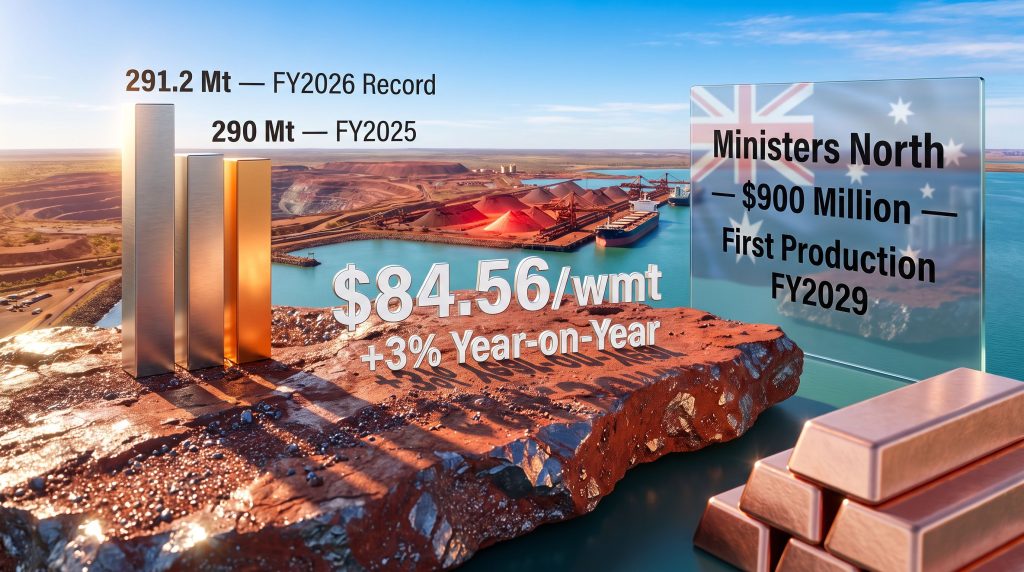
| Average Realised Iron Ore Price | $84.56/wmt | ~$82.10/wmt (implied) |
| Year-on-Year Price Change | +3% | – |
| Q4 FY2026 Realised Price | $83.58/wmt | – |
| Q4 Year-on-Year Price Change | +5% | – |
| Annual Production (100% basis) | 291.2 Mt | 290 Mt |
| Q4 Production | 74.8 Mt | 77.5 Mt |
| Q4 Consensus Estimate | 75.1 Mt | – |
Annual production of 291.2 million metric tonnes from BHP's Western Australia iron ore operations represented a record level of output, marginally exceeding the prior year's 290 Mt despite the disruptions associated with the procurement dispute and subsequent resolution. The Q4 shortfall relative to both the prior year and analyst consensus was modest and largely attributable to factors including the Port Hedland labour situation rather than any fundamental operational deterioration.
Understanding Realised Price Versus Spot Price
Investors monitoring iron ore spot benchmarks, such as the Singapore Exchange iron ore derivatives contract or Platts IODEX assessments for 62% Fe fines, will note that BHP's reported realised prices frequently diverge from prevailing spot levels. This is because BHP's revenue is a blended outcome across:
- Quarterly lagged pricing on a proportion of contract tonnes, which references the prior quarter's average rather than the current spot price
- Annual negotiated pricing with certain long-term customers at fixed or formula-based rates
- Spot and index-linked sales for volumes sold into the seaborne spot market
- Product-grade premiums and discounts reflecting the specific iron content, moisture, and chemistry of each cargo relative to the 62% Fe index
This layered pricing architecture means BHP's realised price is structurally more stable than spot market headlines suggest, but it also means that short-term spot price spikes do not immediately translate into equivalent realised price gains.
Port Hedland: The World's Highest-Stakes Iron Ore Chokepoint
A Strike 26 Years in the Making
The industrial action scheduled at BHP's Port Hedland operations marked the first Port Hedland strike in 26 years, a fact that underscores both the rarity of the event and the significance of the wage deadlock that produced it. Port Hedland is not merely a large port. It is the world's largest bulk export terminal by tonnage, processing approximately $80 million worth of iron ore daily across BHP and other Pilbara producers sharing its infrastructure.
The timing of the strike carried particular market sensitivity given that CMRG had only concluded its purchasing restriction agreement with BHP in April 2026, meaning Chinese mills were in the process of re-establishing normal procurement rhythms at the precise moment when Port Hedland throughput became uncertain.
Downstream Market Implications
Even a short-duration port stoppage at Port Hedland creates compounding effects that extend well beyond the immediate loading delay:
- Vessel queuing costs accumulate rapidly for bulk carriers waiting at anchor, adding demurrage expenses that can reach tens of thousands of dollars per vessel per day
- Inventory drawdowns at Chinese ports accelerate as replacement cargoes are delayed, tightening the buffer between port stocks and steelmaker consumption
- Spot market premiums on promptly available cargoes from Brazil or other origins tend to widen during Australian supply disruptions, even if those origins cannot fully substitute Australian volumes
- Steelmaker operating decisions become constrained as blast furnace managers seek to protect burden consistency with reduced Pilbara ore availability
Australia and Brazil collectively supply the vast majority of the world's seaborne iron ore. Within Australia, Port Hedland accounts for the dominant share of export volumes. This geographic concentration leaves limited flexibility for Chinese buyers to rapidly diversify away from Pilbara supply disruptions.
FY2027 Outlook and the Ministers North Investment Decision
Production Guidance and What the Range Signals
BHP's Western Australia iron ore production guidance for fiscal 2027 of 286 to 298 million metric tonnes encompasses a wider range than might be expected from a mature, long-operating asset base. The breadth of the range reflects genuine operational uncertainty, including the duration and resolution of the Port Hedland labour dispute, the pacing of pit development across multiple Pilbara mine sites, and the ramp-up trajectory of replacement ore sources as existing pits approach end-of-life.
Ministers North: A $900 Million Statement of Conviction
| Project Detail | Specification |
|---|---|
| Project Name | Ministers North Iron Ore Project |
| Location | Pilbara, Western Australia |
| Approved Capital | $900 million |
| First Production Target | Fiscal 2029 |
The approval of Ministers North at this juncture carries a significance that extends beyond the project's own economics. BHP committed $900 million to new Pilbara iron ore capacity during a period when its largest customer was actively restricting purchases of its products and global steel demand projections were subject to downward revision pressure from China's property sector weakness.
This capital allocation decision reflects BHP's internal assessment that the structural demand case for seaborne iron ore over a multi-decade horizon remains intact, even if near-term pricing volatility and buyer-side political pressure create headline uncertainty. Pilbara's geological endowment, including the banded iron formations of the Hamersley Province, continues to provide among the lowest extraction cost profiles of any iron ore province globally.
Copper: Structural Growth Story Meets Operational Headwinds
Quarterly Copper Performance
| Metric | Q4 FY2026 | Q4 FY2025 | Consensus |
|---|---|---|---|
| Copper Production | 491,900 tonnes | 516,200 tonnes | 492,700 tonnes |
| Year-on-Year Change | -4.7% | – | – |
BHP's quarterly copper output of 491,900 tonnes was broadly in line with analyst expectations but represented a meaningful year-on-year decline of approximately 4.7% from the prior year's 516,200 tonnes. As Reuters reports, two distinct factors drove the underperformance relative to historical levels.
The first was operational. An unexpected underground conveyor belt failure at the Carrapateena mine disrupted ore handling for an extended period, with the recovery process projected to affect mine production for up to eight weeks. The second factor is structural and forward-looking. Grade decline at Escondida, the world's largest copper mine by production volume, is projected to reduce BHP's copper output by as much as 15.5% in the following fiscal year.
Why the Demand Case Remains Compelling Despite Output Pressure
Copper is drawing increasing attention from major mining groups as demand growth accelerates across multiple end-use sectors simultaneously, with AI data centre power infrastructure joining the electric vehicle and grid buildout as structurally significant consumption drivers.
The convergence of clean energy transition demand and technology infrastructure expansion creates an unusual demand profile for copper: one where consumption growth is driven by two largely independent economic forces rather than a single cyclical driver. Furthermore, the ongoing copper supply crunch is adding pressure to an already constrained global pipeline of developable projects.
Consequently, copper demand growth continues to attract significant investment attention, with BMI projecting that structural supply deficits could push copper prices toward $17,000 per tonne by 2035 as deficits widen progressively through the late 2020s and into the following decade.
BHP's projection that fiscal 2026 unit costs would land at the lower end of its forecast range adds an important qualification to the volume underperformance narrative. Operational efficiency gains that reduce the cost per tonne of copper produced provide a meaningful buffer, ensuring that volume shortfalls do not translate proportionally into earnings deterioration.
The next major ASX story will hit our subscribers first
Scenario Analysis: What Happens If Purchasing Restrictions Return?
| Scenario | Likely Market Outcome |
|---|---|
| Targeted product-grade restrictions (as in 2024–2025) | Spot price support above $100/t; limited full-year realised price impact |
| Broad BHP cargo embargo across all Pilbara products | Significant supply disruption; potential price spike above $110/t threshold |
| Full seaborne iron ore purchasing freeze by CMRG | Structurally unworkable without severe domestic steel production contraction |
The scenario analysis above illustrates a key asymmetry in the CMRG leverage model. The more aggressive the purchasing restriction, the more severe the self-inflicted cost to Chinese steelmaking operations. This creates a practical ceiling on how far state buyer leverage can be deployed before it becomes counterproductive to the very cost-reduction objective it was designed to serve.
The April 2026 resolution of the procurement dispute confirmed this dynamic in practice. According to reporting on the halt and resumption, supply security ultimately prevailed over short-term pricing negotiation tactics once the operational implications for blast furnace burden management became sufficiently constraining, reinforcing the limits of CMRG's leverage model.
Key Performance Summary: BHP Iron Ore and Copper, FY2026
- Average realised iron ore price rose 3% to $84.56 per wet metric tonne for the full fiscal year
- Q4 iron ore realised price increased 5% year-on-year to $83.58 per wet metric tonne, reflecting the paradox of BHP higher quarterly iron ore prices emerging from a period of active buying curbs
- Record annual production of 291.2 Mt from Western Australia operations exceeded the prior year's 290 Mt
- Q4 production of 74.8 Mt came in marginally below the 75.1 Mt consensus and materially below the prior year's 77.5 Mt
- China's purchasing restrictions were fully lifted in April 2026 following concluded contract negotiations
- Port Hedland strike represents BHP's first Port Hedland industrial action in 26 years, with approximately $80 million in daily iron ore exports at risk
- Copper output fell 4.7% year-on-year to 491,900 tonnes, with further declines of up to 15.5% projected for the following year due to Escondida grade decline
- $900 million approved for the Ministers North iron ore project, targeting first production in fiscal 2029
- FY2027 iron ore guidance set at 286 to 298 million metric tonnes
Disclaimer: This article contains forward-looking statements and financial projections sourced from publicly available reporting and analyst consensus data. Commodity price forecasts, production guidance, and market scenario analyses are inherently uncertain and subject to change. This content is for informational purposes only and does not constitute investment advice. Readers should conduct independent research and consult qualified financial advisers before making investment decisions.
Want To Be Among The First To Spot The Next Major ASX Mineral Discovery?
Discovery Alert's proprietary Discovery IQ model delivers real-time alerts on significant ASX mineral discoveries across iron ore, copper, and more than 30 other commodities, turning complex geological data into actionable investment insights. Explore how historic discoveries have generated substantial returns by visiting Discovery Alert's dedicated discoveries page, and begin your 14-day free trial today to position yourself ahead of the broader market.