July 17, 2026
The Structural Divide That Defines Canada's Aluminium Industry
Global commodity cycles have a habit of obscuring internal contradictions. Aluminium is a case in point. Prices for the metal have been among the strongest performers across the base metals complex over the past year, yet within Canada's aluminium sector, the experience of that strength has been profoundly uneven. Canadian aluminium extruders seek trade protection amid US tariffs and import pressure as primary smelters, insulated by long-term hydropower contracts and low-carbon credentials, navigate the current environment with relative confidence. Extrusion companies, sitting further down the value chain and far more exposed to cross-border trade flows, are experiencing something closer to a structural crisis.
Understanding why these two segments of the same industry face such different realities requires looking beyond commodity price charts and into the mechanics of how each segment earns its revenue, where its customers are located, and how sensitive its margins are to trade policy shifts.
When big ASX news breaks, our subscribers know first
How Aluminium Extrusion Differs From Primary Smelting
Primary aluminium production involves smelting alumina into raw metal through an energy-intensive electrolytic process. The product, typically in the form of ingots or billets, is a commodity traded on global exchanges. Canadian smelters benefit from some of the world's lowest electricity costs, derived from abundant hydroelectric resources in Quebec and British Columbia. This structural cost advantage makes them globally competitive regardless of trade friction at the finished product level.
Extrusion is a fundamentally different business. Extruders purchase aluminium billets and force them through precision dies under high pressure to produce shaped profiles used in construction, transportation, industrial machinery, and consumer products. The value added lies in fabrication, precision, and customisation rather than raw metal production. Margins are thinner, customer relationships are more local, and product specifications are often bespoke.
Critically, the competitiveness of an extrusion operation is far more sensitive to import competition and tariff changes than a smelter producing standardised commodity metal. Furthermore, shifts in the aluminium and alumina markets can rapidly amplify these sensitivities across the entire value chain.
Canada's Position in the Global Aluminium Value Chain
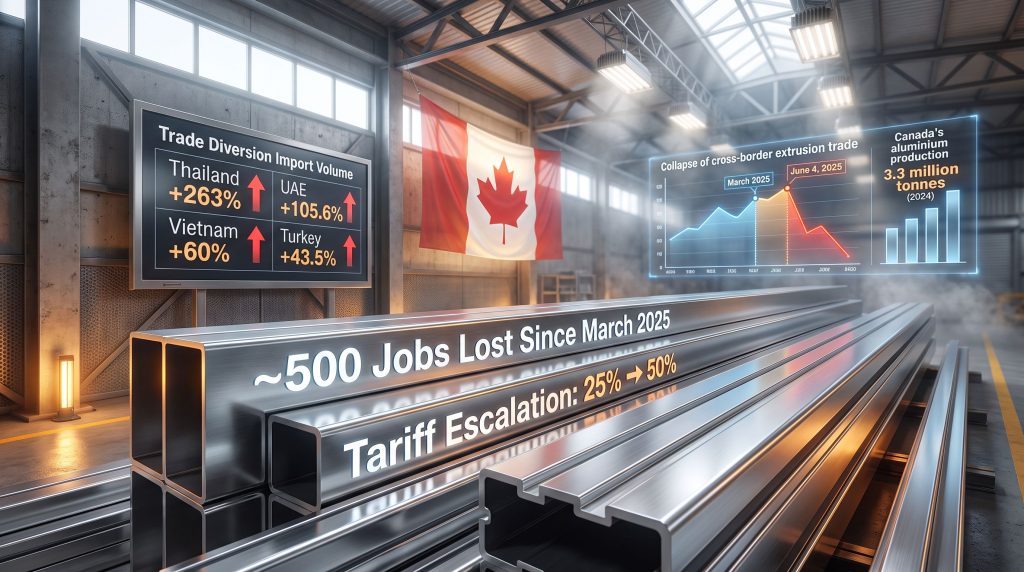
Canada ranks as the world's fourth-largest aluminium producer, accounting for approximately 4.5% of global output. In 2024, the country produced roughly 3.3 million tonnes of aluminium, with close to 3 million tonnes exported. Of that export volume, approximately 90% was directed to the United States, according to data from the Aluminum Association of Canada.
This concentration creates an asymmetric dependency. Canadian primary producers are tightly integrated into US industrial supply chains, but the exposure for extruders is more acute because their products compete directly with fabricated goods that can be sourced from lower-cost manufacturing countries in Asia and the Middle East.
The hydropower advantage that makes Canadian smelters competitive internationally does not transfer downstream. An extruder competing on profile shape, surface finish, and delivery lead time against imports from Vietnam or Thailand cannot offset cost disadvantages simply by pointing to a green energy credential.
The 40% Export Exposure Problem
Canadian aluminium extrusion companies direct approximately 40% of their output to the US market. For context, this is a far higher proportional dependency on a single export destination than most comparable manufacturing subsectors carry. It also means that any significant disruption to that cross-border trade relationship hits revenue and capacity utilisation simultaneously.
When US aluminium tariffs began targeting aluminium products in early 2025, extruders found themselves squeezed from both directions: losing access to their largest export market while simultaneously facing a surge of import competition at home from trade-diverted product that could no longer enter the United States.
The Escalating US Tariff Timeline
The sequence of US tariff escalation has compounded the problem at each stage:
| Tariff Event | Date | Rate Applied | Scope |
|---|---|---|---|
| Initial Section 232 Tariff | March 2025 | 25% | Aluminium imports |
| Tariff Escalation | June 4, 2025 | 50% | Aluminium imports |
| Scope Expansion | Post-June 2025 | 50% | Full value of aluminium-containing products |
The shift from taxing the aluminium content of a product to taxing its full value was particularly damaging for extruders. A highly fabricated aluminium profile might contain aluminium representing only 40–60% of its total value. Applying the tariff to the full product value rather than just the metal component effectively doubled or tripled the real tariff burden on complex fabricated goods compared to basic commodity forms of aluminium.
This design feature of the tariff structure, whether intentional or incidental, has disproportionately penalised value-added aluminium products over raw metal. It has also made it uneconomical for many Canadian extruders to maintain their US customer relationships, even where those relationships were long-established. The broader impact of tariffs on supply chains across North America has consequently intensified pressure on fabricators at every tier.
Trade Diversion: The Second Front Hitting Canadian Extruders
The tariff disruption does not end at the US border. A well-documented consequence of large-scale import tariffs is trade diversion: producers who previously exported to the now-protected market redirect their volumes elsewhere. For Canadian extruders, that redirection has landed directly in their domestic market.
Import Surge Data by Country of Origin
Industry data comparing current monthly import volumes against the 2023–2024 monthly average reveals a striking pattern:
| Origin Country | Import Volume Increase vs. 2023–2024 Monthly Average |
|---|---|
| Vietnam | +60% |
| Thailand | +263% |
| Turkey | +43.5% |
| United Arab Emirates | +105.6% |
Thailand's figure is particularly striking. A more than 260% increase in monthly export volumes to Canada in a short time frame suggests a systematic reorientation of production capacity rather than opportunistic spot sales. These are structural trade flow shifts, not temporary fluctuations.
The Third-Country Complication
The situation is further complicated by US antidumping cases targeting Canadian-processed extrusions that incorporate foreign aluminium. Some Asian producers have historically routed metal through third countries, including Canada, to access the US market under more favourable tariff conditions. The US has responded with antidumping duties targeting this practice, which now creates a secondary layer of legal and commercial risk for Canadian extruders that process imported billets and attempt to sell into the US.
This dynamic effectively narrows the competitive space for Canadian extruders from multiple directions simultaneously.
Employment Impact: Beyond the Headline Numbers
The Canadian aluminium extrusion sector employs an estimated 4,000 workers. Since March 2025, approximately 500 positions have been eliminated, representing roughly 12.5% of the total workforce. Industry representatives have warned that a further 800 jobs remain at risk without meaningful policy intervention.
These figures, cited by Apel Extrusions Ltd. President Mike Flynn, translate into a potential total workforce reduction of 32.5% if the at-risk positions are lost. For a manufacturing sector of this scale, that represents a generational contraction.
What makes the employment dimension particularly significant is geography. Extrusion facilities tend to be clustered in mid-sized industrial communities rather than large urban centres. Job losses in these locations carry disproportionate local economic weight, affecting not just direct employees but suppliers, service businesses, and municipal tax bases.
The downstream multiplier effect amplifies the headline numbers. Extrusion operations source tooling, die maintenance, surface treatment, logistics, and technical services from local ecosystems. When an extrusion plant cuts shifts or closes lines, those supporting businesses feel the contraction within months.
What Canadian Extruders Are Requesting
The Canadian Coalition of Aluminum Extruders has framed its requests explicitly around fair market access rather than financial subsidy. The distinction matters politically, because trade protection measures carry different optics than direct industry bailouts. The core requests centre on:
- Tariff-rate quotas (TRQs) to limit the volume of imported extrusions entering Canada at preferential duty rates
- Anti-dumping and countervailing duty measures targeting countries with documented volume surges
- A formal exclusion from US Section 232 tariff measures for Canadian extruded products
- Direct government support comparable to what Canada's steel sector has received during analogous disruptions
The Steel Sector Blueprint
| Policy Dimension | Steel Sector | Aluminium Extrusion Sector |
|---|---|---|
| Tariff-Rate Quotas (TRQs) | Established | Sought |
| Anti-Dumping Orders | Active | Partially active |
| Government Support Funding | Included in $1.5B package | Partially included |
| Formal Trade Tribunal Cases | Multiple | In progress via CITT |
The steel sector analogy is instructive. Canada deployed a combination of TRQs, anti-dumping orders, and financial support mechanisms when its steel industry faced comparable import pressure. Steel sector measures were not implemented overnight, and the realistic timeline for equivalent aluminium extrusion protections likely stretches across multiple quarters, not weeks. In addition, the aluminium and steel tariffs imposed during this period have made the case for policy parity between the two sectors increasingly difficult to dismiss.
The next major ASX story will hit our subscribers first
How the Canadian Government Has Responded
The federal government's response has been layered but, in the view of industry representatives, not yet sufficient for the extrusion segment specifically.
Key policy actions to date include:
- March 13, 2025: Canada imposed 25% reciprocal tariffs on US aluminium products, covering approximately $3 billion in trade value
- May 2026: The federal government announced a $1.5 billion support package including the Business Development Bank of Canada's Steel and Aluminum Industries Support Program
- June 2026: Canada extended tariff-rate quotas and exemption measures for one additional year through to late June 2027
Additionally, the government has imposed tariffs on aluminium imports containing Chinese-smelted and cast aluminium, targeting a key transshipment pathway that has historically been used to circumvent origin-based trade measures.
The Buy Canadian procurement policy represents a demand-side lever that could theoretically benefit domestic extruders on government infrastructure projects. However, the practical effect depends heavily on implementation specifics, particularly whether aluminium content requirements are defined at the extruded product level or the raw metal level.
The Aluminum Trade Monitoring Task Force continues to assess the situation, but industry bodies argue that monitoring without targeted intervention is insufficient when job losses are already occurring at pace.
The Risks of Stronger Trade Protection
No serious policy analysis of trade protection for Canadian aluminium extruders should ignore the genuine trade-offs involved.
While trade protection advocates frame their case around fair market conditions rather than financial assistance, independent analysts caution that import restrictions and quotas can increase input costs for downstream fabricators, potentially undermining the broader Canadian manufacturing base the measures are designed to protect.
The cost transmission problem is straightforward: if import quotas reduce the supply of competitively priced extruded aluminium in the Canadian market, downstream buyers including window fabricators, curtain wall manufacturers, and automotive parts producers face higher input costs. Some of those industries are themselves under competitive pressure from imports, meaning the protection granted to one segment of the supply chain can amplify stress on the next.
There is also a retaliatory risk dimension. Additional Canadian trade measures, particularly if structured in ways that the US perceives as targeting American exports rather than third-country imports, could invite further US escalation. In a bilateral trade relationship as large and integrated as Canada-US, this risk carries real weight.
How Primary Producers Are Adapting
Canadian primary aluminium producers are not passive observers of this disruption. The US market uncertainty has accelerated a strategic pivot toward European buyers, with several major producers negotiating or extending long-term supply agreements with European manufacturers seeking low-carbon aluminium for automotive and packaging applications.
This repositioning reflects a broader market development: the emergence of a green aluminium premium in European and increasingly Asian markets. Canadian smelters, powered predominantly by hydroelectric generation, produce aluminium with a carbon footprint significantly below the global average. As sustainability reporting requirements tighten and Scope 3 emissions become material liabilities for large manufacturers, the provenance and carbon intensity of input materials is gaining commercial significance.
This green aluminium opportunity, while real and growing, does not resolve the extrusion sector's immediate challenges. Extruders do not automatically inherit the low-carbon premium associated with the billet they process. Capturing that value requires investment in traceability systems, third-party certification, and customer education — none of which delivers relief within the timeframe that current job losses demand.
The CITT Anti-Dumping Framework and Chinese Extrusions
The Canadian International Trade Tribunal has an active role in this landscape through its oversight of anti-dumping orders on Chinese aluminium extrusions. The CITT has previously found that the expiry of anti-dumping orders against Chinese extrusion imports would likely cause material injury to domestic producers, providing the legal basis for maintaining those orders.
Anti-dumping duties and countervailing duties operate differently in mechanism but serve complementary functions. Anti-dumping duties target below-cost pricing by foreign producers, while countervailing duties address subsidies provided by foreign governments to their exporters. In the Chinese extrusion context, both instruments have been relevant because Chinese aluminium production has historically benefited from state subsidies alongside pricing practices that undercut market rates.
The current import surge data from Vietnam, Thailand, and the UAE raises questions about whether some of that volume involves aluminium of Chinese origin that has been processed or remelted offshore before export. This transshipment concern is not unique to Canada, and trade authorities worldwide have been developing more sophisticated origin verification frameworks to address it across the global aluminium industry.
Scenario Projections: Three Pathways Forward
| Scenario | Likelihood Driver | Employment Outlook | Industry Competitiveness Impact |
|---|---|---|---|
| Trade Protection Granted | Political will + CITT support | Stabilisation | Moderate improvement |
| Policy Stalemate | Competing domestic interests | Continued decline | Deterioration |
| Bilateral Resolution | US-Canada trade negotiations | Recovery | Strong improvement |
Scenario A: Successful Trade Protection Implementation would require a combination of CITT findings supporting new anti-dumping measures, cabinet-level commitment to TRQ expansion, and a Section 232 exclusion negotiated with Washington. Each of these elements faces its own timeline and uncertainty. Realistically, full implementation of this scenario would take 12 to 24 months from the point of political commitment.
Scenario B: Policy Stalemate reflects the risk that competing domestic interests — specifically downstream manufacturers who benefit from lower import prices — dilute the policy response sufficiently to provide inadequate relief. This is the path-of-least-resistance outcome and carries the highest probability of continued employment contraction.
Scenario C: Bilateral Resolution through US-Canada trade negotiations represents the highest-value outcome but also the one most dependent on factors entirely outside Canada's control. A broader renegotiation of the US-Canada trade framework that addresses Section 232 aluminium tariffs would benefit both the extrusion and primary sectors simultaneously, but the timeline for such negotiations is inherently unpredictable. This outcome is consequently the most transformative for the global aluminium industry as a whole.
Frequently Asked Questions
What is the Canadian Coalition of Aluminum Extruders and what are they asking for?
The Canadian Coalition of Aluminum Extruders represents companies that convert aluminium billets into fabricated profiles for construction, industrial, and transportation applications. The coalition is requesting tariff-rate quotas to limit import volumes, anti-dumping measures targeting countries with documented surges, and treatment comparable to what Canada's steel sector has received during similar trade disruptions.
How do US Section 232 tariffs affect Canadian aluminium extrusion companies specifically?
Section 232 tariffs were applied at 25% from March 2025, escalated to 50% in June 2025, and were subsequently expanded to apply to the full value of aluminium-containing products rather than only their metal content. This last change dramatically increased the effective tariff burden on complex fabricated products like extrusions, which have high non-metal value components.
What is the difference between a tariff-rate quota and a standard import tariff?
A standard import tariff applies a single duty rate to all imports of a product regardless of volume. A tariff-rate quota (TRQ) allows a specified volume of imports to enter at a lower or zero duty rate, with a higher tariff applying to volumes above that threshold. TRQs are often used to balance the interests of domestic producers seeking protection and downstream users who need access to competitively priced imports up to a reasonable volume.
What is the Canadian International Trade Tribunal and what role does it play?
The CITT is an independent administrative tribunal that conducts inquiries into dumping and subsidising of imported goods, safeguard measures, and government procurement complaints. In the aluminium extrusion context, the CITT has jurisdiction to recommend anti-dumping and countervailing duties and to review the ongoing need for existing orders. Furthermore, Canadian aluminium extruders seek trade protection amid US tariffs and import pressure in part by presenting evidence to the CITT in support of new and extended measures.
This article is intended for informational purposes only and does not constitute financial, legal, or investment advice. Trade policy outcomes and employment projections involve significant uncertainty and may differ materially from scenarios described. Readers should consult qualified advisers for guidance specific to their circumstances.
Want to Capitalise on Major Commodity Shifts Before the Broader Market Does?
Discovery Alert's proprietary Discovery IQ model scans ASX announcements in real time, instantly identifying significant mineral discoveries across aluminium, base metals, and beyond — transforming complex data into actionable investment opportunities for both short-term traders and long-term investors. Explore how historic mineral discoveries have generated extraordinary returns and begin your 14-day free trial today to gain a market-leading edge.