
July 17, 2026
The Hidden Legal Fault Line Running Through Western Critical Mineral Strategy
Supply chain vulnerability is rarely visible until the moment it becomes catastrophic. For years, Western governments mapped their critical mineral exposure through a single lens: geography controlled by geopolitical rivals. China's dominance in refining, the Democratic Republic of Congo's grip on cobalt mining, Indonesia's restrictions on unprocessed nickel ore exports. These were the risks that populated boardroom presentations and policy white papers. What almost nobody modelled was the scenario in which the disruption originated inside Western regulatory architecture itself.
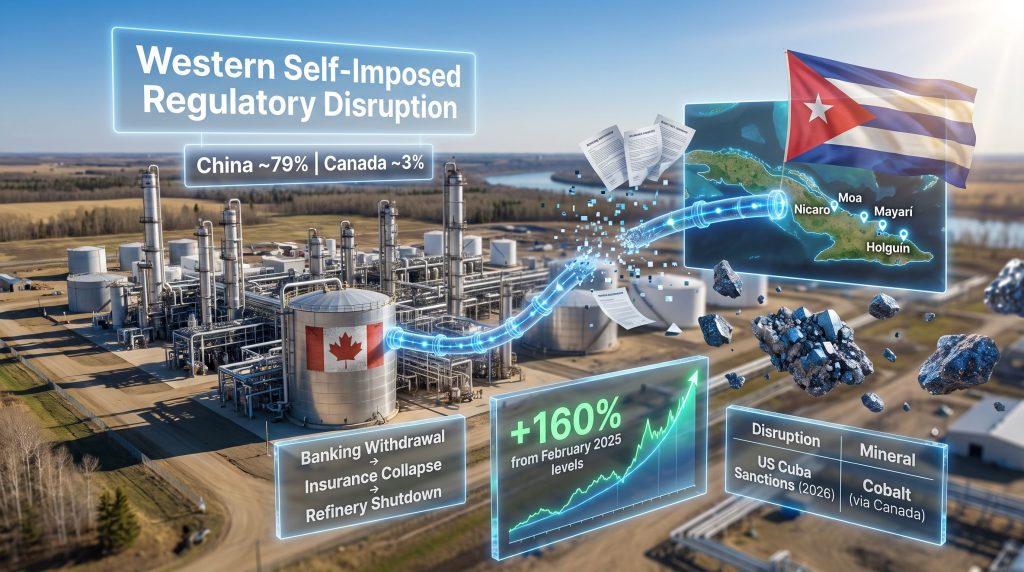
That scenario arrived in mid-2026. The shutdown of Sherritt International's cobalt refinery in Fort Saskatchewan, Alberta, did not happen because of a Chinese export ban, a DRC quota, or an Indonesian resource nationalism decree. It happened because US sanctions targeting Cuba's metals and mining sectors made it legally and financially impossible to move feedstock from eastern Cuba to central Alberta. The refinery was not sanctioned. It was rendered inoperable by the collapse of the banking, insurance, and trade finance infrastructure that kept its supply chain functioning.
The Cuba cobalt sanctions supply chain episode represents something genuinely new in critical mineral risk analysis: a Western government's own regulatory tools functioning as the proximate cause of an allied nation's processing shutdown.
When big ASX news breaks, our subscribers know first
Cuba's Lateritic Geology: A Reserve Base That Defies Its Public Profile
Cuba occupies a peculiar position in global mineral markets. It receives almost no attention from mainstream mining investors, yet it holds one of the world's largest cobalt reserve bases, ranking approximately fourth globally by reserve volume. The country's strategic mineral wealth is concentrated almost entirely in the lateritic nickel-cobalt districts of eastern Cuba, centered on the Moa, Nicaro, Mayarí, and Holguín regions.
What makes the Moa operation particularly significant from a supply chain perspective is not just its geological endowment but its degree of vertical integration. Rather than exporting unrefined ore, Moa processes lateritic material on-site using high-pressure acid leaching (HPAL), producing mixed sulphide precipitate (MSP). This intermediate product is then shipped to Canada for final refining. The HPAL step captures substantially more value per tonne than raw ore exports, positioning Cuba in a more sophisticated tier of the mineral value chain than most similarly endowed developing-nation producers.
Despite this geological and processing advantage, Cuba's actual output has been in prolonged structural decline:
| Metric | Peak Period (Mid-2000s) | 2023 Levels | Approximate Change |
|---|---|---|---|
| Nickel Output | ~70,000+ tonnes | ~43,000 tonnes | ~40% decline |
| Cobalt Output | ~6,000 tonnes | ~3,000 tonnes | ~50% decline |
| Global Cobalt Share | Meaningful non-African source | Diminishing | Structural erosion |
This decline reflects chronic underinvestment, ageing processing infrastructure, and severely constrained access to international capital markets, largely a consequence of the pre-existing US sanctions framework. Cuba's secondary mineral assets, including the Castellanos zinc-lead-barite project, remain largely undeveloped, reinforcing nickel and cobalt as the country's defining strategic commodities.
The gap between geological endowment and actual production output is the central paradox of Cuba's mining sector. The reserves are there. The processing capability exists. What has been missing is the legal, financial, and political environment required to scale output.
How OFAC Designations Cascade Into Physical Supply Chain Collapse
Understanding the Fort Saskatchewan shutdown requires understanding how modern sanctions operate. OFAC designations do not typically target physical assets directly. They target the transactional infrastructure surrounding those assets. In May 2026, a US executive order broadened sanctions affecting Cuba's metals and mining sectors. On June 23, 2026, OFAC designated five Cuban state entities, including Geominera and a financial arm of GAESA, as sanctioned parties. These designations effectively prohibited US persons and any entities with US-dollar exposure from engaging in transactions connected to Cuban mining operations.
The cascade from designation to physical shutdown unfolded in four distinct stages:
Stage 1: Banking Withdrawal
Trade finance institutions with US-dollar clearing exposure began exiting Cuba-linked transactions within days of the designations. Letters of credit for MSP shipments became unissuable through correspondent banking networks that could not risk OFAC liability.
Stage 2: Insurance Collapse
Marine and cargo insurers withdrew coverage for Cuba-origin mineral shipments. Shipping lines facing secondary sanctions exposure suspended Cuba-linked logistics services, making physical movement of MSP practically impossible regardless of the financial arrangements.
Stage 3: Commercial Relationship Severance
Auditing and compliance firms advised corporate clients to suspend Cuba-connected operations pending legal review. Most significantly, Panasonic, a major battery supplier to Tesla, halted its partnership with a Canadian supplier after determining it could not verify whether Cuban cobalt had entered its supply chain. For a battery manufacturer with US market exposure, the inability to provide traceability documentation created an unacceptable compliance risk. Reuters reported that this kind of supplier suspension reflects a broader pattern of compliance caution in cobalt-linked battery supply chains.
Stage 4: Refinery Shutdown
With feedstock inventory exhausted and no legally viable pathway to replenish MSP stocks, the Fort Saskatchewan refinery entered a formal shutdown state by mid-June 2026. The Globe and Mail noted that Sherritt flagged a going concern risk as a direct consequence of the Trump-era sanctions framework tightening around Cuban operations.
The Fort Saskatchewan refinery was not sanctioned, not targeted, and not accused of wrongdoing. It became collateral damage when the legal and financial infrastructure connecting Cuba's processing output to Canadian refining capacity ceased to function within weeks of the OFAC designations.
North America's Cobalt Refining Concentration: A Problem Predating the Shutdown
The Fort Saskatchewan closure did not create North America's cobalt refining vulnerability. It revealed one that had been present for years.
| Region | Share of Global Refined Cobalt (2025) |
|---|---|
| China | ~79% |
| Canada | ~3% |
| Rest of World | ~18% |
China's approximate 79% share of global refined cobalt output gives it structural leverage over battery-grade material that no amount of mine-level diversification can fully offset. Western nations — the US, Canada, and Australia combined — contribute only a marginal share of global cobalt mine supply. North America's refining capacity was already thin before the Fort Saskatchewan closure. Removing the only domestic Canadian cobalt refinery from operational status, even temporarily, reduced that thin capacity to essentially zero.
The supply chain vulnerability operates at two distinct tiers:
-
Tier 1 (Mining): Global cobalt production is overwhelmingly concentrated in the DRC (~70%) and Indonesia, with both nations having demonstrated willingness to use export management tools, including DRC cobalt export bans and Indonesia's nickel restrictions on unprocessed ore.
-
Tier 2 (Refining): China's ~79% refining share creates a structural bottleneck that persists even when mine supply is available. Western refining capacity is not merely small — it is feedstock-dependent on politically complex source jurisdictions, with Cuba having represented one of the few non-DRC, non-Indonesian intermediate product sources accessible to a Western refiner.
Removing Cuba from the accessible feedstock pool narrows Western refiners' options in ways that go beyond simple volume arithmetic.
The Infrastructure Fallacy: Why Refineries Alone Cannot Secure Supply Chains
Governments across North America and Europe have committed substantial capital to building domestic critical mineral processing capacity on the premise that processing infrastructure is the key vulnerability. Build the refinery, diversify the supply chain. The Fort Saskatchewan case dismantles this logic at its foundation.
A functioning refinery requires three simultaneous conditions:
- Geological availability of ore or intermediate product in sufficient volume
- Logistical accessibility allowing physical movement of that material
- Legal and financial viability making transactions bankable, insurable, and compliant
The Cuba-Canada pipeline satisfied conditions 1 and 2 fully. It was rendered non-functional by condition 3 alone. No amount of refinery construction addresses this failure mode. Policy frameworks that have invested billions in processing capacity have systematically underweighted feedstock traceability and legal compliance risk as independent variables in supply chain security.
Mining industry analyst Patricio Faúndez of GEM Mining Consulting identified the broader structural implication in a July 2026 research note: critical minerals supply chains require supply chains that are simultaneously traceable, financeable, and legally viable — and that supply disruption risk can originate from within Western regulatory architecture, not solely from geopolitical rivals.
This is a categorically different type of supply chain risk from resource nationalism or state-directed export controls. It does not require a hostile actor. It requires only a regulatory decision made without adequate modelling of downstream supply chain consequences.
Market Dynamics: Cobalt and Nickel Pricing in a Constrained Supply Environment
Cobalt prices had already risen approximately 160% from February 2025 levels before the Cuba sanctions escalation added further pressure to an already tightening market. The effective removal of Cuban cobalt from Western-accessible supply channels, combined with the ongoing DRC export management framework and Indonesia's nickel restrictions, has created a layered supply constraint that analysts are increasingly treating as structural rather than cyclical.
On the nickel side, BMO Capital Markets analyst George Heppel has argued that recent price weakness has materially overshot fundamentals, with values falling further down the global cost curve than underlying supply-demand dynamics justify. A structural recovery toward US$18,000 to US$20,000 per tonne is anticipated over the medium term, driven by supply constraints and Indonesia's growing incentive to support sustainable price levels. Rising nickel prices would directly increase the economic cost of leaving Cuba's laterite resources stranded and inaccessible to Western supply chains.
| Disruption Source | Mechanism | Affected Mineral | Western Response |
|---|---|---|---|
| China export controls | State-directed restriction | Gallium, germanium, graphite | Diversification push |
| Indonesia nickel export ban | Resource nationalism | Nickel ore | Downstream investment |
| DRC cobalt quotas | Export management | Cobalt | Stockpiling, substitution |
| US Cuba sanctions (2026) | Western regulatory action | Cobalt via Canada | Policy gap, no clear response |
The absence of a clear Western policy response to the Cuba sanctions disruption is itself informative. The institutional and analytical frameworks built to respond to external supply chain threats have no ready-made protocol for disruptions generated by allied-government regulatory action.
The next major ASX story will hit our subscribers first
Downstream Consequences: Battery Manufacturing and Aerospace Procurement
Battery Supply Chain Compliance Paralysis
Cobalt remains a critical input for NMC (nickel manganese cobalt) battery chemistries used in electric vehicles and grid-scale energy storage. LFP (lithium iron phosphate) batteries do not require cobalt, but NMC chemistries — which dominate high-energy-density applications where weight and volume constraints are primary design parameters — cannot easily substitute away from cobalt at current technology maturity levels.
The Panasonic decision to pause its Canadian supplier partnership illustrates a dynamic that extends far beyond one company. Once Cuban cobalt provenance could not be verified through standard traceability documentation, the compliance risk for any battery manufacturer with US-dollar exposure became unmanageable. Traceability requirements, originally designed to address conflict mineral concerns from the DRC, are now functioning as de facto supply chain gatekeepers in a sanctions context for which the frameworks were never designed.
Aerospace Superalloy Constraints
Cobalt's role in aerospace is structurally different from its battery application. As a primary constituent of nickel-based superalloys used in jet engines and industrial gas turbines, cobalt in aerospace applications has no viable near-term substitution pathway. The performance characteristics of these alloys, particularly at extreme operating temperatures, depend on cobalt's specific thermophysical properties in ways that cannot be replicated by currently available alternative formulations. Tighter cobalt availability disproportionately pressures aerospace procurement pipelines, where long-term supply contracts are standard practice and spot market exposure is typically minimised.
Rebuilding Resilience: What Genuine Supply Chain Security Requires
The Fort Saskatchewan episode defines a new policy benchmark. Furthermore, any critical mineral strategy that does not account for the legal and financial viability of feedstock supply chains alongside physical processing capacity is incomplete. This is particularly relevant in the context of critical minerals energy security, where the Cuba cobalt sanctions supply chain disruption has exposed gaps that extend well beyond simple processing investment. Practically, this translates into several specific requirements:
-
Sanctions impact assessments for critical minerals: New regulatory tools are needed to evaluate how sanctions decisions affect allied-nation supply chain infrastructure before implementation, not after.
-
Feedstock diversification mandates: Government-supported offtake frameworks must ensure refineries have access to multiple, legally verified supply sources rather than single-origin feedstock pipelines.
-
Traceability infrastructure investment: Blockchain-based and third-party verified mineral provenance systems reduce compliance risk for downstream manufacturers and make supply chains more resilient to regulatory shock.
-
Strategic MSP stockpiling programs: Reserves of cobalt intermediate products could buffer against sudden supply disruptions caused by regulatory change, without requiring permanent feedstock diversification to be achieved before resilience exists.
-
Multilateral cobalt supply agreements: Collective feedstock security arrangements among allied nations reduce the exposure of individual refineries to politically-induced supply disruption.
A longer-term structural concern deserves direct acknowledgement. Cuba's cobalt output is currently flowing primarily through European, Canadian, and Chinese intermediaries operating outside US-dollar clearing systems. Secondary sanctions risk threatens even these alternative channels over time. The longer Cuba's mineral output remains inaccessible to Western supply chains under conventional commercial terms, the more deeply it integrates into non-Western trade networks. That structural shift, once consolidated, may prove considerably more difficult to reverse than the regulatory decision that triggered it.
Mineral security does not depend only on having plants, technology or political allies. It requires supply chains that are traceable, financeable and legally viable. Restrictions on supply can emerge from within the Western regulatory architecture itself, not only from geopolitical rivals. (Patricio Faúndez, GEM Mining Consulting, July 2026, as reported by Canadian Mining Journal)
The Cuba cobalt sanctions supply chain disruption is not primarily a story about one refinery or one Caribbean island. It is, however, a stress test of Western critical mineral strategy that exposed a category of risk that policy frameworks were not built to manage. Whether governments adapt their regulatory and supply chain tools to address this gap — or continue treating processing capacity as a sufficient proxy for supply chain security — will determine whether the Fort Saskatchewan shutdown is remembered as a wake-up call or a preview.
This article contains forward-looking statements and references to analyst price forecasts, including BMO Capital Markets' nickel price outlook. These projections are not guarantees of future performance. Readers should conduct independent research before making investment decisions based on commodity price assumptions or supply chain risk assessments.
Want to Stay Ahead of the Next Major Mineral Discovery Driven by Supply Chain Shifts?
As critical mineral supply chains face growing regulatory and geopolitical pressures, Discovery Alert's proprietary Discovery IQ model scans ASX announcements in real time, instantly identifying significant cobalt, nickel, and broader mineral discoveries so subscribers can act on actionable opportunities before the broader market reacts — explore historic discoveries and their returns or start your 14-day free trial today.