July 16, 2026
The Invisible Architecture Behind China's Central Asian Resource Strategy
Few bilateral relationships in the global resource economy have evolved as quietly, or as consequentially, as the one between China and Kazakhstan. While headlines fixate on trade wars, rare earth embargoes, and battery metal shortages, a slower and more structurally significant story has been taking shape across the Central Asian steppe. Over two decades, China has woven itself into the fabric of Kazakhstan's resource economy with a precision that goes well beyond transactional commodity purchasing. The result is a partnership that now touches nearly every mineral category central to the global energy transition, from uranium and copper to rare earths, lithium, and beyond.
Understanding the depth of China Kazakhstan mineral and energy ties requires moving past the headline figures and examining the underlying logic: why Kazakhstan, why now, and what the intensifying relationship signals for global resource geopolitics through the 2030s.
When big ASX news breaks, our subscribers know first
Why Kazakhstan Became the Cornerstone of China's Resource Security Architecture
Kazakhstan's appeal to Chinese strategic planners is not accidental. The country sits at the intersection of geography, geology, and geopolitics in a way that few nations can match. Sharing a 1,782-kilometre land border with China's Xinjiang region, Kazakhstan offers a direct overland conduit for resource flows that bypasses maritime chokepoints entirely. This geographic intimacy has made pipeline and rail infrastructure economically viable in ways that would be impractical for more distant producers.
However, geography alone does not explain the depth of Chinese engagement. Kazakhstan's mineral endowment is genuinely exceptional. The country holds significant reserves across virtually every category that China's industrial economy requires: uranium for its expanding nuclear fleet, copper for power infrastructure and electric vehicles, zinc and nickel for alloy production and battery chemistry, chromite and titanium for aerospace and defence manufacturing, and gold as a monetary reserve asset. Furthermore, few single countries offer such a comprehensive resource profile, and that breadth is central to why Chinese capital has flowed there so consistently.
The bilateral relationship has also been shaped by a strategic shift away from pure trade toward structural interdependence. Chinese state-linked entities have moved from simply purchasing Kazakh commodities to owning equity stakes in extraction operations, co-investing in processing infrastructure, and anchoring logistics corridors that make Kazakhstan's resource exports flow eastward as a matter of physical necessity. Consequently, the metals and mining geopolitics of the entire Central Asian region have been reshaped by this evolving dynamic.
Kazakhstan's Uranium Position and Its Centrality to China's Nuclear Expansion
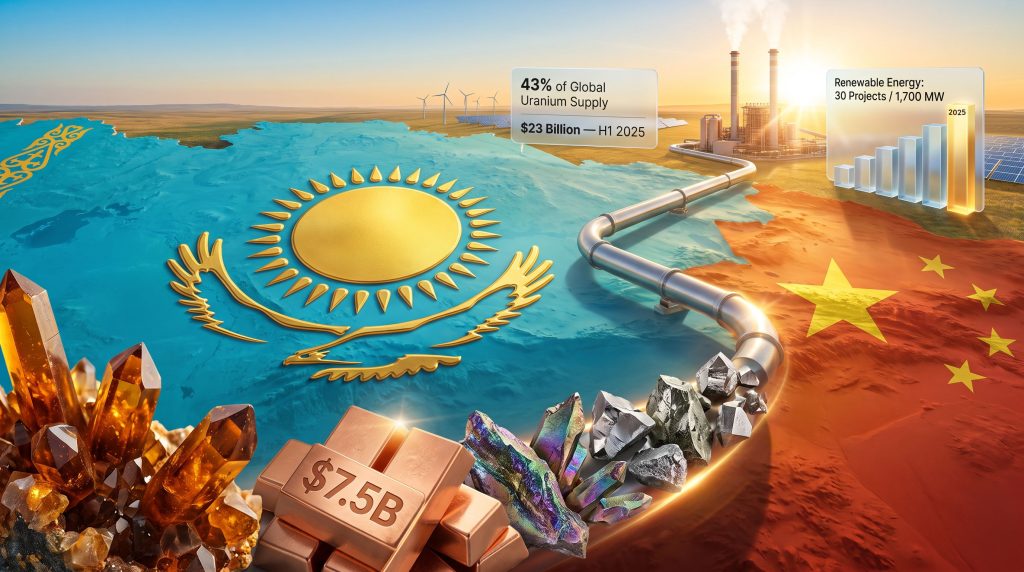
No single commodity better illustrates the depth of China Kazakhstan mineral and energy ties than uranium. Kazakhstan uranium dominance accounts for approximately 43% of global uranium supply as of 2025, making it by a substantial margin the world's single largest producer. To contextualise that figure:
| Uranium Producer | Estimated Global Share (2025) |
|---|---|
| Kazakhstan | ~43% |
| Canada | ~15% |
| Namibia | ~11% |
| Australia | ~8% |
| Uzbekistan | ~7% |
| Russia | ~5% |
Chinese state-linked capital has been instrumental in developing the Kazakh uranium sector to its current scale. The state nuclear company Kazatomprom, in which Chinese entities hold meaningful stakes through joint venture structures, operates the in-situ recovery (ISR) mining method across the majority of its deposits. ISR is a lower-cost, lower-surface-disturbance extraction approach that injects a leaching solution into the ore body underground and pumps uranium-rich liquid back to surface for processing.
This technique suits Kazakhstan's sandstone-hosted uranium deposits particularly well, enabling the country to produce uranium at cash costs that consistently undercut most global competitors. For China, which is constructing more nuclear reactors than any other nation and targeting a tripling of nuclear capacity by 2035, securing long-term access to Kazakhstani uranium is not a peripheral concern. It is foundational to the country's energy security calculus.
Copper, Zinc, and Nickel: The $23 Billion Industrial Metals Commitment
Beyond uranium, the scale of Chinese investment in Kazakhstan's broader metals and mining sector reached a striking threshold in the first half of 2025. Chinese entities committed approximately $23 billion to Kazakhstan's metals and mining industry during that period alone, with copper receiving the largest individual allocation of approximately $7.5 billion.
This investment wave is not purely extractive in its orientation. A landmark agreement signed in June 2024 targets the construction of one of Central Asia's most technologically advanced copper smelting facilities, with a projected completion date of 2028. The significance of this facility extends beyond its production capacity. It represents a deliberate shift in the bilateral economic model, moving Kazakhstan from a supplier of copper concentrate toward a producer of refined copper metal and potentially value-added copper products.
Copper smelting is an energy-intensive process, and Kazakhstan's significant natural gas resources give it a competitive cost structure for operating such facilities. China's involvement in financing and technology transfer for the smelter signals a longer-term industrial integration strategy rather than a purely extractive relationship.
The construction of a major copper smelting facility within Kazakhstan by 2028 marks a structural turning point: Chinese capital is no longer simply extracting raw materials but actively building the processing infrastructure that keeps more value within the host country's borders, while simultaneously deepening supply chain integration.
Rare Earths and Kazakhstan's Emerging Position in Critical Mineral Rankings
How Significant Is Kazakhstan's Rare Earth Potential?
Perhaps the least-discussed but most strategically significant dimension of Kazakhstan's mineral profile is its rare earth potential. Recent geological surveys have identified a major rare earth deposit that could position Kazakhstan among the top three globally for rare earth reserves, a ranking currently dominated by China, Brazil, and Vietnam. The Kazakhstan rare earth discovery has consequently attracted significant international attention from resource analysts and policymakers alike.
If confirmed through detailed resource estimation work, this would represent a profound shift in global rare earth supply geography. China currently processes approximately 85-90% of the world's rare earth elements even where the ore originates elsewhere, giving it extraordinary leverage over the permanent magnet supply chains used in electric vehicle motors, wind turbines, and defence systems. A large Kazakh rare earth deposit with Chinese processing involvement would extend rather than diversify that dominance, particularly given the sophistication of China's rare earth strategy across global supply chains.
Kazakhstan's broader strategic mineral portfolio also includes:
- Tungsten: A critical metal used in cutting tools, electronics, and defence applications, where China holds dominant production share globally
- Chromite: Essential for stainless steel production; Kazakhstan is already among the world's top chromite producers
- Titanium: Used in aerospace, medical devices, and high-performance alloys
- Lithium: Emerging potential as battery-grade lithium demand accelerates through the 2030s
- Gold: A meaningful reserve asset with significant existing production
Energy Infrastructure: Two Decades of Capital Lock-In
The oil and gas dimension of China Kazakhstan mineral and energy ties predates the current critical minerals focus by nearly two decades. Chinese state energy companies, including CNPC, SINOPEC, and CNOOC, collectively hold an estimated 25% to 40% of Kazakhstan's oil and gas sector, a penetration level that reflects sustained capital deployment since the early 2000s. The depth of this energy cooperation has been documented across multiple high-level bilateral engagements.
The Kazakhstan-China Oil Pipeline, operational since 2005, and the China-Central Asia Gas Pipeline are the physical anchors of this energy relationship. These assets represent sunk infrastructure costs measured in billions of dollars that create powerful economic incentives for continued cooperation regardless of short-term political fluctuations.
| Infrastructure Asset | Operational Since | Strategic Function |
|---|---|---|
| Kazakhstan-China Oil Pipeline | 2005 | Crude oil export to Chinese refineries |
| China-Central Asia Gas Pipeline | 2009 | Natural gas transit from Turkmenistan through Kazakhstan |
| Renewable energy projects (30 active) | Multiple, accelerating post-2020 | Low-carbon electricity generation |
| Copper smelter (planned) | 2028 (target) | Downstream metal processing |
The renewable energy dimension has expanded substantially in recent years. As of 2025, 30 renewable energy projects with Chinese participation are active across Kazakhstan, representing a combined installed capacity of 1,700 MW. These projects span photovoltaic solar and wind power, reflecting China's effort to export its renewable energy manufacturing expertise alongside its capital.
The next major ASX story will hit our subscribers first
The Belt and Road's Role in Binding Resource Flows
Kazakhstan occupies a uniquely central position within the Belt and Road Initiative's continental infrastructure ambitions. As the largest landlocked country in the world, Kazakhstan is geographically unavoidable for any overland trade corridor connecting East Asia to Europe. Furthermore, BRI investment in railway upgrades, dry port facilities, and logistics corridors has simultaneously served Chinese resource security objectives and Kazakhstan's own ambition to become a transcontinental trade hub.
The Trans-Caspian International Transport Route, sometimes called the Middle Corridor, has gained strategic importance as an alternative to Russia-transiting routes following the geopolitical disruptions of 2022. Kazakhstan's infrastructure investments under BRI frameworks have positioned it to capture growing volumes of both westbound manufactured goods and eastbound commodity flows.
BRI infrastructure does not merely facilitate trade. In the Kazakhstan context, it creates physical dependencies that make eastward resource flows the path of least resistance, structurally reinforcing the bilateral commodity relationship regardless of diplomatic cycles.
Trade Doubling Targets and the July 2025 WAIC Commitment
High-level diplomatic engagements in 2024 and 2025 produced explicit commitments to double bilateral trade, with a stated focus on critical minerals, new energy technologies, and the digital economy. The most recent such engagement occurred on the sidelines of the World Artificial Intelligence Conference (WAIC) in Shanghai in July 2026, where both presidents called for accelerating the implementation of key projects.
| Category | 2020 Baseline | 2025 Estimate | Forward Trajectory |
|---|---|---|---|
| Energy exports (oil and gas) | Dominant share | Significant but declining as a percentage | Diversifying |
| Critical mineral exports | Emerging | Rapidly expanding | Primary growth driver |
| Renewable energy cooperation | Minimal | 30 projects / 1,700 MW | Rapid expansion |
| Downstream processing | Limited | Growing via new agreements | Strategic priority |
| Digital economy and AI | Nascent | Emerging | Elevated priority post-WAIC |
The inclusion of the digital economy and artificial intelligence within the bilateral cooperation framework is a notable development. It signals that the partnership is no longer purely resource-focused but is expanding into data infrastructure, smart manufacturing, and technology transfer — areas with significant long-term economic multiplier effects for Kazakhstan.
Structural Risks and Kazakhstan's Multi-Vector Balancing Act
What Are the Key Risks for Investors and Policymakers?
The depth of Chinese capital penetration across Kazakhstan's most strategically sensitive sectors raises legitimate questions about sovereign autonomy. Analysts have noted concerns about the pace at which technology transfer occurs relative to capital inflows, and about the degree of Kazakh participation in operational decision-making within joint venture structures. These are not uniquely Kazakh concerns, as they echo debates about Chinese resource investment across Africa and Southeast Asia.
In addition, they carry particular weight given the concentration of Chinese stakes in uranium and hydrocarbon assets. The intensifying critical minerals demand globally has only amplified the strategic sensitivity of these holdings.
Kazakhstan has responded by maintaining what its foreign policy establishment describes as a multi-vector diplomatic orientation. The country is simultaneously engaged with Western-led frameworks including the C5+1 Critical Minerals Dialogue and a Strategic Energy Dialogue with the United States. These engagements provide Kazakhstan with diplomatic optionality and, importantly, give Western governments a continued stake in Kazakhstan's resource sovereignty.
Three risk scenarios deserve particular attention from investors and policymakers tracking this relationship:
- Sanctions spillover risk: Escalating restrictions on China's access to certain dual-use mineral categories could pressure Kazakhstan to limit Chinese participation in rare earth and advanced material extraction, creating project-level uncertainty for joint ventures
- Commodity price volatility: A sustained decline in copper or uranium prices could slow Chinese investment timelines and delay the 2028 copper smelter, given that economic returns on downstream processing facilities are highly sensitive to commodity price cycles
- Domestic political pressure: Growing public concern within Kazakhstan about foreign ownership of strategic assets has already produced regulatory reviews of Chinese-held hydrocarbon stakes, a dynamic that could intensify as the rare earth sector develops
How Kazakhstan Compares Across China's Central Asian Resource Network
While Kazakhstan represents the most significant node in China's Central Asian resource network, it is not the only one. Understanding relative priorities helps contextualise the scale of Chinese engagement. For instance, a detailed analysis of China-Kazakhstan energy relations from the oil and gas sector reveals how deeply this relationship has evolved over successive decades.
| Country | Primary Resource Focus | Chinese Investment Scale | Strategic Priority |
|---|---|---|---|
| Kazakhstan | Uranium, copper, oil, rare earths | $23B+ (H1 2025, metals/mining) | Highest |
| Turkmenistan | Natural gas | Multi-billion pipeline infrastructure | High |
| Uzbekistan | Gold, uranium, gas | Growing rapidly post-2022 | Medium-High |
| Kyrgyzstan | Gold, hydropower | Moderate, BRI-linked | Medium |
| Tajikistan | Aluminum, hydropower | Limited but expanding | Lower |
Kazakhstan's position at the top of this hierarchy reflects both the breadth of its mineral endowment and the depth of existing infrastructure integration. No other Central Asian country comes close to matching the combination of uranium dominance, copper potential, hydrocarbon production scale, and rare earth upside that Kazakhstan offers.
The Long-Term Strategic Outlook
The trajectory of China Kazakhstan mineral and energy ties points toward deepening integration across multiple dimensions simultaneously. Uranium cooperation will remain a stable and expanding pillar as China's nuclear build-out accelerates. Copper investment is entering an active infrastructure phase, with the 2028 smelter representing a tangible milestone. Rare earth development, if geological surveys confirm deposit quality and scale, could fundamentally reshape the bilateral relationship's strategic weight within the broader global critical minerals landscape.
Kazakhstan, for its part, is navigating this partnership with increasing sophistication. Its engagement with Western frameworks is not merely rhetorical. It reflects a genuine effort to create competitive tension among external partners that preserves sovereign leverage over the country's most valuable assets.
The evolution of this bilateral relationship from a hydrocarbon-focused partnership toward a multi-sector critical minerals and clean energy alliance mirrors the broader structural shift in global resource geopolitics. As demand for battery metals, rare earths, and uranium intensifies through the 2030s, the strategic stakes embedded in this relationship will only grow larger for both parties.
Key Dimensions of the Partnership at a Glance
| Dimension | Current Status | Forward Trajectory |
|---|---|---|
| Uranium cooperation | Kazakhstan = 43% of global supply | Stable and expanding |
| Copper investment | $7.5B committed H1 2025 | Accelerating toward 2028 smelter |
| Total mining investment | $23B in H1 2025 | Sustained high-volume |
| Renewable energy | 30 projects / 1,700 MW | Rapid expansion |
| Oil and gas Chinese ownership | 25-40% of sector | Downstream integration deepening |
| Rare earth potential | Major deposit identified; top-3 ranking possible | Under active development |
| Trade doubling target | Pledged at multiple 2024-2025 summits | Priority diplomatic objective |
| Western engagement | C5+1 and U.S. Strategic Energy Dialogue active | Multi-vector balancing ongoing |
Disclaimer: This article contains forward-looking statements and market projections that involve inherent uncertainty. Investment figures, reserve estimates, and capacity targets referenced herein are sourced from publicly available reporting and should not be construed as financial advice. Geological surveys suggesting top-three rare earth reserve rankings remain subject to formal resource estimation processes and independent verification. Readers should conduct independent due diligence before drawing investment conclusions from information contained in this article.
Want to Track the Next Major Critical Mineral Discovery Before the Market Does?
As China's resource strategy reshapes global supply chains for uranium, copper, and rare earths, Discovery Alert's proprietary Discovery IQ model delivers real-time ASX mineral discovery alerts, turning complex commodity data into actionable investment insights — explore historic discoveries and their returns to understand what early positioning can mean, then begin your 14-day free trial at Discovery Alert to stay ahead of the next significant find.