July 16, 2026
The Architecture of Vulnerability: Understanding the Strait of Hormuz as a Global Energy Chokepoint
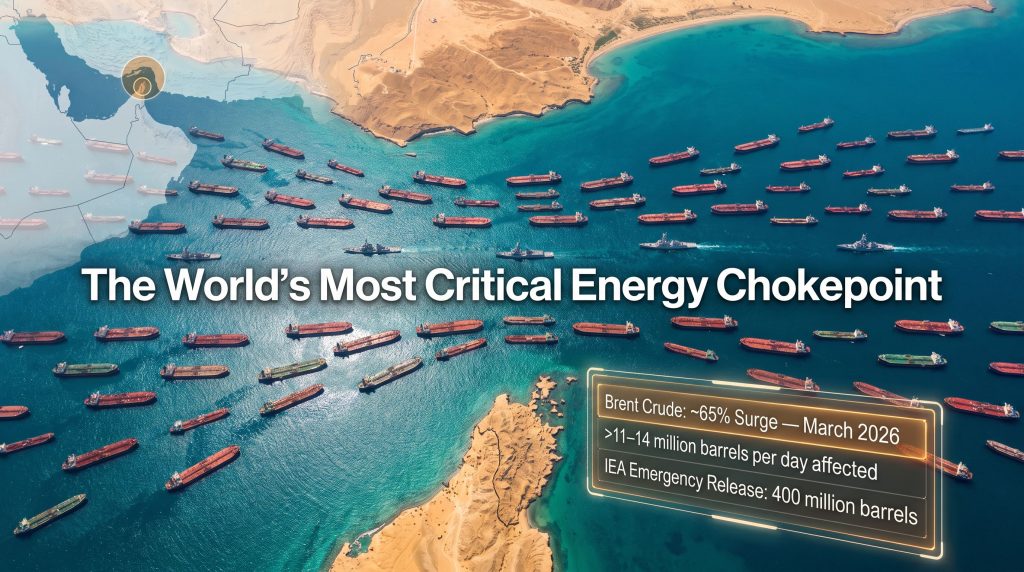
Energy security debates typically focus on reserves, production capacity, and technological transition timelines. Yet the most acute vulnerabilities in the global oil system are not geological or technological in nature — they are geographical. A single waterway, measuring roughly 33 kilometres at its narrowest navigable point, has long represented the most concentrated point of systemic risk in the entire global energy supply chain. The Strait of Hormuz oil disruption of 2026 transformed that theoretical vulnerability into lived economic reality on a scale that exceeded every previous disruption in recorded market history.
Understanding what happened — and why the consequences reverberated so far beyond the Gulf region — requires examining not just the disruption itself, but the structural architecture that made the global oil system so exposed to a single point of failure.
When big ASX news breaks, our subscribers know first
Why the Strait of Hormuz Has No Substitute
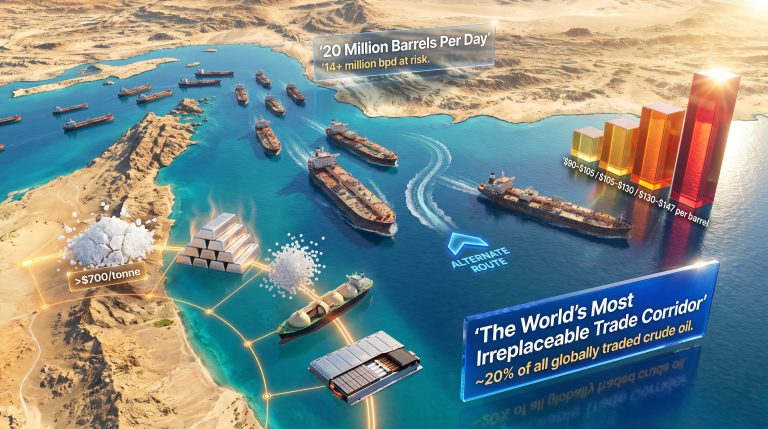
Under normal operating conditions, approximately 20 million barrels per day (mbd) of crude oil and refined petroleum products pass through the Strait of Hormuz. That figure represents roughly one-fifth of total global oil consumption, split between an estimated 15 mbd of crude oil and 5 mbd of refined products. No other maritime chokepoint on earth carries a comparable share of globally traded hydrocarbons.
The geographic reality of the strait compounds its strategic importance. Connecting the Persian Gulf to the Gulf of Oman, it serves as the only viable maritime exit point for the majority of crude oil exported by Saudi Arabia, the UAE, Kuwait, Iraq, Qatar, and Iran. While alternative pipeline infrastructure exists — including Saudi Arabia's East-West Pipeline and the UAE's Abu Dhabi Crude Oil Pipeline — these were designed as supplementary infrastructure, not full substitutes for maritime transit.
Their combined throughput capacity covers only a fraction of normal Hormuz volumes, leaving the global system structurally dependent on this single narrow corridor. Furthermore, this concentration risk has no parallel in global commodity trade. Even the most significant alternative maritime routes — the Suez Canal, the Malacca Strait — do not carry an equivalent share of a single commodity's global supply in the way Hormuz does for petroleum.
Historical Disruptions: What Previous Crises Teach Us
The 2026 Strait of Hormuz oil disruption did not emerge from a vacuum. Energy markets have absorbed major supply shocks before, and each episode offers a reference point for measuring the severity of what unfolded in 2026. Notably, understanding crude oil price trends through past crises helps contextualise the scale of what followed.
| Disruption Event | Estimated Supply Loss | Duration | Price Impact |
|---|---|---|---|
| 1973 Arab Oil Embargo | ~4–5 mbd | ~5 months | Prices quadrupled |
| Iran-Iraq War (1980–88) | ~4 mbd at peak | Multi-year | Moderate, gradual |
| Gulf War (1990–91) | ~4–5 mbd | ~6 months | Sharp spike, rapid recovery |
| 2026 Hormuz Closure | >11–14 mbd | Ongoing (as of mid-2026) | Brent surged ~65% in March 2026 |
The 1973 Arab Oil Embargo, historically regarded as the defining energy security crisis of the twentieth century, removed approximately 4 to 5 mbd from global supply for roughly five months. The 2026 disruption exceeded that volume by a factor of two to three and showed no comparable trajectory toward resolution in its early stages.
Scale Perspective: By the end of May 2026, more than 1.1 billion barrels of crude — equivalent to approximately 10 days of typical global consumption — had failed to reach the market. According to IMF analysis reported by ET EnergyWorld, this cumulative shortfall exceeded the combined supply losses recorded during the 1973 oil shock, the Iran-Iraq War, and the Gulf War. (ET EnergyWorld / IMF Blog, July 2026)
The 2026 Crisis: How the Strait Closed and What Followed
The sequence that produced the 2026 Strait of Hormuz oil disruption began on February 28, 2026, when military strikes against Iranian targets triggered an immediate Iranian retaliatory response. Iranian forces deployed drones, missiles, and naval assets to enforce a de facto blockade across the strait. Within weeks, commercial vessel transits collapsed by more than 90%.
A small number of vessels continued to transit the waterway under an irregular arrangement involving passage fees paid to Iranian Revolutionary Guard Corps forces — a legally contested and operationally unpredictable mechanism that offered little meaningful relief to global supply chains. For a detailed examination of how oil trade geopolitics shaped these events, the broader regional context is essential.
The scale of the resulting supply shock is best understood through quantitative terms:
| Metric | Recorded Impact |
|---|---|
| Reduction in global oil flows | ~11 million barrels per day |
| Gulf oil export decline | ~60% |
| IEA-estimated affected output | >14 million barrels per day |
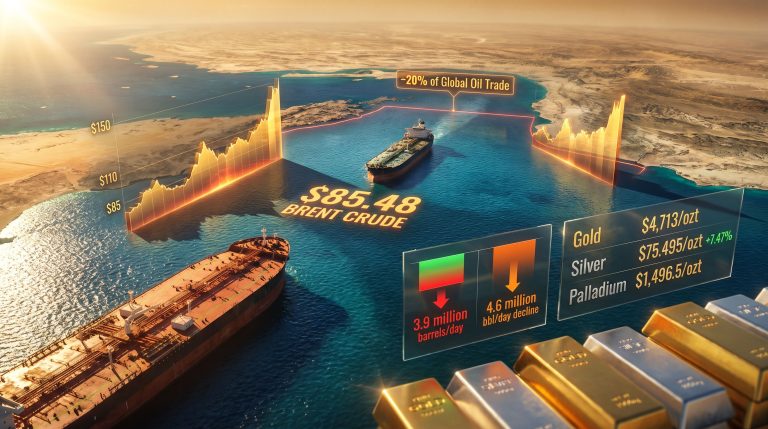
| Brent crude price surge (March 2026) | ~65% month-on-month |
| Tankers immobilised or stranded | 150+ vessels |
| Global consumption share affected | ~20% |
| Brent crude stabilisation range | $90–$100 per barrel |
The immobilisation of more than 150 tankers outside the waterway created a substantial floating inventory backlog — a latent supply overhang with significant implications for price dynamics once any reopening framework took effect.
Three Mechanisms That Prevented a Complete Price Collapse
Despite the unprecedented scale of the supply disruption, Brent crude prices stabilised in the $90 to $100 per barrel range rather than spiking toward the $150 per barrel threshold that analysts had flagged as a risk scenario. According to IMF analysis as reported by ET EnergyWorld, this relative containment resulted from three distinct absorption mechanisms operating simultaneously.
Demand Compression Across Asian Markets
Higher energy prices triggered measurable demand destruction, particularly across Asian economies that depend most heavily on Gulf crude imports. Industrial and transport sectors accelerated fuel substitution toward coal and renewable energy alternatives where infrastructure permitted. The price elasticity effect reduced aggregate petroleum demand, partially closing the supply-demand gap from the demand side rather than the supply side.
Asian economies bore a disproportionate share of this demand destruction, given both their geographic proximity to Gulf supply sources and their structural dependence on Middle Eastern crude grades. This asymmetric burden distribution added a geopolitical dimension to the economic shock.
Non-Gulf Production Acceleration
Producers outside the Gulf region collectively expanded output by approximately 2 million barrels per day above 2025 baseline levels. The United States, Venezuela, Guyana, and Russia were identified as the primary contributors to this production increase. Critically, the global oil supply had been running approximately 2 mbd above demand in the period immediately preceding the conflict — a pre-existing buffer that absorbed the initial shock before alternative supply chains could respond at scale.
However, spare capacity deployment was largely exhausted within the March-to-May 2026 window, leaving the system with dramatically reduced flexibility for any subsequent disruption. This oil market disruption consequently exposed how fragile the global system's redundancy mechanisms truly were.
Strategic and Commercial Inventory Drawdowns
The third stabilising mechanism involved accelerated drawdowns from both commercial and strategic inventories. Global commercial stockpiles, including substantial Chinese crude reserves, were consumed at an elevated rate. The International Energy Agency authorised the largest coordinated emergency reserve release in its institutional history: 400 million barrels from member-state strategic petroleum reserves.
Despite these measures, IMF analysis identified an estimated market deficit of approximately 4.0 million barrels per day during the March-to-May 2026 period — a deficit rate that depleted the majority of the global oil system's remaining structural flexibility.
IMF Assessment (via ET EnergyWorld, July 2026): The buffers that absorbed the initial shock — spare production capacity, demand flexibility, and inventory depth — were substantially consumed during the disruption period. The global oil system now enters any subsequent event from a materially weaker starting position than it held in early 2026.
Current Status and the Partial Reopening Framework
As of mid-2026, a ceasefire and partial reopening framework between the United States and Iran has provided some relief to global oil markets. A U.S. Navy-protected transit corridor is currently facilitating approximately 5 to 8 million barrels per day of outbound flow — still well below the pre-war baseline of approximately 20 mbd.
Full freedom of navigation has not been restored. Iran retains meaningful practical leverage over the chokepoint, and the shipping and insurance industries continue to exercise significant operational caution before normalising transit volumes. OPEC market influence remains a critical variable in how quickly any normalisation can realistically proceed.
According to the Brookings Institution's analysis of the Strait of Hormuz and global oil markets, IMF analysis indicates that even following a full reopening, it will likely take two to three months for a substantial share of normal oil flows to resume. The lag reflects the time required for stranded tankers to clear, insurance markets to normalise pricing, and supply chains to rebuild operational momentum.
A less-discussed risk factor involves the condition of Gulf oilfield infrastructure during a prolonged closure. When upstream production cannot be exported, onshore and offshore storage facilities progressively fill toward operational capacity limits. Once those limits are reached, producers face the prospect of curtailing or shutting in active wellhead production. Saudi Arabia, the UAE, and Kuwait represent the most immediately exposed parties to this storage ceiling problem.
The next major ASX story will hit our subscribers first
Systemic Risks and Economic Contagion Pathways
The economic consequences of an extended Strait of Hormuz oil disruption extend well beyond pump prices. Elevated energy costs function as a regressive tax on household purchasing power globally, hitting lower-income populations hardest. Businesses facing higher fuel and logistics costs reduce capital expenditure, compress hiring plans, and pass costs to consumers, compounding inflationary pressures.
Aviation, shipping, and road freight sectors face acute margin compression that cascades through global supply chains. Emerging market economies with limited fiscal space and high petroleum import dependency face the most severe adjustment pressures, with reduced capacity to deploy targeted relief measures.
Structural Warning: IMF analysis highlights that operational minimum inventory levels — the floor below which the physical oil distribution system begins to fail mechanically — are now within reach across several major markets. This is not a price risk. It is a physical supply availability risk with no monetary policy solution.
Comparing 1973 and 2026: A Framework Analysis
| Dimension | 1973 Oil Embargo | 2026 Hormuz Closure |
|---|---|---|
| Primary cause | OPEC political embargo | Military conflict / chokepoint blockade |
| Supply loss (peak) | ~4–5 mbd | >11–14 mbd |
| Duration (to date) | ~5 months | Ongoing |
| Emergency reserve response | Limited / nascent IEA | 400 million barrels (IEA record) |
| Price impact | ~4x increase | ~65% surge (March 2026) |
| Demand response | Rationing, conservation | Fuel substitution, efficiency acceleration |
| Geographic concentration | Arab producers only | All Gulf exporters simultaneously |
The 1973 embargo, while historically transformative in reshaping global energy policy, affected a smaller absolute volume of supply and operated within a less financially integrated global economy. The 2026 disruption is distinguished by its simultaneous impact on all major Gulf exporters, the absence of readily deployable spare capacity, and the near-exhaustion of strategic buffer mechanisms that did not exist in comparable form in 1973.
Policy Lessons: What Institutions Are Recommending
Three structural reform priorities have emerged from institutional analysis of the 2026 disruption.
Inventory Rebuilding as Infrastructure Investment
Emergency reserve drawdowns are finite by definition. Post-disruption inventory rebuilding programmes need to be treated with the same policy priority as physical energy infrastructure investment. Countries that allowed strategic reserves to decline below recommended thresholds entered the 2026 crisis with reduced shock-absorption capacity.
Route Diversification as National Security Policy
Dependence on a single maritime chokepoint for one-fifth of global oil supply represents a systemic concentration risk that no hedging mechanism can fully offset. Policy responses under discussion include accelerated pipeline diversification, expanded port infrastructure in alternative corridors, and bilateral energy security frameworks that reduce chokepoint dependency. Alternative routing options under evaluation include expanded capacity through the Red Sea corridor and overland pipeline networks across Turkey and Central Asia.
Targeted Consumer Support Over Broad Subsidies
Broad-based energy price controls suppress the price signals that incentivise efficiency improvements and demand reduction — the same demand-side response that helped absorb the 2026 shock. IMF guidance emphasises directing fiscal support to the most economically vulnerable households through means-tested mechanisms, preserving both fiscal sustainability and market price signals.
The Long Road to Market Normalisation
Recovery from the 2026 crisis will unfold across multiple timeframes. In the near term, the priority is maximising flow through the partially reopened transit corridor whilst rebuilding commercial and strategic inventories before the next disruption event. Over a medium-term horizon of one to five years, the structural reforms necessary to reduce single-chokepoint exposure require sustained investment in alternative routing infrastructure and bilateral supply agreements.
The longer-term implication is more fundamental. The disruption has materially strengthened the strategic investment case for energy transition in major consuming economies. Reduced petroleum import dependency through electrification and renewable deployment directly reduces exposure to geopolitical chokepoint risk. However, as CNBC's expert analysis on Hormuz closure scenarios highlights, energy transition timelines measured in decades mean that near-term oil market resilience infrastructure remains critically important for the foreseeable future.
The world's oil system proved resilient enough to absorb the shock without catastrophic failure. That resilience, however, came at a cost: the buffers that provided it are now largely depleted, and the system's capacity to absorb the next disruption from the same starting position no longer exists.
This article is based on publicly reported information and IMF analysis as reported by ET EnergyWorld (July 2026). Forward-looking statements, price projections, and scenario analyses involve inherent uncertainty. Readers should not construe this content as financial or investment advice.
Want to Stay Ahead of the Next Major Market-Moving Discovery?
While geopolitical shocks reshape global energy markets, Discovery Alert's proprietary Discovery IQ model scans ASX announcements in real time, delivering instant notifications on significant mineral discoveries — from energy commodities to critical minerals driving the energy transition — so subscribers can identify actionable opportunities before the broader market reacts. Start your 14-day free trial today and see why informed investors rely on Discovery Alert to stay ahead.