August 26, 2026
When Supply Geography Becomes Price Destiny
Few dynamics in commodity markets are as concentrated, and therefore as fragile, as the global nickel supply chain. While most industrial metals draw from a distributed base of producing nations, nickel has become almost singularly dependent on one jurisdiction. When that jurisdiction adjusts its domestic policy settings, the reverberations travel instantly across the London Metal Exchange, into battery manufacturer procurement desks, and through the portfolios of every fund with base metals exposure. Understanding why the nickel price hits three-week high on Indonesia supply risks requires unpacking not just the headline numbers, but the structural mechanics that make this metal uniquely vulnerable to geographic concentration risk.
When big ASX news breaks, our subscribers know first
The Market Regime Has Fundamentally Changed
From Oversupply to Deficit in a Single Policy Cycle
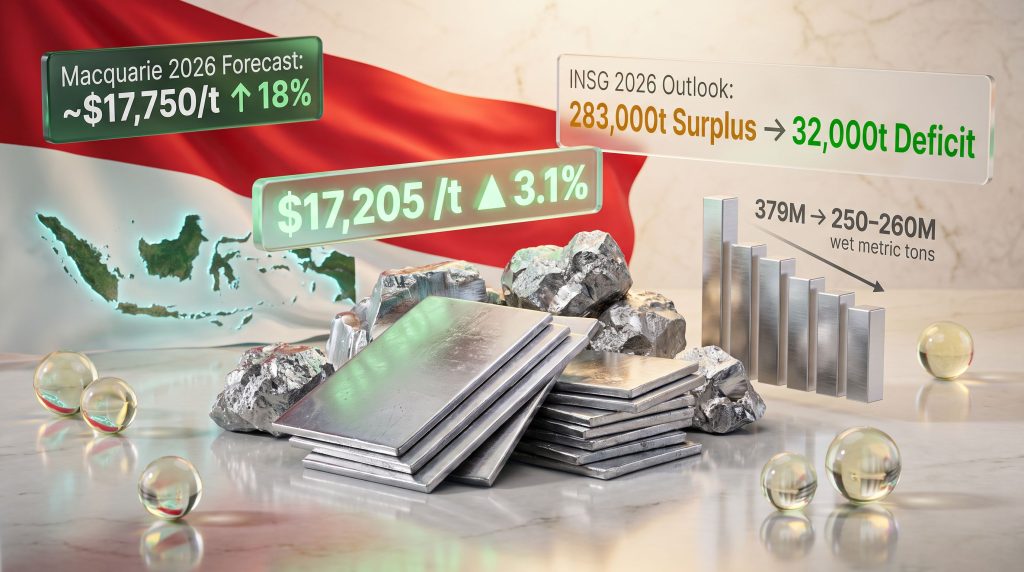
The most significant development in nickel markets during 2026 is not the price level itself but the directional shift in the underlying supply-demand balance. The International Nickel Study Group revised its 2026 market projection from a 283,000-tonne surplus to a 32,000-tonne deficit, a swing exceeding 315,000 tonnes that occurred within months, driven overwhelmingly by supply-side constraints originating in Indonesia. Furthermore, understanding the broader Indonesian nickel market trends helps contextualise just how rapidly this balance sheet inversion has unfolded.
This marks the first projected nickel deficit in five years, fundamentally rewriting the investment thesis for the metal and catching many market participants positioned for continued oversupply completely off-guard.
Macquarie responded to this balance sheet inversion by raising its 2026 nickel price forecast by 18%, to approximately $17,750 per tonne. That revision is significant not merely as a number but as a signal: one of the world's most analytically rigorous commodity banks concluded that the market had entered structurally different territory.
For investors and procurement teams, the distinction matters enormously. Surplus markets reward buyers who defer purchases and penalise producers who invest in expansion. Deficit markets operate in reverse. The speed of this transition from one regime to the other illustrates how quickly commodity market logic can invert when a single dominant supplier adjusts its policy settings.
Three Compounding Supply Shocks Now Priced Into Nickel
Understanding the Quota Reduction Mechanism
Indonesia's nickel mining industry operates under an annual permit system known as RKAB (Rencana Kerja dan Anggaran Biaya) allocations, which govern the legal volume of ore each producer is permitted to extract. In 2026, the Indonesian government reduced the aggregate national quota to 250 to 260 million wet metric tonnes, a contraction of more than 30% compared to 2025 levels when the ceiling stood at approximately 379 million wet metric tonnes. Consequently, the Indonesia nickel industry challenges stemming from these quota decisions are now reverberating through global supply chains.
The scale of individual project impacts has been striking. Weda Bay Nickel, one of Indonesia's largest operations, reportedly saw its allocation fall from 42 million tonnes to approximately 12 million tonnes, a reduction of more than 70% at the project level. When ore feed to smelters declines at that magnitude, downstream processing capacity sits idle regardless of how efficiently it operates.
Miners were scheduled to submit revised quota applications at the start of July 2026, but the government had not established a clear processing timeline as of mid-month. This regulatory ambiguity is itself a market-moving variable. Producers cannot commit to output plans. Buyers cannot secure forward supply. Traders price in uncertainty as a premium.
The Three-Vector Risk Table
| Supply Shock | Core Mechanism | Market Consequence |
|---|---|---|
| Mining Quota Reduction | Aggregate RKAB permits cut to 250–260 million WMT from 379 million in 2025 | Smelter feed shortfall; idle capacity rising |
| Sulfur Supply Vulnerability | ~75% of Indonesian sulfur imports sourced from Gulf-region suppliers exposed to shipping disruptions | HPAL processing curtailment risk independent of quota decisions |
| Export Policy Overhaul | Nickel trade centralised through a state-owned entity | Chinese buyers pausing purchasing; near-term demand uncertainty layered onto supply anxiety |
Satellite Data Confirms the Smelter Slowdown
One of the more technically sophisticated indicators now informing nickel market analysis is satellite-based industrial monitoring. Earth-i, a firm specialising in remote sensing of industrial activity, tracks thermal and visual signatures from smelting operations across Indonesia. Its data reveals that the index of inactive smelter capacity in Indonesia now stands at 17.2%, representing an 8.4 percentage-point increase year-on-year.
This metric functions as a real-time leading indicator, capturing supply tightness before official production statistics are compiled and published, often weeks or months later. For traders and analysts who understand how to read this data, rising idle smelter capacity is not just a lagging confirmation of quota cuts; it is a forward signal about the trajectory of refined nickel supply in coming months.
The HPAL-Sulfur Nexus: A Vulnerability Most Commentators Miss
Why Processing Chemistry Creates a Hidden Chokepoint
The dominant processing technology for Indonesia's laterite nickel ore is High-Pressure Acid Leach, known as HPAL. This method uses sulfuric acid under high temperature and pressure to dissolve nickel and cobalt from laterite ore, producing a mixed hydroxide precipitate (MHP) that feeds directly into battery-grade nickel sulfate production.
The critical and widely underappreciated vulnerability is that sulfuric acid production requires elemental sulfur, and Indonesia imports approximately 75% of its sulfur requirements from Gulf-region suppliers. With Middle East shipping corridors, including the Strait of Hormuz and Red Sea transit routes, facing escalating disruption risk in 2026, this creates a secondary production constraint that operates entirely independently of mining quota decisions.
A producer could hold a valid RKAB permit with full ore access and still be forced to curtail HPAL throughput if sulfur deliveries are delayed or interrupted. This dual-constraint dynamic is one of the most technically sophisticated and least-discussed risk factors currently affecting nickel supply.
Scenario Analysis: What a Sulfur Disruption Could Cost the Market
Scenario A: Partial Disruption (30-day delay)
- Operators draw down existing sulfur stockpiles with minimal immediate output impact
- Markets price in a forward risk premium of approximately $200 to $400 per tonne on spot nickel
Scenario B: Extended Disruption (60 to 90 days)
- HPAL facilities begin reducing throughput as stockpiles are exhausted
- MHP output declines materially, tightening battery-grade nickel availability
- Downstream EV supply chains begin competing for alternative sources
- Price support builds toward the $18,000 to $19,000 per tonne range
Scenario C: Structural Rerouting
- Indonesian processors invest in alternative sulfur sourcing or domestic sulfur recovery infrastructure
- Long-term resilience improves but near-term capital diversion delays capacity expansion
- A multi-year adjustment period with structural price support above historical averages
US Monetary Policy as a Secondary Price Accelerant
How the Fed Rate Narrative Amplified a Fundamental Move
The nickel rally did not occur in isolation. Softer-than-expected US producer price index data released in mid-July 2026 prompted traders to reduce their bets on continued Federal Reserve tightening. This macro shift provided the second leg of the price move.
The mechanism is well established: higher interest rates increase the cost of capital across the manufacturing sector, reducing demand for industrial inputs including base metals. As rate expectations fell, that headwind diminished, and metals rallied broadly. Nickel price momentum led the London Metal Exchange session with an intraday gain of up to 3.1%, while aluminium rose 0.7%, copper edged higher, and lead rebounded 1.1% following pressure from a record warehouse delivery by Trafigura Group.
Current Price Levels and Trading Range
| Metric | Level |
|---|---|
| Three-Week High (July 2026) | ~$17,205 per tonne |
| Six-Month Low (Prior Floor) | ~$16,300 per tonne |
| Macquarie 2026 Price Forecast | ~$17,750 per tonne |
| Analyst Projected Floor Range | $17,000 to $18,000 per tonne |
| Peak Intraday Gain (Single Session) | Up to 3.1% |
A portion of the rally reflects short-covering dynamics rather than purely fundamental repositioning. Traders who had positioned for continued oversupply were forced to unwind as the balance sheet data shifted. Chinese capital inflows into nickel futures markets added a speculative layer, amplifying volatility beyond what supply fundamentals alone would produce. This combination of genuine structural concern and momentum-driven positioning is creating a more complex and volatile price environment than the underlying data might suggest in isolation.
Battery Supply Chains and the NMC Chemistry Dependency
Who Wins and Who Loses in a Deficit Nickel Market
Nickel's relevance to the battery metals complex cannot be overstated. High-energy-density NMC (nickel-manganese-cobalt) lithium-ion cells, the chemistry of choice for most premium electric vehicle platforms, are heavily nickel-dependent. In addition, the broader battery metals investment landscape is being reshaped as the deficit thesis takes hold. Battery manufacturers operating under long-term nickel offtake agreements secured during the oversupply period of 2023 to 2025 are now structurally advantaged. Those relying on spot market purchasing face a meaningfully different cost environment.
This creates a bifurcated landscape across the EV supply chain:
- Producers with locked-in supply contracts: Insulated from near-term spot price volatility; able to offer competitive cell pricing to automaker customers
- Spot market purchasers: Exposed to rising procurement costs that may compress margins or be passed through to end consumers
- Automakers with no nickel hedging strategy: Potentially facing procurement challenges as battery-grade supply tightens
- Investors in nickel sulfate producers: Likely to see improved realised prices if the deficit deepens as projected
Furthermore, the accelerating demand from battery storage expansion programmes globally is compounding the pressure on already-constrained nickel supplies, adding another layer of urgency to procurement strategies across the sector.
The next major ASX story will hit our subscribers first
The Concentration Problem: Why No Other Metal Carries This Risk
Geographic Dependency as a Systemic Vulnerability
Indonesia's share of global nickel output at 60 to 65% is extraordinary by any historical comparison. No other tier-one industrial metal has such a concentrated production geography. The consequence is that Jakarta's regulatory decisions now function as the primary price lever for a commodity critical to both stainless steel manufacturing and the global energy transition.
This concentration emerged rapidly. A decade ago, Indonesia accounted for a far smaller share of global output. The development of HPAL technology and Chinese investment in Indonesian processing infrastructure created an accelerated build-out of processing capacity that outpaced all other producing nations. The efficiency gains were real, but so is the systemic fragility that comes with them.
When a single jurisdiction controls the majority of global output for a strategic industrial metal, domestic policy uncertainty does not remain domestic for long. It becomes a global market event within hours.
Monitoring tools that investors should now treat as primary leading indicators include:
- RKAB quota application outcomes and government processing timelines
- Indonesian smelter utilisation rates via satellite monitoring data
- Gulf-region shipping lane disruption indices as a proxy for sulfur supply risk
- Chinese futures market positioning as a measure of speculative momentum
- INSG quarterly balance sheet revisions as the authoritative deficit/surplus benchmark
Frequently Asked Questions
Why did the nickel price hits three-week high on Indonesia supply risks occur in July 2026?
Nickel climbed on the back of two reinforcing forces: fading expectations for US Federal Reserve rate increases following soft producer price data, and deepening uncertainty around Indonesia's mining quota allocation process. Because Indonesia supplies over 60% of global nickel output, any regulatory ambiguity in Jakarta translates directly into market-moving supply uncertainty.
What is the INSG's revised nickel market outlook for 2026?
The International Nickel Study Group reversed its projection from a 283,000-tonne surplus to a 32,000-tonne deficit, the first projected nickel deficit in five years, attributing the shift primarily to Indonesian supply constraints.
How does sulfur supply affect nickel production?
HPAL processing, the dominant technology for treating Indonesia's laterite nickel ore, requires large volumes of sulfuric acid derived from elemental sulfur. With approximately 75% of Indonesia's sulfur imports originating from Gulf-region suppliers, disruptions to Middle East shipping routes create an independent production risk separate from mining quota decisions.
What does a nickel deficit mean for EV battery supply chains?
Battery manufacturers relying on spot market nickel purchases face rising input costs as supply tightens. However, those with long-term offtake agreements secured during the prior oversupply period are insulated from near-term price volatility and hold a competitive procurement advantage.
What price level are analysts forecasting for nickel through 2026?
Macquarie raised its 2026 nickel price forecast by approximately 18% to around $17,750 per tonne following the Indonesian quota reductions and emerging sulfur supply concerns. Analyst consensus for a price floor ranges between $17,000 and $18,000 per tonne.
What the Rally Actually Signals for the Remainder of 2026
The current nickel price recovery should not be interpreted as a temporary spike reversing toward a prior equilibrium. The structural inputs that drove a five-year surplus period, namely rapid Indonesian capacity expansion under permissive quota frameworks, have inverted. The same jurisdictional concentration that enabled the supply surge now makes the market highly sensitive to any policy tightening or operational disruption within that single geography.
The convergence of quota uncertainty, sulfur supply vulnerability, and export policy disruption is unlikely to resolve within weeks. Each of these three vectors has its own timeline and its own political or logistical complexity. The probability that all three normalise simultaneously is low. Consequently, the supply risk premium now embedded in nickel prices has structural rather than transient characteristics, and investors and procurement teams who treat the current move as temporary do so at meaningful risk to their positioning and cost exposure through the remainder of the year.
Want to Capitalise on the Next Major Commodity Supply Shock Before the Market Moves?
Discovery Alert's proprietary Discovery IQ model delivers real-time alerts on significant ASX mineral discoveries in the nickel, battery metals, and broader resources sector, transforming complex supply and market data into actionable investment insights the moment they hit the exchange. Explore historic discoveries and their exceptional returns on Discovery Alert's dedicated discoveries page, and begin your 14-day free trial today to position yourself ahead of the next major market shift.