July 17, 2026
The Quiet Revolution Reshaping Global Fuel Markets
Most conversations about oil market power centre on crude production: who pumps more, who cuts, and how OPEC's global oil influence ripples through futures markets. But a structurally distinct and arguably more consequential power shift has been unfolding at the refinery gate rather than the wellhead. The chokepoint in today's energy market is not crude oil availability. It is the conversion of crude into the transportation fuels the world actually consumes. And the nation that has positioned itself to dominate that conversion layer at the global scale is India refining swing producer.
Understanding why this matters requires separating two concepts that markets frequently conflate: crude swing production and refined product swing supply. Saudi Arabia manages the former, adjusting upstream output volumes to influence benchmark prices. A refining swing producer operates differently. It controls the transformation of crude into diesel, jet fuel, and gasoline, and it redirects those finished barrels toward wherever supply shortfalls generate the highest margin return. This is a product-level balancing function that crude volume adjustments cannot directly replicate, and it is the role India now increasingly occupies in the global energy system.
When big ASX news breaks, our subscribers know first
Why the World Needed a New Source of Refined Fuel Flexibility
The structural conditions that elevated India's India refining swing producer status did not emerge overnight. They reflect the convergence of several years of simultaneous supply degradation across competing refining centres.
Russia's refining infrastructure has sustained damage from Ukrainian drone strikes, forcing Moscow to progressively restrict its own exports of diesel, gasoline, and jet fuel. At peak functionality, Russia was a primary source of diesel for European and Atlantic Basin markets. That supply link has been materially severed.
Middle Eastern refinery output, meanwhile, has been disrupted by months of conflict-related operational pressure. Several facilities continue to run below normal throughput rates, reducing the region's ability to supply product-hungry African and Asian import markets. European diesel inventories have remained exceptionally tight as a result, with jet fuel availability similarly constrained.
Key Concept: A refining swing producer does not control crude output. It controls the conversion of crude into high-value transportation fuels and redirects those barrels dynamically toward the markets offering the highest marginal return. This is structurally distinct from OPEC-style volume management.
Into this vacuum, a nation with growing processing capacity, diversified crude sourcing, and commercial flexibility to redirect export flows has stepped forward. The ability to absorb disruptions elsewhere and redistribute refined barrels toward acute shortage zones is precisely what defines the swing supplier function at the product level. Furthermore, geopolitical and logistical oil risks have only intensified this dynamic in recent years.
India's Refining Infrastructure: Scale, Utilisation, and the Growth Trajectory
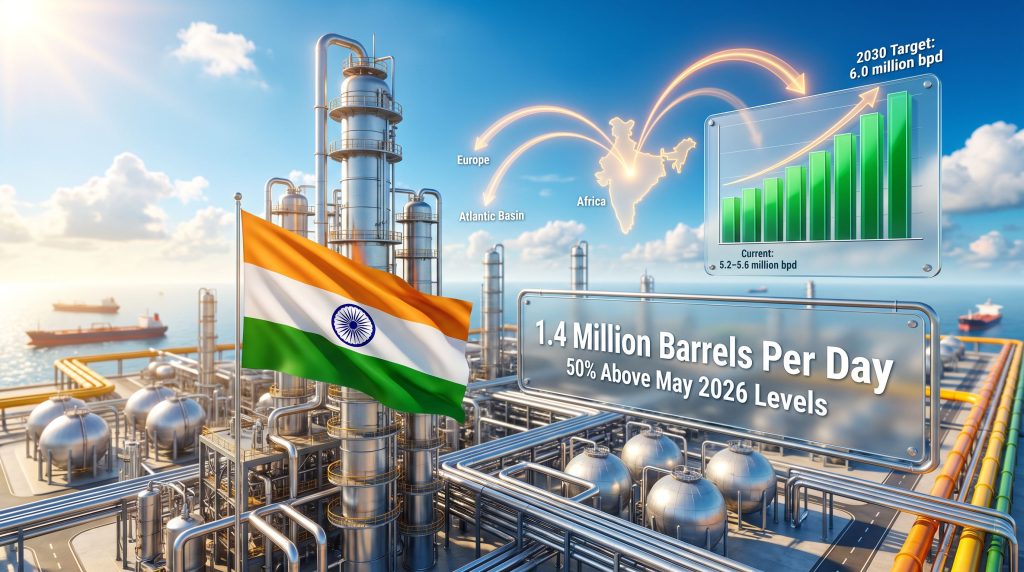
India currently operates between 5.2 and 5.6 million barrels per day of refining capacity, making it the world's fourth-largest refining nation by throughput. What distinguishes the Indian system is not merely its scale but its operating intensity. State-owned refineries have been running at utilisation rates between 108% and 117% through 2024 and 2025, consistently exceeding nameplate capacity through operational optimisation.
The International Energy Agency projects India's refining capacity will grow a further 15% by 2030, supported by investment growth that has averaged 23% annually over the past five years. India's planned capacity addition of approximately 1 million barrels per day over a seven-year horizon represents the largest expansion pipeline outside China. For a broader overview, India's refining industry publications offer detailed technical perspectives on these developments.
| Metric | Current Position | 2030 Target |
|---|---|---|
| Total Refining Capacity | ~5.2–5.6 million bpd | ~6.0 million bpd |
| State Refinery Utilisation Rate | 108–117% (2024–25) | Sustained high-run strategy |
| Refined Product Exports (2023) | ~1.2 million bpd | Targeting further expansion |
| Diesel Exports | ~600,000 bpd | Growing with new capacity |
| Gasoline Exports | ~400,000 bpd | Increasing as margins permit |
| Planned New Capacity Addition | ~1 million bpd (7-year horizon) | Largest outside China |
| Global Refining Rank | 4th largest globally | Targeting 2nd largest by 2035 |
The contrast with peer refining regions is stark. European refinery infrastructure is aging, chronically underinvested, and experiencing structural capacity closures. Chinese refinery runs have fallen toward pandemic-era lows as crude imports collapsed and domestic demand softened, according to recent market data. Middle Eastern capacity faces both a development plateau and ongoing conflict-related operational constraints. The United States remains primarily domestically oriented with limited swing export flexibility.
India's expansion trajectory is therefore not competing with rising peers. It is filling a structural gap left by stagnating or declining capacity elsewhere.
The Crude Sourcing Model: How Import Dependency Became Strategic Advantage
India imports approximately 90% of its crude oil requirements. In conventional energy security analysis, this level of external dependence is categorised as a vulnerability. However, India has reframed it as a procurement model. Indeed, India's energy import structure reflects a broader national strategy of leveraging dependency into commercial flexibility.
Rather than anchoring supply to a single origin, Indian refiners maintain active purchasing relationships across seven or more origin regions simultaneously:
- Russia (currently exceeding 50% of monthly import volumes, per Kpler data from July 2026)
- Iraq (a longstanding primary supplier)
- Saudi Arabia and the UAE (Gulf region anchors)
- United States (light sweet crude grades for blending)
- West Africa (diverse light crude streams)
- Latin America (additional grade diversification)
This multi-origin procurement architecture means that disruption to any single supply corridor does not constrain Indian refinery throughput. When one origin becomes commercially disadvantaged or operationally interrupted, purchasing shifts to another. The system is self-correcting by design.
Russian crude now accounting for more than half of monthly imports reflects opportunistic discount capture rather than strategic dependency. Indian refiners process heavier and higher-sulphur crude grades through sophisticated conversion units, producing light and middle distillates that command premium pricing on export markets. The arbitrage logic is deliberate: acquire the most economically advantageous crude input, maximise conversion yield, and sell finished products wherever global shortages generate the highest return.
Strategic Insight: India's refining model operates on a deliberate arbitrage logic: acquire the most economically advantageous crude regardless of origin, maximise conversion efficiency, and export the resulting products to wherever global shortages generate the highest margin premium.
Anatomy of India's July 2026 Export Surge
The clearest empirical demonstration of India's swing supplier mechanics came in mid-2026. Kpler tracking data shows India on course to export approximately 1.4 million barrels per day of refined products in July 2026, representing a figure roughly 50% above May 2026 export volumes and the highest monthly total recorded since September of the prior year.
The destination composition of those exports is as instructive as the volume itself. Two months prior, over 80% of India's diesel exports were directed toward African markets, with European buyers receiving nothing. This was not a permanent routing preference. It was a direct response to the market signal available at that moment: the Hormuz crisis had scrambled Middle Eastern trade flows, African import markets were scrambling for replacement diesel, and the margin premium for African delivery exceeded what European markets were offering at that time.
When European diesel inventories tightened further under the combined weight of reduced Russian exports and ongoing Middle Eastern supply disruptions, Indian cargo routing shifted. Barrels that had been heading toward African ports began moving westward toward European terminals, following the margin signal with commercial precision. Consequently, oil price movements across both regions responded directly to India's routing decisions.
This dynamic redirectability is the core mechanical feature of swing supplier status. It is not simply about export volume. It is about the capacity to change destination, adjust product mix, and respond to shifting premium geographies within weeks rather than quarters.
Scenario Analysis: India's Swing Role Under Different Stress Conditions
Scenario 1: Hormuz Disruption
When Gulf refinery output is constrained and Hormuz-dependent trade flows are compromised, African import markets face acute diesel shortfalls. India pivots rapidly, redirecting over 80% of diesel export volumes toward African destinations within weeks. European markets are temporarily deprioritised as India captures the highest available margin premium.
Scenario 2: Russian Refinery Degradation
Sustained Ukrainian drone strikes on Russian refining infrastructure reduce Moscow's throughput and restrict its export availability. European diesel inventories fall to critically tight levels. India captures the European margin premium and shifts cargo routing westward, filling the supply gap that Russian export restrictions have created.
Scenario 3: Simultaneous Multi-Region Stress
Both Middle Eastern and Russian supply are constrained at the same time. India operates as the primary global balancing mechanism for diesel and jet fuel simultaneously. This scenario demonstrates the full swing supplier function in operation: volume flexibility combined with destination flexibility, supported by crude source flexibility.
Export Duty Policy and the Domestic Security Balancing Act
New Delhi's recognition of its refining influence has translated into active policy management of the export-domestic supply tension. The government recently moved to nearly double export duties on diesel and jet fuel while simultaneously reducing levies on gasoline exports. The asymmetric adjustment reflects product-specific domestic demand priorities.
The policy logic is straightforward: before refined product barrels leave Indian shores to capture international margin premiums, the government wants to ensure sufficient domestic availability. Diesel and jet fuel are critical inputs for Indian logistics, agriculture, and aviation infrastructure. Allowing those product streams to flow unrestricted toward premium-paying overseas markets during periods of global tightness creates domestic supply risk.
Policy Watch: The export duty adjustment signals that New Delhi is actively managing the dual mandate of global fuel supplier and domestic energy security provider. This tension will intensify as both domestic consumption and international demand for Indian barrels grow simultaneously.
The gasoline duty reduction reflects the inverse domestic calculation. India's gasoline consumption, while growing, faces greater competition from substitutes and is more price-responsive than diesel or jet fuel. Directing more gasoline toward export markets during periods of strong overseas demand is therefore less domestically risky.
This export duty mechanism functions as the primary policy lever through which New Delhi modulates India's swing supplier behaviour, adjusting the proportion of refinery output directed outward versus retained domestically in real time.
The next major ASX story will hit our subscribers first
The Hormuz Dependency Paradox
One of the lesser-appreciated structural tensions in India's swing supplier position involves the Strait of Hormuz. India has urged shipowners to avoid deploying their nationals on Hormuz-route voyages as tensions in the strait have intensified during July 2026. The strategic irony embedded in this guidance is significant.
India's swing supplier capability depends on the ability to import crude through trade routes that transit the same disruption zones it profits from supplying around. A prolonged Hormuz closure would simultaneously constrain Indian crude procurement volumes and eliminate the supply shortfalls that Indian refined product exports are currently filling. The nation that benefits most commercially from Hormuz instability in the short term is also deeply exposed to Hormuz disruption in its input supply chain.
This paradox does not undermine India's swing supplier role under partial disruption scenarios. However, it sets a ceiling on how extreme a crisis India can buffer. A full and sustained Hormuz closure would strain Indian refinery throughput rather than simply redirecting it.
Risk Matrix: What Could Constrain India's Swing Role?
| Risk Category | Specific Threat | Probability | Impact |
|---|---|---|---|
| Crude Supply Disruption | Hormuz closure cutting Indian crude imports | Medium-High | Severe |
| Domestic Demand Surge | Rapid consumption growth absorbing export-bound barrels | Medium | Moderate |
| Policy Reversal | Government restricting exports to protect domestic supply | Medium | High |
| Geopolitical Exposure | Indian shipping routes through conflict zones | Medium | Moderate-High |
| Refinery Capacity Delays | Infrastructure project overruns limiting planned additions | Low-Medium | Moderate |
| Competitive Displacement | New refining capacity in Africa or Southeast Asia | Low | Low-Moderate |
Three Scenarios for India's Swing Role Through 2030
Scenario A: Continued Geopolitical Fragmentation
Sustained Russian refinery degradation and ongoing Middle East instability maintain structural demand for Indian product barrels. India's swing supplier role becomes institutionalised within global fuel trade architecture. Export volumes trend toward 1.5 to 1.8 million bpd as new capacity additions come online through the decade.
Scenario B: Partial Geopolitical Stabilisation
Reduction in conflict-driven supply disruptions narrows the premium India captures on swing exports. India's competitive advantage shifts toward cost efficiency and crude arbitrage rather than crisis premium capture. Domestic demand growth absorbs a larger share of capacity additions, moderating export volume growth.
Scenario C: Accelerated Domestic Demand Absorption
India's own consumption growth outpaces capacity additions. Export flexibility narrows as the domestic market becomes the primary destination for incremental refinery output. India transitions from a dynamically flexible swing supplier toward a primarily domestic-focused refining giant, still influential but less responsive to external margin signals.
Where India Stands in the Global Refining Hierarchy
| Ranking Dimension | Current Position | Projected Position |
|---|---|---|
| Global Refining Capacity Rank | 4th largest | 2nd largest by 2035 |
| Middle Distillate Export Rank | 4th largest globally | Rising |
| Capacity Growth Rate | Fastest outside China | Sustained through 2030+ |
| Export Destination Reach | Asia, Europe, Africa, Atlantic Basin | Expanding |
The competitive landscape reinforces India's trajectory. China's refinery run rates have fallen to pandemic-era lows as crude imports collapsed, creating space for Indian product flows into Asian deficit markets. Middle Eastern capacity faces both a development plateau and conflict-related disruption. European infrastructure continues aging without compensating investment. The United States prioritises its domestic market.
India occupies the only major refining growth trajectory outside China, and it is doing so at precisely the historical moment when the world's existing refining centres are most constrained. Understanding oil's role in the global economy makes clear why this structural shift carries such significant long-term implications. In addition, a comprehensive list of India's refineries illustrates just how broadly distributed and strategically positioned this infrastructure has become.
The long-term implication is that global fuel markets are acquiring a new price-setting mechanism at the product level. Saudi Arabia retains its crude volume influence. But India is increasingly determining who receives the next diesel cargo, at what margin, and on what timeline. As refining capacity continues expanding while competing regions stagnate, that determination will carry growing weight in how energy markets price security of supply.
This article is intended for informational purposes only and does not constitute financial or investment advice. All projections, scenario analyses, and forward-looking statements involve inherent uncertainty and should not be relied upon as predictions of future outcomes. Readers should conduct independent research before making any investment or commercial decisions related to the energy sector.
Want to Track the ASX Discoveries Reshaping Tomorrow's Energy and Resources Landscape?
As India's rising refining dominance reshapes global commodity flows and investor attention turns to the resource sectors feeding that demand, Discovery Alert's proprietary Discovery IQ model delivers real-time alerts on significant ASX mineral discoveries — transforming complex data across 30+ commodities into clear, actionable insights the moment they hit the market. Explore historic discoveries and their exceptional returns on Discovery Alert's dedicated discoveries page, and begin your 14-day free trial to position yourself ahead of the market.