May 17, 2026
Strategic Mining Economics Shape Global Resource Leadership
Mining conglomerates worldwide face an increasingly complex operational landscape where cost efficiency and resource quality determine market dominance. In this environment, BHP's iron ore supremacy exemplifies how the ability to maintain structural advantages across multiple commodities while generating consistent cash flows has become the defining characteristic of industry leadership. Understanding these dynamics requires examining how operational excellence translates into sustained competitive positioning across volatile commodity cycles.
The intersection of geological advantages, technological integration, and strategic capital allocation creates differentiated value propositions that separate market leaders from competitors. This framework becomes particularly relevant when analysing how major mining enterprises navigate the balance between established cash-generating assets and growth investments in emerging commodities. Furthermore, iron ore price trends continue to influence strategic decisions across the industry.
When big ASX news breaks, our subscribers know first
How Do Mining Giants Maintain Market Leadership Through Cost Structure?
Foundation of Operational Excellence
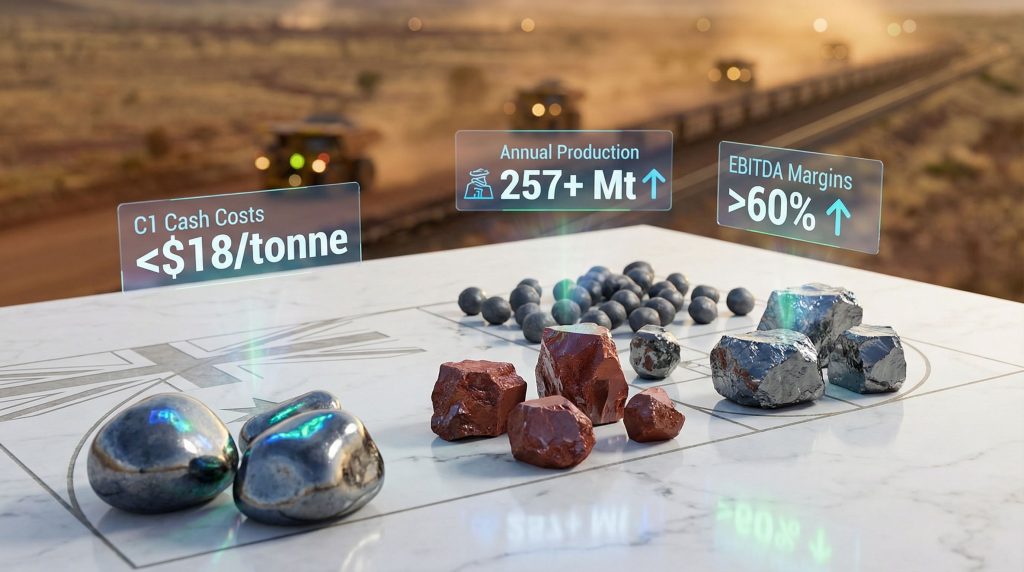
The cornerstone of mining industry dominance lies in achieving and maintaining the lowest possible production costs while sustaining high-quality output. Leading operators have demonstrated the ability to maintain C1 cash costs below industry benchmarks through integrated operational systems and technological advancement. These cost advantages create defensive moats during commodity price downturns whilst generating exceptional margins during favourable market conditions.
Key Performance Metrics:
• Unit Cost Leadership: Industry-leading operators achieve C1 cash costs significantly below global averages
• Margin Sustainability: Maintaining profitable operations across diverse commodity price environments
• Operational Efficiency: Integrated mining, processing, and transportation systems optimise total cost structure
• Quality Premiums: Superior product specifications command premium pricing in global markets
The achievement of cost leadership requires systematic optimisation across the entire value chain. From extraction methodologies to final product delivery, each operational component must contribute to overall efficiency gains whilst maintaining safety and environmental standards. In addition, AI mining technology is increasingly becoming crucial for maintaining competitive advantages.
Infrastructure Integration Advantages
Large-scale mining operations benefit from dedicated infrastructure investments that create barriers to entry for potential competitors. These integrated systems encompass mining facilities, processing plants, rail networks, and port terminals designed to optimise throughput whilst minimising per-unit transportation costs.
Infrastructure Components:
| Component | Strategic Value | Operational Impact |
|---|---|---|
| Mining Operations | Resource extraction efficiency | Direct cost per tonne control |
| Processing Facilities | Product quality optimisation | Premium pricing capability |
| Transportation Networks | Logistics cost minimisation | Supply chain reliability |
| Port Infrastructure | Export capacity maximisation | Market access flexibility |
The integration of these components creates operational synergies that compound cost advantages whilst providing supply chain resilience. Companies with fully integrated systems can maintain production continuity even when individual components face operational challenges.
What Financial Metrics Define Mining Industry Advantages?
Cash Generation Analysis
The ability to generate substantial free cash flow consistently distinguishes successful mining operations from less efficient competitors. This cash generation capability stems from the combination of high-volume production, low-cost operations, and premium product pricing.
Performance Indicators:
• Free Cash Flow Generation: Superior cash flow per tonne compared to industry peers
• EBITDA Margins: Sustained high margins across commodity price cycles
• Capital Efficiency: Optimal returns on invested capital across operational assets
• Dividend Sustainability: Consistent shareholder returns supported by operational cash flows
Mike Henry, BHP Chief Executive Officer, stated in a recent CNBC interview that "the company operates as the highest margin major iron ore business globally, generating approximately ten dollars per tonne more in free cash flow than their nearest competitor." This performance differential demonstrates the value of operational excellence in creating sustainable competitive advantages.
The measurement of financial performance in mining operations requires consideration of commodity price volatility and its impact on profitability metrics. Companies with strong cost positions can maintain positive cash flows even during challenging market conditions, providing financial stability for long-term planning. However, understanding various capital raising methods remains essential for funding expansion initiatives.
Margin Resilience Framework
Sustainable margin performance requires operational flexibility combined with cost discipline. Leading mining companies have demonstrated the ability to maintain profitable operations across varying commodity price environments through strategic cost management and operational optimisation.
Margin Protection Strategies:
-
Variable Cost Management: Flexible cost structures that adjust to production volumes
-
Fixed Cost Optimisation: Infrastructure investments that reduce per-unit fixed costs
-
Product Quality Premium: Superior specifications commanding higher market pricing
-
Operational Reliability: Consistent production schedules maintaining customer relationships
The implementation of these strategies requires long-term investment in operational capabilities combined with disciplined capital allocation. Companies that successfully execute this approach create sustainable competitive moats that protect profitability across market cycles.
Why Do Established Commodities Remain Central Despite Portfolio Diversification?
Strategic Portfolio Balance
Whilst mining companies increasingly invest in growth commodities like copper and critical minerals, established high-volume operations continue serving as cash generation foundations. This strategic balance allows companies to fund diversification initiatives whilst maintaining dividend commitments and financial stability.
Mike Henry emphasised that "BHP achieved thirty percent growth in copper production over the past four years whilst continuing to generate strong performance from iron ore operations." The company recently announced a US$4.3 billion silver streaming deal linked to the Antamina mine in Peru, demonstrating how established operations fund strategic investments.
Portfolio Strategy Components:
• Cash Generation Base: High-volume, low-cost operations providing financial foundation
• Growth Investments: Strategic allocation to emerging commodities with supply constraints
• Risk Diversification: Geographic and commodity exposure spreading operational risks
• Capital Allocation Discipline: Systematic investment prioritisation based on return potential
The maintenance of this balance requires sophisticated capital allocation frameworks that optimise returns across diverse commodity exposures whilst managing operational risks and market volatility. Furthermore, copper & uranium investment opportunities continue to attract significant attention from major miners.
Market Position Resilience
Companies maintaining significant market share in established commodities benefit from pricing influence and customer relationship stability. These positions provide defensive characteristics during market downturns whilst supporting growth investments in emerging sectors.
Resilience Factors:
| Factor | Market Impact | Strategic Value |
|---|---|---|
| Market Share Position | Pricing influence capability | Revenue stability |
| Customer Relationships | Long-term contract potential | Cash flow predictability |
| Cost Leadership | Defensive positioning | Margin protection |
| Quality Standards | Premium pricing access | Competitive differentiation |
The preservation of market leadership positions requires continuous investment in operational excellence combined with strategic customer relationship management. Companies that maintain these positions create sustainable competitive advantages that support long-term value creation.
How Do Global Market Dynamics Impact Mining Strategies?
China Market Dependencies and Transitions
China's steel production exceeding one billion tonnes annually creates massive demand for high-quality iron ore, establishing the foundation for global trading patterns. However, economic development transitions within China require strategic positioning by mining companies to adapt to evolving demand characteristics.
Mike Henry acknowledged that "China faces economic development pressures that may impact steel demand over the medium to long term. However, companies with the lowest cost and most reliable operations maintain defensive positioning across various market scenarios."
Market Scenario Analysis:
• Continued Strong Demand: Infrastructure development sustains current consumption levels
• Gradual Transition: Demand moderation as China shifts economic development focus
• Quality Premium Growth: Environmental regulations favour high-grade product specifications
• Alternative Market Development: Emerging economies increase steel consumption requirements
Understanding these scenarios enables mining companies to optimise production capabilities whilst maintaining flexibility for changing market conditions. Consequently, monitoring US-China trade impact becomes increasingly important for strategic planning.
Regional Market Diversification
Successful mining operations require geographic diversification to reduce concentration risks whilst capturing growth opportunities in emerging markets. This approach provides revenue stability whilst positioning companies for long-term demand evolution.
Diversification Benefits:
-
Risk Mitigation: Reduced dependence on individual market performance
-
Growth Capture: Access to emerging market demand increases
-
Pricing Optimisation: Multiple market exposure improves price realisation
-
Supply Chain Resilience: Geographic distribution reduces logistics vulnerabilities
The implementation of regional diversification strategies requires understanding local market dynamics combined with operational flexibility to serve diverse customer requirements effectively.
What Operational Excellence Drives Cost Leadership?
Technology Integration Impact
Advanced mining technologies combined with automated systems create operational efficiency gains that translate into sustainable cost advantages. These technological investments support predictive maintenance protocols whilst improving safety standards across operations.
Technology Applications:
• Automated Mining Systems: Reduced labour costs with improved operational precision
• Predictive Maintenance: Equipment optimisation minimising unplanned downtime
• Data Analytics Integration: Performance optimisation across operational components
• Safety Technology Implementation: Risk reduction whilst maintaining productivity levels
The successful integration of these technologies requires substantial capital investment combined with workforce training and operational process redesign. Companies that execute this integration effectively achieve sustainable competitive advantages.
Geological Resource Advantages
Natural resource quality and accessibility create fundamental competitive advantages that technology and operational excellence can optimise but cannot replicate. Superior ore grades combined with favourable mining conditions translate into lower extraction costs and higher product quality.
Resource Quality Factors:
| Factor | Operational Impact | Cost Advantage |
|---|---|---|
| Ore Grade Quality | Processing efficiency gains | Lower treatment costs |
| Deposit Accessibility | Reduced extraction complexity | Mining cost minimisation |
| Geographic Location | Transportation cost optimisation | Logistics advantages |
| Resource Scale | Production volume capability | Fixed cost absorption |
Companies with superior geological resources maintain structural advantages that support long-term competitive positioning regardless of operational improvements implemented by competitors. For instance, BHP's Western Australian operations exemplify these geological advantages.
The next major ASX story will hit our subscribers first
How Do Cash Flows Support Strategic Growth Initiatives?
Capital Allocation Framework
Strong cash generation from established operations enables strategic investments in growth commodities whilst maintaining shareholder return commitments. This financial flexibility allows companies to execute long-term strategies without compromising short-term performance.
The recent silver streaming transaction demonstrates how established mining operations can unlock capital for strategic redeployment whilst maintaining operational control over productive assets. This approach maximises financial flexibility whilst preserving operational capabilities.
Allocation Priorities:
-
Operational Maintenance: Sustaining cost leadership through infrastructure investment
-
Growth Investments: Strategic expansion in supply-constrained commodities
-
Shareholder Returns: Consistent dividend distributions supported by cash generation
-
Financial Flexibility: Maintaining balance sheet strength for opportunistic investments
The execution of this framework requires disciplined evaluation of investment opportunities combined with systematic risk assessment across diverse commodity exposures.
Infrastructure Investment Returns
Strategic infrastructure investments generate compounding returns through operational efficiency improvements and capacity expansion capabilities. These investments create long-term competitive advantages whilst supporting production volume growth.
Recent expansions in port and rail capacity demonstrate commitment to maintaining operational leadership whilst supporting sustainable production increases. These projects provide foundation for long-term volume growth whilst optimising unit cost performance.
Investment Benefits:
• Capacity Expansion: Support for increased production volumes without proportional cost increases
• Efficiency Gains: Operational improvements reducing per-unit costs across the value chain
• Reliability Enhancement: Supply chain resilience supporting customer relationship stability
• Future Optionality: Infrastructure capability enabling rapid response to market opportunities
The successful execution of these investments requires long-term planning combined with operational expertise to maximise return potential whilst managing construction and operational risks.
What Competitive Threats Challenge Market Leadership?
Emerging Supply Competition
New mining projects globally create potential supply increases that could impact commodity pricing and market share distribution. However, companies with established cost leadership positions maintain defensive advantages against new entrant competition.
Competitive Response Strategies:
• Cost Position Defence: Continuous operational improvement maintaining cost leadership
• Quality Differentiation: Superior product specifications commanding premium pricing
• Customer Relationship Management: Long-term partnerships providing demand stability
• Operational Flexibility: Production optimisation responding to market conditions
The implementation of these strategies requires ongoing investment in operational capabilities combined with strategic market positioning to maintain competitive advantages.
Market Concentration Risk Management
Heavy reliance on specific geographic markets or customer segments creates vulnerability to economic policy changes and demand fluctuations. Effective risk management requires diversification strategies combined with operational flexibility.
Risk Mitigation Approaches:
| Risk Type | Mitigation Strategy | Operational Response |
|---|---|---|
| Geographic Concentration | Market diversification | Customer base expansion |
| Demand Volatility | Flexible production capacity | Operational scalability |
| Policy Changes | Stakeholder engagement | Regulatory compliance |
| Price Fluctuations | Cost leadership maintenance | Margin protection |
Companies that successfully implement comprehensive risk management frameworks maintain operational resilience whilst preserving growth optionality across changing market conditions.
Sustaining Competitive Excellence Through Strategic Integration
BHP's iron ore supremacy demonstrates how geological advantages, operational excellence, and strategic infrastructure investments combine to create sustainable competitive positioning. Whilst portfolio diversification into copper and other commodities provides growth opportunities, established operations remain essential for cash generation and dividend sustainability.
The business model's resilience stems from maintaining industry-leading production costs whilst delivering premium product quality to global markets. This positioning ensures continued market leadership regardless of commodity price cycles or demand fluctuations across different geographic regions.
Success Factors:
• Cost Leadership Maintenance: Continuous operational improvement sustaining competitive advantages
• Quality Premium Capture: Superior product specifications supporting pricing power
• Strategic Capital Allocation: Balanced investment approach optimising returns across commodities
• Market Position Defence: Operational reliability maintaining customer relationships and market share
Future success requires balancing established operations optimisation with portfolio diversification initiatives, maintaining the cost leadership and operational excellence that define sustainable competitive advantage in global mining markets. BHP's iron ore supremacy continues to exemplify this strategic approach.
Companies that successfully execute this strategic approach create value for shareholders whilst positioning themselves for long-term success across evolving commodity market dynamics and changing global demand patterns. Therefore, BHP's iron ore supremacy serves as a blueprint for sustainable competitive advantage in the global mining industry.
Want to Discover the Next Major Mining Opportunity?
Discovery Alert's proprietary Discovery IQ model delivers instant notifications on significant ASX mineral discoveries, empowering subscribers to identify actionable investment opportunities ahead of the broader market. Understanding why major mineral discoveries can lead to exceptional returns is crucial for mining investors, which is why Discovery Alert's dedicated discoveries page showcases historic examples of substantial market outcomes from companies like De Grey Mining and WA1 Resources.