August 6, 2026
When Battery Chemistry Becomes a Geopolitical Instrument
The history of energy transitions reveals a consistent pattern: the technology that ultimately wins at scale is rarely the most sophisticated option available. It is almost always the one that can be produced cheaply, reliably, and without depending on materials controlled by a handful of nations. This dynamic is now reshaping the global battery storage industry in ways that extend far beyond laboratory announcements.
Lithium-ion chemistry has served the world remarkably well since its commercial introduction in the early 1990s. However, the supply architecture that underpins it carries structural vulnerabilities that become increasingly difficult to overlook as renewable energy deployment accelerates. Roughly one-third of global lithium originates from ecologically sensitive salt flat systems in Argentina and Chile, where extraction competes directly with scarce water resources in arid communities.
Meanwhile, approximately 70% of the world's cobalt supply originates from a single country, the Democratic Republic of Congo, a jurisdiction with documented concerns around labour practices and political stability. These are not hypothetical risks. They are live constraints shaping investment decisions and industrial policy across multiple continents, and they sit at the heart of the evolving battery metals landscape.
Into this environment steps the China all-iron flow battery, a technology that, if its laboratory results can be translated into commercial reality, could fundamentally alter the materials economics of grid-scale energy storage.
When big ASX news breaks, our subscribers know first
How Flow Batteries Actually Work, and Why Architecture Matters
Before assessing the significance of recent Chinese research, it is worth understanding what distinguishes flow batteries from conventional lithium-ion systems at a fundamental engineering level.
In a standard lithium-ion battery, energy is stored within the physical structure of solid electrode materials. Capacity is therefore fixed at the point of manufacture. Scaling up requires adding more cells, which adds complexity and cost in a non-linear fashion.
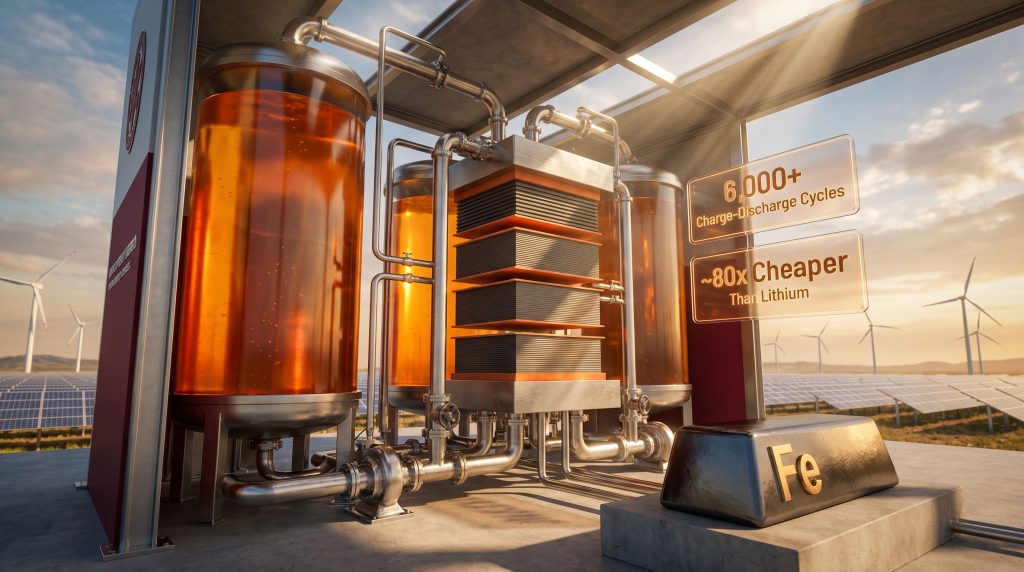
Flow batteries operate on an entirely different principle. Energy is held in liquid electrolytes stored in external tanks, separate from the electrochemical cell where reactions actually occur. The cell stack itself does not store energy. It simply facilitates the conversion between chemical and electrical energy as fluids are pumped through it.
This separation of energy storage from power conversion has a profound practical consequence: increasing storage capacity requires only building larger tanks, not redesigning the core cell architecture. For grid operators managing megawatt-hour or gigawatt-hour scale requirements, this modularity is highly attractive.
| Feature | Lithium-Ion (Grid) | Vanadium Flow | All-Iron Flow (Lab) |
|---|---|---|---|
| Primary active material | Lithium + Cobalt | Vanadium | Iron |
| Relative material cost | High | Very High | Very Low (~80x cheaper than lithium) |
| Electrolyte type | Solid/gel | Aqueous vanadium solution | Aqueous iron complex |
| Flammability risk | Moderate-High | Low | Very Low (water-based) |
| Grid scalability | Moderate | High | High |
| Cycle life (approximate) | 3,000-6,000 | 10,000-20,000 | 6,000+ (lab) |
| Commercialisation stage | Mature | Commercial (niche) | Pre-commercial |
The architectural advantages of flow batteries have been understood for decades. The challenge has always been finding a chemistry that is cheap enough, stable enough, and safe enough to justify deployment at grid scale. Vanadium flow batteries have established a commercial footprint, but vanadium's high and volatile price limits the addressable market. The all-iron flow battery attempts to solve this cost problem by substituting one of the Earth's most abundant metals.
The Molecular Engineering Behind China's 6,000-Cycle Result
Researchers at the Institute of Metal Research, Chinese Academy of Sciences published findings in the peer-reviewed journal Advanced Energy Materials detailing an alkaline all-iron flow battery that achieved more than 6,000 charge-discharge cycles with no measurable capacity degradation in laboratory conditions. At the rate of one full cycle per day, this corresponds to approximately 16 years of continuous operation, a durability benchmark that competes credibly with established grid storage technologies.
What makes this result technically significant is not merely the cycle count but the specific failure mechanisms that were overcome to achieve it. Furthermore, previous all-iron flow battery research was consistently undermined by three interrelated problems:
- Electrolyte degradation over repeated cycling, as active iron species became chemically unstable.
- Hydrogen evolution side reactions at the negative electrode, which consumed electrolyte and reduced round-trip efficiency.
- Electrolyte crossover through the membrane separator, where active materials migrated between the two sides of the cell and progressively contaminated both electrolytes.
The research team addressed these failures through targeted molecular redesign of the negative electrolyte. The new iron complex incorporates a bulky molecular geometry combined with negatively charged functional groups. These two structural features work in combination: the bulky architecture physically obstructs crossover migration through the membrane's pores, while the negatively charged groups create an electrostatic repulsion effect against the membrane's similarly charged surface, further suppressing ion migration.
The result is a stabilised active iron centre that maintains electrochemical performance across thousands of cycles while simultaneously suppressing the hydrogen evolution reaction that had previously caused progressive efficiency loss.
This is a meaningfully different engineering approach from earlier all-iron flow battery research, which had largely attempted to address crossover and degradation through membrane selection rather than electrolyte redesign. Intervening at the molecular level of the electrolyte itself represents a more fundamental solution.
Iron vs. Lithium: Understanding the 80x Cost Differential
The headline figure circulating around this technology is that iron costs approximately 80 times less than raw lithium as a material input. This is broadly accurate as a commodity comparison, but it requires important contextualisation for anyone seeking to understand its commercial implications.
Material cost is only one component of a battery system's total cost structure. The following factors determine whether a raw material cost advantage survives into a delivered system cost advantage:
- Membrane costs, which represent a significant portion of flow battery capital expenditure and are not influenced by iron's abundance.
- Balance-of-plant costs, including pumps, flow management systems, thermal regulation hardware, and control electronics, which are common to all flow battery architectures.
- Manufacturing scale economics, where lithium-ion benefits from decades of accumulated scale that have driven per-kWh costs down dramatically.
- Engineering and integration costs, particularly at megawatt and above scale where thermal and flow management become complex.
The 80x material cost advantage is a genuine starting point, not a delivered outcome. A rigorous techno-economic analysis at megawatt scale has not yet been published, because no pilot project has reached that scale. What the cost differential does represent is a powerful theoretical incentive to solve the remaining engineering challenges, because the potential margin improvement for a successful all-iron flow battery at scale is genuinely transformative.
Sodium-Ion Batteries: China's Parallel Track
The China all-iron flow battery is not the only alternative chemistry where China is pressing forward aggressively. Sodium-ion batteries have advanced from academic research to early commercial deployment with notable speed, and their progress offers a useful comparison point for understanding where iron-based systems currently sit on the maturity curve.
Sodium shares lithium's fundamental electrochemical operating principle, allowing existing lithium-ion manufacturing knowledge and equipment to be partially repurposed. Sodium is dramatically cheaper and more globally abundant than lithium. The primary limitation is lower energy density, which constrains applications where physical size and weight matter.
Key 2025 milestones in China's sodium-ion deployment include:
- CATL, the world's largest battery manufacturer by volume, announced mass production plans for sodium-ion batteries under its Naxtra brand in April 2025, targeting heavy-duty commercial trucks and passenger vehicles.
- Yadea deployed sodium-ion batteries in a pilot programme covering two- and three-wheel electric scooters priced between approximately $400 and $660, alongside a battery-swapping infrastructure rollout.
- Chinese automakers became the first globally to bring sodium-powered passenger vehicles to market, though limited energy density continues to constrain driving range performance.
The sodium-ion trajectory is instructive. From meaningful laboratory results to early commercial deployment took roughly five to seven years of intensive engineering, pilot validation, and supply chain development. This timeline provides a reference frame for assessing the all-iron flow battery's commercialisation pathway, and it mirrors patterns seen in the broader Chinese battery recycling breakthrough efforts reshaping materials recovery globally.
The Strategic Logic Behind China's Alternative Chemistry Push
It would be a mistake to interpret China's battery chemistry diversification purely as a scientific endeavour. Both all-iron flow batteries and sodium-ion batteries share a strategically important characteristic: they reduce or eliminate dependence on lithium and cobalt, materials where China's domestic reserves are limited relative to its manufacturing ambitions.
China currently dominates the processing and manufacturing stages of the global battery supply chain, but it remains exposed to upstream raw material supply from South America and Africa for lithium and cobalt respectively. Developing commercially viable post-lithium chemistries using domestically abundant materials such as iron and sodium directly addresses this upstream vulnerability.
This strategic alignment between industrial research priorities and materials security objectives means that Chinese research institutions working on alternative battery chemistries operate with long-term mandates and institutional support that pure commercial entities in other markets may not replicate. Consequently, the Chinese Academy of Sciences, where the all-iron flow battery research originated, is one of the world's largest and most well-resourced public research organisations, with the capacity to pursue multi-decade technology development programmes.
In addition, the broader context of critical minerals and energy security is driving governments worldwide to reconsider their exposure to concentrated supply chains — precisely the vulnerability that iron-based chemistries are engineered to circumvent.
The next major ASX story will hit our subscribers first
What the Commercialisation Pathway Actually Looks Like
Understanding the gap between a laboratory result and a commercial product is essential for placing the all-iron flow battery breakthrough in the correct context. The typical development trajectory for a novel electrochemical storage technology runs through the following stages:
- Cell-level laboratory validation, confirming electrochemical performance at small scale under controlled conditions. This is where the Chinese research currently sits.
- Kilowatt-scale stack prototyping, demonstrating that cell-level performance is preserved when multiple cells are assembled together, managing thermal and flow distribution challenges.
- Hundred-kilowatt pilot system, testing real-world grid integration including variable charging from renewable sources and discharge management under load.
- Megawatt-scale demonstration project, validating system economics, maintenance requirements, and long-duration durability under industrial operating conditions.
- Commercial deployment, requiring regulatory validation, supply chain establishment, and bankable performance guarantees.
As of mid-2026, no pilot project for the alkaline all-iron flow battery has been publicly announced. The transition from peer-reviewed laboratory results to commercially viable grid storage typically requires between five and ten years of dedicated engineering development across these stages.
This is not a criticism of the research. A 6,000-cycle, zero-decay result at the laboratory level is genuinely significant. It simply means that investors and energy planners should treat this as a technology to monitor carefully over the coming decade, not a near-term disruption to existing storage markets.
Scenario Pathways to 2035
What Are the Most Likely Commercial Outcomes?
Three plausible futures exist for the all-iron flow battery's commercial trajectory, each with meaningfully different implications for the grid storage market.
Scenario A: Incremental displacement by the early 2030s. Pilot-scale validation proceeds successfully over the next three to four years, early commercial projects emerge targeting long-duration grid storage in markets with strong iron availability and renewable buildout requirements. All-iron flow batteries capture a niche but growing segment of utility-scale storage while lithium-ion retains dominance in high-energy-density applications.
Scenario B: Accelerated transition driven by cost performance. Membrane and thermal management challenges prove more tractable than currently anticipated, system-level cost advantages are demonstrated at scale earlier than expected, and the technology's safety and supply chain advantages attract rapid adoption — particularly in markets seeking to reduce lithium import dependence. This outcome would have profound implications for critical minerals demand globally.
Scenario C: Extended pre-commercial phase. Membrane durability, thermal management at scale, or electrolyte stability under real-world industrial conditions prove more difficult to maintain than laboratory results suggest, pushing commercial viability beyond 2035 and preserving lithium-ion's dominant position in grid storage.
The honest assessment is that Scenario C carries non-trivial probability. Many promising battery chemistries have demonstrated exceptional laboratory performance only to encounter scaling challenges that delayed or ultimately prevented commercialisation. The all-iron flow battery's molecularly redesigned electrolyte represents a genuine advance, but the engineering distance between a controlled laboratory environment and a megawatt-scale grid installation is substantial.
Furthermore, ongoing pressures from the lithium market downturn may paradoxically slow investment in alternatives by temporarily reducing the urgency to find cheaper substitutes, even as the long-term structural case for iron-based chemistries strengthens.
Where This Technology Fits in the Broader Storage Landscape
The China all-iron flow battery occupies a specific and well-defined market niche: stationary, long-duration, grid-scale storage in applications where physical footprint is not a constraint. This is the segment where its strengths — low material cost, non-flammable chemistry, modular scalability, and supply chain independence — align most naturally with market requirements.
It is not a competitor to lithium-ion in electric vehicles, portable electronics, or any application where energy density and physical size matter. Its natural competitive set is vanadium flow batteries and other long-duration storage technologies in utility-scale renewable integration projects.
For countries in the Global South seeking to build renewable energy infrastructure without the supply chain dependencies that have historically concentrated energy transition economics in wealthier nations, an iron-based system using locally available materials could be particularly compelling if the technology reaches commercial viability. This represents a genuinely underappreciated dimension of the all-iron flow battery's long-term strategic significance.
The science is real. The engineering challenge ahead is equally real. The decade ahead will determine which scenario materialises.
This article is intended for informational purposes only and does not constitute financial or investment advice. Forward-looking assessments regarding technology commercialisation timelines involve significant uncertainty and should not be relied upon for investment decisions.
Want to Track the Next Big Shift in Critical Minerals Before the Market Moves?
Discovery Alert's proprietary Discovery IQ model scans ASX announcements in real time, instantly alerting subscribers to significant mineral discoveries across battery metals and critical commodities — turning complex data into actionable opportunities. Explore how major mineral discoveries have historically delivered extraordinary returns on Discovery Alert's dedicated discoveries page, and begin your 14-day free trial today to position yourself ahead of the market.