
May 16, 2026
The Invisible Chokepoint: Why Three Countries Hold the World's PGE Supply Hostage
Most commodity markets tolerate a degree of geographic concentration. Iron ore, copper, and lithium each have dominant producers, yet the industry manages risk through diversified trade routes and reserve redundancy. Platinum group elements operate under an entirely different set of constraints. The mineralogy itself is the problem: economically significant PGE deposits outside of a handful of geological provinces are extraordinarily rare, and the processing infrastructure required to refine these metals is capital-intensive, slow to build, and deeply embedded in just three national economies.
That structural reality was already a known risk before 2026. What the first quarter of this year added was confirmation that the deterioration is accelerating, not stabilising. Understanding the platinum and palladium dynamics at play is essential context for evaluating what comes next.
When big ASX news breaks, our subscribers know first
How Concentrated Is Global PGE Supply? The Three-Country Problem
South Africa, Russia, and Zimbabwe collectively account for approximately 90% of global primary PGE supply. South Africa alone hosts the overwhelming majority of the world's known PGE reserve base, concentrated within the Bushveld Igneous Complex, one of the most mineralogically unique geological formations on Earth. Russia's Norilsk Nickel operates from the Norilsk-Talnakh sulphide deposit system in Siberia, producing roughly 40% of the world's primary palladium as a co-product of nickel and copper mining.
Zimbabwe's Great Dyke, a layered intrusion running nearly 550 kilometres through the country's centre, hosts Zimplats and several smaller producers. Furthermore, the PGM supply constraints affecting each of these jurisdictions compound one another rather than operating in isolation.
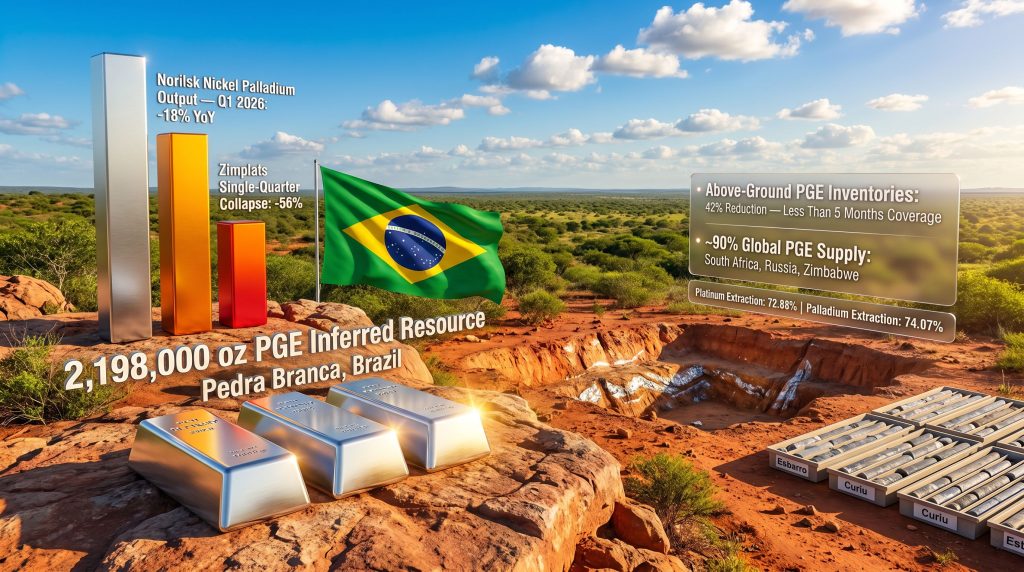
This is not simply a matter of market share percentages. The critical distinction is that these three geographies function with minimal redundancy between them. When production volumes fall within any one of them, there is no meaningful spare capacity elsewhere to absorb the shortfall. Above-ground inventories, historically maintained as a buffer, have now been drawn down by 42%, leaving a coverage window estimated at fewer than five months of global consumption.
"Geographic concentration in PGE supply is qualitatively different from concentration in other commodity markets. The combination of rare mineralogy, specialised infrastructure, and limited jurisdictional alternatives means that production disruptions do not self-correct through market mechanisms the way they might in more distributed supply systems."
Q1 2026 Production Data: Quantifying the Acceleration
Norilsk Nickel's Output Decline and What Full-Year Guidance Confirms
Russia's Norilsk Nickel reported first-quarter 2026 platinum production down 26% year-over-year and palladium output down 18% over the same period. Copper production, which serves as a corroborating operational indicator given that PGEs are extracted as co-products from the same ore bodies, fell 10% in the quarter. These are not marginal adjustments. A 26% single-quarter decline in platinum from the world's largest palladium producer represents a material volume removal from an already undersupplied market.
What makes the data more consequential is that full-year 2026 guidance from Norilsk does not suggest a recovery. The company has projected further annual palladium declines of 10 to 11% and platinum declines of 5 to 8% for the full year. That guidance trajectory means Q1 2026 was not an anomaly driven by seasonal or maintenance factors; it reflects the company's own expectations for sustained volume reduction across the remainder of the year.
Zimplats' 56% Single-Quarter Collapse and the Infrastructure Fragility Problem
Zimbabwe's Zimplats reported a 56% decline in combined six-element platinum group output for Q1 2026. The cause was an extended smelter shutdown. This single data point illustrates a risk category that market participants frequently underestimate in PGE analysis: the binary nature of processing infrastructure in highly concentrated supply geographies.
PGE ore must pass through smelting before it becomes a tradeable intermediate product. Unlike some base metal operations where alternative processing routes or toll facilities provide operational flexibility, PGE smelting capacity in Zimbabwe is not meaningfully distributed. When one facility goes offline, output does not decline proportionally; it can collapse toward zero for the duration of the shutdown. A 56% quarterly decline from a single operational event demonstrates precisely that dynamic.
In addition, the ongoing South Africa mining decline adds further pressure to a supply base that is already stretched across all three dominant producing nations.
Zimbabwe's government compounded the supply pressure by announcing an indefinite ban on the export of unrefined critical minerals in late April 2026. The policy removes a processing and trade pathway within one of the three countries controlling global PGE output, adding a regulatory constraint layer on top of an already compromised production environment.
The Structural Deficit in Numbers
The table below consolidates the key quantitative data points defining the current PGE supply-demand framework:
| Metric | Data Point |
|---|---|
| Annual PGE deficit range (multi-year average) | 500,000 to 700,000 oz per year |
| Above-ground inventory drawdown | 42% reduction |
| Remaining inventory coverage | Less than 5 months |
| Share of global PGE supply from 3 countries | ~90% |
| Norilsk's share of primary palladium supply | ~40% |
| Platinum demand from automotive applications | ~40% of total |
| Palladium and rhodium demand from automotive | ~80% of total |
| PGE premium for hybrid vs. ICE vehicles | 10 to 20% more PGEs per unit |
| China physical platinum investment growth | Near zero (2019) to 400,000+ oz (2025) |
| Platinum price range (recent cycle) | All-time high ~$2,700/oz, settling near $2,000/oz |
| Palladium price range (recent cycle) | ~$2,000/oz, settling near $1,700/oz |
The Hybrid Vehicle Demand Multiplier: A Widely Misread Signal
A persistent misunderstanding in mainstream coverage of the energy transition is that the shift away from pure internal combustion engine vehicles reduces PGE demand. The arithmetic does not support that conclusion. Hybrid vehicles, which retain a combustion engine alongside an electric drivetrain, require 10 to 20% more platinum group elements per unit than a conventional internal combustion vehicle. As hybrid production volumes rise globally, the per-vehicle PGE intensity of the automotive fleet is moving upward, not downward.
This matters because automotive applications account for approximately 40% of total platinum demand and approximately 80% of combined palladium and rhodium demand. The autocatalyst function, which reduces nitrogen oxide, carbon monoxide, and hydrocarbon emissions from combustion engines, requires loadings that scale with engine complexity. Hybrid powertrains, managing more complex thermal cycles across both electric and combustion modes, require heavier catalyst loadings to meet emissions standards.
China's Physical Investment Demand: A New Structural Layer
Physical platinum investment in China grew from near zero in 2019 to over 400,000 ounces in 2025. This demand source did not exist at meaningful scale at the beginning of the decade and operates entirely independently of automotive sector dynamics. Chinese retail and institutional investors have been accumulating physical platinum through bar and coin products, adding a layer of structural demand that has no historical precedent within the PGE market's supply models.
The significance of this development is that it introduces demand inelasticity into a market segment that was previously price-sensitive and relatively small. Physical investment demand, once established as a cultural savings vehicle, tends to persist and grow, as the gold market demonstrated over several decades.
The ValOre Metals Pedra Branca PGE Project: Geological and Technical Profile
Location, Scale, and Jurisdictional Context
The ValOre Metals Pedra Branca PGE project is located in Ceará State, northeastern Brazil, covering 51,096 hectares across 45 exploration licences. The land package is district-scale by any reasonable measure, and its position in Brazil provides access to an established mining regulatory framework, functional logistics infrastructure, and a workforce with experience in large-scale resource extraction.
Brazil's geological survey agencies maintain well-documented titling processes, and the country's history as a significant gold, iron ore, and niobium producer means that both government and civil institutions have existing frameworks for managing large mining operations. These are not guarantees of smooth development, but they represent a structurally lower jurisdictional risk profile than the three countries currently dominating PGE supply. For a comprehensive overview of the Pedra Branca asset, ValOre Metals provides detailed project documentation covering the full scope of the licence area.
The 2022 NI 43-101 Inferred Resource: What the Numbers Mean
The project's current resource estimate, calculated under Canada's National Instrument 43-101 standard and based on 2022 data, defines an inferred resource of 2,198,000 ounces of platinum, palladium, and gold across 63.6 million tonnes at a grade of 1.08 grams per tonne of 2PGE+Au. The resource is distributed across seven distinct near-surface deposit zones, a geological configuration that supports staged development planning and reduces the capital exposure of any single development decision.
| Deposit Zone | Resource (oz) | Grade (g/t 2PGE+Au) | Notes |
|---|---|---|---|
| Esbarro | 403,000 | 1.16 | Primary bioleaching testwork focus |
| Curiu | 150,000 | 2.20 | Highest grade among named deposits |
| Cedro | Part of combined >1Moz | Not separately stated | Core deposit group |
| Cana Brava | Part of combined >1Moz | Not separately stated | Core deposit group |
| Trapia and Massape (southern zones) | Part of combined >1Moz | Not separately stated | Southern extension |
| Total Inferred Resource | 2,198,000 | 1.08 | 63.6 Mt; 2022 data |
A critical detail that does not appear in headline resource summaries is that the current 2,198,000-ounce figure does not incorporate more than 6,000 metres of drilling completed across five new zones in 2023, including the Salvador target. The resource is therefore a 2022 snapshot of a project that has continued to evolve. A resource update incorporating the 2023 drilling programmes and resources was targeted for Q1 2026, which means the officially stated ounce count is likely a floor rather than a ceiling for the project's actual endowment.
Near-Surface Geometry and Open-Pit Development Potential
The near-surface nature of Pedra Branca's mineralisation is a capital efficiency differentiator that is frequently underweighted in junior developer comparisons. Underground PGE mining, which characterises the deep-level South African operations, carries significantly higher capital intensity per ounce of resource accessed. Near-surface deposits amenable to open-pit methods can achieve substantially lower strip ratios in early development stages, reducing both the initial capital requirement and the time required to reach positive cash flow.
The seven near-surface zones at Pedra Branca, distributed across a district-scale land package, create optionality for phased open-pit development that begins with the highest-grade or most metallurgically accessible zones while maintaining exploration upside across the broader licence area.
Metallurgical De-Risking: Phase 2 Testwork and Processing Results
Why Metallurgy Is the Gating Factor for PGE Project Economics
PGE ores present some of the most technically demanding processing challenges in the mining industry. Unlike gold, which can be recovered from many ore types using relatively straightforward cyanidation, platinum group elements occur in complex mineralogical associations with sulphides, chromites, and silicates that require carefully sequenced pre-treatment before conventional leaching can achieve meaningful recovery rates. The history of PGE project failures at the development stage is littered with cases where resource ounces could not be converted to saleable product at acceptable cost.
This is the primary reason metallurgical testwork results carry disproportionate weight in the market's assessment of junior PGE developers. A project that demonstrates viable processing economics fundamentally changes its risk category.
Phase 2 Testwork: University of Cape Town Partnership
In February 2026, ValOre Metals advanced into Phase 2 metallurgical testwork in partnership with the University of Cape Town, a globally recognised centre of expertise in PGE processing research. The partnership feeds directly into the PEA preparation process and signals that the testwork programme is being conducted at an institutional standard rather than through exploratory bench-scale work alone.
The methodological approach combines bioleaching pre-treatment with subsequent cyanidation. Bioleaching uses microbial activity to oxidise sulphide minerals that would otherwise encapsulate PGE particles and prevent leaching solutions from accessing them. The pre-treatment step effectively unlocks mineralisation that conventional cyanidation alone cannot recover.
Extraction Results From Weathered Esbarro Material
| Material Type | Platinum Extraction | Palladium Extraction | Method |
|---|---|---|---|
| Weathered Esbarro (bioleach + cyanidation) | 72.88% | 74.07% | Bioleaching pre-treatment + cyanidation |
| Chromitite material | 66% | 79% | Leaching testwork |
Recovery rates in the 70% range for weathered material are considered commercially meaningful for a PGE project at this stage. The significance of the weathered zone extends beyond the headline percentages: approximately 30% of the inferred resource ounces reside in shallow weathered material, meaning this metallurgical pathway is applicable to a material proportion of the deposit's total ounce count. Weathered material typically requires less energy-intensive comminution than fresh rock, further supporting the capital efficiency argument for early-stage mining from the upper portions of the deposit.
Chromitite material, which represents a distinct lithological unit within the Pedra Branca system, returned approximately 66% platinum and 79% palladium recovery. The variation in recovery rates between material types reinforces the importance of completing additional testwork across the full range of ore domains before the PEA is finalised.
The next major ASX story will hit our subscribers first
2026 Development Milestones: A Staged Value Creation Pathway
ValOre Metals' 2026 programme at the ValOre Metals Pedra Branca PGE project is structured around four primary work streams, each designed to advance the project toward a definitive economic assessment. Understanding the various mining study stages provides useful context for how these milestones build upon one another:
-
Q1 2026: Resource update incorporating drilling data from the five new zones completed in 2023, including the Salvador target, to establish an expanded official ounce count.
-
Q3 2026: Merger and acquisition evaluation targeting potential near-term production pathways, reflecting the company's awareness that resource developers are valued differently from producers and that accelerating cash flow optionality has strategic merit.
-
Q4 2026: Preliminary Economic Assessment delivery, the primary near-term catalyst and the document that will establish whether Pedra Branca's ounces can be extracted and sold under realistic operating assumptions.
-
Ongoing work streams running in parallel throughout the year:
- Metallurgical and engineering study progression feeding into PEA preparation
- Relogging of historical drill core at core deposits to refine mine planning parameters
- Regional prospecting via VRIFY technology and surface geochemistry across the broader licence area
- Trado auger drilling programs and resources along the 8-kilometre Pitombeiras trend, a geologically defined corridor with expansion potential beyond the current resource footprint
"The Q4 2026 PEA is the document the market is waiting for. It transforms Pedra Branca from a resource with demonstrated metallurgical amenability into a project with a quantified economic profile, changing the basis on which institutional investors can evaluate it."
The Valuation Gap: Why PGE Developers May Be Systematically Mispriced
How Markets Have Historically Priced Junior PGE Developers
Junior PGE developers occupy an unusual position in the mining equity universe. The metals they are developing are in structural deficit, the supply base is geographically and geopolitically fragile, and the demand profile is supported by both industrial necessity and growing investment interest. Yet the equity valuations of companies at the pre-production stage have not historically tracked the magnitude of the supply-demand imbalance with precision.
Several mechanisms explain this disconnect. Institutional capital is constrained by liquidity requirements that exclude most junior developers regardless of asset quality. The multi-year lead time between resource definition and production means that even a genuinely supply-constrained market does not immediately benefit companies that are years away from adding ounces. Furthermore, the processing complexity of PGE ores creates a persistent uncertainty discount that only metallurgical testwork can reduce.
The Lag Between Documented Supply Deterioration and Equity Re-Rating
The documented supply deterioration in PGE markets is now current rather than projected. Norilsk's Q1 2026 production data, Zimplats' 56% quarterly output collapse, and Zimbabwe's export restriction are not forecast scenarios; they are confirmed data points. However, market valuations of PGE developers have not moved proportionally to reflect the compression of the development window for alternative supply.
This lag has historical precedent. In multiple commodity cycles, the period between documented supply deterioration and equity re-rating of developers has ranged from several quarters to several years, depending on market sentiment, capital availability, and the presence of a catalytic event that forces institutional reassessment. The combination of confirmed production declines, policy-driven supply restrictions, and a scheduled PEA delivery creates the conditions under which re-rating catalysts can emerge.
The ValOre Metals Pedra Branca PGE project sits at an intersection that is structurally uncommon: a district-scale resource in a stable jurisdiction, with active metallurgical testwork underway, in a commodity market experiencing simultaneous production declines across its two largest non-South African producers. Whether the market assigns value to that combination before or after the Q4 2026 PEA is delivered remains the central investment question.
Disclaimer: This article is intended for informational purposes only and does not constitute financial advice. Forward-looking statements regarding production timelines, resource estimates, metallurgical outcomes, and market conditions involve assumptions and uncertainties that may cause actual results to differ materially. Investors should conduct independent due diligence and consult a licensed financial adviser before making investment decisions. Resource estimates referenced are inferred and carry a lower confidence level than measured or indicated resources under NI 43-101 standards.
Frequently Asked Questions: ValOre Metals Pedra Branca PGE Project
What Is the Total Resource Size at Pedra Branca, and What Does Inferred Classification Mean?
The project holds an NI 43-101 inferred resource of 2,198,000 ounces of platinum, palladium, and gold across 63.6 million tonnes at 1.08 grams per tonne, based on 2022 data. Inferred is the lowest confidence classification under NI 43-101 standards, meaning the estimate is based on limited geological evidence and sampling, with insufficient data to support the higher confidence categories of indicated or measured. The 2023 drilling programme across five new zones has not yet been incorporated into the official estimate.
What Makes Bioleaching Relevant to Pedra Branca's Processing Approach?
Bioleaching uses bacteria to oxidise sulphide minerals that surround and effectively trap PGE particles, preventing conventional leaching solutions from accessing them. By breaking down the sulphide matrix first, the subsequent cyanidation step achieves meaningfully higher extraction rates. The testwork at Pedra Branca demonstrated platinum extraction of approximately 72.88% and palladium extraction of approximately 74.07% from weathered material using this combined approach.
Why Does the Zimplats Smelter Shutdown Matter to the Global PGE Market?
Zimbabwe is one of three countries accounting for approximately 90% of global primary PGE supply. Zimplats' smelter shutdown produced a 56% collapse in six-element output for Q1 2026, illustrating how concentrated processing infrastructure can convert an operational event into a market-scale supply disruption. The indefinite export ban on unrefined critical minerals announced by Zimbabwe's government adds a regulatory layer that further constrains the volume of PGE material that can move through international trade channels.
How Does Hybrid Vehicle Adoption Affect PGE Demand?
Hybrid vehicles consume 10 to 20% more platinum group elements per unit than conventional internal combustion engine vehicles. As hybrid production volumes grow globally, the aggregate PGE loading requirement of the automotive fleet increases rather than decreases, contrary to a common assumption that electrification reduces PGE demand uniformly across all vehicle categories.
What Is the Significance of Curiu's 2.20 g/t Grade Within the Pedra Branca Resource?
Curiu is the highest-grade named deposit within the Pedra Branca resource at 2.20 grams per tonne 2PGE+Au, compared to the project average of 1.08 grams per tonne. Higher-grade zones within a larger resource provide optionality for early-stage development sequencing, allowing a project developer to prioritise higher-margin ore in the initial mining phases to improve project economics and reduce payback periods.
When Is the PEA Expected and Why Does It Matter?
ValOre Metals has targeted delivery of the Preliminary Economic Assessment in Q4 2026. The PEA will establish whether Pedra Branca's ounces can be extracted and sold at a profit under realistic operating cost and revenue assumptions, providing the foundational economic framework required for the project to progress to pre-feasibility study stage and attract institutional development capital.
Want to Know Which ASX-Listed Companies Could Benefit From the Growing PGE Supply Crisis?
Discovery Alert's proprietary Discovery IQ model scans ASX announcements in real time, delivering instant alerts on significant mineral discoveries — including those in critical commodities facing structural supply deficits like platinum group elements — so subscribers can identify actionable opportunities well ahead of the broader market. Explore historic mineral discoveries and their market returns to understand the potential scale of major finds, then begin a 14-day free trial to position yourself at the forefront of the next significant ASX discovery.