May 16, 2026
The Mineral That Could Reshape Europe's Industrial Future
Long before electric vehicles became a policy priority, the global battery supply chain quietly consolidated around a single geography. China did not merely become the world's largest graphite producer — it built an integrated industrial system encompassing raw material extraction, chemical purification, and anode material manufacturing that took decades to construct. Today, as Germany turns to Madagascar graphite as a strategic alternative, any nation attempting to replicate or bypass that system faces not just a logistics challenge but a structural one rooted in chemistry, capital, and time.
For European industrial policymakers, this reality has moved from background concern to urgent agenda item. The question is no longer whether to diversify graphite supply chains — it is how quickly that diversification can be operationalised, and which African jurisdictions are positioned to absorb the resulting investment flows. The answer, increasingly, points toward Madagascar.
When big ASX news breaks, our subscribers know first
How China's Graphite Stranglehold Created a Structural Risk for Europe
Graphite occupies a chemically irreplaceable position in lithium-ion battery architecture. As the primary anode material, it hosts lithium ions during charging cycles, and no commercially scalable substitute has yet displaced it at the volumes required by automotive and stationary storage manufacturers. Unlike cathode chemistry — where nickel, cobalt, and manganese formulations continue to evolve — the graphite anode remains a constant across the dominant battery formats used in electric vehicles today.
China's dominance in this space operates across two distinct levels that are often conflated but are analytically separate:
- Raw material extraction: China accounts for the overwhelming majority of global natural graphite mining output, with major producing regions concentrated in Heilongjiang, Shandong, and Inner Mongolia provinces.
- Downstream processing: Crucially, China also controls the conversion of raw graphite into battery-grade anode material — a multi-stage process involving milling, purification to remove silicate and other impurities, and spheronisation to reshape flake graphite into the rounded particles required by battery manufacturers. This processing capability represents the more defensible competitive moat.
The significance of this dual position became acutely apparent when Beijing signalled potential export restrictions on graphite products in late 2023, triggering immediate risk assessments across European automotive supply chains. Furthermore, the global graphite shortage has intensified pressure on Germany, as the continent's largest vehicle manufacturing economy and home to Volkswagen, BMW, and Mercedes-Benz, which faces disproportionate exposure as each of these manufacturers navigates significant EV platform transitions that depend on stable anode material supply.
Quantifying Europe's Graphite Exposure
| Metric | Detail |
|---|---|
| EU graphite classification | Critical Raw Material under the EU CRM Act |
| Primary global supplier | China (dominant across mining and processing) |
| Key end-use | Lithium-ion battery anodes for EVs and energy storage |
| German automotive exposure | Three of Europe's largest EV platform developers |
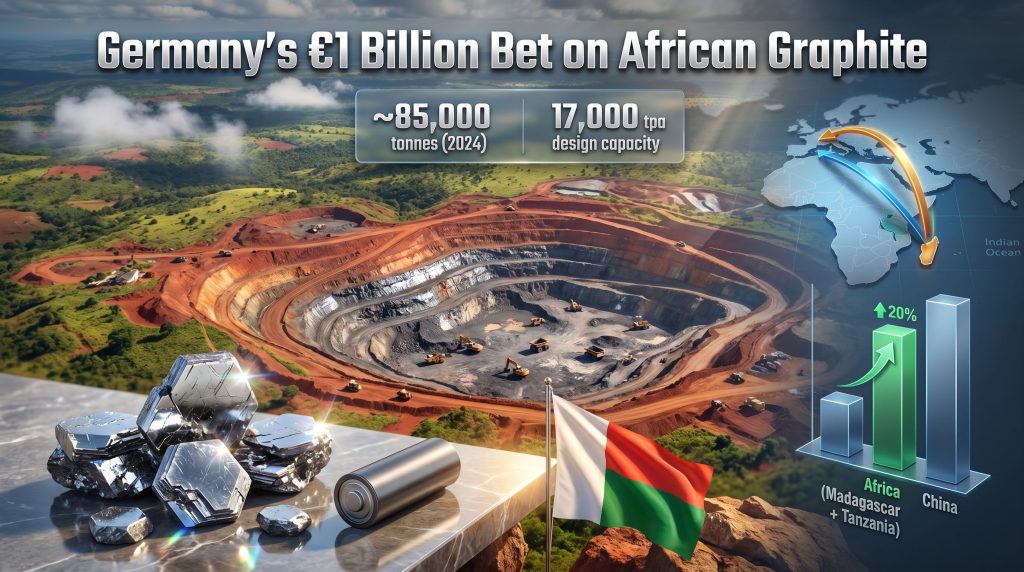
| Madagascar graphite output (2024) | ~85,000 tonnes (USGS data) |
| Madagascar graphite output (2025) | ~80,000 tonnes |
| EU diversification target | No single third country to supply more than 65% of any strategic mineral |
Critical Policy Context: The European Union's Critical Raw Materials Act does not merely classify graphite as strategically important — it imposes binding diversification benchmarks requiring that no single external country supply more than 65% of any listed material to the EU. This transforms graphite sourcing from a commercial procurement decision into a compliance obligation for European manufacturers.
Germany's Federal Minerals Strategy and the Role of the BGR
Understanding why Germany turns to Madagascar graphite requires understanding the institutional architecture through which Germany conducts its resource diplomacy. The Federal Institute for Geosciences and Natural Resources, known by its German acronym BGR, functions as the technical assessment arm of Germany's mineral security apparatus. Its evaluations carry a weight that private consultancy reports cannot replicate — a positive BGR assessment is a precondition, not merely a recommendation, for downstream government financing and bilateral diplomatic engagement.
BGR geoscientists recently conducted a site visit to NextSource Materials' Molo graphite mine in Madagascar, framing the facility as a benchmark asset for the assessment of natural graphite and anode material supply potential. The visit was co-facilitated by Madagascar's Ministry of Mines, a detail that elevates the engagement from routine corporate outreach to government-to-government technical cooperation. BGR's findings are expected to be submitted directly to Germany's Federal Ministry for Economic Cooperation and Development, which manages the policy and financing instruments that follow a positive assessment.
Germany's Critical Mineral Financing Architecture
| Instrument | Scale | Mechanism |
|---|---|---|
| KfW Raw Materials Fund | €1 billion | State development bank-managed investment vehicle |
| Franco-Italian-German Investment Framework | €2.5 billion | Trilateral European co-financing initiative |
| BGR Technical Assessment Program | Ongoing | Geoscientific evaluation of overseas mineral assets |
The sequence from BGR site visit to commercial supply agreement follows a well-established institutional pathway that Germany has previously deployed in other critical mineral jurisdictions. Understanding this pathway is essential for assessing the significance of the Madagascar engagement. In addition, the broader battery metals landscape underscores just how competitive the race for supply chain security has become across Western economies.
Step-by-Step: Germany's Mineral Assessment to Supply Chain Integration Process
- BGR technical site visit — geoscientists evaluate deposit geology, infrastructure quality, and production capacity against benchmark criteria.
- Benchmark asset designation — the site is formally identified as a reference-grade supply candidate within Germany's critical mineral assessment framework.
- Report submission to Federal Ministry — BGR findings inform official development cooperation priorities and trade policy positioning.
- Financing instrument activation — KfW or multilateral European frameworks are engaged to reduce investment risk and support project development.
- Offtake framework negotiation — German industrial buyers enter commercial discussions backed by government risk mitigation structures.
- Long-term supply agreement — a bilateral mineral partnership is formalised between Germany and the host nation government.
Institutional Insight: Germany has operationalised this exact sequence in other resource jurisdictions. Madagascar's graphite sector is now being processed through the same policy architecture, which suggests that commercial and diplomatic outcomes are the intended trajectory of the engagement — not simply academic geoscientific research.
Madagascar's Geology and Its Competitive Edge in Graphite Quality
Not all graphite is commercially equivalent, and this is a distinction that matters enormously for battery manufacturers but is rarely explained in mainstream coverage. Natural graphite deposits are broadly categorised by flake size and carbon purity, with large-flake, high-purity material commanding significant price premiums over fine-flake or amorphous graphite.
Madagascar's geological endowment is particularly valuable because its deposits predominantly yield large-flake graphite with naturally high carbon content. This matters for battery applications because:
- Larger flake sizes are more amenable to the spheronisation process that converts raw graphite into the rounded anode particles battery manufacturers require.
- Higher natural purity reduces the intensity of chemical purification required, lowering processing costs and the environmental footprint of production.
- Structural integrity of large flakes provides better electrochemical cycling performance in finished battery cells, extending effective battery life.
NextSource Materials has developed what it refers to as SuperFlake branded graphite grades at the Molo mine, positioning its output as particularly suited to battery anode specifications. The company has secured commercial validation through existing offtake arrangements, including with thyssenkrupp Materials Trading, prior to the German government engagement — a sequence that lends credibility to the deposit's commercial readiness.
However, the processing challenges associated with converting raw graphite into battery-grade material remain a genuine consideration. The Molo mine carries a design capacity of 17,000 tonnes per annum but is currently operating at an annualised rate of approximately 11,000 tonnes, reflecting technical constraints that remain a genuine due diligence consideration for European policymakers assessing supply reliability.
Madagascar's Rise as Africa's Leading Graphite Producer
According to United States Geological Survey data, Madagascar surpassed Mozambique to become Africa's largest graphite producer in 2024, generating approximately 85,000 tonnes of output that year. Production moderated slightly to around 80,000 tonnes in 2025, reflecting the operational realities of an industry still scaling up rather than any structural decline.
The competitive landscape within Madagascar itself includes several active operators:
| Operator | Project/Operations | Status |
|---|---|---|
| NextSource Materials | Molo graphite mine | Operational; ~11,000 tpa annualised vs. 17,000 tpa design capacity |
| Tirupati Graphite | Multiple Madagascar projects | Active |
| Établissements Gallois | Madagascar operations | Active |
Madagascar's investment environment improved materially following the lifting of a 16-year mining ban, which had suppressed foreign capital inflows into the sector for more than a decade. The recovery of investor confidence has been gradual, and infrastructure limitations — particularly in logistics and energy supply — continue to constrain the pace at which existing projects can scale toward full capacity.
NextSource has also advanced plans for downstream processing facilities in strategic locations including Mauritius, a development that would move the company further along the value chain by supplying processed anode material closer to European end-markets rather than exporting raw concentrate.
Africa vs. China: An Honest Supply Chain Maturity Assessment
| Dimension | China | Africa (Madagascar + Tanzania) |
|---|---|---|
| Mining output | Globally dominant | Emerging; Madagascar ~80,000-85,000 tpa |
| Processing capability | Fully integrated anode material manufacturing | Early-stage; downstream ambitions developing |
| Geopolitical risk profile | High (concentration + export restriction risk) | Moderate (jurisdiction-specific political risk) |
| Western policy alignment | Low | High (active engagement from Germany, EU, North America) |
| Infrastructure maturity | Advanced | Developing |
| Investment timeline to full capacity | Established | 3-7 years depending on jurisdiction |
This comparison reveals the core challenge for European supply chain planners: African graphite producers offer geopolitical diversification but not yet processing parity. China's integrated graphite industrial system represents a multi-decade capital accumulation advantage that cannot be replicated quickly. Consequently, the critical minerals demand driven by the energy transition is placing immense pressure on Western-aligned producers who are primarily operating at the raw material extraction stage.
This means European battery manufacturers would still require processing capacity to be developed — either in Africa, in Europe itself, or in intermediate jurisdictions such as Mauritius.
The next major ASX story will hit our subscribers first
Tanzania and the Broader African Graphite Pipeline
While Madagascar currently leads African graphite production by volume, Tanzania represents the most significant emerging competitor on the continent. Several projects in various stages of development are building toward commercial production:
- Epanko mine (EcoGraf) — advancing through development with a focus on battery-grade purified graphite.
- Mahenge project (Black Rock Mining) — a large-scale graphite deposit with substantial resource estimates positioned for long-term production.
The expansion of Tanzania's graphite pipeline intensifies competition among Western governments for preferential access to African battery mineral assets, while simultaneously strengthening African host governments' negotiating leverage in discussions with prospective investors and offtake partners.
Scenario Analysis: Three Trajectories for Germany's Madagascar Graphite Strategy
The following scenarios are analytical projections based on publicly available policy frameworks and market conditions. They do not constitute investment advice or confirmed outcomes.
Scenario A: Full Supply Partnership Established
BGR findings are strongly positive; KfW financing is activated; a long-term offtake agreement is secured between German industrial buyers and Molo's operator. Madagascar becomes an anchor African graphite supplier for German industry, and European capital supports expansion of the Molo mine toward and beyond its 17,000-tonne design capacity.
Scenario B: Partial Engagement — Technical Cooperation Only
BGR assessment validates deposit quality but operational constraints and infrastructure gaps limit near-term commercial commitments. Germany maintains technical cooperation and monitoring while pursuing parallel supply options in Tanzania. Madagascar remains a strategic reserve option rather than a primary immediate supplier.
Scenario C: Competitive Displacement by Other Western Nations
United States, Japanese, or other Western government programs move faster to secure Molo offtake or broader Madagascar graphite access. German engagement is crowded out, accelerating the need to activate the €2.5 billion trilateral European framework for alternative African assets. Intensified Western competition drives up project valuations and accelerates development timelines across the continent.
Speculative Consideration: A less-discussed fourth scenario involves Madagascar itself adopting a more assertive resource nationalism posture as competition for its graphite intensifies. African host governments observing precedents set in lithium-rich nations may seek to impose beneficiation requirements — mandating that graphite be processed domestically before export — as a condition of long-term supply agreements. This would fundamentally alter the economics of Madagascar graphite projects and deserves monitoring by investors with exposure to the sector.
What Investors and Industry Observers Should Watch
Several indicators will clarify which trajectory Germany's Madagascar engagement follows over the next 12 to 24 months. The critical raw materials transition underway across Europe means these signals carry significant weight for both policymakers and market participants. Key indicators include:
- Submission of BGR's technical assessment report to Germany's Federal Ministry for Economic Cooperation and Development and any subsequent public financing announcements.
- Progress by NextSource Materials in closing the gap between the Molo mine's current annualised output of approximately 11,000 tonnes and its 17,000-tonne design capacity.
- Competing engagement signals from US, Japanese, South Korean, or other Western government programs targeting Madagascar's graphite sector — particularly through instruments such as the US Defense Production Act or Japan's JOGMEC financing framework.
- Evolution of EU Critical Raw Materials Act implementation benchmarks and their effect on member-state bilateral mineral diplomacy timelines.
- Development of downstream processing capacity, whether in Madagascar, Mauritius, or European facilities, which would determine how much value is captured at each stage of the supply chain.
Frequently Asked Questions
Why is graphite so difficult to substitute in battery applications?
Graphite's layered crystalline structure allows lithium ions to intercalate — insert themselves between atomic layers — during charging, and release during discharge. This electrochemical mechanism is highly efficient and is not yet replicated at commercial scale by alternative anode materials such as silicon, which suffers from significant volumetric expansion that degrades battery cycle life.
What distinguishes natural graphite from synthetic graphite in battery applications?
Synthetic graphite is manufactured from petroleum coke through high-temperature processing and offers consistent quality but at significantly higher energy cost. Natural graphite requires less energy to produce but demands more purification to reach battery-grade specifications. Large-flake natural graphite from deposits like those in Madagascar is increasingly preferred for certain battery formats because of its structural properties and improving cost competitiveness.
How does BGR's assessment differ from a private sector mining report?
BGR is a federal government institution whose technical evaluations carry official policy weight and feed directly into Germany's development financing and diplomatic decision-making processes. A positive BGR assessment is a precursor to government-backed financing mechanisms — it is not equivalent to a commercial feasibility study produced for investor purposes.
Is Madagascar's investment environment sufficiently stable for long-term supply chain commitments?
Madagascar's investment climate has improved following the end of its prolonged mining ban, but operational risks including infrastructure constraints, logistics costs, and technical production limitations remain material considerations. Government-to-government engagement of the kind signalled by the BGR visit, co-facilitated by Madagascar's Ministry of Mines, represents one mechanism through which Western governments seek to embed political risk mitigation into mineral partnership structures.
How significant is the gap between current Molo production and design capacity?
The Molo mine's current annualised production rate of approximately 11,000 tonnes against a design capacity of 17,000 tonnes represents a shortfall of roughly 35%. For European supply reliability assessments, understanding the technical nature of constraints limiting full-capacity operation — whether related to processing equipment, power supply, or logistics — is essential due diligence.
This article is intended for informational and analytical purposes only. It does not constitute financial or investment advice. Scenario projections and forward-looking assessments involve inherent uncertainty and should not be relied upon as predictions of actual outcomes. Readers should conduct independent research before making any investment decisions.
Want to Track the Next Major Mineral Discovery Before the Market Does?
Discovery Alert's proprietary Discovery IQ model delivers real-time ASX alerts the moment significant mineral discoveries — including battery and critical minerals like graphite — are announced, translating complex data across 30+ commodities into clear, actionable insights for investors at every level. Explore Discovery Alert's discoveries page to see how major mineral finds have historically generated substantial returns, and begin your 14-day free trial today to position yourself ahead of the broader market.