May 16, 2026
Why Credit Ratings Are a Structural Lever in Global Metals Markets
In capital-intensive industries like aluminium production, the difference between a single credit rating notch is rarely just symbolic. For large diversified metals conglomerates operating across multiple commodity cycles, credit ratings function as a gating mechanism that determines not only the cost of borrowed capital but the very feasibility of long-term industrial expansion. When refineries need expanding, mining operations need deepening, and downstream product lines need building out, access to affordable debt is not a competitive convenience — it is a competitive necessity.
The speculative-grade credit spectrum, which spans from B- through BB+, carries a practical dividing line that many investors underestimate. While investment-grade status begins at BBB-, the distinction between a B+ and a BB rating carries its own substantial weight. A BB-rated issuer is still considered non-investment-grade, but it communicates meaningfully lower default risk and typically commands tighter yield spreads in bond markets.
For a company carrying billions of dollars in total debt, even a 50 to 100 basis point compression in borrowing costs can translate into tens of millions of dollars in annual interest savings — freeing capital for productive industrial deployment rather than debt servicing.
It is within this framework that the Vedanta S&P Global BB upgrade, issued on 14 May 2026, becomes most legible — not simply as a financial event, but as a structural signal about the operational and balance sheet trajectory of one of Asia's largest integrated metals producers.
When big ASX news breaks, our subscribers know first
From Restructuring to Recovery: The Four Pillars Behind the Upgrade
S&P Global's decision to lift Vedanta Resources from B+ to BB with a stable outlook was not driven by a single factor. The agency's assessment reflected a convergence of four distinct improvements across the business, each reinforcing the others.
- Operational performance: A strengthening EBITDA trajectory anchored by aluminium integration and supportive commodity pricing provided the earnings foundation S&P required.
- Liquidity reinforcement: Since early 2026, Vedanta secured more than USD 2 billion in new long-term banking facilities whilst maintaining cash reserves exceeding USD 3 billion, giving the group a robust liquidity buffer against near-term obligations.
- Proactive refinancing: Vedanta raised more than USD 3.5 billion through bond issuances since September 2024 and secured over USD 3 billion in syndicated term loans during FY26 alone — demonstrating renewed and diversified access to global capital markets following its 2023 debt restructuring phase.
- Consistent deleveraging: Adjusted debt is projected to decline by USD 500 million in FY27, with a further USD 1 billion reduction forecast for FY28.
Furthermore, the timeline below captures how these developments unfolded across the credit recovery cycle:
| Milestone | Detail |
|---|---|
| 2023 | Debt restructuring phase completed |
| September 2024 | Bond market re-entry begins |
| FY26 | Over USD 3 billion in syndicated term loans secured |
| Early 2026 | USD 2+ billion in new long-term banking lines established |
| May 14, 2026 | S&P Global upgrades to BB with stable outlook |
| FY27 Forecast | Adjusted debt reduction of USD 500 million |
| FY28 Forecast | Additional USD 1 billion debt reduction |
The pattern S&P credited is well-established in post-restructuring credit narratives: agencies respond positively when companies demonstrate balance sheet repair, liquidity restoration, reduced refinancing risk, and earnings stabilisation across multiple consecutive reporting periods. Vedanta's trajectory fits this model closely.
Aluminium Integration: The Cost Architecture Driving Margin Expansion
The Economics of Backward Integration in Aluminium Production
Few cost-reduction strategies in industrial manufacturing carry the structural permanence of backward integration. In aluminium production, the supply chain runs from bauxite ore through alumina refining and ultimately into primary metal smelting. At each stage, a producer dependent on third-party suppliers absorbs spot market price risk, procurement premiums, and logistics exposure. Understanding bauxite supply dynamics is, consequently, essential context for appreciating the strategic logic of Vedanta's integration programme.
Vedanta's strategy has been to progressively internalise this supply chain through the expansion of its Lanjigarh alumina refinery in Odisha and the parallel development of captive bauxite mining operations. The financial logic is straightforward: every percentage point of captive raw material coverage reduces dependence on external procurement and the margin erosion that comes with it.
Captive Alumina Coverage: The 60% to 75%+ Transition
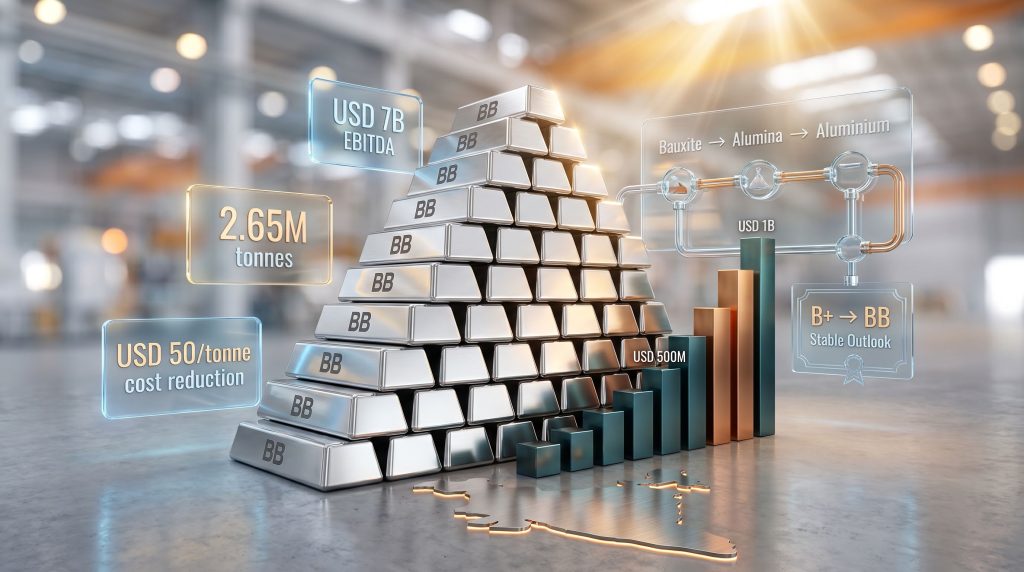
In FY26, Vedanta's captive alumina production covered approximately 60% of its total aluminium production requirements. S&P's base-case projections anticipate the addition of roughly 1 million tonnes of captive alumina capacity, pushing coverage beyond 75% by FY27. The cost impact is estimated at approximately USD 50 per tonne of aluminium produced.
To understand the scale of that saving, consider Vedanta's projected aluminium sales volumes:
- FY26: 2.456 million tonnes
- FY28: 2.65 million tonnes (forecast)
At USD 50 per tonne applied across 2.65 million tonnes, the potential annual cost saving approaches USD 132.5 million — a material and recurring EBITDA contribution that accrues before any commodity price uplift is counted.
This is not a one-time efficiency gain. The structural permanence of captive raw material supply means the saving compounds across every future tonne produced — making integration a long-duration earnings quality improvement rather than a cyclical earnings boost.
Bauxite Mining: The 12 to 18 Month Incremental Play
Beyond alumina, the gradual expansion of captive bauxite mining operations is expected to deliver further cost efficiency improvements over the next 12 to 18 months. Securing domestic bauxite supply reduces Vedanta's exposure to international ore price fluctuations and logistical disruptions that have periodically destabilised imported raw material costs for Indian smelters.
India holds substantial domestic bauxite reserves, and the ability to access those resources at controlled cost is a structural advantage for producers with the capital and operational scale to develop them. For broader context, the commodity price impacts of raw material volatility on integrated producers have been well-documented across the global metals sector.
Financial Projections Through FY28: Stability With a Declining Debt Profile
EBITDA Stability and Volume Growth
S&P's base-case financial forecast for Vedanta projects group EBITDA remaining at approximately USD 7 billion annually through both FY27 and FY28. That headline stability masks an important underlying dynamic: as production costs decline through integration and debt servicing costs fall through deleveraging, the quality and durability of that EBITDA improves even if the headline figure holds steady.
| Metric | FY26 (Actual/Estimate) | FY27 (Forecast) | FY28 (Forecast) |
|---|---|---|---|
| Group EBITDA | ~USD 7 billion | ~USD 7 billion | ~USD 7 billion |
| Aluminium Sales Volume | 2.456 million tonnes | Increasing | 2.65 million tonnes |
| Aluminium Production Cost | USD 1,752/tonne | Declining | ~USD 1,700/tonne |
| Adjusted Debt Reduction | – | USD 500 million | USD 1 billion (additional) |
| Captive Alumina Coverage | ~60% | >75% | Expanding further |
Value-Added Products: The Margin Layer Above LME Pricing
A growing proportion of Vedanta's aluminium and zinc output consists of value-added products that command premiums above London Metal Exchange benchmark prices. This product mix shift is strategically significant because it reduces earnings sensitivity to spot commodity price cycles. When aluminium prices soften, producers locked into commodity-grade primary metal sales absorb the full impact.
Producers selling fabricated, alloyed, or specialised aluminium products, however, retain a premium buffer that partially insulates margins. This downstream product diversification is a well-understood margin enhancement strategy in the global aluminium industry, but executing it at scale requires substantial capital investment and technical capability.
The FFO-to-Debt Ratio: S&P's Critical Monitoring Metric
S&P's stable outlook carries an explicit condition: Vedanta must maintain a funds from operations (FFO) to debt ratio above 30% over the next 12 to 24 months. This threshold is the agency's primary gauge of cash generation efficiency relative to total debt obligations.
Sustained performance above this threshold, combined with continued holding company debt reduction and stronger free cash flow generation, are the conditions S&P has outlined as prerequisites for any future upgrade consideration toward BB+ or beyond.
The Demerger Dimension: Credit Neutrality and Structural Complexity
Five Listed Entities and the Holding Company Question
Vedanta Limited's separation into five independently listed entities was assessed by S&P as broadly credit-neutral at the holding company level. The agency's reasoning centres on the holding company retaining access to subsidiary cash flows under its existing analytical framework — meaning the demerger does not impair the financial consolidation that underpins the group credit profile.
The strategic logic for the demerger is distinct from the credit question. Separating businesses into standalone listed entities allows each to attract sector-specific institutional investors, potentially unlocking valuation multiples that are suppressed within a diversified conglomerate structure. Aluminium, zinc, oil and gas, and steel businesses carry different earnings profiles, capital cycles, and investor bases.
The Structural Mismatch S&P Flagged
Despite the credit-neutral assessment of the demerger itself, S&P identified a structural imbalance that remains a tangible constraint on the group's credit profile. The numbers reveal the tension clearly:
- Holding company debt: Over 30% of consolidated group debt sits at the holding company level
- Holding company earnings contribution: Approximately 5% of group earnings
- Hindustan Zinc and BALCO combined debt: Approximately 6% of consolidated debt
- Hindustan Zinc and BALCO combined earnings: Over 30% of group earnings
This structural mismatch — where debt is concentrated at the entity generating the least earnings whilst the highest-earning subsidiaries carry relatively little debt — creates subordination risk for holding company creditors. It also means that distributing cash upward from subsidiaries to service holding company obligations depends on dividend flows and intercompany mechanisms that can face regulatory, minority shareholder, and governance constraints.
The agency also upgraded Vedanta's senior unsecured notes from B to BB- as part of the same rating action — a move that improves the risk profile for existing bondholders but still reflects the one-notch structural subordination typically applied to holding company unsecured debt.
Comparative Credit Positioning: Where Vedanta Sits in the Global Metals Spectrum
The Gap Between BB and Investment Grade
The distance between Vedanta's current BB rating and investment-grade status, which begins at BBB-, is two full rating notches. In practical terms, bridging that gap requires not just continued operational improvement but sustained, multi-period demonstration of financial discipline across leverage metrics, cash flow generation, and structural debt reduction.
Investment-grade status would open Vedanta's paper to a substantially broader institutional investor base, including pension funds and insurance companies with investment-grade mandates that currently preclude participation. For context, leading aluminium producers such as Rio Tinto, BHP, and South32 typically carry ratings in the BBB to A range, reflecting lower leverage, higher free cash flow conversion, and structurally simpler balance sheets.
What Post-Restructuring Credit Recoveries Typically Look Like
The credit recovery trajectory that Vedanta has followed is recognisable within the global metals and mining sector. Companies that emerge from debt restructuring phases with a clear refinancing plan, demonstrated access to diversified capital markets, and a credible operational improvement narrative tend to receive incremental upgrades from rating agencies as each milestone is delivered.
The key variables that distinguish sustained recoveries from temporary improvements are commodity price durability, structural cost reduction, and management's willingness to prioritise balance sheet repair over capital returns. S&P's explicit reference to favourable commodity prices as a contributing factor to the Vedanta S&P Global BB upgrade is a reminder that the timing of credit recoveries in mining is rarely independent of price cycles.
The critical question for analysts is whether the structural improvements in backward integration and cost reduction are sufficient to maintain the upgraded credit profile through a commodity price correction — or whether the rating remains partially commodity-price-dependent.
The next major ASX story will hit our subscribers first
Key Risks That Could Reverse the Rating Trajectory
No credit upgrade in the commodities sector comes without a set of downside scenarios worth monitoring. S&P identified several risk factors that could pressure Vedanta's BB rating:
- Commodity price reversal: A sustained decline in aluminium or zinc prices could compress EBITDA and push the FFO-to-debt ratio below the 30% threshold that anchors the stable outlook.
- Holding company debt overhang: Failure to meaningfully reduce the disproportionate debt concentration at the holding company relative to its earnings contribution would sustain a structural vulnerability in the credit profile.
- Demerger execution risk: Capital allocation pressures across the five newly listed entities could create unexpected balance sheet stress at the subsidiary level, potentially complicating dividend flows to the holding company.
- Refinancing risk resurgence: Any deterioration in capital market access could reverse the liquidity improvements S&P credited as a core driver of the upgrade.
Conditions for a future upgrade to BB+ or higher would, furthermore, require sustained FFO-to-debt ratios above 30% across multiple consecutive periods, demonstrable holding company debt reduction, continued captive raw material expansion, and maintenance of diversified funding access across bond and syndicated loan markets.
India's Aluminium Ambitions and the Integrated Producer Advantage
Domestic Production Depth as a Strategic Differentiator
Vedanta's credit recovery story sits within a broader industrial context that gives it additional strategic weight. India has been systematically developing its aluminium production capacity to reduce import dependency and strengthen domestic industrial supply chains. This mirrors broader industrial decarbonisation projects and capacity-building initiatives taking place across the Asian metals sector. Vertically integrated producers with captive raw material security are structurally better positioned to support national industrial objectives than pure smelters reliant on imported alumina or bauxite.
The Lanjigarh refinery expansion in Odisha and the progressive development of captive bauxite mining capacity represent Vedanta's contribution to deepening India's domestic aluminium supply chain. The cost competitiveness gains from that integration are not only a balance sheet benefit for Vedanta but a broader industrial efficiency improvement for Indian aluminium manufacturing. In addition, an aluminium joint venture model — as seen elsewhere in the sector — illustrates how strategic partnerships can further accelerate integration and cost reduction ambitions.
The Compounding Effect of Lower Financing Costs
The Vedanta S&P Global BB upgrade carries a compounding benefit that extends beyond the immediate rate cycle. A lower cost of capital enables more efficient financing of future capital expenditure programmes, including refinery expansions, mine development, and downstream value-added product capacity. Lower financing costs reduce the hurdle rate for project approval, consequently accelerating the investment cycle and reinforcing the operational improvements that drove the upgrade in the first place.
For investors and analysts tracking Vedanta's trajectory, the Vedanta S&P Global BB upgrade is therefore best understood not as a destination but as an enabling milestone — one that lowers the structural cost of executing the operational strategy that the rating itself is designed to reflect. Further analysis from S&P Global outlines additional context on the rating rationale and forward-looking conditions attached to the stable outlook.
Readers seeking broader context on aluminium production trends, refinery developments, and commodity market dynamics across Asia can explore ongoing industry coverage at AL Circle, which provides reporting on the global aluminium sector.
Disclaimer: This article contains forward-looking financial projections and credit rating assessments sourced from S&P Global Ratings as reported in industry publications. These forecasts are subject to change based on commodity price movements, operational performance, and broader macroeconomic conditions. Nothing in this article constitutes financial or investment advice. Readers should conduct their own due diligence before making any investment decisions.
Want to Identify the Next Major Metals Discovery Before the Market Moves?
Discovery Alert's proprietary Discovery IQ model delivers real-time alerts on significant ASX mineral discoveries, instantly translating complex data across more than 30 commodities into actionable insights for investors at every level — explore historic examples of exceptional discovery returns to understand the scale of opportunity, then begin a 14-day free trial at Discovery Alert to position yourself ahead of the broader market.