June 25, 2026
The Hidden Economics of Greenfield Mega-Projects: Why Cost Blowouts Are the Rule, Not the Exception
There is a well-documented pattern in large-scale resource infrastructure development that most investors learn about the hard way. Studies of major mining and energy projects constructed over the past three decades consistently show that projects exceeding US$1 billion in capital expenditure run over budget at rates approaching 70 to 80 percent. The average cost overrun across this cohort is not a modest 10 or 15 percent. It routinely lands between 30 and 50 percent above the original sanctioned figure. Understanding this structural reality is essential context for interpreting the BHP Jansen potash project cost blowout, which has now placed the combined two-stage development approximately US$4.7 billion above its original approved budget.
This is not simply a story about one company making poor estimates. It is, furthermore, a case study in the compounding forces that make greenfield mega-projects one of the most capital-destructive environments in global business, and a useful lens for investors trying to assess whether the punishment already priced into BHP Group Ltd (ASX: BHP) shares is proportionate to the underlying damage.
When big ASX news breaks, our subscribers know first
Breaking Down the BHP Jansen Cost Blowout: What the Numbers Actually Show
The scale of the budget deterioration across both Jansen stages is significant enough to warrant careful examination rather than a simple headline figure.
| Project Phase | Original Approved Budget | Revised Estimate | Cost Increase | Timeline Shift |
|---|---|---|---|---|
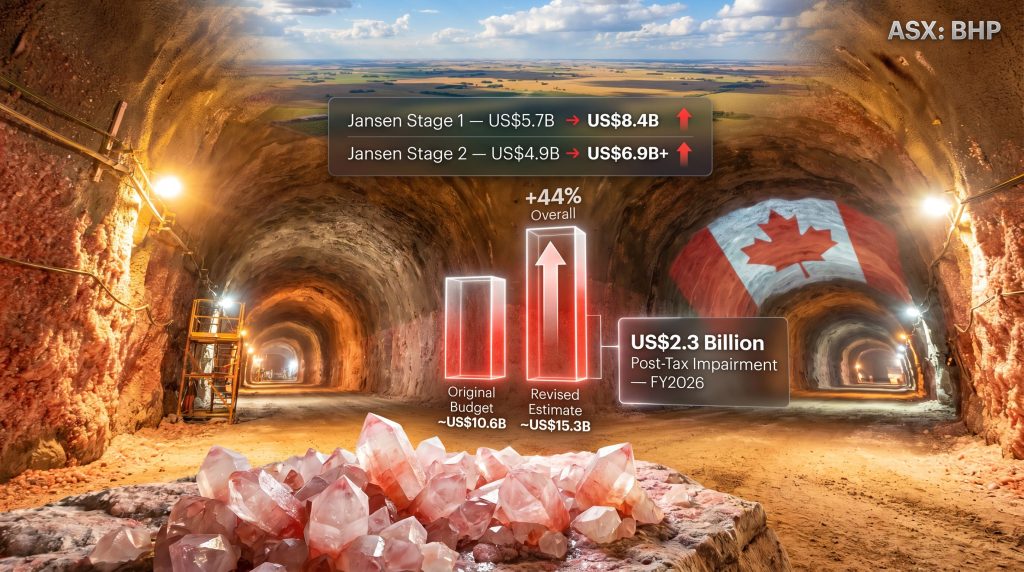
| Jansen Stage 1 | US$5.7 billion (2021) | US$8.4 billion | +47% (~US$2.7B) | Delayed to mid-2027 |
| Jansen Stage 2 | US$4.9 billion (2023) | US$6.9 billion+ | +40% (~US$2.0–2.5B) | Pushed to FY2031 |
| Combined Project | ~US$10.6 billion | ~US$15.3 billion | +44% overall | Multiple revisions |
The most recent trigger was a comprehensive internal review of Stage 2 cost and schedule assumptions, which revealed that the original execution plan was no longer viable under current operating conditions. BHP confirmed it would recognise an approximately US$2.3 billion post-tax impairment charge against Stage 2 in its FY2026 financial results, while simultaneously disclosing that first production from Stage 2 has been pushed from 2029 to FY2031.
Stage 1, which was originally sanctioned in 2021 at US$5.7 billion, has itself escalated to approximately US$8.4 billion and remains targeted for first production in FY2027. A further cost and timing update on Stage 1 is expected before 31 December 2026, which means investors face at least one more potential revision cycle before the first tonne of Jansen potash is produced.
The Four Structural Drivers Behind the Cost Deterioration
The budget deterioration across both stages shares common root causes, none of which are unique to BHP but all of which have been more severe at Jansen than the original feasibility models assumed. The definitive feasibility study assumptions embedded in the project's sanctioned budget have, in each case, proven optimistic:
-
Sustained input cost inflation: Steel, specialised underground mining equipment, concrete, and engineered components have all remained significantly more expensive than pre-pandemic benchmarks, with limited deflation materialising in remote construction markets.
-
Engineering scope changes: Material design revisions introduced after the original execution plan was locked in are one of the most destructive forces in large project budgets. At Jansen, underground mine design complexity appears to have exceeded initial estimates.
-
Skilled trades shortages and productivity shortfalls: Saskatchewan's remote geography creates a structural disadvantage in attracting and retaining qualified underground mining tradespeople. On-site productivity has reportedly tracked below the assumptions embedded in the original schedule.
-
Regulatory and permitting complexity: The permitting risks surrounding large-scale underground potash development in Canada proved more layered and time-consuming than the project's feasibility phase anticipated, adding both direct cost and schedule risk.
Potash as a Commodity: Why BHP Chose Saskatchewan and What It Says About Long-Run Strategy
To understand why BHP has continued investing through repeated cost overruns rather than walking away, it is necessary to understand what potash actually represents as a commodity and why Saskatchewan specifically is considered one of the most strategically valuable potash jurisdictions on the planet.
Potash, primarily in the form of potassium chloride (KCl), is one of three primary macronutrients applied to agricultural soils globally, alongside nitrogen and phosphate. Unlike those two, potash cannot be synthesised from atmospheric inputs. It must be mined. Global potash supply is therefore structurally dependent on the location of economically viable deposits, which are concentrated in a small number of jurisdictions: Canada, Russia, Belarus, and to a lesser extent Germany and China.
The Saskatchewan Williston Basin, where Jansen is located, hosts what is widely regarded as the world's largest and highest-quality potash resource base. The ore body characteristics at Jansen are noteworthy:
-
The deposit sits at depths of roughly 1,000 to 1,100 metres below surface, requiring shaft sinking and conventional underground room-and-pillar mining methods rather than solution mining.
-
The potash ore grade at Jansen is considered high-quality by global standards, with potassium chloride content supporting competitive production economics at scale.
-
The multi-decade resource life of the Williston Basin deposits underpins the case for a long-duration capital commitment, even when near-term construction economics are unfavourable.
The depth profile of Jansen is a critical but underappreciated factor in understanding the project's cost structure. Underground potash mining at depths exceeding 1,000 metres demands highly specialised shaft sinking expertise, ventilation engineering, and ground control systems that are fundamentally different from shallow open-cut or solution mining operations. This technical complexity was always going to make Jansen one of the most engineering-intensive potash developments ever attempted.
The geopolitical dimension adds another layer of strategic logic. Following Russia's invasion of Ukraine in 2022 and the subsequent disruption to Belarusian potash exports through Western sanctions, the global potash market experienced a period of extreme price volatility. Spot prices for muriate of potash (MOP) surged above US$1,000 per tonne in mid-2022 before retreating sharply as demand destruction and supply rerouting took effect. This price cycle illustrated both the fragility of a market dominated by a small number of politically exposed producers and the long-run premium that attaches to stable, sovereign-risk-light supply from jurisdictions like Canada.
What the US$2.3 Billion Impairment Actually Communicates to the Market
Non-Cash Mechanics vs. Credibility Signals
An impairment charge is a balance sheet adjustment, not a cash payment. It reflects a formal accounting recognition that the carrying value of an asset exceeds the present value of its expected future cash flows under revised assumptions. In isolation, a non-cash impairment does not reduce BHP's liquidity, impair its debt covenants, or constrain its dividend capacity in the near term.
However, the market's reaction to the announcement — a share price decline of approximately 3.2% on the day of disclosure, with the stock sitting around 8% below its 52-week high in the days that followed — was not primarily driven by the accounting mechanics. The more significant investor concern is the pattern of successive upward revisions that has now become a defining characteristic of the BHP Jansen potash project cost blowout's execution history:
-
Stage 1 sanctioned at US$5.7 billion in 2021
-
Stage 1 subsequently revised toward US$8.4 billion, a 47% increase
-
Stage 2 sanctioned at US$4.9 billion in October 2023
-
Stage 2 now revised to US$6.9 billion or higher, a further 40% increase
Each revision compounds institutional scepticism around management's capacity to produce reliable capital estimates for greenfield projects of this complexity. For large fund managers with multi-decade investment horizons, the credibility of capital allocation decisions matters as much as any individual project's economics.
It is also worth noting that BHP shares had appreciated approximately 35% since the start of 2026 before the announcement. A stock that has run strongly leaves little cushion for negative surprises, and the Jansen update landed into a market that had already priced in considerable optimism.
How Jansen Compares to Other Mining Mega-Project Overruns
The Jansen cost trajectory is severe but not historically unprecedented. The following comparison places it within the broader context of large-scale resource project execution:
| Project | Operator | Original Budget | Final/Revised Cost | Overrun % |
|---|---|---|---|---|
| Jansen (Stages 1+2) | BHP | ~US$10.6B | ~US$15.3B | ~44% |
| Oyu Tolgoi Underground | Rio Tinto | US$5.3B | US$7.06B | ~33% |
| Gorgon LNG | Chevron-led | US$37B | US$54B | ~46% |
| Ichthys LNG | INPEX-led | US$34B | US$45B+ | ~32% |
Note: Project scope definitions and the basis for original budget figures vary. Comparisons are illustrative using publicly available data.
What this table reveals is that Jansen's overrun percentage is broadly consistent with the worst cohort of large resource projects, but it is not an outlier by historical standards. The Gorgon LNG project, for instance, represents a similar scale of budget deterioration in percentage terms, and that project ultimately became a cash-generating asset of significant value for its participants.
The Saskatchewan Factor: Remote Construction Economics
One dimension of Jansen's cost challenge that receives insufficient attention is the specific economics of remote construction in central Canada. Saskatchewan's potash mining industry is well-established, but the existing producer base, dominated by Nutrien (the world's largest potash producer by capacity), has absorbed much of the available skilled underground mining workforce. BHP is essentially competing for labour in a market where incumbent operators have entrenched employment relationships and superior logistical infrastructure built over decades.
Labour mobilisation costs for a greenfield project of Jansen's scale in this geography are materially higher than analogous projects in more established mining regions. Fly-in fly-out rosters, accommodation camp construction and maintenance, and the productivity penalty associated with high workforce turnover in remote locations all compound the base wage inflation that has persisted across the sector since 2021.
The Potash Market Structure: Understanding Long-Run Price Dynamics
One of the least understood aspects of the Jansen investment thesis is the oligopolistic structure of the global potash market and its implications for long-run pricing.
Global potash supply has historically been coordinated, to varying degrees, by two dominant trading organisations: Canpotex (the export marketing arm of Canadian producers Nutrien and Mosaic) and the now-disrupted Belarusian Potash Company. This quasi-cartel structure provided a degree of price stability that made potash an attractive commodity for long-duration capital investment.
The sanctions imposed on Belarusian exports following the 2022 geopolitical disruption permanently altered the supply-side dynamics of this market. While prices have retreated from their 2022 peaks, the effective removal of one of the world's three largest exporters from Western markets has created a structural vacancy that Canadian producers are best positioned to fill over the medium to long term.
For BHP, Jansen's full buildout would position the company as a top-tier global potash exporter, with access to the same Canpotex marketing infrastructure used by Nutrien and Mosaic. Entry into this export channel represents a significant competitive advantage that is rarely discussed in coverage of the project's cost problems.
The next major ASX story will hit our subscribers first
Jansen's Delay and Its Compounding Effect on Project Economics
The two-year extension of Stage 2's timeline to FY2031 creates financial consequences that extend beyond the headline cost increase:
-
Net present value erosion: At any positive discount rate, a two-year delay in future cash flows reduces their present value. For a project of Jansen Stage 2's scale, this NPV reduction is material regardless of the discount rate applied.
-
Extended capital carry period: BHP must continue funding construction expenditure for two additional years without the offsetting revenue contribution that Stage 2 production would have provided from 2029 onward.
-
Increased inflation exposure: Each additional year of construction extends the project's vulnerability to further input cost escalation, creating a compounding risk that is difficult to fully hedge.
-
Competitor timeline convergence: Nutrien's brownfield expansion capacity and potential new entrant projects elsewhere could alter the market's supply-demand balance by the time Jansen Stage 2 reaches full production.
Does the BHP Jansen Blowout Change the Core Investment Case for ASX: BHP?
The Two Earnings Pillars the Blowout Does Not Touch
Investors who hold BHP shares primarily for their exposure to iron ore cash flow and copper growth will find that neither of those investment premises has been materially altered by the Jansen update. The iron ore cash flow generated by BHP's Pilbara operations remains one of the most resilient earnings streams in global mining.
BHP's Pilbara iron ore operations remain among the most cost-competitive iron ore production systems in the world, generating substantial free cash flow across a wide range of iron ore price scenarios. This cash engine funds BHP's dividend, its exploration programme, and its capital commitments to growth projects including Jansen itself.
The copper portfolio, anchored by Escondida in Chile and the Copper South Australia operations including Olympic Dam, provides direct leverage to what many analysts regard as the most structurally compelling commodity. The copper demand outlook is driven by the convergence of electric vehicle manufacturing, grid-scale energy storage, data centre buildout, and renewable energy generation — creating a demand profile that is largely independent of traditional economic cycles.
Jansen as a Long-Duration Option, Not a Near-Term Catalyst
The most analytically useful framing for Jansen within BHP's portfolio is to treat it as a long-duration option on agricultural commodity demand. The project has become more expensive and more delayed, but BHP's decision to continue rather than abandon it signals management's conviction that the underlying commodity thesis remains intact.
Investors who approach BHP with a five-to-ten-year horizon should distinguish between the project's execution setbacks — which are real and concerning from a capital discipline perspective — and the strategic merit of the underlying asset, which has not fundamentally changed. What has changed is the cost of exercising that option and the timeline to cash flow realisation.
Key Risk Factors to Monitor Through the Jansen Development Cycle
Investors maintaining BHP exposure through the Jansen build-out period should track the following risk variables, given the considerable commodity price sensitivity embedded in this project's economics:
-
Stage 1 update before 31 December 2026: Any further upward revision to Stage 1 costs would represent a fourth successive budget miss and could trigger a more severe institutional reassessment of management's project estimation capability.
-
Global potash price trajectory: The recovery or further deterioration of MOP prices from current levels will significantly influence the NPV assumptions underlying both stages of Jansen.
-
AUD/USD exchange rate movements: Jansen's costs are denominated in US and Canadian dollars, while BHP's ASX-listed shares are priced in Australian dollars. Currency movements create an additional layer of return variability for Australian shareholders.
-
Competitor expansion timelines: Nutrien's brownfield capacity additions and any new greenfield entrants to the potash market could affect long-run pricing assumptions that underpin Jansen's project economics.
-
Capital allocation decisions at BHP board level: Institutional investors will be watching closely for any signals that BHP's board is considering scaling back, restructuring, or seeking a joint venture partner for Jansen Stage 2 as an alternative to continued sole-ownership capital deployment. Understanding the broader commodity price sensitivity of these decisions is essential for long-term shareholders.
Scenario Analysis: Three Pathways for Jansen by 2031
| Scenario | Key Assumptions | Implication for BHP Shareholders |
|---|---|---|
| Base Case | Stage 1 delivers in FY2027 at current revised cost; Stage 2 completes FY2031 with no further overruns | Jansen becomes a meaningful third earnings pillar by early 2030s; credibility partially restored |
| Upside Case | Potash prices recover toward US$400–500/tonne; Stage 2 costs stabilise; operational performance exceeds plan | NPV recovery; Jansen re-rated as a core strategic asset; positive re-rating of BHP's diversification premium |
| Downside Case | Further Stage 1 or Stage 2 overruns materialise; potash prices remain suppressed below US$250/tonne | Additional impairments required; capital reallocation pressure intensifies; management credibility erosion accelerates |
This scenario analysis is illustrative and does not constitute financial advice. Actual outcomes will depend on factors including commodity prices, construction execution, and global agricultural demand conditions that cannot be predicted with certainty.
Frequently Asked Questions: BHP Jansen Potash Cost Blowout
What is the total cost of the BHP Jansen potash project now?
The combined revised estimate for Jansen Stage 1 and Stage 2 is approximately US$15.3 billion, compared to an original combined approved budget of roughly US$10.6 billion. This represents a total increase of approximately 44% across both phases.
When will Jansen start producing potash?
Stage 1 first production remains targeted for FY2027. Stage 2 production has been delayed to FY2031, two years later than the original 2029 target.
What is the BHP Jansen impairment charge?
BHP will recognise an approximately US$2.3 billion post-tax impairment against Jansen Stage 2 in its FY2026 financial results. This is a non-cash accounting adjustment and does not represent an immediate cash outflow.
Why did the BHP Jansen project go so far over budget?
The primary contributors include sustained construction cost inflation across specialised materials and equipment, significant engineering and design scope changes introduced after project sanction, skilled trades shortages and below-target productivity in remote Saskatchewan, and greater-than-anticipated regulatory and permitting complexity. The BHP Jansen potash project cost blowout reflects forces that are structurally common to greenfield mega-projects of this scale.
Is BHP going to cancel the Jansen project?
No. BHP has confirmed it is proceeding with both Stage 1 and Stage 2. The company has explicitly characterised the latest update as a revision to cost and timeline rather than any change to its strategic commitment to potash.
How have BHP shares performed since the Jansen announcement?
BHP shares declined approximately 3.2% on the day of the announcement and were trading roughly 8% below their 52-week record high in the days following the update, according to Motley Fool Australia's reporting on the event.
This article contains general information only and does not constitute financial advice. Investing in shares involves risk, including the potential loss of capital. Past performance is not indicative of future results. Readers should seek independent financial advice before making investment decisions.
Want to Stay Ahead of the Next Major ASX Mineral Discovery?
While BHP's Jansen saga illustrates the challenges of mega-project investing, Discovery Alert's proprietary Discovery IQ model scans ASX announcements in real time, instantly identifying significant mineral discoveries and turning complex data into actionable opportunities — explore historic discoveries that have generated extraordinary returns and begin your 14-day free trial at Discovery Alert to position yourself ahead of the broader market.