June 25, 2026
The Quiet Industrial Giant Outpacing the Market in 2026
Most investors fixate on the loudest opportunities: artificial intelligence, semiconductor titans, and consumer technology platforms that generate endless media coverage. Yet some of the most durable wealth-building positions in a portfolio emerge from businesses that operate almost invisibly within the industrial economy. The global industrial gas sector is a textbook example, and its largest player has been compounding returns with remarkable consistency.
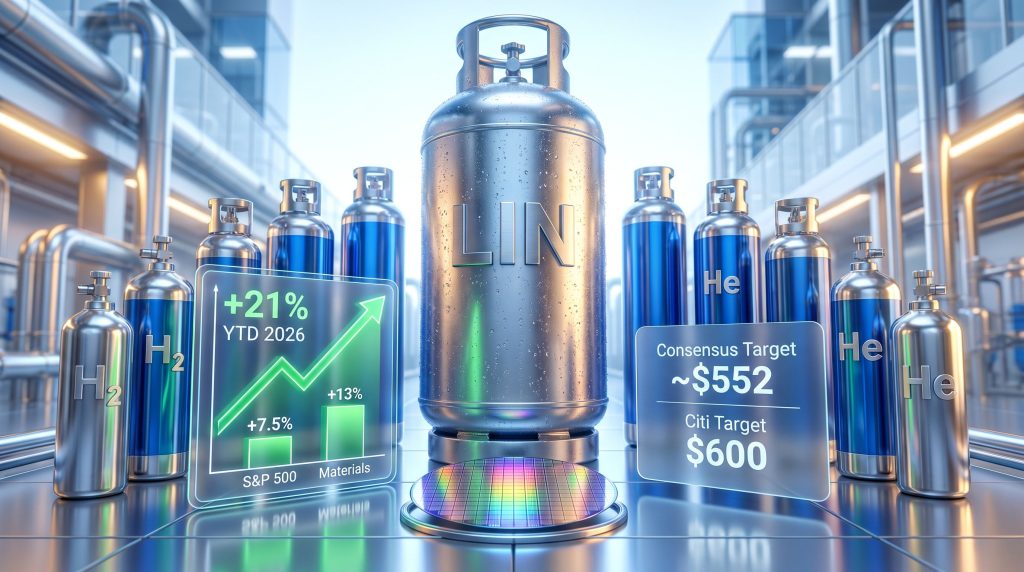
Linde (LIN) has delivered a year-to-date return exceeding 21% in 2026, a figure that stands in sharp contrast to the S&P 500's 7.5% advance over the same period. Even the S&P 500 Materials sector, which has itself performed solidly at roughly 13% year-to-date, trails Linde's advance by a meaningful margin. This is not a story about a hot trade or a narrative-driven momentum play. For investors searching for evidence that Linde stock more room to go represents a credible thesis, understanding the mechanics beneath that outperformance is essential.
When big ASX news breaks, our subscribers know first
Understanding Linde's Business Architecture: Infrastructure, Not Commodity
A common misconception about Linde is that it operates as a traditional materials company, exposed to volatile commodity pricing cycles. The reality is considerably more nuanced. Linde functions as an industrial infrastructure provider, producing atmospheric gases such as oxygen, nitrogen, and argon, alongside specialty gases including hydrogen, helium, and carbon dioxide, distributed under long-term contractual arrangements.
What Makes the Take-or-Pay Model So Powerful?
The critical structural feature here is the take-or-pay contract model. Under these agreements, industrial customers commit to purchasing a minimum volume of gas over a contracted period, regardless of whether they actually consume that volume. This shifts demand risk substantially away from Linde and toward the customer, creating a revenue stream that more closely resembles a toll-road operator or regulated utility than a cyclical materials producer.
This distinction matters enormously for portfolio construction. While commodity companies see earnings swing dramatically with spot-market pricing, Linde's earnings visibility is anchored by contractual obligations spanning years. Furthermore, it explains why the stock has historically commanded a valuation premium relative to the broader materials sector.
Volume Growth and the Estimate Revision Cycle Driving 2026 Momentum
The immediate catalyst for Linde's mid-2026 outperformance traces back to a notable analyst development. Citi raised its price target on Linde to $600 from $585 and established a formal short-term positive view in late June 2026. The rationale centred on a potentially more supportive environment for upward earnings estimate revisions, driven by two converging forces.
First, North American manufacturing has demonstrated broad-based strength across multiple industrial verticals simultaneously, including metals processing, petroleum refining, and electronics fabrication. When multiple industries expand production concurrently, industrial gas demand compounds rapidly.
Second, Asian industrial activity, particularly within semiconductor-adjacent supply chains, showed early signs of inflection. This matters to Linde because its regional gas supply agreements in Asia are calibrated to manufacturing output volumes. A recovery in Asian electronics production represents a high-margin volume uplift, since incremental gas delivered through existing infrastructure carries minimal additional operating cost.
This cost structure insight is important and often overlooked. Industrial gas companies that supply customers via dedicated pipelines or on-site plants enjoy near-zero marginal cost on incremental volume. Once the infrastructure investment is made, additional units sold are almost entirely incremental margin, making volume growth disproportionately powerful as an earnings catalyst.
The Backlog Quality Shift: Why Not All $10 Billion Is Equal
Linde's project backlog, valued at approximately $10 billion, is undergoing a meaningful qualitative transformation. Historically, industrial gas backlogs were dominated by heavy industry commitments: steel mills, refineries, and chemical plants. However, two categories are now commanding increasing weight within Linde's forward order book.
Semiconductor and electronics manufacturing represents the first structural shift. Chip fabrication is extraordinarily gas-intensive. Ultra-high-purity nitrogen is used to prevent oxidation during processing, whilst argon and helium serve as carrier and purging gases. Critically, purity specifications measured in parts per billion make Linde's quality-control infrastructure a genuine barrier to entry. As global semiconductor capacity expansion continues, Linde's contracted volumes grow correspondingly.
Emerging space industry applications represent the second shift. Rocket propellants, cryogenic systems, and precision atmospheric testing all require industrial and specialty gases in significant quantities. This is a nascent but rapidly expanding end-market that introduces Linde to demand curves largely decoupled from traditional economic cycles.
| Backlog Segment | Growth Characteristics | Cyclicality Exposure |
|---|---|---|
| Heavy industry (steel, refining) | Moderate | High |
| Semiconductor and electronics | High | Low-Medium |
| Space and aerospace | Early-stage, rapid | Very Low |
| Healthcare gases | Stable | Very Low |
This compositional shift represents a qualitative upgrade to earnings predictability. Secular growth end-markets carry less sensitivity to global GDP fluctuations, which is precisely the characteristic that institutional investors pay premium multiples to access. In the context of broader energy transition minerals investment themes, Linde's positioning across multiple critical industrial verticals becomes even more strategically significant.
Helium: The Unpriced Earnings Catalyst Most Investors Are Missing
Among all the factors supporting the case that Linde stock more room to go remains a credible proposition, the helium dynamic is perhaps the least understood and the most immediately actionable from an earnings-surprise perspective.
Helium is a genuinely irreplaceable industrial gas. Unlike most elements, it cannot be synthesised economically. It is extracted exclusively as a byproduct during natural gas processing at specific geological formations, predominantly in the United States, Qatar, Algeria, and Russia. Once released into the atmosphere, helium is lost permanently, as its molecules are light enough to escape Earth's gravitational field over time. The ongoing global helium supply crisis has consequently elevated its strategic importance across multiple industries.
Supply tightened materially in 2026 following geopolitical disruptions that affected key helium transit routes, including the closure of the Strait of Hormuz, which created measurable shortages in global helium availability. Prices responded accordingly, moving substantially above normalised levels.
The critical detail for Linde investors is this: Linde has not incorporated elevated helium pricing into its formal earnings guidance. This creates an asymmetric situation. If helium prices normalise before Linde benefits, the guidance range remains appropriate. If Linde is able to crystallise the supply advantage through contract wins or spot sales, actual earnings will exceed what guidance implies.
The more strategically interesting question concerns how Linde is likely deploying its helium supply position. Rather than liquidating inventory into elevated spot markets for a one-time gain, the evidence suggests management is using the supply advantage to secure new long-term contracts. According to recent earnings call analysis, this approach sacrifices the immediate earnings spike in exchange for durable volume commitments and pricing certainty over multi-year horizons — consistent with Linde's broader operating philosophy.
| Helium Monetisation Approach | Short-Term Earnings Impact | Long-Term Earnings Impact |
|---|---|---|
| Spot market liquidation | High one-time boost | Minimal recurring benefit |
| Long-term contract conversion | Moderate, deferred | High, structural |
| Hybrid approach | Moderate | Moderate to High |
Hydrogen Economy and AI Infrastructure: The Bull Case Convergence
Beyond the near-term catalysts, two secular themes create a compelling multi-year investment thesis for Linde.
Clean hydrogen is positioned to become one of the most significant industrial transformation stories of the coming decade. Linde is already the world's largest producer and distributor of hydrogen by volume, with infrastructure spanning electrolysers, liquefaction facilities, distribution networks, and storage systems. As industrial decarbonisation trends accelerate across steel manufacturing, chemical production, and heavy transport, demand for low-emission hydrogen is expected to scale rapidly.
Importantly, Linde's hydrogen business is not simply a bet on future policy. The company is actively building contracted hydrogen supply relationships with industrial customers today, locking in long-term agreements that will generate earnings regardless of the pace of broader policy development.
AI-driven semiconductor demand creates a parallel growth vector. The extraordinary buildout of AI computing infrastructure requires advanced chips fabricated in ever-more-complex processes, all of which demand increasing volumes of ultra-high-purity specialty gases. Each new AI data centre that comes online supports chip manufacturing that, in turn, increases gas consumption volumes for Linde's semiconductor customers.
The next major ASX story will hit our subscribers first
Valuation: The Premium Is Real, and So Is the Risk
Intellectual honesty requires acknowledging that Linde's investment case is not without tension. The stock currently trades at approximately 34x trailing earnings, more than double the peer average of roughly 16.6x for the broader industrial materials sector. In an environment of elevated global recession risks, premium-valued industrials face additional scrutiny from institutional allocators.
| Metric | Linde (LIN) | Sector Peer Average |
|---|---|---|
| Trailing P/E | ~34x | ~16.6x |
| Forward P/E | ~27-28x | Not disclosed |
| Adjusted Operating Margin | ~29.8% | Significantly lower |
| YTD Return (2026) | ~21% | ~13% (Materials sector) |
| Analyst Consensus Price Target | ~$552.71 | N/A |
| Citi Price Target | $600 | N/A |
This premium valuation demands consistent and elite-level capital allocation. One bear-case valuation framework places intrinsic value closer to the $250 to $260 range, suggesting the current price embeds years of flawless execution. This is not an impossible standard for Linde to meet given its track record, but it leaves limited margin of safety for execution missteps.
The primary metric investors should monitor is return on invested capital (ROIC). A sustained ROIC decline below 20% would signal that Linde's project pipeline is maturing in quality, which would likely trigger multiple compression.
Bull, Base, and Bear: Three Scenarios for LIN Through 2027
Bull Case assumes hydrogen adoption accelerates, semiconductor capacity expansion continues, and helium contract wins add a durable earnings stream. Under this scenario, LIN could be re-rated toward infrastructure-equivalent multiples, supporting price targets in the $600 to $732 range that the most optimistic analysts currently envision.
Base Case assumes manufacturing recovery in North America and Asia proceeds at a measured pace, volume growth delivers mid-to-high single digit earnings growth annually, and analyst consensus targets in the $552 to $600 range are achieved over 12 to 18 months.
Bear Case centres on deterioration in European industrial demand, where Linde carries substantial operational exposure. Combined with broader multiple compression across premium-valuation industrials, this scenario could see the stock retrace toward the $370 range, implying a 20 to 30% drawdown from current levels.
What Analyst Sentiment Reveals
Current institutional positioning reflects predominantly constructive sentiment toward Linde, and analyst commentary on LIN's trajectory has been notably positive heading into the second half of 2026.
| Analyst Rating | Share of Coverage Universe |
|---|---|
| Strong Buy | 57% |
| Hold / Neutral | Minority |
| Sell / Underperform | Minimal |
The consensus price target of approximately $552.71 implies meaningful upside from the mid-$518 range observed in late June 2026. Citi's revised target of $600 sits at the more aggressive end of near-term projections, whilst longer-term bull scenarios envision targets approaching $732 contingent on hydrogen and semiconductor demand convergence.
Which Metrics Are Institutions Watching Most Closely?
Three metrics are at the top of institutional watchlists:
- New long-term contract intake, particularly whether helium supply advantages are being converted into durable volume commitments
- Return on invested capital trends, as the clearest signal of project quality within the $10 billion backlog
- Any formal guidance update that incorporates helium pricing, which would serve as a tangible positive catalyst
Is LIN Right for Your Portfolio?
For investors considering commodities diversification strategies, Linde stock more room to go represents one of the more structurally compelling arguments within the industrial gas space.
Consider adding LIN if:
- You are seeking industrial infrastructure exposure with meaningful secular growth optionality in hydrogen and semiconductor supply chains
- Revenue stability through take-or-pay contracts aligns with your portfolio's risk tolerance requirements
- Your investment horizon extends to three or more years, allowing sufficient time for hydrogen economy catalysts to begin generating earnings contributions
Exercise greater caution if:
- Valuation sensitivity is a core portfolio discipline and you require a meaningful margin of safety below 30x earnings
- You already carry concentrated exposure to premium-multiple industrial holdings
- European industrial recovery is a significant assumption within your base case
Key Facts at a Glance
- 21%+ YTD return in 2026 versus 7.5% for the S&P 500 and 13% for the Materials sector
- $10 billion project backlog increasingly weighted towards semiconductors and emerging industry verticals
- Helium earnings upside not reflected in current guidance, representing a potential positive surprise catalyst
- 57% of analysts rate LIN as a Strong Buy with a consensus target near $552
- ~34x trailing P/E versus ~16.6x peer average represents meaningful execution risk
- European industrial exposure is the most credible downside scenario for earnings revisions
- ROIC trends remain the primary valuation anchor to monitor for premium sustainability
This article is intended for informational purposes only and does not constitute financial advice. All financial projections, price targets, and analyst estimates referenced reflect publicly available information as of late June 2026 and are subject to change. Past performance is not indicative of future results. Readers should conduct their own due diligence before making investment decisions.
Want to Spot the Next Major Industrial or Mineral Discovery Before the Broader Market Does?
While Linde's infrastructure model demonstrates the compounding power of securing positions in high-conviction opportunities early, Discovery Alert's proprietary Discovery IQ model delivers real-time alerts on significant ASX mineral discoveries, instantly translating complex data across 30+ commodities into actionable insights for both short-term traders and long-term investors — explore historic discovery returns on Discovery Alert's dedicated discoveries page to understand the scale of opportunity, and begin your 14-day free trial at Discovery Alert to position yourself ahead of the market.