June 24, 2026
The Hidden Economics of Underground Potash: Why Mega-Projects Consistently Defy Their Budgets
Mining textbooks and investor presentations make large-scale resource development look deceptively straightforward. Identify a high-grade deposit, model the cash flows, sanction the capital, and wait for the ore to flow. The reality of underground potash development in Saskatchewan tells a very different story, and the BHP Jansen potash cost blowout has brought that gap between theory and practice into sharp focus for global investors.
Potash mining is technically distinct from virtually every other form of large-scale resource extraction. Unlike open-pit copper or iron ore operations, underground potash requires precision shaft sinking through hundreds of metres of overlying rock, careful brine management to prevent water ingress into the orebody, and highly controlled cavern development to preserve structural integrity. Each of these technical requirements introduces variability that surface mining simply does not face.
When those variables compound across a multi-year construction timeline at a remote Saskatchewan site, the consequences for capital budgets can be severe. Understanding mining project economics helps investors better appreciate why even well-resourced projects can spiral beyond their original estimates.
When big ASX news breaks, our subscribers know first
A Cost Escalation Story Five Years in the Making
The BHP Jansen potash cost blowout did not arrive without warning signals. Since the project was first sanctioned in 2021, the combination of inflationary construction inputs, mid-build design modifications, and productivity shortfalls has systematically eroded the original investment case across both development stages.
The numbers tell the story with uncomfortable clarity:
| Development Stage | Original Sanctioned Cost | Revised Estimate | Cost Increase | Overrun % |
|---|---|---|---|---|
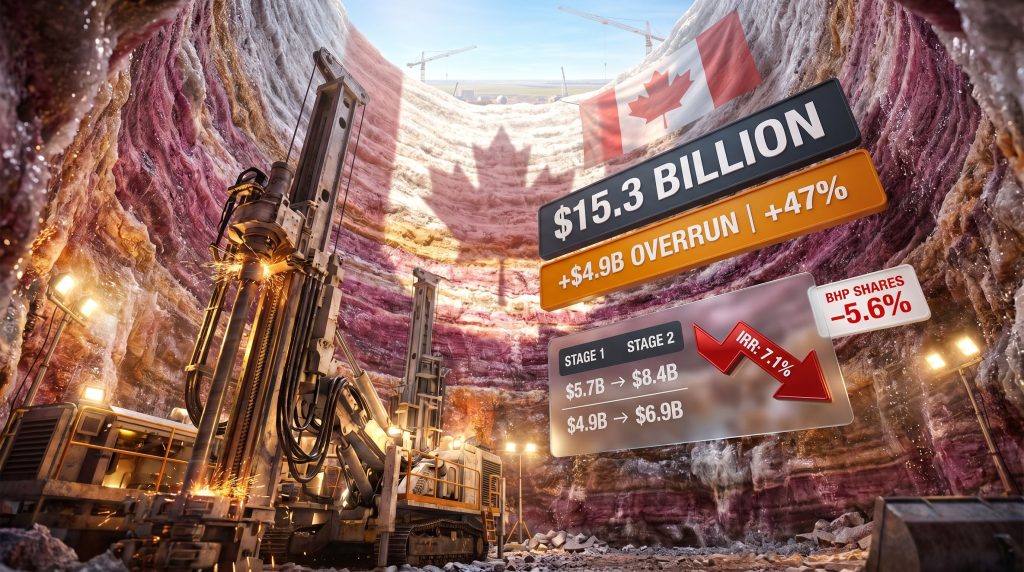
| Stage 1 (sanctioned 2021) | $5.7 billion | $8.4 billion | +$2.7 billion | +47% |
| Stage 2 (sanctioned 2023) | $4.9 billion | $6.9 billion | +$2.0 billion | +41% |
| Total Combined | ~$10.4 billion | $15.3 billion | +$4.9 billion | +47% |
Stage 2's revised cost of $6.9 billion represents a $2.0 billion increase on the original sanctioned budget of $4.9 billion, while first production from that stage has been deferred to late fiscal 2031, approximately four years later than earlier expectations. Stage 1 remains broadly on track, with first output still anticipated around mid-2027.
BHP has booked a non-cash impairment charge of up to $2.3 billion against Jansen, bringing total cumulative impairments on the asset to approximately $4.1 billion. According to reporting by Reuters, Barclays analysts estimate BHP's all-in capital deployment into the project, including all pre-sanctioning expenditure phases, has now reached approximately $20.3 billion.
Scale of Commitment: Barclays calculates that BHP has deployed roughly $20.3 billion into Jansen across all phases, with $4.1 billion of that total already written down. The blended internal rate of return across both stages has fallen to approximately 7.1%, roughly half of BHP's own earlier projections for the asset.
What Is Actually Driving the Cost Escalation?
Understanding the BHP Jansen potash cost blowout requires separating the project-specific factors from the broader structural forces that have reshaped mining construction economics over the past four years.
Inflationary Pressure on Construction Inputs
Global mining construction costs escalated sharply between 2021 and 2024. Labour, structural steel, specialised underground equipment, and concrete all experienced significant price inflation during this period. Saskatchewan's geographic remoteness amplifies logistics costs relative to more accessible jurisdictions, compressing the margin for error on fixed-price contractor arrangements that were set against a pre-inflationary cost environment.
Design Modifications Mid-Construction
Engineering changes introduced after initial project sanctioning required physical rework, extended construction timelines, and increased material volumes. In underground potash mining, mid-build design alterations are particularly costly because of the precision tolerances involved in shaft sinking and cavern development. A modification that would be relatively straightforward in a surface facility can require weeks of remediation work underground.
Productivity Shortfalls and Workforce Variables
Lower-than-projected workforce productivity has required additional labour hours, compounding both direct costs and schedule delays. This pattern is not unique to Jansen. Studies of large-scale greenfield mining developments globally show a persistent tendency for feasibility-stage productivity assumptions to prove optimistic once construction moves from planning to execution.
The gap between modelled and actual productivity frequently represents the largest single driver of greenfield project cost overruns. Furthermore, definitive feasibility studies rarely capture the full complexity of remote underground construction, leaving projects exposed to compounding variances once execution begins.
The Stage 2 Sanctioning Decision: A Case Study in Commodity Timing Risk
Perhaps the most instructive element of the Jansen story is not the cost overrun itself, but the timing of the Stage 2 sanctioning decision. BHP approved Stage 2 in 2023, before Stage 1 had produced a single tonne of potash, at a moment when global fertiliser prices had spiked to multi-year highs following Russia's invasion of Ukraine and the associated disruption to Eastern European potash supply chains.
Russia and Belarus together account for roughly 40% of global potash export volumes. The sanctions-driven supply shock that emerged from 2022 onward created exactly the kind of price environment that makes large capital commitments look compelling on a discounted cash flow model. Potash prices have since retreated materially from those elevated levels, meaning the investment case was effectively stress-tested against a price environment that proved transitory.
This dynamic illustrates a recurring challenge in long-cycle mining investment that is rarely discussed openly. The commodity price impacts of geopolitical supply disruptions can look deceptively permanent at the moment capital decisions are being made:
- Capital decisions made at commodity price peaks tend to lock in construction costs that outlast the price cycle that justified them
- The lag between sanction and first production in large underground projects typically spans five to seven years, creating substantial exposure to commodity price mean reversion
- Removing the stage-gate discipline of waiting for Stage 1 validation also eliminated the opportunity to incorporate real-world cost and productivity data into the Stage 2 feasibility assumptions
Market and Analyst Reaction: Reading the Investor Psychology
BHP's Sydney-listed shares fell as much as 5.6% on the day the announcement landed, representing the steepest single-session decline in approximately 14 months. London-listed BHP stock dropped 4.4% in parallel. The scale of the share price reaction is worth examining carefully, because it reveals something about how institutional investors are interpreting the situation beyond the arithmetic of the writedown.
The market response reflects at least three distinct concerns running simultaneously:
- The quantum of the impairment: A $2.3 billion non-cash writedown is material in absolute terms, even for a company of BHP's scale
- The pattern of repetition: Jansen has now exceeded its cost and schedule estimates on three separate occasions across both stages, raising questions about whether the revised figures are now reliable
- The IRR compression: A blended return of approximately 7.1% sits uncomfortably close to, and potentially below, the weighted average cost of capital thresholds that diversified miners typically apply when approving greenfield projects
Analysts at both Barclays and Jefferies characterised the update as unhelpful, particularly given the subdued near-term outlook for global potash prices. Barclays has specifically flagged upside risk to BHP's medium-term capital expenditure guidance, suggesting that further budget pressure cannot be entirely ruled out.
Despite the scale of the revision, BHP has maintained its overall capital expenditure guidance for fiscal year 2027 at approximately $11 billion. This signals management's intent to absorb the Jansen revision within existing budget parameters rather than triggering a broader portfolio-level guidance downgrade. However, analysts note this leaves limited buffer if additional cost pressures emerge elsewhere in the project.
The Saskatchewan Potash Basin: Why the Geology Still Matters
It is easy, amid the noise of cost overruns and writedowns, to lose sight of the underlying geological asset that makes Jansen strategically compelling in the first place. The Williston Basin beneath Saskatchewan hosts one of the world's largest and highest-grade potash deposits, formed approximately 360 million years ago during the Devonian period when shallow inland seas evaporated and left behind vast evaporite sequences.
Potash ore in Saskatchewan typically occurs as sylvinite, a mixture of sylvite (potassium chloride) and halite (sodium chloride). Grade is expressed as the ratio of K₂O content, and Saskatchewan's Prairie Evaporite formation generally delivers ore grades in the range of 20% to 35% K₂O, which is high by global standards. This grade quality is a critical factor in the long-run operating cost calculation, because higher-grade ore requires less processing to produce a tonne of product-grade potash.
BHP's projected unit operating cost of $114 to $130 per tonne at full combined capacity reflects this geological advantage. Even at the revised total capital cost of $15.3 billion, the operating cost structure provides meaningful downside protection across a range of price scenarios, assuming potash prices recover toward mid-cycle norms. In this respect, the cut-off grade economics of the deposit remain a genuine long-term asset, even as near-term capital discipline comes under scrutiny.
The next major ASX story will hit our subscribers first
Jansen in the Global Competitive Context
| Producer / Project | Country | Estimated Capacity | Cost Position |
|---|---|---|---|
| Nutrien (legacy Canpotex) | Canada | ~14 Mtpa combined | Low-cost incumbent |
| Mosaic Company | Canada / USA | ~10 Mtpa | Mid-cost |
| Eurochem Usolsky | Russia | ~2.3 Mtpa (expanding) | Low-cost |
| BHP Jansen (Stages 1+2) | Canada | ~8-10 Mtpa (at full build) | Targeting lowest-cost Canadian |
| Danakali (Colluli) | Eritrea | ~472 Ktpa (Phase 1) | Higher-cost emerging producer |
Jansen will enter a market dominated by established incumbents, particularly Nutrien, which operates multiple fully depreciated Saskatchewan mines with cost structures built on decades of amortised capital investment. BHP's competitive position depends entirely on achieving its projected operating cost target, a goal that now carries elevated execution risk given the project's track record.
Scenario Analysis: What Potash Price Does the Revised Jansen Need?
At a total project cost of $15.3 billion and a projected operating cost range of $114 to $130 per tonne, Jansen most likely requires a sustained long-run potash price in the vicinity of $350 to $400 per tonne to generate returns consistent with BHP's capital allocation hurdle rates. Current spot potash prices as of mid-2026 sit materially below the elevated levels that prevailed when Stage 2 was sanctioned in 2023.
A price recovery to the $350 to $400 per tonne range would require one or more of the following conditions:
- A meaningful acceleration in agricultural demand from high-intensity farming regions across Asia and Sub-Saharan Africa
- A further supply-side disruption affecting Russian or Belarusian export volumes
- A structural increase in food commodity prices that flows through to fertiliser demand and potash pricing
None of these scenarios can be ruled out over a decade-long horizon, but none can be assumed either. The permanent capital destruction represented by $4.1 billion in cumulative impairments is real and irreversible regardless of how the potash price behaves from this point forward. Consequently, commodity market volatility of this kind serves as a reminder that even the most strategically compelling deposits carry substantial timing and execution risk.
Investor Note: The long-run thesis for potash as a food security commodity remains structurally intact. Global population growth, dietary transitions in emerging markets, and agricultural intensification continue to support long-dated demand. However, a sound long-run commodity thesis does not guarantee acceptable returns on a specific project where capital has already been significantly overcommitted relative to original assumptions. These are distinct analytical questions that investors should evaluate separately.
What the Jansen Episode Teaches About Large-Scale Mining Project Risk
The BHP Jansen potash cost blowout offers several lessons that extend well beyond this specific project:
- Contingency adequacy is chronically underestimated: Industry benchmarks suggest greenfield underground projects should carry contingency allowances of 20% to 30%. Jansen's overruns across both stages suggest initial contingencies were insufficient for the technical complexity involved
- Stage-gate discipline exists for a reason: Sanctioning Stage 2 before Stage 1 reached production removed a critical real-world validation checkpoint. Production-stage data consistently reveals cost and productivity realities that pre-production feasibility studies cannot replicate
- Remote geography carries a structural cost premium: Saskatchewan's location relative to major construction supply chains creates a persistent logistics cost burden that is frequently underweighted in feasibility-stage modelling
- IRR calculations are highly sensitive to capex assumptions: At the original $10.4 billion combined budget, a return of approximately 14% may have been achievable at mid-cycle potash prices. At $15.3 billion, the same price assumptions yield approximately half that return, illustrating the non-linear relationship between capital cost escalation and project economics
The Jansen story is not unique. From Olympic Dam to Simandou to various LNG megaprojects, the resource industry has a well-documented history of large-scale greenfield developments that substantially exceeded their original capital budgets. What makes Jansen particularly instructive is the combination of factors: a technically complex underground extraction method, a remote jurisdiction, a commodity price cycle that turned after sanctioning, and the strategic decision to accelerate Stage 2 before Stage 1 had validated key operational assumptions.
BHP's ability to deliver Stage 1 first production on schedule by mid-2027 will be closely watched by analysts and institutional investors as the first real-world test of whether the project's revised cost and operational assumptions hold. That milestone will not resolve the capital allocation questions raised by the BHP Jansen potash cost blowout, but it will provide the first meaningful data point for assessing whether Jansen's long-term value proposition remains intact.
This article contains analysis and forward-looking projections based on publicly available information. It does not constitute financial advice. Commodity price forecasts, project return estimates, and timeline projections involve material uncertainty and should not be relied upon as predictions of future outcomes. Investors should conduct independent due diligence before making investment decisions.
Want to Stay Ahead of the Next Major Mineral Discovery Before the Market Catches On?
While mega-projects like Jansen illustrate the complexities of large-scale mining investment, Discovery Alert's proprietary Discovery IQ model scans ASX announcements in real time, delivering instant alerts on significant mineral discoveries and turning complex resource data into actionable opportunities — explore historic discoveries that generated exceptional returns and begin your 14-day free trial today.