June 24, 2026
The Cost of Capital Has Become Mining's Most Powerful Filter
Few forces reshape a development pipeline as quietly or as completely as a sustained shift in borrowing costs. Unlike a commodity price collapse or a regulatory reversal, rising interest rates do not announce themselves with dramatic headlines. They work through the mathematics of discounted cash flow, compressing net present values, widening required return thresholds, and gradually eliminating the projects that cannot clear an increasingly elevated financing bar. In 2026, that filter is operating at full force across North American mining, and nowhere is its effect more pronounced than in salt project financing.
Salt occupies an unusual position in the mining universe. It is among the most essential industrial commodities on the continent, embedded in de-icing operations, chemical manufacturing, water treatment, and food processing. Yet it commands roughly US$54 per tonne at the domestic level, according to the USGS 2026 Mineral Commodity Summaries, making it one of the lowest-revenue-per-tonne commodities that still requires genuinely capital-intensive underground infrastructure to extract at scale. That combination creates a financing challenge that higher-value metals rarely face with the same intensity.
When big ASX news breaks, our subscribers know first
Why the Fed's June 2026 Projections Matter for Mine Developers
At its June 2026 meeting, the Federal Reserve held its policy rate at 3.50% to 3.75% while simultaneously revising its Summary of Economic Projections in a direction that rattled capital markets. The year-end inflation forecast was lifted to 3.6%, and expected economic growth was trimmed to 2.2%. Interest rate markets responded by increasing the probability of a further rate increase, reinforcing what many institutional lenders had already begun to treat as structural rather than transitory: an era of genuinely elevated borrowing costs.
For most industries, a policy rate in this range is an inconvenience. For underground mine development, it can be the difference between a financeable project and one that sits indefinitely at the feasibility stage. The mechanism is straightforward: higher discount rates reduce the present value of cash flows that may not materialise for five to ten years after the financing decision is made. Mines generate revenue over multi-decade horizons, meaning that even a modest upward shift in the discount rate applied to those future cash flows can translate into a substantial reduction in calculated net present value.
When elevated borrowing costs coincide with upward-revised inflation forecasts and downward-revised growth projections, the message to capital-intensive developers is clear: financing will remain expensive, and the window for easy project finance debt has closed.
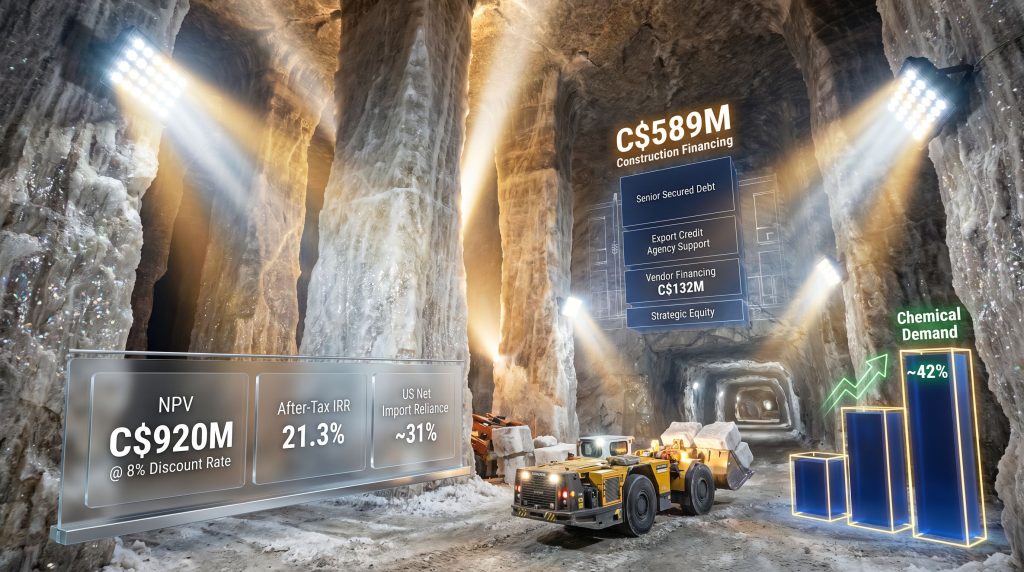
Compounding the rate environment is the sustained inflation in mine-construction inputs that has persisted since 2021. Steel, skilled labour, engineering services, and heavy mining equipment have all experienced meaningful cost escalation over that period. A project that modelled C$480 million in construction capital under a prior study may now require C$589 million or more under a current feasibility estimate, as seen with the Great Atlantic Salt Project's progression from its 2023 preliminary figures to its September 2025 SLR Consulting feasibility study. That cost increase does not reflect a change in the orebody. It reflects the real-world inflation of building anything large and complex in the current environment.
The dual compression effect is critical to understand. Rising construction budgets reduce projected returns on invested capital at the same time as higher discount rates reduce the present value of those returns. Projects caught in this squeeze face a shrinking margin between their modelled internal rate of return and the hurdle rate investors actually require — a gap that determines whether financing conversations proceed or stall.
Salt's Structural Vulnerability to Financing Cost Cycles
Why Low Revenue Per Tonne Creates a Unique Pressure Point
Most commodities that attract large-scale mine development offer revenue profiles that provide meaningful headroom above operating costs. Gold, copper, and lithium all generate substantially more revenue per tonne of ore processed than salt, which means that changes in financing costs, while still significant, represent a smaller proportion of the overall return calculation.
Salt inverts this dynamic. With domestic rock salt averaging roughly US$54 per tonne, developers must generate sufficient returns from a compressed revenue base while still funding construction programs that run into the hundreds of millions. The cut-off grade economics that institutional lenders scrutinise most carefully — including initial capex per tonne of annual capacity, internal rate of return, and projected debt service coverage — are all under greater pressure in a high-rate environment for a commodity at this price point.
The table below illustrates the key supply and market metrics that define the current salt financing landscape:
| Metric | Data Point |
|---|---|
| US Net Import Reliance (2025) | ~31% of apparent consumption |
| Years Since Last North American Salt Mine Build | ~25 years |
| Average Domestic Rock Salt Value | ~US$54 per tonne |
| Chemical Demand Market Share | ~42% of total salt demand |
| Great Atlantic Salt Project Initial Capex | ~C$589 million |
| Great Atlantic After-Tax NPV (8% discount) | ~C$920 million |
| After-Tax IRR | 21.3% |
| Design Capacity | 4.0 Mtpa |
| Projected Annual Post-Tax Free Cash Flow | ~C$188 million |
| Mine Life | 24.3 years |
The 25-Year Build Gap and What It Signals
No new salt mine has been constructed in North America in approximately 25 years. That statistic is not simply a historical footnote. It is a direct consequence of how the economics of salt mining interact with capital markets across commodity cycles. When financing is cheap and construction costs are contained, marginal projects find lenders. When rates rise and construction budgets inflate, the marginal projects disappear first, and the supply pipeline narrows.
The result is a structural underinvestment gap that has quietly accumulated while demand has continued to grow. According to USGS 2026 data, US net import reliance reached approximately 31% of apparent consumption in 2025. Salt demand is fundamentally inelastic. De-icing operations cannot substitute away from salt. Chemical manufacturing, which now accounts for roughly 42% of total salt demand according to USGS figures, requires it as a feedstock input that cannot be easily replaced. Water treatment and food processing applications share similar characteristics.
This inelasticity matters enormously for the supply gap narrative. When demand does not contract in response to tighter supply, constrained domestic production creates real price support rather than simply theoretical scarcity. The 25-year build gap is not evidence that salt is uneconomic to mine. It is evidence that the financing conditions required to justify new mine construction have rarely aligned for long enough to produce a committed development decision.
Dissecting the Capital Stack: What a Financeable Salt Project Requires
The Modern Financing Architecture for Large-Scale Mine Development
Traditional project finance debt — the single-lender senior secured model that dominated mine development financing through much of the 2000s and early 2010s — has become significantly harder to access for standalone developers in a tighter credit environment. Commercial banks with shorter duration mandates find it increasingly difficult to justify lending into a construction program that may take three to four years to build and another one to two years to ramp to full production, all before a single dollar of operating cash flow is generated.
The modern capital stack for a capital-intensive salt project therefore requires multiple financing layers, each addressing a different category of investor risk. Furthermore, understanding the various capital raising methods available is essential for developers navigating this complex environment:
- Senior secured project finance debt: Lowest cost of capital when secured, but requires independent feasibility validation, advanced permitting, and a demonstrated return spread above the lender's hurdle rate
- Export credit agency support: Provides longer loan tenors and lower rates by attaching government-backed credit enhancement, often linked to qualifying equipment procurement from the lending country. For instance, Export Finance Australia has previously supported major salt and potash projects, demonstrating how state-backed institutions can play a meaningful role in project capitalisation
- Vendor financing: Reduces the total equity a developer must raise by embedding a financing component within major equipment contracts, preserving existing shareholder value
- Offtake-backed structures: Revenue certainty from signed offtake agreements reduces perceived cash flow risk, improving debt serviceability ratios and often unlocking better borrowing terms
- Strategic equity: Participation by industry players or major investors signals market validation and can improve access to the institutional debt required to complete the financing package
- Broker-led equity financing: Provides flexibility to fund pre-construction activities, due diligence, and early works while the primary construction financing package is assembled
Vendor Financing as a Dilution-Reduction Tool
One of the least-discussed but most strategically significant elements of modern mine financing is the vendor finance component embedded within major equipment agreements. In February 2026, Atlas Salt entered into an agreement with Sandvik Mining for approximately C$132 million of underground mining equipment, which includes a potential financing component subject to Sandvik's approval.
The arithmetic of vendor financing is straightforward but its implications for existing shareholders are substantial. If a developer can secure C$132 million in equipment-linked vendor financing, the total equity required to fund a C$589 million construction program falls by a corresponding amount. Every reduction in the funded equity requirement changes the per-share economics of the project for investors who participated at earlier stages.
It is important to treat this financing component as conditional rather than committed. A potential vendor financing arrangement remains subject to third-party approval and should be evaluated as a possible reduction in equity requirements rather than a guaranteed funding source until formal approval is confirmed.
Letters of Interest vs. Committed Financing: A Critical Distinction
One of the most common misunderstandings in development-stage mine analysis is the conflation of lender Letters of Interest with committed financing packages. A Letter of Interest signals that a lender has conducted preliminary project review and is willing to advance to formal due diligence. It does not represent a binding credit decision or a committed loan.
The appointment of a dedicated project financing advisor — such as Endeavour Financial, which Atlas Salt engaged in November 2024 — is a meaningful institutional signal. It indicates that the developer is preparing for the structured financing process that institutional lenders require, including independent technical audits, financial model stress-testing, and legal due diligence on permits and land tenure. However, the process that follows an advisor appointment can still take twelve to twenty-four months before a committed package is assembled. Consequently, investors should also monitor for any management red flags that could signal execution risk during this extended timeline.
Reading Feasibility Economics Through a Financing Lens
Headline NPV figures attract investor attention, but the metric that matters most for salt project financing decisions is the spread between a project's modelled after-tax internal rate of return and the hurdle rate that lenders and equity investors currently require.
The Great Atlantic Salt Project's September 2025 definitive feasibility study, prepared by SLR Consulting, models the following key parameters:
| Metric | Feasibility Study Figure | Financing Relevance |
|---|---|---|
| After-Tax IRR | 21.3% | Substantial spread above typical 8-12% lender hurdles |
| After-Tax NPV (8% discount rate) | ~C$920 million | Validates project viability under realistic financing assumptions |
| Initial Construction Capex | ~C$589 million | Independently verified cost basis for lender confidence |
| Annual Post-Tax Free Cash Flow | ~C$188 million | Supports debt service coverage calculations |
| Design Capacity | 4.0 Mtpa | Scale alignment with debt repayment timelines |
| Mine Life | 24.3 years | Exceeds typical institutional debt tenors |
An after-tax IRR of 21.3% provides meaningful buffer above the financing thresholds that institutional lenders typically apply to capital-intensive mine development. That spread can absorb moderate construction cost overruns, modest schedule delays, and further increases in borrowing costs without pushing the project below economic viability thresholds.
What the feasibility study does not resolve is the gap between the project's modelled economics and the market's current valuation. With an enterprise value of approximately C$138.5 million against a modelled NPV of approximately C$920 million, the discount reflects genuine financing uncertainty rather than scepticism about the underlying geology. That gap narrows as financing milestones are achieved and widens when financing uncertainty increases, making the construction financing package the single most important valuation catalyst for the project.
The Permitting-Financing Nexus: Why Regulatory Progress Has Measurable Dollar Value
In a 3.75% rate environment, permitting delays carry a compounding financial cost that is often underestimated by investors focused on headline NPV. Every quarter that a project spends waiting for regulatory clearance extends the pre-cash-flow period, increases total interest burden during construction, and prompts lenders to demand higher returns to compensate for additional uncertainty.
Jurisdictional stability has therefore become a genuine financing variable, not merely an operational consideration. Stable regulatory environments reduce the risk premium that both lenders and equity investors embed in their required returns. In addition, broader mining permits reform at the federal level can have meaningful downstream effects on how quickly development-stage projects can satisfy the regulatory milestones that lenders require before committing capital.
In February 2026, the Government of Newfoundland and Labrador approved Atlas Salt's work plan, formalised a community and employment agreement following a Cabinet-level vote, and confirmed that environmental requirements had been satisfied, with site preparation beginning the same month. These represent concrete permitting milestones that institutional lenders can verify during due diligence. According to Atlas Salt's project disclosures, operating within the Canadian securities framework, including National Instrument 45-106 compliance and full disclosure on SEDAR Plus, adds an additional layer of institutional transparency that sophisticated debt providers value during their credit assessment process.
The next major ASX story will hit our subscribers first
Funded Producers vs. Pre-Financing Developers: Understanding the Valuation Architecture
The valuation frameworks applied to funded salt producers and development-stage projects operate on fundamentally different logic, and understanding that distinction is essential for investors evaluating the salt project financing landscape.
Funded producers generate operating cash flow. Investors value them on earnings multiples, cash flow yields, and dividend capacity. Financing risk is largely resolved because the mine is already built and debt service is already embedded in the operating cost structure.
Pre-financing developers carry three distinct risk categories that funded producers do not:
- Financing execution risk: The possibility that the full construction package cannot be assembled at acceptable terms
- Dilution risk: The certainty that additional equity will be required before cash flow generation begins
- Construction execution risk: The possibility that the mine costs more or takes longer to build than the feasibility study projects
Higher financing costs widen the valuation gap between these two categories. When borrowing costs are elevated, the market assigns a steeper discount to pre-financing developers because the probability-weighted cost of carrying those risks for longer is higher. This creates a larger potential re-rating event for developers that successfully close their construction financing packages, transitioning from feasibility-study valuation to operating-asset valuation in a single catalyst event.
A Practical Screening Framework for Salt Project Financing Risk
Investors evaluating development-stage salt projects in the current environment should apply a financing-first screening framework rather than leading with geological or resource-size assessments. The following questions provide a structured approach:
- What is the spread between the project's modelled after-tax IRR and the current financing hurdle rate, and is it wide enough to absorb realistic cost and schedule overruns?
- Has the developer received formal Letters of Interest or term sheets from institutional debt providers, and have these been disclosed transparently?
- What is the permitting status, and has environmental clearance been formally confirmed by the relevant regulatory authority?
- Does the capital stack include non-dilutive financing components such as vendor finance, export credit agency support, or offtake-backed debt?
- What is the jurisdictional risk profile, and has government engagement been formally documented rather than informally characterised?
- What is the gap between current enterprise value and modelled NPV, and which specific financing milestones would most directly close that gap?
- Has an independent feasibility study been completed by a qualified engineering firm, and does it include sensitivity analysis across multiple discount rate assumptions?
The final point deserves particular emphasis. A feasibility study that presents a single NPV figure without discount rate sensitivity analysis is insufficient for financing evaluation purposes. Institutional lenders stress-test project economics across a range of financing cost assumptions precisely because the policy rate environment can shift between the time a financing package is assembled and the time construction is completed.
The Broader Implication: When Capital Becomes the Cut-Off Grade
There is a useful parallel between the geological concept of cut-off grade and the current financing environment. In mining, cut-off grade defines the minimum ore quality that can be profitably extracted given prevailing commodity prices and operating costs. Material below cut-off grade stays in the ground regardless of its physical presence in the deposit.
In 2026, the cost of capital functions analogously. Projects below the financing threshold — those whose modelled returns cannot clear the hurdle rate that lenders and equity investors require — remain in the development pipeline regardless of their underlying geological quality. They are not bad projects in any absolute sense. They are projects whose economics, in the current rate environment, do not generate the return spread required to attract committed capital.
This dynamic has a structural consequence for North American salt supply that extends well beyond any individual project. When financing conditions eliminate marginal projects from the development pipeline, the projects that do advance gain pricing power, market position, and strategic importance that they would not have commanded in a lower-rate environment. The 25-year build gap has already demonstrated what sustained underinvestment looks like. A 31% import reliance figure is its measurable result. For investors prepared to apply a rigorous financing lens, the distinction between projects that can clear the financing threshold and those that cannot is the most important analytical task in the current salt project financing environment.
Disclaimer: This article is provided for informational purposes only and does not constitute financial or investment advice. All financial projections, including NPV, IRR, and capital cost estimates, are derived from feasibility study modelling and represent study projections rather than guaranteed outcomes. Readers should conduct their own due diligence and consult a qualified financial adviser before making investment decisions. All figures are in Canadian dollars unless otherwise stated.
Want to Stay Ahead of Significant Mineral Discoveries the Moment They Hit the ASX?
Discovery Alert's proprietary Discovery IQ model delivers real-time alerts on significant ASX mineral discoveries, transforming complex data across more than 30 commodities into clear, actionable insights for both short-term traders and long-term investors — begin your 14-day free trial today, or explore how historic discoveries have generated substantial market returns to understand the opportunity that early positioning can create.