June 19, 2026
The Hidden Economics of Mega-Mine Cost Blowouts in the Potash Sector
Few commodities carry the quiet strategic weight of potash. As the foundational nutrient input for modern agriculture, it underpins food production across every inhabited continent. Yet unlike copper or lithium, it rarely commands headlines outside specialist mining circles. That dynamic is shifting rapidly as BHP's Jansen potash project in Saskatchewan, Canada, reshapes expectations about what it costs to build a tier-one potash mine from scratch in the 21st century.
The revised BHP Jansen Stage Two cost estimate of US$6.9 billion is not simply a budget update. It represents a case study in the compounding pressures facing large-scale underground mining development, and it raises pointed questions about capital discipline, long-cycle asset economics, and the true cost of entering a commodity market at industrial scale.
When big ASX news breaks, our subscribers know first
From $4.9 Billion to $6.9 Billion: Understanding the Full Scope of the Revision
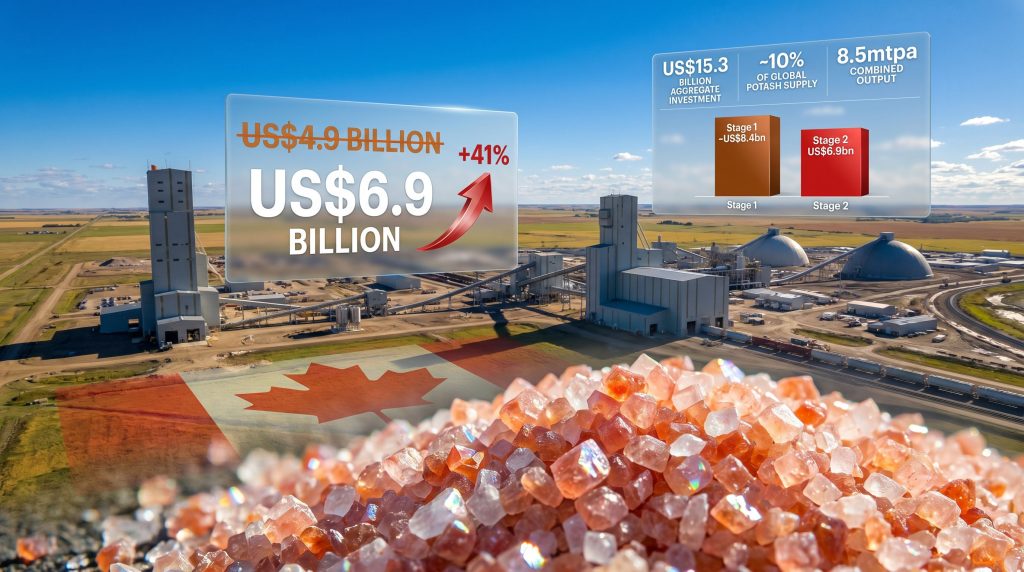
When BHP's board approved Jansen Stage 2 in October 2023, the assigned capital estimate was US$4.9 billion. That figure has now been revised to US$6.9 billion following a comprehensive internal review of project delivery, costs, and scheduling, representing an increase of US$2.0 billion, or approximately 41%.
To put that in context: a 41% cost overrun is not unusual in the history of large mining and resources infrastructure, but it is significant enough to place Jansen Stage 2 among the most capital-intensive potash developments ever undertaken. When combined with Stage 1, which is now tracking at approximately US$8.4 billion, the total projected investment across the Jansen complex climbs to an estimated US$15.3 billion.
What Actually Drove the Cost Increase?
BHP attributed the bulk of the increase to three distinct factors identified during the review process:
- Additional construction hours beyond what was originally modelled at project approval
- Higher material quantities revealed through detailed engineering assessments conducted as design maturity increased
- Broad market cost escalation affecting labour, procurement, and logistics inputs across the construction supply chain
| Cost Driver | Nature of Impact |
|---|---|
| Additional construction hours | Labour cost overrun beyond original modelling |
| Higher material quantities | Volume and procurement uplift from detailed engineering |
| Market cost escalation | Macro inflationary pressure across inputs |
What is particularly instructive here is the sequencing. The higher material quantities were not caused by scope creep in the traditional sense; they emerged as engineering reached 83% completion by late May 2026. This is a well-documented phenomenon in underground mine engineering, where bespoke geological conditions and infrastructure complexity are only fully quantified at advanced engineering stages. The original cost model, developed at a lower engineering maturity level, carried embedded uncertainty that has now been resolved at a higher price point.
It is worth noting that 83% engineering completion is generally considered a risk-reduction milestone in project delivery. BHP acknowledged this directly, stating that this progress has materially reduced execution risk for the remaining construction workstreams.
Timeline Revision: Two Years Lost, and What That Costs Investors
The production timeline has also shifted materially. First ore from Jansen Stage 2 was originally targeted for FY2029. That date has been pushed to late FY2031, a two-year delay that was first flagged by BHP in August 2025 before the full capex revision was confirmed in June 2026.
For investors, a two-year delay to a project generating no revenue during construction compounds the capital cost increase in a way that pure headline numbers do not fully capture. The opportunity cost of deferred cash flows at a project of this size is substantial, particularly when combined with an impairment charge that directly affects near-term reported earnings. Furthermore, commodity price impacts over such an extended timeline introduce additional uncertainty that prudent investors cannot ignore.
Stage 1 vs. Stage 2: Current Project Status
| Metric | Jansen Stage 1 | Jansen Stage 2 |
|---|---|---|
| First Production Target | Mid-calendar year 2027 | Late FY2031 |
| Current Status | On track | Under revised schedule |
| Cost Estimate | ~US$8.4bn (cumulative) | US$6.9bn (revised) |
| Output Capacity | ~4.14mtpa (implied) | ~4.36mtpa |
| Engineering Progress | Advanced | 83% complete |
Stage 1 remains on the revised schedule set in January 2026, with first production targeted for mid-calendar year 2027. That milestone, if achieved, will give BHP its first revenue-generating tonnes from the Jansen basin before the more complex task of ramping Stage 2 begins.
The $2.3 Billion Impairment: What It Means and Why It Matters
Alongside the cost revision, BHP has flagged an expected impairment charge of approximately US$2.3 billion, to be recognised in its FY2026 financial results. The charge applies both before and after tax, and it relates to BHP's accumulated investment in the Jansen project to date.
Understanding Impairment in a Mining Context
An impairment charge is triggered when the carrying value of an asset on a company's balance sheet exceeds its recoverable amount. In Jansen's case, the higher capital intensity of Stage 2 has compressed the project's net present value (NPV) relative to the book value of the investment already made. In simple terms, the mine is now expected to cost more to build than previously assumed, and at current consensus potash prices, the incremental value it generates does not fully support the original carrying value.
This does not mean the project is loss-making. It means the return profile has narrowed, and accounting standards require that narrowing to be reflected on the balance sheet immediately rather than carried forward at an inflated value.
Does the Return on Investment Still Hold Up?
BHP's updated economics for Jansen Stage 2 at consensus potash prices are as follows:
- Internal rate of return (IRR): 11%
- Payback period: eight years from first production
- EBITDA margins: forecast above 65%
- Unit cost at full ramp-up: US$114-130 per tonne (unchanged from original approval estimate)
The 11% IRR figure deserves careful interpretation. For a mining major, 11% at consensus commodity prices is considered a threshold-level return rather than a compelling one. It leaves limited buffer against potash price weakness, currency movements, or further cost escalation during the remaining construction phase. However, the unit cost position tells a more compelling structural story. At US$114-130 per tonne, Jansen is projected to be the lowest-unit-cost Canadian potash mine once both stages reach full production, placing it firmly in the bottom quartile of the global cost curve.
Cost curve positioning in mining is one of the most durable indicators of long-term asset value. Mines at the low end of the cost curve survive commodity price downturns that eliminate higher-cost producers, and they capture disproportionate margins during pricing upswings.
Group Capital Allocation: BHP Holds the Line on FY27 Guidance
Despite the scale of the revision, BHP has confirmed it does not intend to alter its group-level capital expenditure guidance for FY27, which remains at approximately US$11 billion. This indicates that the Jansen overrun is being absorbed within the existing capital allocation framework rather than forcing a broader portfolio restructure or asset divestment. Consequently, broader mining industry consolidation pressures do not appear to be influencing BHP's near-term strategic posture on this project.
This is a significant signal. It suggests BHP's balance sheet retains sufficient flexibility to accommodate a US$2.0 billion cost revision without triggering a cascading adjustment to its broader investment programme, which spans copper, iron ore, and other long-duration commodities.
Jansen's Role in the Global Potash Supply Equation
The strategic stakes of the Jansen project extend well beyond BHP's own corporate economics. Potash is a non-substitutable agricultural input. Crops require potassium for root development, water regulation, and disease resistance, and there is no synthetic alternative that replicates its function at scale. Global potash supply is highly concentrated, with Canada, Russia, and Belarus historically accounting for the majority of production.
What Jansen Means for Global Supply at Full Ramp-Up
Once both Jansen stages reach full production and complete a planned two-year ramp-up, the combined operation is projected to produce approximately 8.5 million tonnes per annum (mtpa). That volume would represent roughly 10% of total global potash output, making Jansen one of the most consequential single-site potash assets on the planet.
| Metric | Jansen (Combined, Full Ramp-Up) | Context |
|---|---|---|
| Annual Output | ~8.5mtpa | ~10% of global supply |
| Unit Cost | US$114-130/t | Lowest in Canada |
| Global Supply Share | ~10% | Major new entrant |
| EBITDA Margin | >65% | Top-tier mining economics |
| IRR at Consensus | 11% | Threshold-level return |
The Geological Case for Jansen
Saskatchewan's Williston Basin, where Jansen is located, hosts some of the world's highest-grade and most extensive potash deposits. The basin's potash-bearing formations, primarily the Esterhazy Member of the Prairie Evaporite formation, were deposited in an ancient inland sea roughly 380 million years ago. The resulting ore bodies are remarkably consistent in grade and thickness across large lateral distances, which is relatively unusual in underground mining and contributes directly to the low projected unit cost.
Saskatchewan potash ore grades typically range from 20-30% K2O equivalent, which is among the highest-grade potash mineralisation found anywhere in the world. This grade profile, combined with the mechanised room-and-pillar or continuous mining methods used in the basin, allows for high-volume extraction at relatively low operating cost per tonne. Indeed, understanding cut-off grade economics helps contextualise why Saskatchewan's geological endowment, rather than any single engineering decision, underpins Jansen's long-term cost competitiveness.
The next major ASX story will hit our subscribers first
The Strategic Case: Why BHP Is Staying the Course
BHP's commitment to Jansen through a 41% cost overrun and a two-year delay reflects its broader commodity diversification thesis. The company has explicitly positioned potash as a future-facing commodity, a category it also uses for copper, nickel, and other materials linked to energy transition and food security.
Brandon Craig, BHP's Americas President and incoming CEO, reaffirmed that Jansen occupies a central role in BHP's long-term growth strategy, citing the commodity's demand fundamentals and its portfolio diversification benefits relative to BHP's dominant iron ore and copper exposure.
The bull case for potash demand rests on several structural dynamics:
- Global population growth continuing to intensify demand for calorie-dense agricultural output
- Soil nutrient depletion in intensively farmed regions across Asia, Africa, and Latin America requiring ongoing potassium replenishment
- Emerging market agricultural intensification as smallholder farmers in developing economies adopt higher-input farming practices
- Supply concentration risk in traditional producing regions creating incentive for western hemisphere supply diversification
Risk Factors Investors Should Not Overlook
The strategic rationale is coherent, but the risk register for Jansen is equally substantial. A thorough definitive feasibility study process might have surfaced some of these challenges earlier, however the scale and complexity of Jansen's construction environment makes perfect foresight exceptionally difficult.
- The 41% capex overrun introduces legitimate questions about the robustness of BHP's original cost estimation methodology
- A two-year production delay compresses the near-term return profile and extends the period of capital deployment without revenue offset
- An 11% IRR at consensus prices provides limited headroom against potash price weakness, and potash markets have historically been volatile
- The US$2.3 billion impairment charge will weigh on FY2026 reported earnings and may prompt scrutiny of BHP's capital discipline framework from institutional investors
- With construction at only 16% completion at end-May 2026, the project still faces the majority of its physical execution risk
This article contains forward-looking statements and financial projections based on publicly available information and BHP's own disclosures. These projections involve inherent uncertainty and should not be construed as investment advice. Potash prices, project costs, and timelines are subject to change. Readers should conduct their own due diligence.
Frequently Asked Questions: BHP Jansen Stage Two
What is the new cost estimate for BHP's Jansen Stage 2 project?
BHP has revised the total investment estimate for Jansen Stage 2 to US$6.9 billion, up from the original US$4.9 billion approved in October 2023, an increase of US$2.0 billion or approximately 41%.
Why did the Jansen Stage 2 cost increase?
The primary drivers were additional construction hours beyond original modelling, higher material quantities identified through detailed engineering reviews as design maturity increased, and broader market cost escalation across labour and procurement.
When will Jansen Stage 2 produce first potash?
First production from Jansen Stage 2 is now targeted for late FY2031, two years later than the original FY2029 schedule.
What impairment charge will BHP recognise?
BHP expects to book an impairment charge of approximately US$2.3 billion in its FY2026 financial results, reflecting the higher capital intensity of the project relative to its recoverable value at consensus potash prices.
What is the expected return on Jansen Stage 2?
At consensus potash prices, the updated IRR is 11%, with an eight-year payback period and forecast EBITDA margins above 65%.
How significant will Jansen be to global potash supply?
Once both stages reach full production, the combined Jansen mine is expected to produce approximately 8.5 million tonnes per annum, representing roughly 10% of global potash output.
Key Metrics Summary: Jansen Stage Two Then vs. Now
| Metric | Original (Oct 2023) | Revised (June 2026) |
|---|---|---|
| Total Investment | US$4.9 billion | US$6.9 billion |
| Cost Increase | – | +US$2.0bn (+41%) |
| First Production | FY2029 | Late FY2031 |
| Delay | – | 2 years |
| Impairment Charge | None | ~US$2.3 billion |
| Stage 2 Output | ~4.36mtpa | ~4.36mtpa (unchanged) |
| Combined Jansen Output | ~8.5mtpa (target) | ~8.5mtpa (target) |
| Global Potash Share | ~10% (target) | ~10% (target) |
| IRR at Consensus Prices | – | 11% |
| Payback Period | – | 8 years |
| EBITDA Margin | >65% | >65% (maintained) |
| Unit Cost (Full Ramp-Up) | US$114-130/t | US$114-130/t (unchanged) |
| Group FY27 Capex Guidance | ~US$11bn | ~US$11bn (unchanged) |
Want to Identify the Next Major Mineral Discovery Before the Market Moves?
Discovery Alert's proprietary Discovery IQ model delivers real-time ASX alerts, transforming complex mineral data into clear, actionable investment insights across more than 30 commodities — no specialist background required. Explore historic examples of major discovery returns on Discovery Alert's dedicated discoveries page and begin your 14-day free trial to position yourself ahead of the broader market.