
June 19, 2026
When Sovereign Fiscal Needs Collide With Private Capital: A Framework for Understanding Mining Jurisdiction Risk
Resource-dependent economies face a structural paradox that rarely surfaces in mainstream commodity analysis. The very industries that generate a nation's foreign exchange are simultaneously the most vulnerable to the mechanisms a government deploys to capture that same hard currency. This tension does not manifest overnight. It builds across fiscal cycles, quietly accumulating as arrears, eroding investor confidence, and ultimately threatening the production capacity that underpins the entire system. Zimbabwe's platinum sector is a textbook illustration of exactly this dynamic, and the numbers involved are no longer trivial.
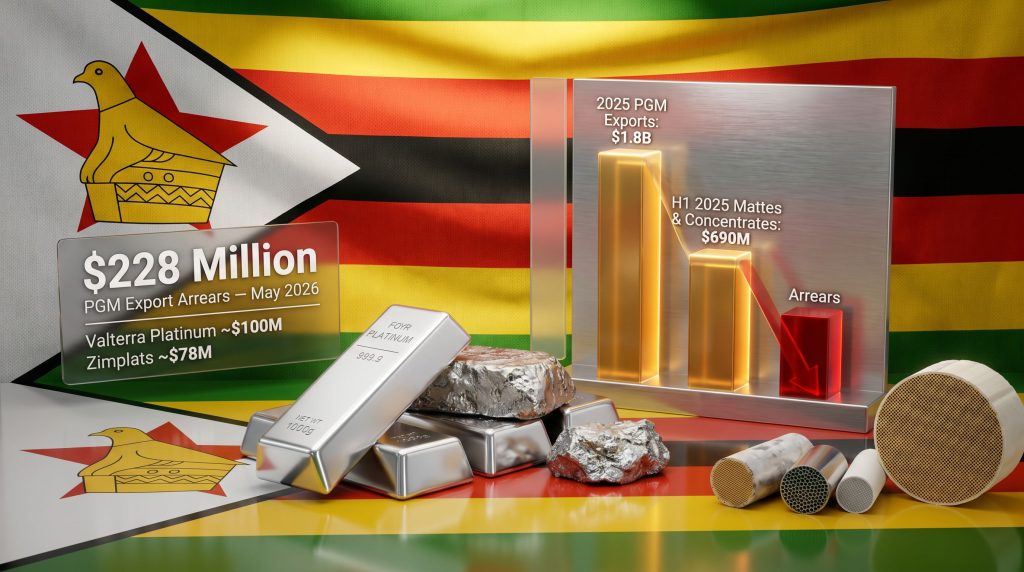
As of May 2026, Zimbabwe platinum producers owed unpaid export earnings totalling $228 million sit on the balance sheets of the country's major platinum group metal (PGM) producers, an amount representing a systemic liquidity drain that compounds pre-existing pressures across an industry already navigating a challenging commodity price environment.
When big ASX news breaks, our subscribers know first
How Zimbabwe's Foreign Currency Retention Mechanism Actually Works
Understanding the arrears problem requires first unpacking the architecture of the retention system itself, because it is frequently mischaracterised as a straightforward tax. It is not.
Under Zimbabwe's foreign exchange framework, all exporters including those in the mining sector are legally obligated to convert 30% of their hard-currency export proceeds into local currency through official government channels. In theory, the government then reimburses exporters with the local-currency equivalent of the surrendered foreign exchange. The mechanism was designed to channel hard currency into the national treasury for three primary purposes:
- Servicing external debt obligations denominated in foreign currencies
- Financing essential imports including fuel, medicines, and food commodities
- Funding domestic capital infrastructure projects
The critical distinction between this arrangement and a standard royalty or export tax is that the retention is theoretically temporary. Exporters are not permanently forfeiting revenue. They are, in theory, receiving a local-currency equivalent in return. The problem arises when the government's fiscal position deteriorates to the point where those reimbursements become erratic, delayed, or incomplete.
When reimbursement timelines slip from days to months to years, the mechanism stops functioning as a currency conversion and begins operating as an involuntary state loan, with the private sector as an unwilling creditor.
Gold producers in Zimbabwe have voiced parallel frustrations, specifically arguing that the conversion process forces part of their export income into a local currency that industry participants broadly regard as overvalued relative to open-market rates. This overvaluation component means that even when reimbursements do arrive, producers may receive less real value than the foreign exchange they originally surrendered. This issue is closely linked to the broader Zimbabwe mining debt dispute that has drawn increasing international attention.
The Scale of the Problem: Breaking Down $228 Million in Arrears
The aggregate figure disclosed at a mining industry conference in Victoria Falls in June 2026 draws together the individual exposures of Zimbabwe's major platinum producers into a single, striking data point.
| Company | Parent Entity | Primary Operations | Reported Arrears |
|---|---|---|---|
| Valterra Platinum | Independent | Unki Mine | ~$100 million |
| Zimplats | Impala Platinum | Ngezi / Selous complex | ~$78 million |
| Other PGM producers | Various | Multiple sites | Remainder of $228M total |
Contextualising these figures against the sector's broader financial performance sharpens the picture considerably.
- South African-owned platinum producers operating in Zimbabwe collectively generated $1.8 billion in combined export revenue during 2025
- The $228 million outstanding therefore represents approximately 12.7% of full-year sector export revenue that has not been returned to producers
- Valterra Platinum's $100 million exposure alone constitutes nearly 44% of total industry arrears, with the disclosure relating specifically to proceeds from its Unki mining operations, as reported by Mining Zimbabwe
- Zimplats, widely regarded as Zimbabwe's single largest platinum mining operation, carries $78 million in unrecovered proceeds
Zimbabwe's finance ministry has not contested the existence of the debt. Official commentary from the ministry attributed the payment shortfalls to revenue constraints rather than any change in the underlying policy framework. Partial disbursements were reportedly initiated in early 2026, yet the aggregate outstanding balance continued to grow through to the May 2026 reference date, suggesting that partial payments are being outpaced by new conversion obligations as exports continue.
Zimbabwe's Strategic Weight in the Global PGM Market
To appreciate why these arrears carry implications beyond Zimbabwe's borders, it is necessary to understand where the country sits in the global PGM supply hierarchy.
Zimbabwe holds the position of the world's third-largest producer of platinum group metals, ranking only behind South Africa and Russia. This places it in an exclusive tier of nations whose output materially influences global PGM pricing and availability. Within Zimbabwe's own export portfolio, platinum group metals rank as the second most valuable mineral export category, surpassed only by gold.
PGMs serve several critical industrial functions that underpin their strategic importance. For investors researching the platinum and palladium market, Zimbabwe's situation is particularly relevant:
- Autocatalysts: Platinum, palladium, and rhodium are the active metals in catalytic converters, which chemically reduce harmful tailpipe emissions including nitrogen oxides and hydrocarbons. Regulatory tightening on vehicle emissions standards in the European Union, China, and India sustains persistent baseline demand
- Hydrogen fuel cells: Platinum is a primary catalyst in proton exchange membrane (PEM) fuel cells, positioning it as a material with growing relevance to the energy transition. Both stationary power generation and hydrogen-powered heavy transport applications are expanding the addressable market for platinum beyond its traditional automotive role
- Industrial applications: PGMs also serve in glass manufacturing, chemical processing, electronics, and jewellery fabrication, providing demand diversification across economic cycles
Any sustained disruption to Zimbabwean PGM output would tighten an already constrained global supply picture, particularly given that South African production has faced its own structural challenges including load-shedding, aging infrastructure, and deep-level mining cost escalation.
Compounding Pressures: The Operational Context for Zimbabwe's Miners
The arrears problem does not exist in isolation. Zimbabwe's platinum producers are navigating a convergence of headwinds that collectively create conditions of significant financial stress.
Commodity price weakness has been a defining feature of the PGM complex in recent years. Following the extraordinary rhodium and palladium price spikes of the early 2020s, the basket price for PGM producers has undergone a sustained correction driven by weaker automotive demand, rising recycling supply from end-of-life catalysts, and uncertainty around the pace of electric vehicle adoption.
Energy supply unreliability poses a particular operational challenge. Zimbabwe's electricity grid has suffered from chronic underinvestment and capacity shortfalls. For PGM producers, which operate energy-intensive smelting and processing infrastructure, power interruptions impose direct production losses and force reliance on expensive backup generation, inflating unit operating costs.
Currency risk adds another layer of complexity. Beyond the overvaluation concern already cited by gold producers, the broader instability of Zimbabwe's local currency environment creates planning uncertainty for mining companies that must budget capital expenditure, labour costs, and procurement in an environment where local input prices can be volatile.
When these pressures are layered onto the liquidity impact of $228 million in withheld export reimbursements, the cumulative effect on working capital becomes material:
- Routine maintenance cycles may be deferred when operating cash flow is constrained
- Capital investment decisions for new development or capacity expansion face higher internal hurdle rates when base-case liquidity is uncertain
- Parent company boards in South Africa must factor the Zimbabwe receivable into group-level financial reporting, potentially affecting dividend policy and capital allocation priorities for the broader group
A Governance Risk, Not Just a Cash-Flow Issue
For investors and analysts assessing Zimbabwe as a mining jurisdiction, the arrears situation warrants framing beyond simple cash-flow accounting. The Platinum Producers' Association has publicly acknowledged that sustained engagement with the government has not produced meaningful improvement in payment timelines. This escalation of rhetoric at a public industry conference signals that private diplomatic channels have been exhausted without resolution.
When an industry association moves from private negotiation to public quantification of state debt at a high-profile mining conference, it typically indicates that the situation has crossed a threshold from operational inconvenience to reportable governance concern.
Furthermore, foreign-invested mining companies operating through listed parent entities in South Africa face disclosure obligations to their shareholders. Material receivables owed by a sovereign counterparty that demonstrates uncertain repayment capacity must be assessed for impairment risk. This creates a pathway from a Zimbabwean fiscal problem to a South African earnings statement. These strategic metals supply risks are increasingly on the radar of global investors monitoring resource geopolitics.
The next major ASX story will hit our subscribers first
What Resolution Would Require: Policy and Fiscal Pathways
Industry Priorities
The industry's stated priorities for resolving the arrears have been articulated with increasing specificity:
- Binding repayment schedules with fixed timelines rather than discretionary disbursements subject to fiscal availability
- Transparent tracking mechanisms allowing producers to monitor the status of outstanding reimbursements in real time
- A formal review of whether the 30% retention rate remains calibrated appropriately given demonstrated fiscal capacity constraints
- Consideration of partial dollarisation of reimbursements to eliminate the overvaluation discount that erodes the real value of local-currency payments
Government Response Options
On the government's side, several structural responses could address the underlying fiscal gap:
| Potential Government Response | Feasibility Assessment |
|---|---|
| Structured bilateral repayment agreements with individual producers | Near-term viable; requires political commitment |
| Prioritisation of PGM sector given export revenue contribution | Administratively straightforward if fiscal will exists |
| Engagement with multilateral institutions on fiscal support | Medium-term; dependent on IMF/World Bank programme status |
| Reform of the retention framework to match obligations to capacity | Structural reform; longer timeline, higher political cost |
The fundamental challenge is that Zimbabwe's foreign currency retention system was designed for a fiscal environment where the government could reliably meet its reimbursement obligations. In a constrained revenue environment, the system's structural flaw becomes apparent: the obligation to convert is immediate and legally enforceable, but the obligation to reimburse is effectively subject to fiscal discretion. Reuters has reported extensively on how this dynamic is weighing on producer confidence.
Investment Climate Implications: Short-Term Pain and Long-Term Risk
The arrears situation carries layered consequences for Zimbabwe's ability to attract and retain mining investment over the coming years.
Near-term pressures (2025 to 2026) include reduced working capital for operations and maintenance, constrained dividend flows to South African parent entities, and heightened scrutiny from institutional shareholders regarding Zimbabwe exposure in portfolio company holdings.
Longer-term structural risks centre on capital allocation decisions. Expansion projects, new shaft development, and processing infrastructure upgrades all require multi-year capital commitments. Companies operating in an environment where the government is a chronic debtor to the industry face a higher risk premium when evaluating these commitments. This translates directly into higher required rates of return and, in marginal cases, project deferral or cancellation.
Zimbabwe platinum producers owed unpaid export earnings face a particularly difficult calculus when weighing new investment against an unresolved sovereign receivable. Consequently, the government faces a difficult but well-defined choice. The PGM sector generated $1.8 billion in export revenue in 2025, making it a cornerstone of the country's hard-currency earnings. Undermining the sector's financial viability through persistent arrears risks damaging the very revenue base the retention system was designed to capture.
However, the broader mining geopolitical risk context matters here. Zimbabwe is not alone in facing these structural tensions between sovereign fiscal needs and private capital requirements. In addition, the platinum investment opportunities available in the region may ultimately depend on how effectively this dispute is resolved, as the outcome will set a precedent for how Zimbabwe balances its obligations to the mining sector against broader fiscal imperatives.
Disclaimer: This article contains forward-looking statements, projections, and analysis of publicly available information. It does not constitute financial or investment advice. Readers should conduct their own due diligence before making any investment decisions relating to companies or jurisdictions discussed herein. All financial figures cited are sourced from publicly reported information as of June 2026.
Want to Stay Ahead of Significant ASX Mineral Discoveries in Real Time?
Discovery Alert's proprietary Discovery IQ model instantly scans ASX announcements across more than 30 commodities, delivering actionable alerts on high-potential discoveries — explore the historic returns major discoveries have generated and begin your 14-day free trial to position yourself ahead of the broader market.