June 24, 2026
The Hidden Geology Behind the World's Most Expensive Potash Gamble
Deep beneath the prairies of Saskatchewan, Canada, lies one of the most mineralogically consistent and economically significant potash deposits ever identified. The Jansen basin sits within the Prairie Evaporite Formation, a geological sequence laid down roughly 380 million years ago during the Devonian period, when a shallow inland sea evaporated and left behind extraordinary concentrations of sylvinite ore, the primary source rock for muriate of potash (MOP), the dominant potash fertiliser traded globally.
What makes Jansen geologically exceptional is not just the scale of its resource, but the continuity and thickness of its ore horizons. Saskatchewan's potash deposits generally occur at depths between 900 metres and 3,200 metres below surface, with Jansen's target horizons sitting at approximately 1,000 metres. At these depths, conventional open-pit mining is impossible, and the technical complexity of shaft sinking through water-bearing rock formations adds layers of engineering risk that surface miners rarely encounter.
This geological reality is central to understanding why the BHP Jansen potash writedown has unfolded the way it has, and why fertiliser megaprojects consistently confound even the most sophisticated capital planners.
When big ASX news breaks, our subscribers know first
Why Deep-Shaft Potash Mining Is Structurally Different From Other Resource Development
Most mining investors familiar with open-pit copper or iron ore operations underestimate the execution complexity specific to deep underground evaporite mining. Potash extraction at depth involves shaft sinking through aquifers, salt dissolution zones, and unstable geological formations that require specialised ground freezing techniques to seal the shaft walls during construction.
The freezing process alone — where a ring of boreholes surrounding the shaft is injected with refrigerant to create a frozen cylinder of rock through which excavation proceeds — can take 18 to 24 months before shaft sinking even begins. Any deviation in the frozen wall's integrity can result in catastrophic water inflow events that have historically destroyed shafts at other Canadian potash operations.
This is a dimension of technical risk that rarely appears in analyst models but fundamentally shapes cost trajectories. When BHP's Stage 1 costs escalated from an implied baseline of approximately $5.3 billion at 2021 approval to an estimated $8.0 billion by 2026, a significant portion of that inflation was driven by the unforgiving physics of deep-shaft construction in Saskatchewan's geology, compounded by post-pandemic supply chain stress.
The Saskatchewan potash basin is often described as the Saudi Arabia of potash. But unlike oil extraction, which can be accelerated with additional drilling, underground potash mining scales on a timeline dictated by geology and shaft engineering, not market demand.
Breaking Down the $2.3 Billion Writedown: What the Numbers Actually Reveal
The BHP Jansen potash writedown, recorded in June 2026, represents a non-cash impairment charge against the project's carrying value on BHP's balance sheet. It is not a cash loss in the conventional sense, but it is a formal accounting acknowledgement that the asset is worth less under current market conditions than what has been capitalised against it. According to BHP's official project page, Jansen remains central to the company's long-term diversification strategy, however the numbers tell a more complicated story.
A Cost Escalation Timeline That Demands Scrutiny
| Milestone | Cost Estimate | Year |
|---|---|---|
| Stage 1 Original Approval Cost (implied) | ~$5.3 billion | 2021 |
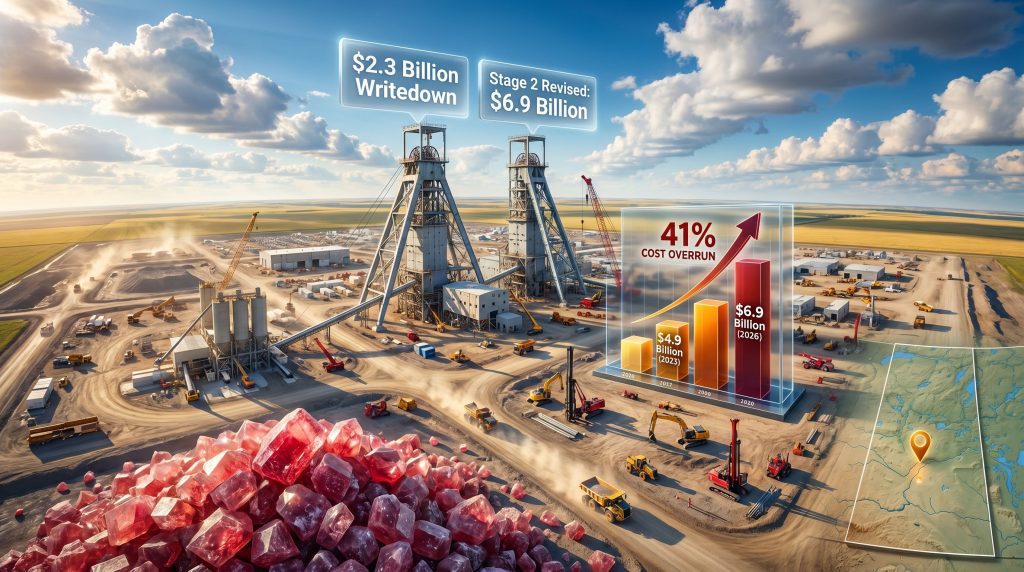
| Stage 2 Original Sanction | $4.9 billion | 2023 |
| Stage 1 Total Cost (estimated) | ~$8.0 billion | 2026 |
| Stage 2 Revised Estimate | $6.9 billion | 2026 |
| Cost Increase on Stage 2 | +$2.0 billion (+41%) | 2026 |
| Impairment Charge Recorded | $2.3 billion | June 2026 |
This is not a first offence. The June 2026 announcement marks the third consecutive instance in which BHP has exceeded budget and schedule benchmarks across the two phases of the project. Stage 1 alone is now tracking approximately 50% above its 2021 approved cost baseline, a figure that would have triggered a project review at most mining houses at a far earlier stage.
The Four Cost Drivers Behind the Overrun
Understanding why the BHP Jansen potash writedown occurred requires disaggregating the cost components rather than treating the overrun as a single event. Furthermore, the mining project permitting environment in Canada has added further complexity to an already challenging build programme:
- Construction input inflation: Post-pandemic materials costs, steel pricing, and specialised equipment procurement in a constrained global supply environment significantly elevated capital intensity across both phases.
- Mid-construction design modifications: Engineering changes introduced after construction commenced expanded project scope, requiring rework and additional contractor engagement at premium rates.
- Labour productivity shortfalls: On-site in Saskatchewan, worker hours extended beyond original estimates while output per labour unit declined, a pattern common in remote Canadian resource construction where camp conditions, shift arrangements, and workforce turnover create productivity drag.
- Schedule slippage compounding financing and overhead costs: Every month of delay adds contractor overhead, equipment hire, financing charges on committed capital, and project management costs that compound against an already stretched budget envelope.
When a megaproject records three consecutive cost overruns, it ceases to be an anomaly. It becomes a structural indicator of either flawed initial estimation methodology, insufficient contingency provisioning, or systemic project governance challenges that boards and institutional investors must interrogate directly.
How Potash Market Conditions Compounded BHP's Capital Exposure
The Commodity Price Reversal That Changed the Risk Profile
The timing of BHP's capital commitment to Stage 2 in 2023 sits at the heart of the investment case tension. Russia's invasion of Ukraine in February 2022 disrupted global potash supply chains in a way that had not been seen since the dissolution of the Soviet Union. Russia and Belarus combined account for approximately 40% of global potash export volumes, and sanctions, logistics disruption, and buyer risk aversion triggered a price spike that pushed MOP spot prices above $1,000 per tonne at certain delivery points in 2022, compared to a historical average closer to $300 to $400 per tonne.
BHP pressed ahead with Stage 2 approval in 2023 against this elevated pricing backdrop. Since then, potash prices have retreated materially as Russian and Belarusian supply partially resumed through alternative logistics channels and global agricultural demand adjusted to higher input costs. The commodity price impact on Jansen's projected return profile, which was underwritten against elevated price assumptions, has consequently compressed in a manner few analysts anticipated at the time of Stage 2 sanction.
Supply-Side Structural Risks for Potash Investors
| Risk Factor | Implication for Jansen |
|---|---|
| Russian and Belarusian supply resumption | Increases global supply volume, suppresses price recovery timeline |
| New Canadian potash entrants | Adds competitive domestic volume to an already softening market |
| Agricultural demand cyclicality | Potash demand is directly linked to crop commodity prices and farmer income levels |
| Currency and input cost inflation | Erodes operating margin even at stable potash prices |
| Geopolitical sanction normalisation | If sanctions ease further, the supply disruption thesis weakens |
One factor not widely discussed in mainstream coverage is the behaviour of potash demand across different crop cycles. Potash is not a discretionary input; crops genuinely require it for yield and disease resistance. However, farmers do vary application rates and timing based on their own cash flow, particularly in commodity-price downturns. This creates short-cycle demand softness even when the long-term agronomic case for potash application remains unchanged, meaning that price recovery timelines are inherently difficult to forecast.
Is BHP's Group Capital Expenditure Strategy Still Credible?
Maintaining the $11 Billion FY2027 Capex Forecast Despite a $2.3 Billion Charge
BHP has reaffirmed its FY2027 group capital expenditure guidance at $11 billion, framing the writedown as a non-cash impairment that does not alter near-term cash deployment commitments. This distinction is technically accurate but merits scrutiny.
The critical investor question is whether the $11 billion capex ceiling is sustainable if Stage 1 or Stage 2 costs continue to escalate beyond their current revised estimates. BHP is simultaneously investing heavily in copper growth assets, including the Escondida expansion in Chile and its Oak Dam copper-gold project in South Australia, placing simultaneous pressure on group capital allocation. In addition, the resource export challenges facing the broader sector add further pressure on capital discipline across BHP's portfolio.
Stage 1 vs. Stage 2: Diverging Execution Risk Profiles
- Stage 1 remains on schedule for first production in mid-2027, notwithstanding cumulative cost inflation of approximately 50% above the 2021 approved baseline.
- Stage 2 has seen first production deferred to late fiscal year 2031, representing a multi-year delay from original guidance.
- A two-year ramp-up period following Stage 2 commissioning means meaningful full-capacity production is unlikely before the early 2030s at the earliest.
- Combined, the two phases are now tracking toward a total capital cost in the vicinity of $14.9 billion, a figure that places Jansen among the most capital-intensive mining projects in global history on a per-tonne-of-annual-capacity basis.
Investor Watch: The gap between BHP's narrative positioning of Jansen as a century-long strategic asset and the reality of three consecutive cost overruns creates a credibility tension that institutional shareholders are actively pricing into the stock. BHP shares fell in response to the announcement.
How Does Jansen Compare to Anglo American's Woodsmith Project?
Two Mega-Scale Fertiliser Projects, Two Capital Allocation Crises
The fertiliser megaproject phenomenon is not unique to BHP. Anglo American's Woodsmith polyhalite project in North Yorkshire, United Kingdom, presents a remarkably parallel set of dynamics, offering investors a comparative framework for understanding sector-wide structural risk.
| Metric | BHP Jansen (Canada) | Anglo American Woodsmith (UK) |
|---|---|---|
| Commodity | Potash (MOP) | Polyhalite (multi-nutrient fertiliser) |
| Location | Saskatchewan, Canada | North Yorkshire, United Kingdom |
| Revised Combined Capex | ~$14.9 billion (Stage 1 + 2 combined) | £7 billion to £9 billion |
| Capital Spent to Date | Multi-billion (ongoing) | ~£2.7 billion (as of 2024) |
| Current Development Status | Stage 1 targeting mid-2027 | Slowed; paused during corporate restructuring |
| Strategic Complication | Repeated cost overruns | Anglo-Teck Resources merger uncertainty |
| Original First Production Target | 2026 (Stage 1) | 2030 |
Woodsmith is itself a geologically significant project, targeting a polyhalite ore body at depths exceeding 1,500 metres beneath the North York Moors National Park. Polyhalite contains potassium, sulphur, magnesium, and calcium simultaneously, offering agronomic advantages over single-nutrient MOP, but it is also far less understood by farmers and fertiliser blenders than conventional potash, creating a market adoption risk that does not exist for Jansen.
Anglo American deliberately slowed Woodsmith's development in 2024 as part of a broader corporate restructuring exercise, and its proposed merger with Teck Resources introduces further strategic uncertainty around whether the project will ultimately proceed to full development on any definitive timeline. Anglo CEO Duncan Wanblad previously indicated a first production target of 2030, but these timelines are now subject to revision given the corporate overlay.
The parallel stories of Jansen and Woodsmith carry a pointed structural lesson: both projects were significantly advanced or greenlit during the 2022 to 2023 fertiliser price supercycle, and both are now confronting cost inflation, schedule slippage, and a materially weaker pricing environment simultaneously. In such circumstances, exploring mining joint ventures has become an increasingly discussed option across the sector.
The next major ASX story will hit our subscribers first
What Are the Broader Implications for BHP's Diversification Strategy?
Potash as a Test Case for BHP's Future-Facing Commodities Thesis
BHP entered potash as part of a deliberate strategic pivot away from overweighting iron ore and thermal coal, seeking exposure to commodities underpinned by long-duration structural demand rather than cyclical industrial activity. The long-term case for potash is grounded in population growth projections, agricultural intensification in developing economies, and the non-substitutability of potassium as a soil nutrient. That thesis has not fundamentally changed. What has changed is the execution timeline and the capital cost required to prove it.
Three Strategic Scenarios for Jansen's Long-Term Trajectory
Scenario 1: Full Execution
Both Stage 1 and Stage 2 complete on revised timelines (2027 and 2031 respectively). Jansen progressively achieves approximately 10% of global potash production capacity by the mid-2030s, and a recovery in potash prices toward historical mid-cycle levels or above eventually vindicates the capital deployed.
Scenario 2: Stage 2 Deferral or Scope Reduction
BHP completes Stage 1 as a standalone operation but exercises capital discipline on Stage 2 timing, reassessing the expansion against prevailing market conditions at or near the 2028 to 2029 decision window. Capital is reallocated toward copper assets offering higher near-term risk-adjusted returns. Jansen operates as a mid-scale producer generating steady cash flow rather than a flagship operation.
Scenario 3: Strategic Restructuring or Joint Venture
Persistent cost overruns and sustained potash price weakness force a more fundamental strategic review. In this scenario, a thorough definitive feasibility study reassessment may accompany efforts to explore partial asset monetisation, reducing balance sheet exposure and sharing development risk with a partner better capitalised or positioned for the potash cycle. Precedent for mid-development restructuring of megaprojects exists across the mining sector.
Scenario 2 carries the highest near-term probability given current market dynamics and institutional shareholder pressure on BHP's capital discipline commitments. BHP's own language around Jansen as a century-long strategic asset suggests the company's conviction remains high, but the gap between strategic narrative and financial reality has widened materially since 2021.
What the Long-Term Demand Case Still Justifies
The Macro Thesis Remains Structurally Intact, But Timing Has Shifted
None of the fundamental demand drivers that originally justified the Jansen investment thesis have disappeared. Global population is projected to reach approximately 9.7 billion by 2050, according to United Nations estimates, requiring agricultural systems to produce significantly more food from a land base that is not expanding proportionally.
Potassium is one of three primary macronutrients essential for crop production, alongside nitrogen and phosphorus. Unlike nitrogen, which can be synthesised from atmospheric sources through the Haber-Bosch process, potassium has no synthetic substitute — it must be mined. This non-substitutability creates a long-duration demand floor that no policy shift or technological development can easily remove.
Western agricultural economies have also developed an increasingly acute awareness of their dependence on Russian and Belarusian potash supply. The 2022 supply disruption demonstrated how vulnerable food production systems become when potash sourcing is geographically concentrated in geopolitically unstable jurisdictions. Canadian potash, drawn from Saskatchewan's world-class evaporite deposits, is the most credible alternative supply source at scale, and Jansen's eventual contribution of roughly 10% of global annual output would represent a meaningful structural shift in supply chain geography.
The timing problem, however, is real. With Stage 1 production beginning in mid-2027 at best and full dual-phase capacity not achievable until the early 2030s, investors pricing Jansen today are discounting cash flows across a horizon of extreme price forecast uncertainty. The project that was designed to benefit from supply chain diversification demand may arrive at market at a point when that supply disruption premium has already been normalised. Furthermore, as reported by The Globe and Mail, the scale of the cost escalation has prompted renewed debate amongst institutional investors about BHP's governance of large capital projects.
Frequently Asked Questions: BHP Jansen Potash Writedown
What is the BHP Jansen potash writedown?
BHP recorded a $2.3 billion non-cash impairment charge against the carrying value of its Jansen potash project in Saskatchewan, Canada, triggered by a $2 billion cost overrun on the Stage 2 expansion, which has risen to $6.9 billion from the $4.9 billion approved in 2023.
How many times has BHP exceeded its Jansen budget?
The June 2026 announcement represents the third consecutive instance in which BHP has exceeded both budget and schedule targets across the two phases of the Jansen project.
When will BHP's Jansen potash mine start producing?
Stage 1 is expected to commence production in mid-2027. Stage 2 production has been deferred to late fiscal year 2031, with full ramp-up to meaningful production capacity expected in the early-to-mid 2030s.
Why did BHP take a writedown on Jansen potash?
The impairment reflects the difference between the project's carrying value and its recoverable amount under current potash price assumptions. Cost overruns driven by construction inflation, design changes, labour productivity issues, and schedule delays — combined with lower potash prices than those prevailing at Stage 2 approval — created the accounting trigger.
Does the Jansen writedown affect BHP's capital expenditure plans?
BHP has maintained its FY2027 group capital expenditure guidance at $11 billion. The writedown is a non-cash accounting adjustment and does not directly alter near-term cash deployment, though it reduces reported earnings and book value.
How does Jansen compare to Anglo American's Woodsmith project?
Both are large-scale fertiliser mining megaprojects advanced during the 2022 to 2023 fertiliser price surge and now facing cost pressure and strategic uncertainty. Woodsmith has been deliberately slowed as Anglo American undergoes corporate restructuring, while Jansen continues despite repeated overruns.
This article is for informational purposes only and does not constitute financial advice. All forecasts, cost estimates, and production timelines are subject to change. Investors should conduct independent due diligence before making investment decisions.
Want to Identify the Next Major ASX Mineral Discovery Before the Broader Market?
Discovery Alert's proprietary Discovery IQ model delivers real-time alerts on significant ASX mineral discoveries, transforming complex geological and market data into clear, actionable investment insights for both short-term traders and long-term investors. Explore Discovery Alert's dedicated discoveries page to understand how historic mineral discoveries have generated substantial returns, and begin your 14-day free trial today to position yourself ahead of the market.